
Divorce Missteps

Over the past 7 years I’ve supported a lot of individuals, particularly women, as they proceed through divorce. As a relationship counsellor I also work to help couples who wish to avoid the divorce process. I’ve learnt a thing or two about what makes the ending of a marriage better, or worse, for the parties involved. Its hard to watch people make mistakes in this journey, choosing actions that often make emotional recovery harder in the long run. If you are willing to learn the mistakes to avoid, here are some of  missteps that we encounter in helping navigating the divorce process.

Misstep 1: not being aware of your rights

Seeing a lawyer is expensive. However not knowing your rights in a divorce is a potential landmine. Without decent legal advice you run the risk of receiving careless and incorrect information about what you can negotiate in a divorce. Do not be threatened by your ex that, “We don’t need to use lawyers, we can just do this ourselves”. Often such statements precede unfair negotiations. Knowing your rights is your right, and is a must.

Misstep 2: Accepting divorce advice from your ex-partner instead of a professional

I’ve lost count of the number of times I encounter clients who accept what their ex-partner tells them what they are entitled to in a divorce. Your soon to be ex-partner does not get to define what your divorce outcome will look like.  This is particularly an issue in codependent relationships where one partner is used to listening to the advice or demands of their romantic partner without challenge. Seek legal advice. An initial consultation should suffice for you to better understand what you are entitled to fight for, and if it is in your interests to do so.

Misstep 3. Not considering or committing to couples counselling

As a couples’ counsellor we often encounter couples trying to decide if they should divorce or stay together. Counselling can help repair your relationship, in certain circumstances and it looks good to the court if you have tried to repair your relationship.

If you are BOTH willing to do the work, relationships CAN recover.

Relationships cannot recover when there is an ongoing affair or one party is continuing the divorce process at the same time as the counselling process. You can’t amputate a leg and reattach it at the same time. Coming to counselling to collect dirt on your partner does not work. Experienced couple counsellors will see through those tactics, and will often call them out. Counselling is used to see if sincere recovery can be made.

Misstep 4. Telegraphing your wants instead of negotiating.

It may sound contradictory to not communicate what you want out of your divorce. It is important that you don’t show “all your cards” until you are ready to make a deal.

The process of divorce is essentially a negotiation. In any negotiation you want to know what your adversary wants, before you let them what you want as part of your divorce settlements.

It may seem tempting to explain, “I just want a basic settlement and full custody of the kids”. But if you do this, you will have just told your ex what matters to you most. Do yourself a favor. Learn about negotiation skills, as if your life depended on it. Because your lifestyle going forward, does. I particularly like the teachings of Chris Voss on negotiation, and have clients who have used the Chris Voss negotiation techniques to break the patterns of fruitless negotiations that they had fallen into.

Misstep 5: Jumping into a new relationship too quickly.

The feelings of rejection often associated with divorce can be extremely painful. It can be tempting to avoid those feelings by jumping into a new relationship as fast as possible. This is a misstep.

Firstly, you need to heal from your previous relationship, not simply avoid the pain. I know this sucks.

Secondly, the impact of a new relationship can influence your negotiations in your divorce. If you have a partner who could be assumed to be paying some of your rent may impact your financial settlements.

Thirdly, children may be negatively impacted by your new relationship. It can be tempting, if you’ve fallen in love with another person, to rush into playing “happy families” with your children and your new partner. You chose your new partner. Your children didn’t. Sometimes children see the new partner as the reason for your marital breakdown, even if this wasn’t the case.

Resist the temptation to involve your new partner in your children’s lives, and even better, take a break from dating in the early months of your divorce.

Misstep 6: continue the conflict communications rather than seeking distance.

If you have had a relationship that has been full of conflict, and if you are used to constant conflict, you might be tempted to continue your continual arguments throughout your divorce process. I would argue, that it might be wise to explore an alternative to constant fighting.

If you had got along with your ex-partner, you probably wouldn’t be divorcing them. The declaration to divorce, can mean that you can STOP fighting. It takes only one party to stop fighting. Just stop. This might mean blocking your ex-partner, so that you don’t communicate with them, except through your lawyers, or only via slower communication channels such as email rather than immediate messaging platforms such a WhatsApp.

Involving your lawyers in all of your interpersonal conflict is a double-edged sword. You may need to use your lawyer to tell your partner to stop harassing you. But if you want the fighting to stop, you have to also agree to stop communicating with your ex-partner. Using third parties or apps to communicate such a parent coordinator person or app (such as the Family Wizard) can help break the cycle of conflict communication.

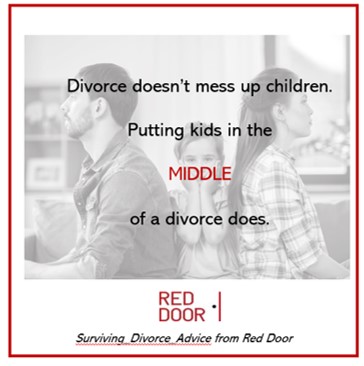
Misstep 7: Triangulation of children

It is very tempting to involve your children in your divorce. Bringing your child into divorce understanding or negotiations happens fairly often. After all, you are hurting and it would be helpful to you if they can see how much pain your ex-partner is causing you. This is a mistake. Your child is entitled to continue to enjoy their parental relationship without your experience influencing their view of their parent.

You don’t win if you turn your child against their other parent. All that happens is that your child loses. They lose the impact of that parent in their life, rather than the impact of your ex-romantic partner on you. They may begin to feel responsible for your emotional state – a reversal of the parent child relationship. Additional triangulation does not pay often pay in the long run. As children mature they will start to observe and appraise your behaviour throughout your divorce.  Later on, children do not appreciate the perception of being manipulated during divorce and this can be one of the reasons that they become estranged from their parents when they grow into adulthood.

You don’t have to hide your pain from your child. Be mindful not to involve them in understanding your pain to the extent that they feel obligated to champion of you. It isn’t fair. It isn’t healthy, for your children. They deserve to have two parents to love if this is being offered.  

Misstep 8: Allowing others to define your value.

Those going through the divorce process can feel diminished. Their marriage is over. This often feels bad, and it is common to feel feel like you have “failed”. Your ex-partner may extend those feelings of failure by telling you that the reason your marriage failed is because of your personal “failings”. They may even feel entitled to judge your competence as a parent.

Most of the women in our support group have been told that they are bad mothers. In every case I’ve encountered such accusations appear grossly misplaced. For those vulnerable individuals, being judged so harshly by their ex-partner can really be a blow. Remember these commentaries are often a  tactic to make you feel bad, and not based in reality. Especially the reality of your children.  You need to know your value, financially and personally.

It is time for you to know your value for yourself. Your value as a person is NOT determined by your ex, or anyone else besides yourself. Its time for you to work on you, so that you know who you are. Don’t let anyone else attempt to define your value. This is an area that people often seek counselling to help them overcome.

Misstep 9: Bad habits lead to compromised ability to cope, and vice versa.

Habits help build your health and over the long term determine how well you can navigate the divorce process. Regular self-medication, especially through alcohol, will erode your ability to cope. Conversely taking a positive approach to habits and your health at this time will be extremely helpful. Exercise, rest, sleep, eat healthily, all of these will help you better survive what is an incredibly stressful life event.

Misstep 10: Doing it alone.

Whilst many people feel ashamed that divorce is happening, the worse thing you can do is feel ashamed and remove yourself from support.

Even I have been delightfully surprised by the amazing value of group support during divorce.  Iron Fairies, our therapeutic support group for women going through divorce is seen as an amazing resource by all of the active members. Each of the women in the Iron Fairies is navigating their own divorce journey, and may feel trapped by their personal struggles, but at the same time, understand the challenges faced by other women, and amazingly suggest creative pathways forward for others, even when they feel ‘stuck’. Being able to help others, reminds group members that we all feel undone sometimes and that we can eventually navigate through these very uncomfortable circumstances. Having a friendly group to vent to can be extremely cathartic, especially if one of the expectations of that group is that you will continue your journey forward, at a glacial or racing pace.

Misstep 11: Wrongful resource allocation

There are a number of resources that you may involve in your divorce journey including a financial adviser, a lawyer, an accountant, a counsellor, a mediator, your family, a support group, and friends. It will be an expensive waste of time to use your lawyer as your counsellor. At a typical cost of USD 1000 per hour, you want to use your time consulting your lawyer as cleverly as possible. Save your crying time for friends, a support group, or a counsellor.

Additionally, divorce is a topic that many people have experience of, and have opinions about. Legal advice from friends can be completely wrong. They have no real obligation to ensure that the action or information they give you is in support of your rights. Please check your legal position with legal professionals.

Misstep 12: Allowing drama to impede or knock you off course.

It is quite possible that you ex will try to get you to delay or even stop the divorce process. Not because they want to reconcile, but because they want to delay or derail the divorce process for their own personal, and sometimes, financial ends. It takes quite a while for people to decide that they need to divorce their partner. Once this decision is made, please try to keep the divorce process moving forward.

You ex may try to delay you by making deals or threats such as, “Let’s meet and see if we can work this out between ourselves”, or, “If you proceed with the divorce I will do x, y, z.”. Ex- partners may try to derail the process by blowing up bombs to distract you from the momentum of divorce. For example, they may accuse you of having affairs, or acting in harassing fashion, or even being a poor parent. Don’t fall for these distractions if they are unfounded.

Once you have made this difficult decision to end your marriage, move steadily towards the exit. You can master the change that needs to happen, rather than allowing your ex-partner’s agenda to master you.

You CAN survive the divorce process. Especially if you avoid some of the pitfalls that make the journey more challenging.

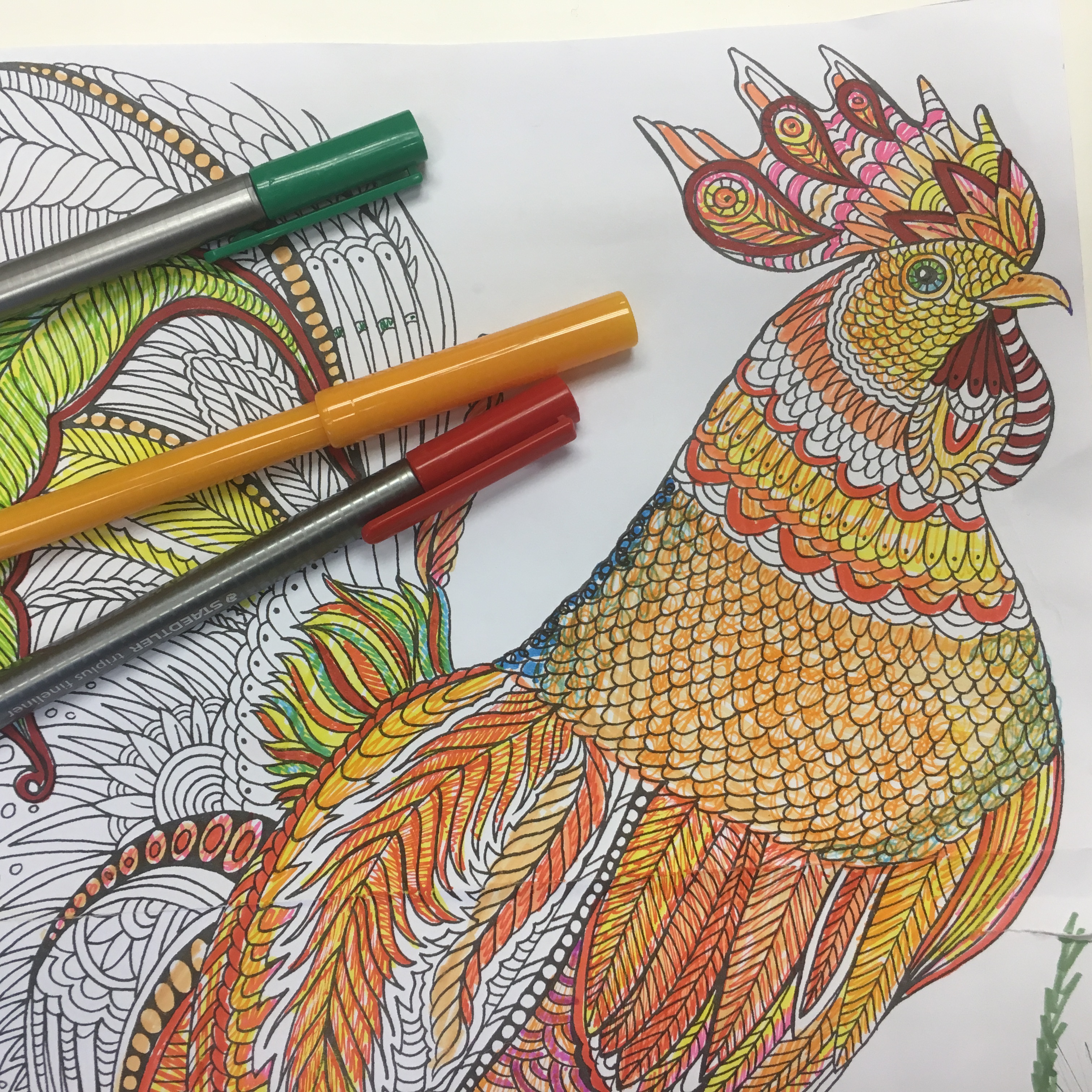
Colour yourself calm.


colouring pix

You possibly enjoyed colouring pictures when you were a child. It is something you can revisit, with benefits, as an adult.

The current popularity of adult colouring books celebrates a return to encouraging our creativity, and embracing the sense of calmness that colouring can offer.

5 Reasons to colour:

Stress Reduction:  The mental focus which is required when colouring pictures – selecting colours, staying inside the lines, considering balance – can induce a meditative-like state. The heart rate is reduced and breathing becomes more calm. The repetitive nature of colouring calms even the busiest minds. Try it for just 10 minutes a day (with no distractions) and check how you feel afterwards.

Age Defying. Both physically and emotionally. It is good for you emotionally to play occasionally, and colouring is a form of such play. Additionally colouring helps to maintain manual dexterity, which is essential to growing older gracefully.

Boost Creativity. Break out of any creativity rut using colouring. Even if you do not think of yourself as an artist, simply selecting colours and designs helps to unleash a heightened connection to your ability to think creatively. Be ready for new ideas!

Brain Development. Colouring helps to develop greater skills of concentration and focus. Furthermore, both hemispheres of the brain are engaged, giving your brain a good ‘workout’.

Mini break. Colouring can create an mini break to calm and centre a person, even if you are feeling ok at the moment.  If you are experiencing anxiety, depression, obsessive compulsive tendencies, or difficulties managing stress, psychological research supports the use of colouring as a part of the therapeutic process.

You may also be wondering when is the best time to start colouring. There really isn’t a bad time to try colouring as a calming technique. I recommend that you give it a try the next time you are stressed, pressured, or feeling run down. At those times,  a colouring activity should help you to collect yourself. You might also consider colouring before your bedtime. Since watching TV and playing on devices has been associated with poorer sleep patterns, colouring could create a more relaxed mind-set, setting you up for a deeper, more refreshing night’s sleep.

I encourage you to try colouring, just for 10 minutes and day, to assess what calm and focus regular colouring can help you achieve.

_________________________________________________________________

Angela Watkins is a psychologist and counsellor at RED DOOR Counselling in Hong Kong. Her current clinical work focuses on parenting, family life, parenting SEN children, anxiety, OCD, career change, stress management and divorce. Angela has been named HK’s top therapist.

Anxiety Attacks – Emergency responses

Living with anxiety feels as if you are inhabited by a monster constantly whispering about your fears, insecurities and your worthlessness, your inevitable failures and the catastrophes which you can’t avoid and are probably creating. It is estimated that 13-14% of people in Europe [1] live with anxiety. One symptom is anxiety attacks. Some people only realise that they have been suffering from anxiety when they experience such an attack.

An anxiety attack differs from a panic attack. It is usually a response to a stressor – often a thought or feeling or specific dread. People feel apprehensive and full of fear. Their hearts may race and they may feel short of breath. Often people feel out of control and may become extremely tearful. A panic attack may include some of these symptoms, but usually occurs without a clear stressor. Both can be terribly frightening. If you experience anxiety attacks it is important that you are prepared with an emergency response.

Here are my favourite techniques to respond when anxiety attacks.

Try this exercise when you feel anxious.

Breathing exercises – Listen to the pattern of your breath when you are anxious. It can give you a clue as to how best to respond to your anxiety. If you are hyperventilating – taking fast, shallow breaths, feeling faint, and fearing that you can’t catch your breath, try to breath into a paper bag. Breathing in and out using a paper bag will recycle air, returning carbon dioxide to the body, which will naturally make the breath deeper and slower. Do this for a minute. If you don’t feel better, try again for another minute.

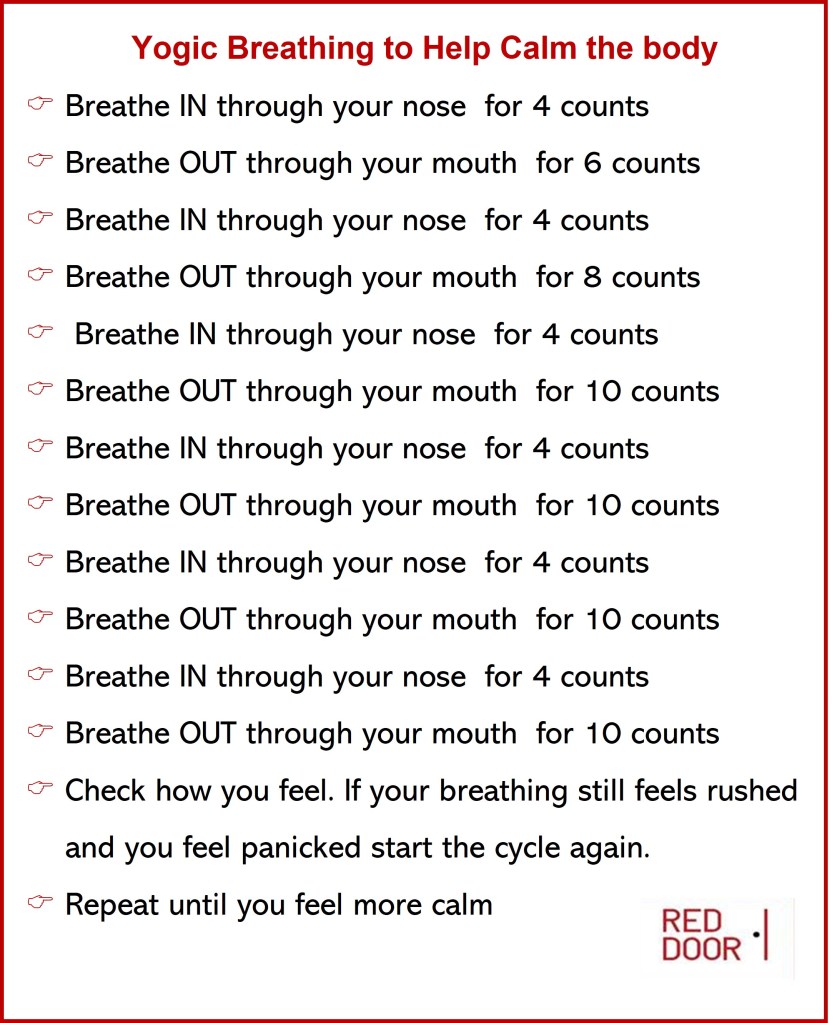
If you are not hyperventilating, you can use the calming breath technique. Breathing exercises such as those used in yoga classes are effective in reducing anxiety. One simple exercise I use with clients uses counting inward and outward breaths to calm the mind. Simply breathe slowly in through your nose for a count of 4, then breathe out of your mouth for a count of 4. Repeat. Then breathe in through your nose for a count of 4, and out of your mouth for a count of 6. Repeat. Then breathe in through your nose for a count of 4, then breathe out of your mouth for a count of 8. Repeat. Check to see if you feel better. If you don’t, repeat the exercise again, concentrating on the sensation of your breath.

Distraction exercises. Distraction exercises help your parasympathetic nervous system override an anxious reaction. By simply refocusing your energy to elements of your environment and allowing your underlying operating system to return to homeostatic (ie regular) breathing.

Use your senses to help calm your breathing

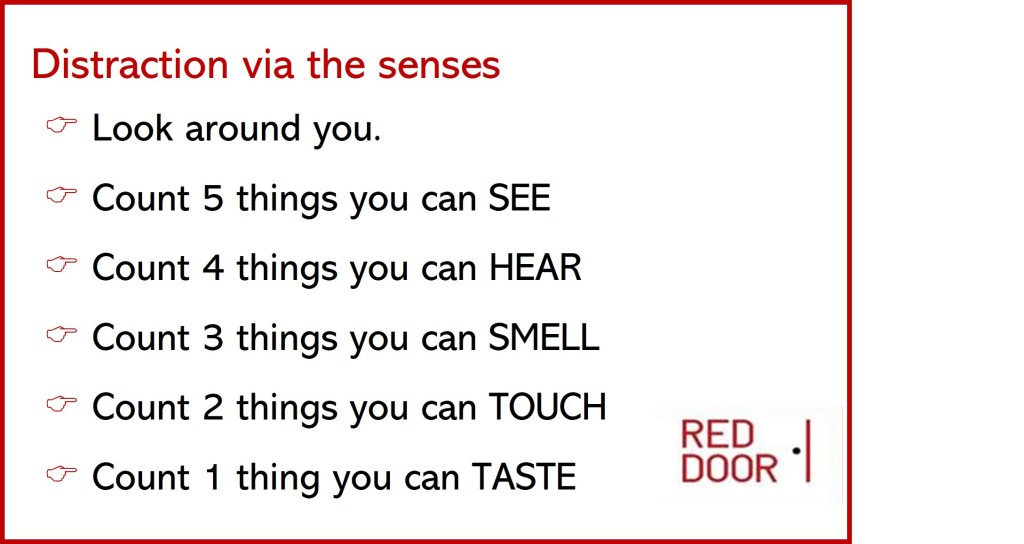
The most commonly used therapeutic technique asks the client to engage their senses to distract their busy minds. Identifying a number of items you can see, smell, hear, touch and taste can help you reset your body. Imagine 5 things you can see, then 4 things you can hear, then 3 things you can smell, then 2 things you can touch, and 1 thing you can taste. Then monitor your breathing again. Has it become less panicked?

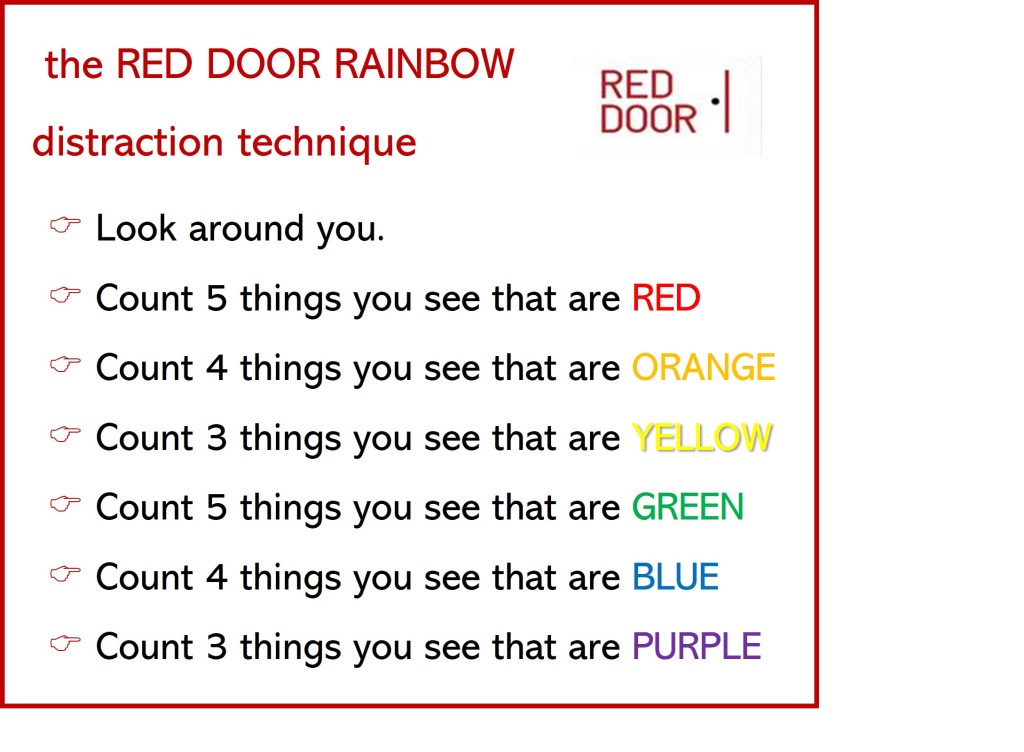
Since we work with a number of teens and children at RED DOOR we also use the RAINBOW technique, often with our proprietary rainbow fidget toy, to help teens achieve quick calm. One can perform this technique without the fidget toy. Simply you count objects in your near vicinity which are specific colours. You can count the number of objects, or a specified number of objects that are red, orange, yellow, green, blue and black.

Distraction and can also be created with some physical “reset” activities such as repeatedly snapping an elastic band against the wrist or performing sets of 10 jumping jacks.

Meditation/Relaxation – Mediation, when practiced regularly, can help people reach a relaxed state more easily. Practice makes progress when it comes to mediation. If you are experiencing an anxiety attack, try to find somewhere to sit quietly or lie down. Then try progressive relaxation, also known as a body scan, which can be especially helpful. Progressive relaxation soothes as you tense and relax muscles – isolating and focusing exclusively on one group of muscles at a time. Begin with your toes, and work up through your muscles to your head, where you may focus on relaxing the muscles around your chin and eyes.  Guided progressive relaxations are available on Spotify, YouTube, and on CD.

Imagery – In the throes of an anxiety attack use your active imagination to help your de-stress. First, isolate the location within your body where you feel the greatest sensation of anxiety. Use imagery to help unwind and relax that spot. Cute, warm, and amusing imagery will be of the greatest help. If you feel tension in your shoulders imagine a collective of kittens massaging the knots away. If you feel butterflies in your stomach – imagine yourself in your stomach with them, asking each to settle on your arms and flutter no more. One client recently expressed her fear of butterflies, so, using imagery, we collected the butterflies and they turned into Golden Retriever puppies, ready for a cuddle.

This mantra might help with your negative self-concept

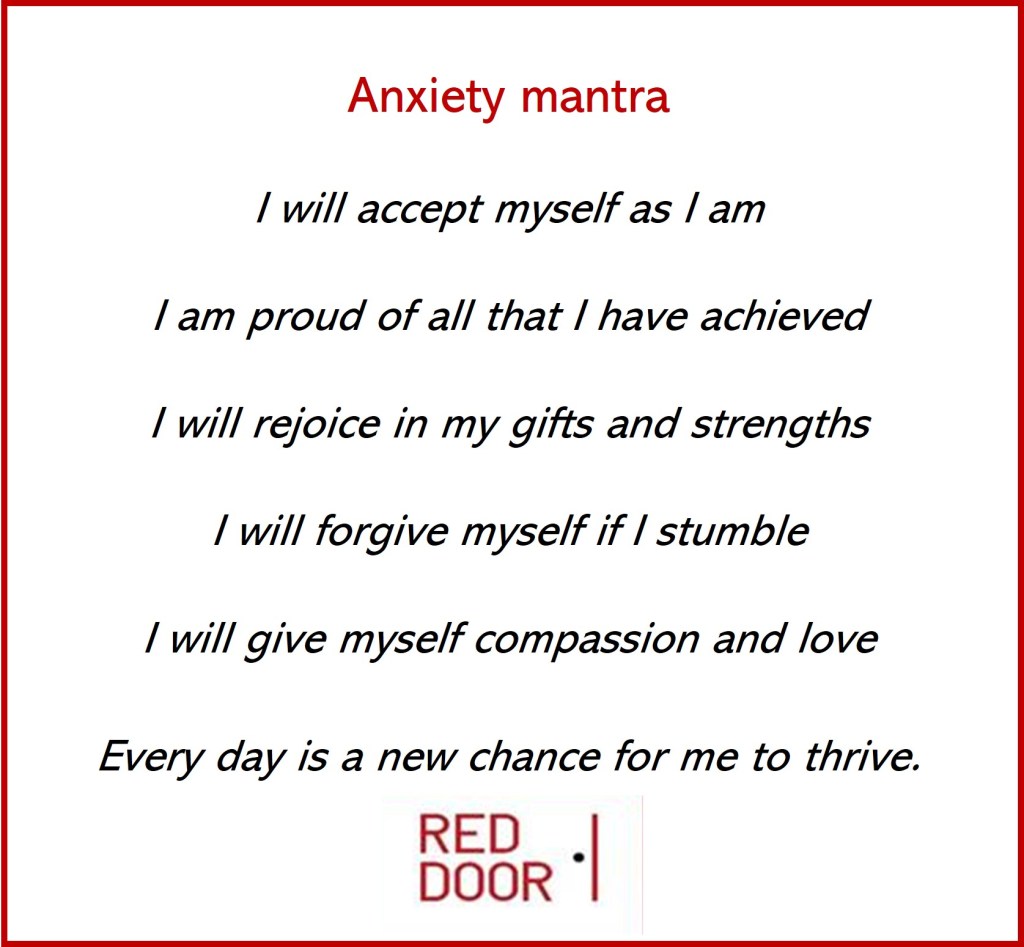
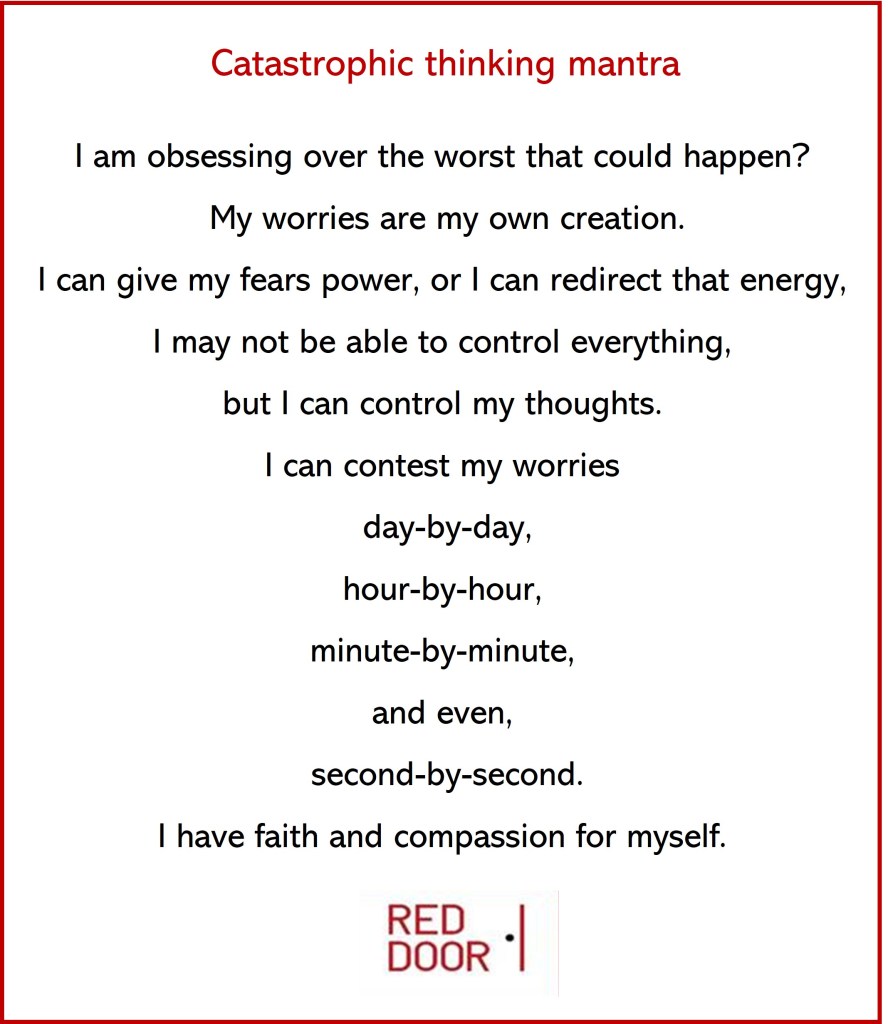
Mantras – Anxiety attacks are created by dreadful thoughts running through your mind. One way to settle these thoughts is to repeat a mantra. While there are mantras on the internet, you may benefit from one that you write specifically for yourself. The mantra should be full of words of kindness, understanding and love. The words “should” or “must” cannot be part of any mantra.

Centre yourself with art therapy techniques

While avoidance is not a long-term technique for managing anxiety, if you are ruminating or feeling a panic attack, distracting yourself with a change of scene or activity can help. Go for a walk, particularly in nature, to reset yourself. Try colouring, which I have detailed in a previous blog [https://reddoorhongkong.wordpress.com/2017/03/06/reasons-to-colour/ ], which involves both sides of the brain, stimulates creativity, and can help to calm the mind.   Even listening to some upbeat tunes at this time, get up and dance, just break the pattern of your anxiety for a moment to reset your emotional clock.

Talk to your anxiety – The long-term cognitive approach to anxiety is to create an internal dispute. Disputing your anxiety helps you reframe situations, see hope, and utilise self-compassion. If you experience anxiety ask yourself to challenge your view of the stressful situation – have you been overgeneralising, personalising, or catastrophizing? Is there an alternative way of looking at this issue? Sarah Wilson[2] , in her compendium of suggestions to utilise in one’s challenge with anxiety suggests an ancient adage, “ First make the beast beautiful”, meaning accept that your anxiety – it is something that originally may have been created to help you, but overtime has started to inappropriately misfire. When you make the anxiety beast beautiful you may say to yourself, “Thank you brain for alerting me to potential danger, but I know I am safe right now, you can go back to your guarding post”.  Developing the process of dispute is an area of action where a therapist can be of significant help. If you cannot create this dispute for yourself, utilise the resources of a counsellor. For more information see our post on this topic https://reddoorhongkong.wordpress.com/2020/09/07/talk-to-your-anxiety/

Prolonged anxiety is extremely challenging to your health. If you have been struggling with anxiety for a while please seek the help of a counsellor or a doctor. They may recommend a combination of therapy and even medication to help lessen your anxiety. There is no shame in needing help. Take charge of your future.

Everyday is a new day for you to thrive. Start gently, start now.

 #mentalhealth #mantra #mindfulness #anxiety #reddoorcounselling #selfhelp #anxietyattack #treatmentanxiety #women

Sources

1: Prevalence –

2004: The ESEMeD/MHEDEA 2000 Investigators,2004, Prevalence of mental disorders in Europe: results from the European Study of the Epidemiology of Mental Disorders (ESEMeD) project

2011: https://www.theguardian.com/society/2011/sep/05/third-europeans-mental-disorder

2: Sarah Wilson, 2018, First we make the beast beautiful: A new journal through anxiety. Dey Street Books

__________________________________________________________________

Angela Watkins is a psychologist and counsellor at RED DOOR Counselling in Hong Kong. Her current clinical work focuses on parenting. relationships, anxiety, OCD, career change, stress management and divorce.

Breaking free from narcissistic manipulation.

We rarely see narcissists in person in the counselling setting. More often, the client in the chair, the person coming for counselling, is seeking understanding or support because of the actions of another person, and the other person may be a narcissist.

If you have had the misfortune to have been in a relationship with a narcissist, you may understand this situation.  The counselling client, the narcissists dance partner, comes to counselling because they have lost almost all sense of themselves, they have been broken down and recognise that they can’t seem to make their partner happy, or get what they need from their relationship. Their partner may have told them that they are ‘crazy’, and that everything difficult in the relationship is their fault. They will have been told that the relationship is exceptional, unique, only they, can really, understand each other. Rather than a compliment this language is used to separate the dance partner, from reality and other sources of realistic support. After all, “Other people aren’t like us, we are special and as such, you need to prove this to me constantly”. If this sounds like your relationship experience, read on, you may he been dating a narcissist.

These days, it seems everyone is being accused of being a narcissist, and there may be some truth in this assertion.

In a world where we are encouraged to regularly display our best selves on social media, we can become rather self-involved. Social media and reality shows encourage narcissistic behaviour. Narcissist are very concerned with their image and like attention. Additionally, we are often socialised as to our unique or special nature. Whilst each of us is different from one another, if you have been raised to believe that you are different in a way that makes you superior to others, rather than simply not the same, you may have crossed the line and become narcissistic.

One can be mildly or moderately or extreme expressions of narcissism. If you have mild narcissistic tendencies these may be a product of one’s emotional development and can change over time. When we refer to a proper “Narcissist”, those people have not only a tendency to express most narcissistic traits, and especially those indicating desire for authority over others, and sense of superiority, and this is consistent over time.

There are various online assessments of narcissism. They are not fully diagnostic tools, but may help you understand how self-involved, or needing of adoration you are on a narcissistic scale.

If you would like to assess your own level of narcissism we have tried and our comments on those tests. It is my personal preference to explore those who provide rating style questions rather than either/or suggestions because more subtle preferences can be counted, and discounted accordingly.

Characteristics of narcissists.

Whilst this is not a diagnostic checklist, you may find that a narcissist has many of the following traits:

  • Unrealistic grandiose sense of self image. Remember Narcissism was once referred to as “megalomania”.
  • Speaking mostly about themselves, reinforcing a narrative where they are superior to others or under-appreciated.
  • Incredibly self-centred with lack of empathy for others.
  • Value power and fame for themselves.
  • Arrogant.
  • Think the rules don’t apply to them.
  • Demand constant attention or adoration.
  • Constantly look to promote themselves.
  • Highly sensitive to criticism, yet at the same time…
  • Quick to criticise and judge others.
  • Feel special and unique, and probably superior to others.
  • Feel entitled to have the best of what is on offer.
  • Will respond with dysregulated emotional responses when questioned – extreme anger, sulking, punishment.
  • Avoidance of personal responsibility for their poor reactions to situations.
  • Deceitful and manipulative.

A true narcissist will exhibit most of these traits, not just one or two.

Narcissists lack empathy and are often quick tempered. As such, they frequently use manipulative techniques, such as gaslighting, to take advantage of others. Whilst not all people who gaslight are narcissists, narcissists almost always use gaslighting as one of their tools to control people in their lives. For more on gaslighting see our blog on surviving gaslighting highlighted at the end of this article.

For the person in a relationship with the narcissist there are innumerable costs, especially to their self-esteem. If any of these situations seem familiar, consider if you need to break free:

  • Narcissists refuse to take responsibility for their actions so be prepared that most problems you have will be your fault. You might hear dialogue such as, “You made me so angry when you accused me of lying. Sure, I came home late and you didn’t know who I was with, and when I told you that I was out with Tim, you said that you were told that he was already at home by his partner. I can’t be responsible for your lack of trust in our relationship. Actually, you need help!”
  • Narcissists’ sense of grandiosity means that they cannot reflect on their own limitations. They may even lecture you on a topic that they have little knowledge of. Be prepared to encounter several lectures not based in reality.
  • You will become confused if your relationship is healthy, or actually really damaging. Narcissists use techniques such as love bombing to win you over. They may tell you that you and they are soulmates and that you are destined to be with each other. This ‘sounds’ like your relationship is superior to others. Don’t fall for this manipulation. It takes time to develop real trust and intimacy. True emotional intimacy cannot be rushed. If you fall for this, later you may find these techniques turned against you as a means to control you. For example, “I thought we were soul mates, but apparently you can’t give up an evening with your family in order to stay home with me. I guess I was wrong”.
  • Narcissists dismiss other people’s achievements. If you succeed your narcissistic partner may dismiss your achievement as luck, or even take responsibility for your success themselves.
  • The world rotates around the narcissist and their self-image. Acts of kindness will need to be acknowledged effusively. They may plan your birthday party, but everyone at the event will know and they will expect you to make a speech publicly stating your appreciation.  
  • A narcissist will be sensitive to any form of criticism. It is unthinkable that the world around them is failing to understand their greatness. If told that they need to reconsider their behaviour, consider alternative ways of performing a task, they will react quickly, often with anger. They may obsess over plans for vengeance and revenge. This will not usually directly be applicable to their partners, after all they choose you because they believe that you are adoring, however your family, your friends or, even your counsellor, may become candidates for such retribution, if those people dare to raise questions over the narcissist’s behaviours.
  • A narcissist may become very sensitive if you are not providing them with enough praise. In this instance they may consider insufficient admiration as a form of criticism.
  • Rules do not apply to them. Narcissists can break social rules because the typical rules do not apply to them.
  • They will often brag about their connections, popularity, and perceived importance. It is important to them that others see them as superior.

How do you spot a narcissist?

You have to be watching – both them and yourself.

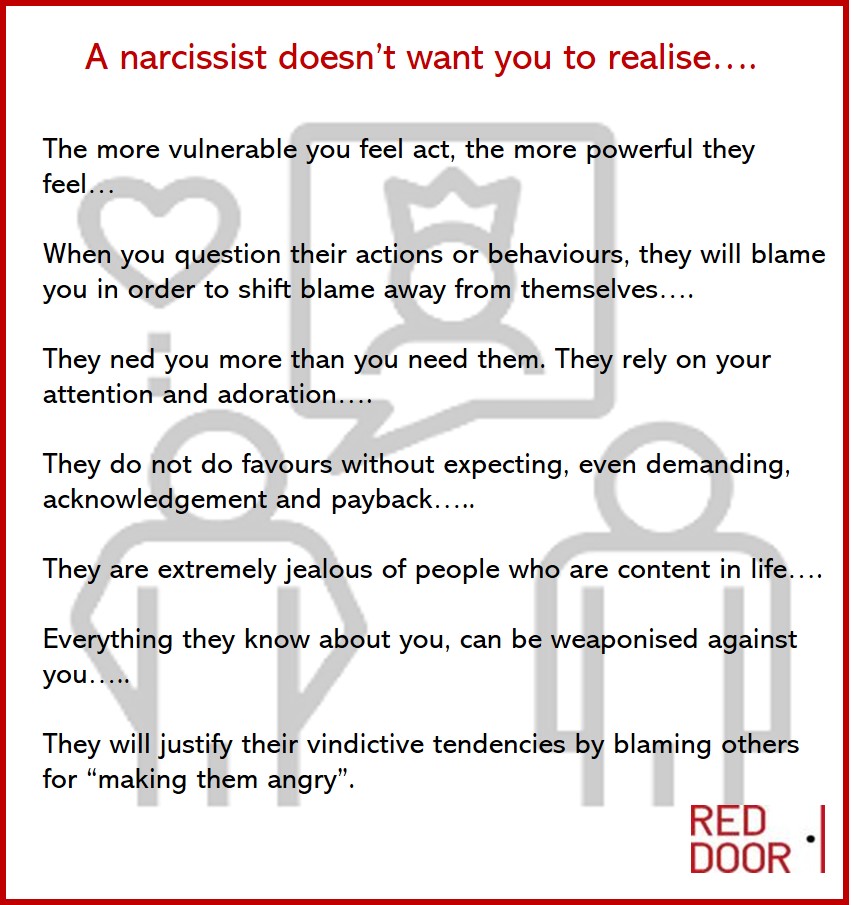
In essence a narcissist is a control freak who needs to orchestrate the feeding of their compulsion for adoration and attention. As such they will use a variety of manipulation techniques to establish that you will be feeding their insatiable appetite for attention.

You can use the above list or narcissistic traits, and set of scenarios to think about if your partner is a narcissist. If you are with a narcissist, it is also because they have been able to manipulate you. You are their chosen partner in a dance of control and manipulation.

Take a good look at yourself. Narcissists are attracted to people they can manipulate. Individuals who are people pleasers, are overly empathetic, are conflict avoidant, who often seek the approval of others instead of relying on their own self-confidence, and generally have self-doubt are more likely to be the chosen partners of narcissists.

If you believe you have some of these traits, you may need to work on yourself. Self-help programmes and counselling could help you build better boundaries and protect your mental health.

How to break free from a narcissist?

Many a meme will tell you that you need to go “No contact” with a narcissist. Essentially life with a narcissist will have you questioning reality. “Up” is only up, if they say it is. As a consequence, individuals coming out of narcissistic relationships are often very confused about what is real, and how to make decisions for themselves. Freeing your mind of the pollution of narcissistic manipulation requires that you break contact with the person muddling the environment to create an atmosphere dedicated to their need for attention.

In a formal recovery process, your counsellor will want you to take charge of your decisions and own your own feelings. You can be okay, even if someone around you is not okay. Only by owning your own decisions in life, and understanding that you are not the source of other people’s happiness, can you truly break free from being susceptible to narcissistic manipulation in future.  

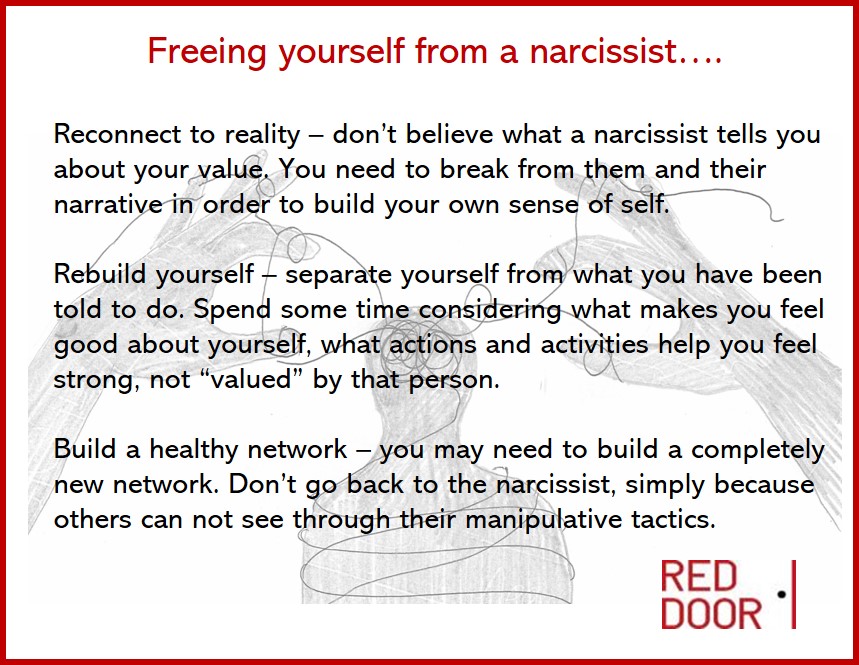
They will want you to reconnect to reality without the narcissist. You have been conditioned to see the world, and particularly other people, including yourself, through a lens that the narcissist provides. You need to start seeing the world through your own eyes again. Discussing what you like, what makes you comfortable and uncomfortable, and rediscovering your sense of self.

Your counsellor will encourage you to spend time rebuilding yourself – separate yourself from what you have been told to ‘do’ or ‘be’. Spend some time considering what makes you feel good about yourself, what actions and activities help you feel strong. You determine who you are and what you do. The narcissist will have installed themselves into the centre of your world. Once you have dislodged this parasite, you have to install yourself as the master of your life.

In addition, your counsellor will encourage you to develop new networks checking yourself to stop repeating co-dependent patterns from the past. New contacts should allow you, even encourage you, to make decisions for yourself. Friends that repeatedly tell you to go back to the narcissist possibly don’t see the manipulation at play. If those contacts cannot respect that you need to separate from someone dominating you, t term mental health build a supportive, sane, network – you may need to build a completely new network separate from the people connected to your narcissistic partner. Don’t go back to the narcissist, simply because others cannot see through the manipulative tactics being used.

If you would like to break free from narcissistic manipulation, consider counselling. You need to have a trained and trustworthy advisor, who can help you become your own person again. You want to build yourself into an independent thinker again. So that you can avoid falling into the trap of another narcissist in future.

About the author

Angela Watkins is a counsellor working out of RED DOOR Counselling in Hong Kong. Angela works with adults and teens on a variety of topics including identity, relationships, trauma, , anxiety, change, and family of origin issues.

Learn more about gaslighting: https://reddoorhongkong.wordpress.com/2023/01/26/surviving-gaslighting/

Non diagnostic tests for narcissism

https://www.mind-diagnostics.org/narcissism-test

https://psychcentral.com/quizzes/narcissistic-personality-quiz#1


Your mental health matters – protecting your mental health in a world experiencing a mental health crisis.

Hong Kong’s mental health crisis has escalated dramatically since the COVID-19 pandemic, but alarmingly, troubling trends were already in motion. The World Health Organization now estimates over 1 billion people worldwide battle mental health conditions requiring support, underscoring an urgent global concern (WHO, 2025).

Locally, data from the Hong Kong Jockey Club Centre for Suicide Research and Prevention at the University of Hong Kong reveals a grim reality: suicide rates in Hong Kong have surged more than 22% since 2011, with suicide tragically the leading cause of death among those aged 15 to 24. A startling 1 in 4 youths in this age group face mental health challenges, with academic pressure topping their stressors, followed closely by work demands. Nearly 20% experienced suicidal thoughts within the past year (HKFP, 2023).

The workforce is also under immense psychological strain. An overwhelming 87% of Hong Kong employees report feeling stressed, with one in five describing this stress as unmanageable (Cigna 360 Hong Kong Well-being Survey, 2025). Work-related pressures, uncertain futures, and social isolation are key contributors, especially among young professionals and Gen Z, the most affected demographic facing elevated anxiety, depression, and burnout.

Mental health is far more than the absence of illness. The WHO defines it as a dynamic state of emotional, psychological, and social well-being that enables people to cope with everyday stresses and thrive. It exists on a continuum, shaped not only by challenges like job loss or divorce but also by positive transitions such as marriage.

Recognizing warning signs early is critical:

Physical symptoms like racing heart, fatigue, muscle pain, or sleep disturbances often signal unmanaged stress activating the body’s fight-or-flight response.

Emotionally, mood swings, irritability, persistent sadness, and feelings of hopelessness warn of deeper struggles.

Cognitive red flags include overthinking, poor concentration, and decision-making difficulties.

Socially, withdrawal, loneliness, and changes in interaction patterns indicate potential burnout.

The urgent takeaway: mental health demands deliberate, daily care. It’s essential to check in regularly with oneself—acknowledging feelings, understanding limits, and crafting protective strategies. Self-care isn’t indulgent; it’s vital. Simple habits like scheduling downtime, practicing mindfulness, engaging in positive self-talk, and nurturing sleep can fortify resilience.

Stress management is equally crucial—setting boundaries, saying no, breaking tasks into manageable chunks, and celebrating small victories help keep stress from becoming overwhelming. Lifestyle choices matter too: regular exercise, outdoor time, nutrition, hydration, and conscious digital detoxes bolster mental resilience.

Lastly, nobody should suffer in silence. Seeking support from trusted friends, family, support groups, and mental health professionals is a sign of strength, not weakness. Talking about struggles makes them more manageable—a truth captured by the saying, “What is shareable is bearable.”

Hong Kong’s mental health landscape not beyond hope. With awareness, proactive care, and compassion—for oneself and others—individuals can move from merely surviving to truly thriving in these challenging times.


The counsellors at Red Door are here to support you if you are not sure who to turn to or would value objective and unbiased guidance. Alternatively, below are a selection of resources and hotlines in Hong Kong to support you in starting a conversation. Please share this and help to raise visibility so that this information can reach more people.

Alcoholics Anonymous Hong Kong

https://www.aa-hk.org/

9073 6922

Emotional Support Hotline – The Samaritan Befrienders

2389 2223 – Mon-Fri 6.30-10pm (English)

2389 2222 – 24 hours (Cantonese)

Suicide Prevention Hotline – The Samaritans

2896 0000 – 24 hours (Multilingual support)

#worldmentalhealthday #mentalhealthawareness #mentalhealthsupport #mentalhealth #wellbeing #selfcare #stressmanagement #anxietyrelief #breakthestigma

About the author.

Contact the RED DOOR reception to set up an appointment with Tanya. reception@reddoor.hk

References

Cigna. (2023, November). 2022 Cigna 360 Global Well-Being Survey [Press release]. https://www.cigna.com.hk/iwov-resources/docs/en/about-cigna/news/2022-Cigna-360-Global-Well-Being-Survey-Reveals-9-in-10-in-Hong-Kong-are-Stressed-and-Burnt-Out-EN.pdf

Mok, L. (2023, May 12). Up to 25% of young Hongkongers have suffered from mental health disorders, HKU research reveals. Hong Kong Free Press. https://hongkongfp.com/2023/05/12/up-to-25-of-young-hongkongers-suffered-from-mental-disorders-hku-research-reveals/#:~:text=inHong%20Kong-,Up%20to%2025%25%20of%20young%20Hongkongers%20have%20suffered%20from%20mental,stress%20from%202019%20to%202022.

The Samaritan Befrienders Hong Kong. (2023). The Samaritan Befrienders Hong Kong 2022 annual report: Empowering the inner-self. https://sbhk.org.hk/wp-content/uploads/2023/07/2022-Annual-Report-2.pdf

World Health Organization. (2022). COVID-19 pandemic triggers 25% increase in prevalence of anxiety and depression worldwide. https://www.who.int/news/item/02-03-2022-covid-19-pandemic-triggers-25-increase-in-prevalence-of-anxiety-and-depression-worldwide

Volunteer for better mental health

volunteer High School students pursuing the International Baccalaureate certification are expected to participate in CAS (Creativity, Action, Service) activities. The goal of these activities is to help children develop a holistic well-rounded perspective to learning and becoming a member of the community.  The activities are mandatory. Outside of CAS, should students (of all ages) be encouraged to participate in volunteering activities?
One benefit of volunteering is to build a CV, and consequently to improve your”chance” to gain entry to an elite university. I am not encouraging you to push your child into volunteering as part of a helicopter parent or over-parenting agenda, but rather to help them explore volunteering as a means to develop independence, resilience and empathy. These traits are predictors of success in life, not just at university.

Psychological benefits of volunteering:

World-centered vs self-centred

Exploring the plight of others helps teens see that other people experience significant challenges, helping them see the world outside of their secure and (frequently) privileged  lifestyle. Regular voluntary work increases the development of empathetic and altruistic behaviour. The voluntary action of giving your time and energy to help others aids in the development of compassion and gratitude.

Improved psychological functioning

Volunteering helps in reducing stress and anxiety, as connecting with others encourages proactiveness, wards off loneliness, and helps to combat the growing psychological culture of individualism and self-absorption.

Gain a sense of satisfaction

One of the primary psychological benefits of volunteering is the sense of accomplishment and self-satisfaction that accompanies working to make a positive difference.

Health Benefits 

For both adults and teenagers, research from the United States by Federal Government’s Corporation for National and Community Service and The University of British Columbia’s Faculty of Education and Department of Psychology, indicates that people who volunteer regularly experience better cardiovascular and mental health, including happiness and resiliency. Your child will live longer and be happier.

Create positively disruptive internal dialogue

Helping others provides teens with a valuable sense of purpose and meaning, allowing them to identify the morals and principles that they hold in high regard and then act upon them. Being aware of one’s priorities becomes rewarding once you are able to live those values and believe that you are channelling your time and efforts to make a difference. Therefore, instead of internalizing what you ‘should’ and ‘would’ do, start tackling what you ‘can’ and ‘will’ do to make a change.

For young people today, working for a charity is generally not seen to be a serious career option or even a legitimate tool for progress. However, the mental health benefits, although still a novel concept, far outweigh the overly simplistic view that volunteering is only a stepping stone to other career options. Despite this, there are a huge variety of ways for someone to serve and help others, whether you sort donations for a local charity or assist caring for children in an orphanage, both big and small acts reap psychological benefits.

You will often find that you will get more out of it than you give.

Teenagers are not aliens

22032017115504-0001

Teenagers Are Not Aliens

While it may sometimes feel like your teen is from another planet, adolescents are not, in fact, an alien species. They are, more simply, a misunderstood one.

If your teen is under 18, legally, they are still a child, and you are responsible for guiding them. As uncomfortable as it might be, take the lead, take control, and help them navigate this challenging stage until their brains are fully developed and capable of independent reasoning.

Understanding the Teen Brain

To truly understand teenagers, it’s essential to understand their developing brains. Until recently, society considered teens as “little adults,” but as detailed in The Teen Brain by Frances Jensen and Amy Ellis Nutt, this is far from the truth.

From a neurological perspective, the teen brain is only about 80% mature. The finely tuned connections in the brain’s wiring are still forming. During this period, their brains are highly receptive to learning and excitement. The neurons at the back of the brain, responsible for sex and excitement, are well-connected, but the frontal lobes—crucial for rational thought, self-awareness, risk assessment, abstract thinking, and planning—are still developing. Jensen likens the teen brain to a sports car that’s revved up but has nowhere to go.

Teens are also expanding their knowledge base, in a phase characterized by great plasticity, offering significant opportunities for growth and learning. However, this open brain is also more responsive to dopamine—the neurotransmitter that makes us feel good and fuels desire, often leading teens to seek out stimuli that boost dopamine levels, like alcohol and drugs.

The Teen Personality: Excited, Curious, and Irrational

Putting it all together, a typical teenage personality can be described as highly excited, often learning easily but struggling to articulate themselves, resist stopping an activity, or see things from another person’s point of view. It’s like a second “terrible toddler” stage.

One memorable example from a recent event involved a parent, an early childhood educator, who said, “I suddenly realized that my teen daughter, who was acting rude and obnoxious, wasn’t looking for a fight. Like a toddler, she was seeking comfort. When I offered a hug, she collapsed into my arms like she did when she was little.”

Tips for Navigating the Teen Brain

Here are some recommendations to consider when communicating with and supporting your teen:

1. Create a Time to Talk

Don’t assume your teen is ready to engage just because you are. Set a specific time for conversations and give them space for silence—remember, “Silence is never silence,” as Irvin Yalom notes.

2. Get Real with Facts and Stories

Teens respond best to concrete data and relatable stories, especially when discussing sensitive topics.

3. Prioritize Sleep

Sleep is vital—teens need at least 8.5 hours nightly to support brain development and stress relief. If they need to wake at 7 am, they should be in bed by around 10 pm, with devices turned off by 10 pm.

4. Use Reinforcement and Support Memory

Since planning and memory are still developing, have your teen write down tasks and repeat instructions to reinforce learning.

5. Limit Distractions

Teens are not great multitaskers, and their easily excitable brains are prone to distraction. Limit messaging, videos, and other distractions during study time. Recent research suggests over 80% of teen driving fatalities involve some form of distraction—often their phones.

6. Help Install the OFF Switch

Teens find it hard to stop activities due to dopamine sensitivity. Teach them to turn devices off and set boundaries on screen time together—discuss and agree on appropriate limits.

7. Perspective Matters

Because self-awareness is still developing, teens may misinterpret your tone or intentions. Be mindful of how they perceive your communication, and ask whether they understand and feel understood.

8. Prioritize Safety

As outdoor activities increase, revisit safety practices with your teen, especially regarding socializing, alcohol, and drugs. Explain how their teen brains are sensitive to substances and work out safety plans. Role-play scenarios, like recognizing when a friend has had too much to drink, and encourage them to seek help when needed.

9. Discuss the X-Plan

Consider talking through options like the “X-plan”—a safety plan designed for emergencies—so your teen knows how to handle difficult situations.

Final Thoughts

I could go on about communication techniques, but I’ll save that for another time. Parenting a teen can be challenging and lonely—but also full of shared laughter and growth. In our workshops, parents often find comfort in knowing they’re not alone in the frustrations and joys of raising teenagers.

Keep striving to understand and support your “alien-teenager.” Remember, we’re all in this together.

X-Plan: Giving your kids a way out (#xplan)

I could write even more about effective communication techniques with teens but I’ll save that for another blog. Parenting a teen can be challenging and even lonely, I noticed in our regular parenting-a-teen workshops that the empathy and frustration that the parent-participants shared, and the laughter as well. Keep going in your search to understand and best support your alien-teenager, and remember, we are not alone.

#parenting

#parenthood

#parentingtips

#raisingteens

#postiveparenting

#parentingteens

#parentingadvice

#teenager

#parentofteen

#reddoorcounselling

Note – an earlier version of this article was published in 2019.

Bullying at school – How to protect your child.

Bullying is generally defined as intentional abuse or intimidation having a component of real or perceived power imbalance and repetition over time. Bullying includes actions such as verbal name calling, physical aggression, social exclusion, psychological stalking or harassment, or through cyber platforms including social media, WhatsApp and email.

Bullying is a serious problem. The prevalence of bullying in schools varies with study place or group. In general, bullying tends to increase through the primary school years and peaks in middle and early secondary school years.

Bullying is being recognized as an important public health issue internationally. The rising phenomenon of bullying is posing enormous challenges to the school educational system in several countries worldwide causing a negative effect on academic stability, student health, well-being, and safety.

Kids bully for a variety of reasons including that they have been bullied (at school or at home); bullying has been supported in particular environments in the past (including mocking by teachers in schools), bullying is not directly addressed and this looking the other way has demonstrated that bullying can be an “effective” tool of controlling other people.

Whilst schools say they have a zero tolerance to threatening behaviour dealing with bullying is not as simple as it might first appear. Many factors make it difficult for schools to deal forcefully with incidents of bullying.

For example, often bullying occurs off campus. On campus bullying is usually regarded within the remit of the school to deal with. When bullying happens between members of a school community, but off campus, sometimes schools see this as outside their jurisdiction. This is sometimes the case with online bullying. If this happens to you, remember that schools often have a communication and technology use policy. It may be good to read the policy so that you can involve the school actively if cyber bullying is a stated infraction of their rules.  

Bullies are people too. Sometimes people who are bullying are actually quite vulnerable individuals themselves. They may be being bullied (in school or at home), they may not have strong social skills in order to better express their needs. Whilst they are dys-regulated and may have reasons for their outbursts and controlling behaviour, this doesn’t dismiss them from some accountability from their actions.  

There is a tendency to blame the victim in aggressive situations. Sometime individuals look to the victim of a crime to see how they have contributed to the situation, not only how they feel as victims of the bullying. We often do this ourselves, as a may to make sense of situations. Whilst no one may be blameless in an incident there are lines of acceptable behaviour that we need to draw and communicate what is poor behaviour, from aggressive behaviour.

Supporting your bullied child/ teen.

Listen to your child – They may want to ignore what has happened. There are times when you can ignore bullying, such as when a bullying person is simply trying to get a rise out of you. Remind your child that no one has the right to harm them.

Document your experience – so that you are clear about what is happening. You want to include if this is a one-time situation or has occurred on a repetitive basis. Also document the impact – was it perceived by your child as hostile or threatening. Include details of the bullying as fully as you can. 

Work collaboratively with the school. Whilst you can assert that you expect the school to take action, remember it will be more helpful to work collaboratively with them not attack them for your child.

Consider ‘retribution’. What do you consider an acceptable “correction of the bullying behaviour”? Do you know, and does your child know, what an appropriate apology looks like for their victim? For example, in a recent example I worked through with my own teen was cyber bullied by a person at her school – she detailed her desire, “he can’t just say some vague sorry on line, he needs to say what he did was wrong and that he understands why it was wrong” . These components of an apology mean, saying a sincere sorry, understanding why the person has done something careless (personal responsibility), understanding the impact on the victim. If you would like to understand more about what makes a good apology to you, I suggest you explore the apology quiz if your child is a teen. What makes an apology meaningful to them?

https://5lovelanguages.com/quizzes/apology-language

Professional support. Consider if your child will need additional help to navigate their feelings around the events.  If exclusion happened you might like to consider counselling. Many schools have school counsellors that you may have free access to. Otherwise consider private counselling. Nip any negative thought cycles or shame created by bullying in the bud. It is established that childhood bullying has a propensity to continue into adulthood and, if persistent, can leave lifelong scars. Help your child access the support to leave these incidents in the past once they leave school.   

Therapeutic exercises such as journalling and confidence building exercises can help the victim of bulling. One journalling exercise I particularly like, at the time of bullying, is one where the victim of bullying writes a letter to themselves. This helps them support themselves and, hopefully, construct a plan of how they would like to respond.

Take a break from social media. If your child has been cyberbullied encourage them to take a break from social media for a while. Cyberbullying is very difficult to contain because of Cyber bullying is different from in person bullying because it is un-boundaries, often moves faster, privacy cannot be maintained, there is no refuge for your child, the content can remain live forever if it is shared by others, and it’s harder to trace. People feel emboldened to say things online that they would rarely feel confident to express face to face. Having your child observe the speed at which gossip can spread online can be distressing. Sometimes being away from the bullying rather than observing how information can spread, can be less distressing.

Quality family time. You may like to spend more time with your child if they have been bullied. This helps to remind your child that their family is their primary source of support, and will always be there for them.

Build a bigger network of friends. Have your child spend time with friends outside of school for a little, rather than their usual school friends can sometimes help. Whilst I don’t recommend isolating from supports at school, sometimes its nice to have some distance from all the drama involved in bulling and have a nice day out where the bulling is not the only topic of conversation

Own it. Encourage your child to talk to their friends about what has happened. Bullying is, unfortunately extremely common. Sometimes your child might feel ashamed of what has happened. Encourage your child to talk openly about their experience. Their loud sharing may save another child from suffering, and possibly harming themselves, in silence.

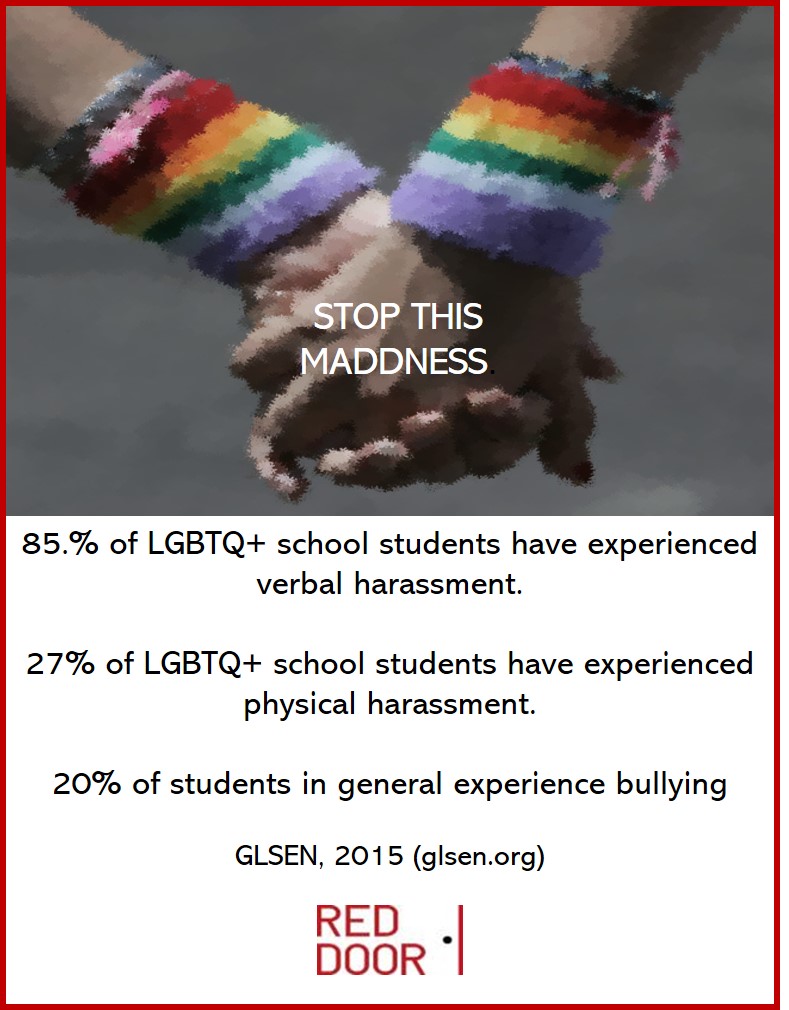
Proactive work. Schools and counselling groups work with children to help them build some resilience to withstand bullying. Some groups, such as members of the LGBTQ+ community, and children with different educational capabilities, experience bullying at higher rates than other teens. Helping them bolster their self-esteem, learn some clever clap backs, may be of help.

Set standards. Do not accept that bullying is a normal or acceptable behaviour, at school, or at work. Check your own behaviour to see if you have been complicit in supporting the bullying of others. We can all be more aware that bullying occurs, and that we can all help to stop these behaviours.

Bullying can have long term impact. Protect and support your child.

About the author: Angela Watkins is a counsellor working with teens and adults as they navigate traumatic, or challenging events in their lives. Angela has been named the best therapist in Hong Kong. If you’d like to meet Angela for an appointment, email her on Angelaw@reddoor.hk

Useful Books on bulling:

De Lara, E.W. (2016) Bullying scars: the impact on adult life and relationships.

Lohmann, RC, and Taylor, J. V. (2013) The bullying workbook for teens.

Martocci, L (2021) My bullied past – why does it still hurt?

Mathews, J and Mathews, A. (2011) Stop the bullying.

Payne, K, J., and Llosa, L.N. (2022) Emotionally resilient tweens and teens.

#teens #teenmentalhealth #reddoorcounselling #bullying #redddoorcounselling

Bullying: How long does it hurt?

Many adults still experience the pain and anxiety associated with bullying incidents from their past. Why can’t they just get over it.?

The effects of bullying are not left behind at school:

When we explore books on bullying (see the end of a few that I recommend) these long-term effects can include Trauma (Adult post bullying syndrome), considering self-harm and suicide, continued feelings of rejection, becoming a people-pleaser, depression, remaining extremely self-conscious, remaining indecisive and anxious, feeling anger, maintaining revenge fantasies, living in denial, having difficulty trusting people, and even bullying others yourself.

The reason that bullying remains important is that the incidents themselves tend to echo a longing for acceptance and belonging, and these incidents remind us that there are threats to our sense of acceptance and belonging – feeling powerless, feeling humiliated, feeling insecure, feeling ashamed. The script we may say to ourselves is “ I want to believe that I am xxx but my experience indicated that I am yyy”

What is bullying?

Bullying is a challenging concept to define. In academic literature many aspects of bullying are argued, for example academics debate aspects such as if a threat needs to be clear, if exclusion is a different or the same as bullying, if a person who has been bullied can also be considered a bully.

In simple terms bullying can involve ongoing actions that are deliberate violations of one’s dignity. (Martocci, 2021). Many people when recounting stories of their personal experiences are reminded how powerless and humiliated, they felt

when they recount their personal historieis of being bullied

Bullying is different from geopolitical atrocities, where people are under physical and deep psychological threat. That doesn’t mean that we should dismiss bullying as it is not as severe as living under threat of war etc.

How can we recover?

When bad events happen to us we can sometimes blame ourselves for what happened, instead of placing bad behaviour at the feet of the people who are not behaving nicely. We can become ashamed of the events, and ourselves.

Individuals can remain obsessed thinking about the bullying incidents, can deny the impact of the actions on them, live in an escapist fantasy where they bullying never happened, or remain angry about what happened. We need to work through these feelings.

If you are still hurting from those events of the past, you might like to consider journalling your feelings around those incidents and responding to specific prompts that we have outlined that can help you work through the impact that those incidents had on you, and may continue to shape your experience. If journalling is not your thing, then consider talking to a counsellor. You will be asked to reflect on those events, and whilst that might feel a little uncomfortable at first, we use these reflections to help understand how bullying has shaped your world view, self-concept, and reactions to conflict. When we explore and understand how these incidents have impacted you, and continue to drive your reactions, we can start to rewire your thoughts, feelings and fears.

Start to heal – reflection exercises

Prompts you might use to help you constructively reflect on your bullying experiences. Journalling is an important process within the counselling realm. For more about the benefits of journalling see our articles on this topic.

Reflective questions that could work as journal prompts.  These prompts will also be helpful if you experienced bullying at work as an adult, not only if you are looking to overcome bullying experiences from your youth.

* What do I let my bullying incident[s] tell me about my value and my sense of belonging?  What is your narrative around what happened. What do you tell yourself about how you were feeling int the moments around being bullied. Did you feel powerless? Humiliated?

  • How did you respond to being bullied? Did you act in denial? Has it made you become depressed? Have you escaped into another world?  Did your shame around these events render you mute to talk about them? What has been good/bad for you about the way you chose to respond?

    * What was unfair about that situation?

    * How has this incident affected your self-confidence?

    * Approaching yourself from a perspective of self-compassion. Can you tell yourself for the components that you might be responsible VERSUS the parts that you are definitely not responsible for. Think about what you would have wanted to happened during an incident of bullying. Maybe you wanted someone to accept you, instead of their perceived rejection of you. How can you give yourself the acceptance you did not receive in that moment?
  • * Do you hold yourself responsible for what happened? Is this a kind way for you to treat yourself?


    About the author: Angela Watkins is a counsellor at RED DOOR counselling in HOng Kong. Angela works with adults and teens exllporing their experience of trauma. For appointments with Angela contact her via email on Angelaw@reddoor.hk

Books on bulling

De Lara, E.W. (2016) Bullying scars: the impact on adult life and relationships.

Lohmann, RC, and Taylor, J. V. (2013) The bullying workbook for teens.

Martocci, L (2021) My bullied past – why does it still hurt?

Mathews, J and Mathews, A. (2011) Stop the bullying.

Payne, K, J., and Llosa, L.N. (2022) Emotionally resilient tweens and teens.

#teens #teenmentalhealth #reddoorcounselling #bullying

How to be a good friend when someone is going through a divorce.

Supporting a friend whilst they go through divorce can be challenging. It is hard to witness people in pain – which is a major component of the divorce process. At times it may be frustrating. You may consider that your friend is making mistakes in their negotiations. You may be of the belief that they are being ‘ too dramatic’ about their circumstances. You may disagree with their narrative of what happened in their marriage. As divorce is an emotional process, your friend might seem, ‘too much’ for you to handle sometimes.

It takes a special kind of friend to be able to support someone during a divorce.

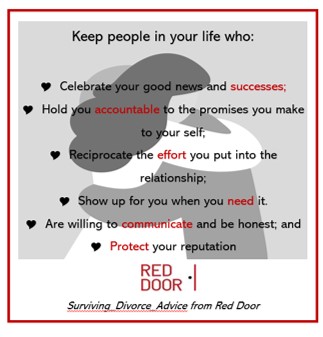
As a counsellor, I help individuals and groups navigating this process. Our RED DOOR proprietary research on divorce indicates that having good friends is one of the most important supports that divorcees say helped them navigate the process positively. It’s great when friends turn up in support of the divorce.

In some instances friend can, inadvertently, make a painful situation worse. In our Iron Fairies support group, a frequent topic of discussion is how divorcees have experienced a second episode of betrayal, first from their marital partner, and secondly, from their closest friends. Friendships make the divorce process both easier, and harder.

The following blog combines my learnings from supporting people through divorce, as well as listening to groups of people share how their friends have helped, and otherwise. If you have a friend going through divorce, I respectfully request that you to consider how you are helping your friend navigate the process, and contemplate if some of your actions might be causing hurt.  

How friends help divorcees navigate the divorce process.

Empathy

Empathy is the ability to emotionally understand what another people feel, see things from their point of view, and imagine yourself in their place. By walking in the shoes of your friend going through divorce, you might better understand their fears, anger, and hurt.  When we listen and really try to understand our friends’ feelings and their experience we can be of more help, if we choose to.

You don’t have to fix a situation; you just need to try to understand it.

Patience

You may fiend your friend’s pain and grief exhaustion to be around. People going through divorce are going to explore a plethora of emotions, and occasionally feel overwhelmed and dysregulated. It is common to feel angry, stuck, scared, sad, tired, and defeated. Helping your friend as they run this emotional gauntlet is difficult. Compassion fatigue is a real thing.

It is helpful to understand that divorce takes longer than most people appreciate. A “quick divorce’ is probably a year to 18 months in duration. And your friend’s pain may not end when the decree nisi is received.

A note to those going through divorce – You will probably be surprised by who turns up for you during your divorce. Most people are unaware of the pain of divorce unless it has happened to them directly. Those who have been through the process may become your closest friends during this challenging time.

Be patient with your friend, and understand that for some months, the divorce may be all that they talk about. Give them some time.

Many divorcees express that they fear their friends become “fed up” listening to their updates about divorce. Understand that you can also set boundaries to say, especially after you have listened to their struggles for a good few months, to draw a line and suggest that you want to have other topics to discuss as well as their divorce. This is fair.

However, don’t block the topic of divorce completely, if your friend trusts you, invalidating their greatest pain and need will hurt them.

Define the type of support that your friend needs

One form of boundary that you might like to define with your friend going through divorce is the type of support that they need at this time. They may need tangible support – helping with activities. You could be that someone who goes to court with them, helps them pack boxes, or look after their children on occasion.

Most divorcees need significant emotional support. If this is too hard for you to provide, for your own reasons, provide practical support instead.

Reputation protection

Unfortunately people like to gossip. A couples’ marital breakdown is a juicy piece of news for others to babble about. Don’t join the party. Disengage.

Divorce has enough challenges – the grief of love lost, the need to conduct tricky negotiations – without the humiliation of being the subject of idle chit chat. If you encounter gossip about your friend, shut it down. Remind people how distasteful it is to engage in malicious talk about a person in pain. Then leave.

A person’s ex partner will have their “version of events” which could be slanderous of your friend. Defend your friend without getting caught in the reeds of scandal. For example, you can simply say, “You certainly have a great story that you are running around telling”, and leave it to that. Those within earshot will get the message.

What actions may hurt your friend, directly or inadvertently.

Switzerland*

Your friend may ask you to stop talking to their ex-partner. What do you think of such a request.  might feel convenient, and more mature, to say that you want to stay neutral. After all, you might think, “every story has two sides”.

The chump lady, a regular commentator on surviving infidelity, calls friends who express a desire to be neutral “Switzerlands”. It is not meant as a compliment. When a person is struggling in pain, people rarely seek out “neutral” support. They want to feel understood.

In my experience as a counsellor, individuals going through divorce need to feel that their friends are on their side. Only when this basic tenant is in place do you have the validity to shine light on your friends choices. Your friend is vulnerable and will possibly surround themselves with people who’s loyalty is clear.

Wanting to remain neutral may be more about your comfort level. It is difficult to negotiate social relationships with both parties in a divorce. Friends that try to play Switzerland sometimes inadvertently given key information away. Simply talking to both parties in a divorce puts you in a position where you might hold information best not shared. Remember you are not a qualified, or invited, mediator.

If you in a couple who were couple friends with the divorcing partners, you will need to be very careful about alliances. Often one of each couple, support different people in the divorce. If you find yourself in this emotional matrix, be careful regarding what information you share with your romantic partner. It is hard to know the value of information when tricky negotiations are taking place.

Comparison

Other peoples drama can seem unattached and difficult to understand, as its not your drama. You may try to analyse your friend’s relationship so that you can find out what went wrong. Check your motives for doing this.

What we see in practice is that sometimes people are looking what to avoid in their own marriage when analyzing their friend’s marital breakdown. Inadvertently, you may be looking to blame your friend for their marriage breakdown, so that you can, within a cognitive bias, say your relationship is stronger than theirs.

For example, you might consider, “Amy’s husband left her. Amy refused to take on work outside the home and the weight of supporting the family fell onto Jim alone. I have a good job so its unlikely that my partner will leave me.”

Its tough to not compare, just reflect, are you helping, or hurting, or even simply trying to provide yourself with an illusion of “security” through this comparison.

Betrayals

Many divorcees experience perceived betrayals by friends during the divorce process. Through our support of people going through the process of divorce we hear numerous accounts of friendship betrayals including:

  • 📜 Sharing key information about the divorcee with their ex-partner.
  • 💌 Flirting with the divorcee’s ex-partner.
  • 😤 Expressing frustration with the divorcee to others, without asking for space from their divorce process.
  • ⚔️ Using your friend’s divorce as a tool against them when competing for a job opportunity.
  • 🎯 Setting the ex-partner up on dates.
  • 🤫 Keeping secrets about their ex-partner and gossiping to others about what you know.
  • 🇨🇭 Pretending to be “Switzerland”

For many people the process of divorce can be humiliating. We need to be careful not to kick our friends with when they are down.

It is not easy to be a good friend during the divorce process. It takes a special person to help navigate the pain, fear and necessary change. If you can be that person for your friend, you are to be admired, congratulated, and cherished.

About the author- Angela Watkins is a counsellor working for several years with individuals going through divorce in individual and group therapy (the Iron Fairies). To contact Angela for session information contact angelaw@reddoor.hk

  • for more information about Switzerlands, read Leave a cheater, gain a life: the chump lady’s survival guide by Tarachy Schorn.