Our reading list – RED DOOR reading recommends
At RED DOOR our team often recommend books for clients to read, to help them be motivated, heal, understand their situations, and stimulate change.
Attached are some of the books we recommend regularly. We put out blogs featuring book recommendations fairly regularly, so continue to follow our pages to keep your reading list fresh.
Take a look at just a few that we recommend regularly. One of these books could be an instrumental part of your journey to feeling differently.
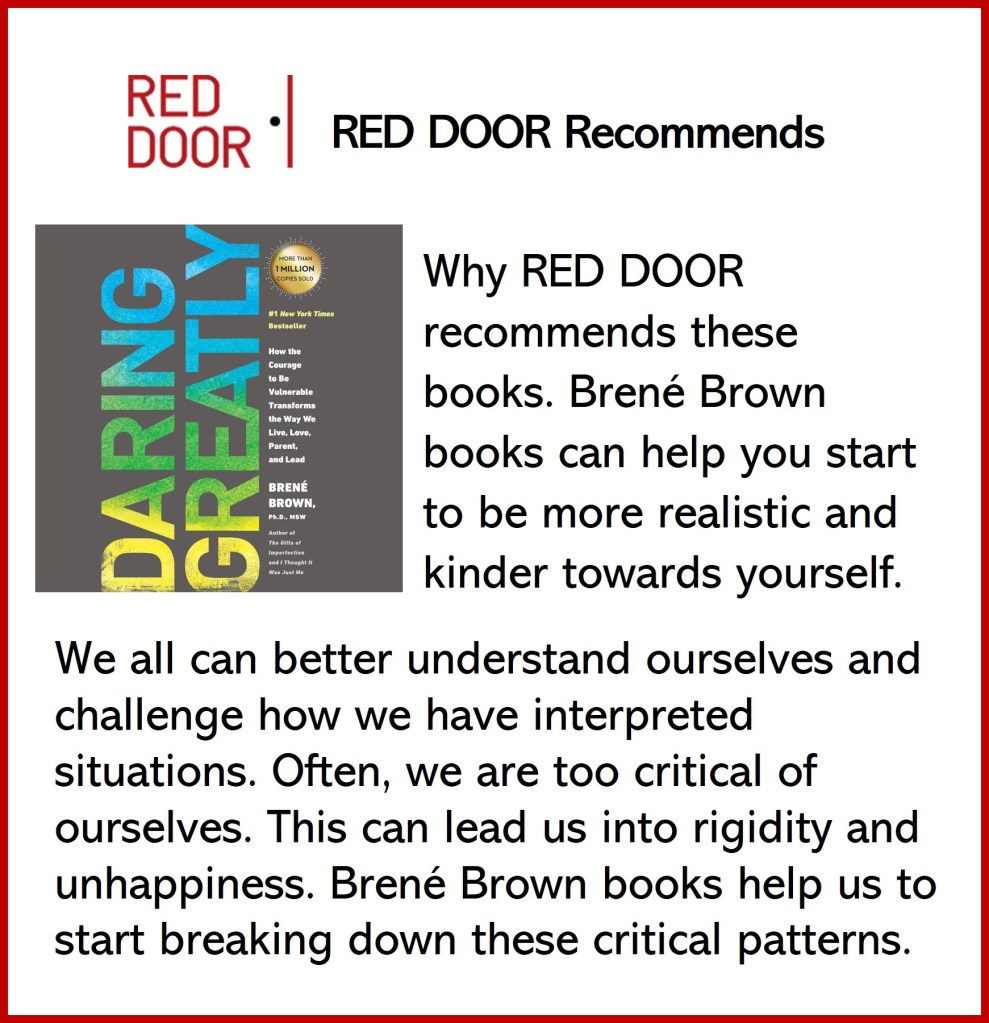
Dare Greatly
Brené Brown

Brené Brown deserves her fandom status as a self-help guru.
Read any of the Brené Brown books including Dare Greatly, Rising Strong, or the Gifts of Imperfection to help you embrace your own vulnerability, be brave, accept yourself as you are, and review “the story you are telling yourself”.
Why RED DOOR recommends these books. Brené Brown books can help you start to be more realistic and kinder towards yourself. We all can better understand ourselves and challenge how we have interpreted situations. Often, we are too critical of ourselves. This can lead us into rigidity and unhappiness. Brené Brown books help us to start breaking down these critical patterns.
——
Atomic Habits
James Clear

Clear’s central hypothesis is that small change compound into big impact. Start small habits and keeping them going is the key to substantive change.
Helping outline what makes a good habit, how to beak bad habits so that you can change outcomes, the cost of your behaviours, and even how you see yourself.
Why RED DOOR recommends this book. When people need to tackle change, and are struggling with motivation, I find this book a helpful resource for them help them frame their goals and understand how and when impact can occur.
—-
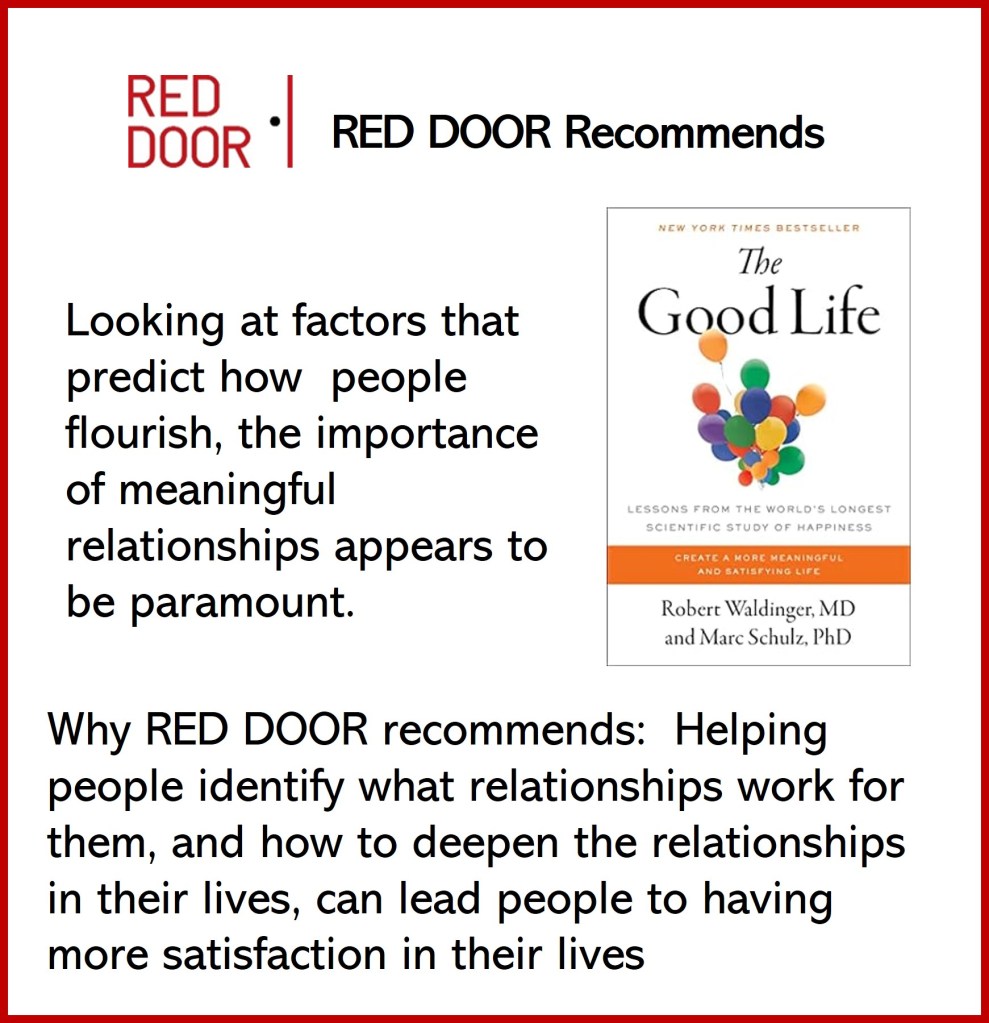
The Good Life: Lessons from the world’s longest scientific study of happiness.
Robert Waldinger & Marc Schulz

This book is built out of a bedrock of research from the Harvard Study of Adult Development as well as a plethora of other longitudinal studies.
The researchers’ study of happiness is not based on what people say will make them happy. Rather they explore what people are doing when they rate their lives as thriving.
One of the greatest influences helping people flourish is the quality of their relationships. This book explores case studies and data exploring what makes relationships positive for them, how these relationships work in a protective manner, how generosity and curiosity shape meaningful connections. If you want to live a good, healthy, satisfying life, this book could help.
Why we recommend it. Helping people identify what relationships work for them, and how to deepen the relationships in their lives, can lead people to having more satisfaction in their lives.
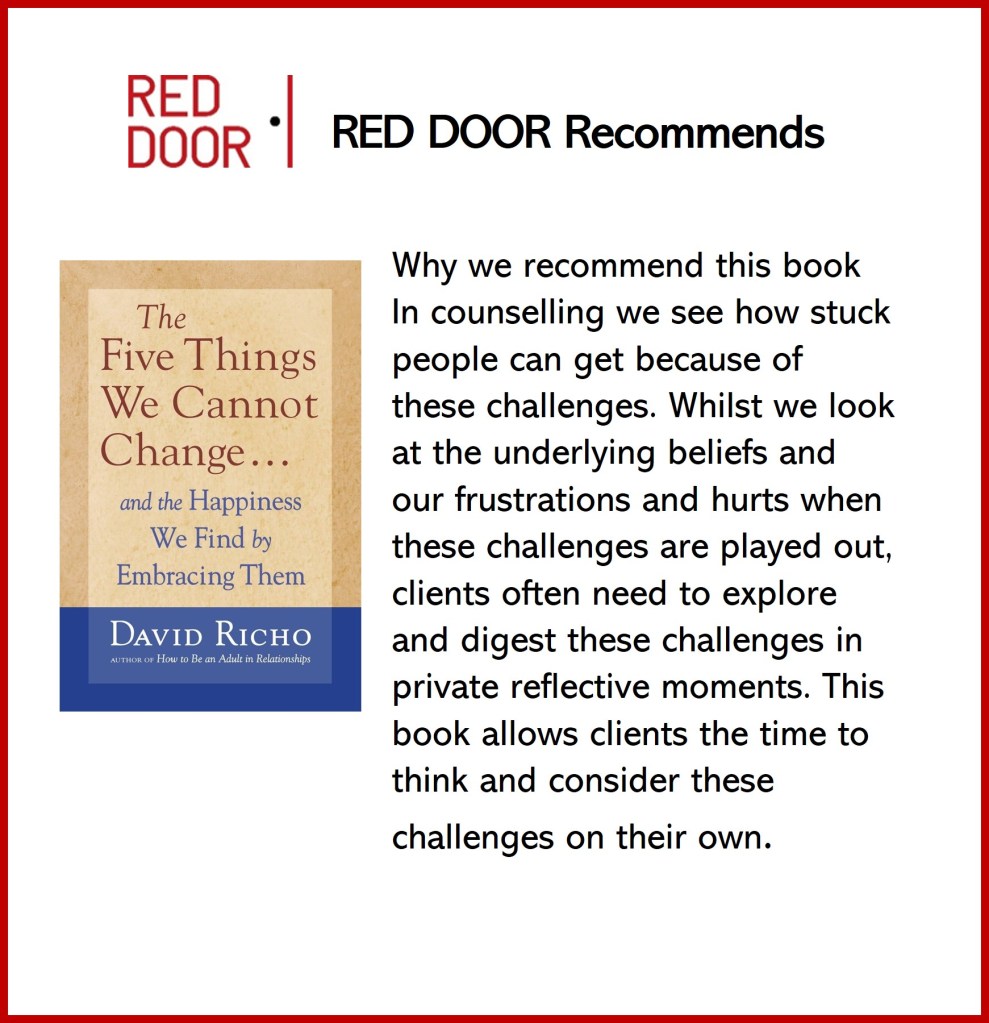
The five things we cannot change
David Richo

Richo talks about the five big challenges that people struggle to understand: including that life is not always fair, everything changes or ends, your plans don’t always work out as you’d like, pain is part of life, and people are not always as loyal and loving as you expect.
Why we recommend this book: In counselling we see how stuck people can get because of these challenges. Whilst we look at the underlying beliefs and our frustrations and hurts when these challenges are played out, clients often need to explore and digest these challenges in private reflective moments. This book allows clients the time to think and consider these challenges on their own.
Can’t hurt me
David Goggins

Over 5 million copies of this book have been sold, attesting to the motivational power of David Goggins. Whist Brené Brown writes to help you better accept yourself, Goggins provides a contrary view of the world, be uncomfortable, strive to be better and do at least one thing a day that is out of your comfort zone. Both Brown and Goggins motivate. Whilst Brown helps you feel calm, Goggins strives to wake you up.
The book recounts much of his personal journey overcoming poverty, self esteem issues, and health challenges. Goggins is a like a Sargent at arms, if you need to go to war with your motivation – this is your man.
Why we recommend this book: When clients need energizing motivation, and particularly have been procrastinating over challenges in their lives, David Goggins trumpets the wake-up call to action.
The Allure of Busyness: Is Being Busy Becoming an Addiction?

Have you ever experienced the allure of the “busy” temptation? Just as the siren’s call can be hard to resist, the idea of being “busy” can be equally enticing – whether to express significance, escape undesirable tasks, or maintain an image of productivity. This trap of busyness then ensnares people, leaving them in a cycle of constantly needing to appear and declare themselves as “busy.”
In today’s fast-paced society, being constantly occupied is often seen as a badge of honor that people wear proudly, using their busyness to boast about hectic lifestyles. However, some may also utilize the “busy” persona as a form of escapism. It appears some of us cannot get enough of the “busy” character. Does this sentiment resonate with you? If so, you are not alone. The tendency to use “busy” to show off or as a means of avoidance is quite common, more so than many realize.
Employees who were uneasy about their work performance were more prone to exaggerate their busyness and workload to influence how others perceive them (Whillans & Dunn, 2018). But here’s the thing: this desire to appear busy can spin out of control, leading to a vicious loop of constantly feeling rushed. There seems to be a prevailing notion that the busier a person is, the more accomplished they are in life, and people often use the “busy” label casually, even if they are not genuinely occupied. This casual usage can color others’ perceptions of that person’s life, making it appear more vibrant or hectic.
According to Ma (2022), individuals may use busyness as a way to avoid addressing more profound emotional or psychological needs. This constant state of activity can serve as a distraction, helping people feel better about themselves or providing a sense of worthiness and value. In the case of chronic busyness, it’s essential to slow down and reflect on what might be driving this compulsive behavior.
Signs of Busyness Addiction
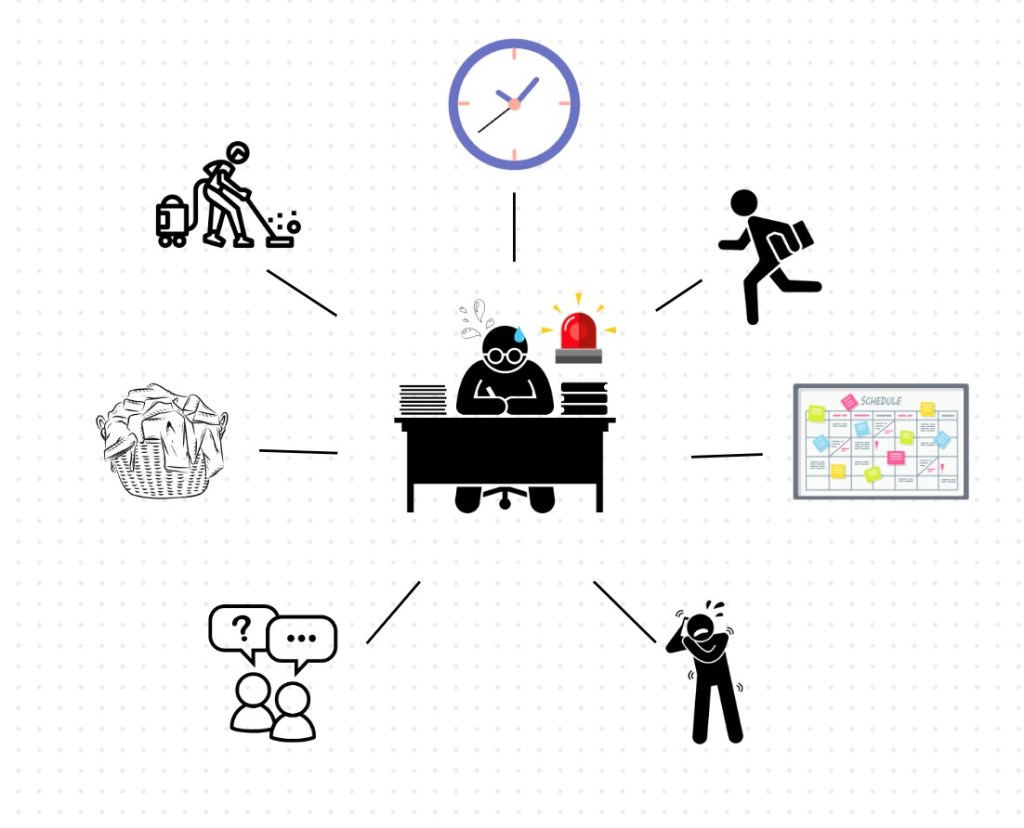
Nowadays, it’s all too easy to become consumed by an endless stream of obligations and commitments. We find ourselves caught in a whirlpool of busyness, frantically juggling work, deadlines, family responsibilities, and a never-ending to-do list. This “hustle life” that we are chasing can lead us down a path of overcommitment, where the fear of letting others down or not meeting expectations drives us to go beyond our means.
Ask yourself, do you have an inability to say “no”? Does your calendar fill up faster than you can cope with? An addiction to busyness often manifests as a compulsive need to say “yes” to everything, leaving no time for rest and recovery. The incessant need to fill our schedules, respond to every email, and juggle multiple tasks has become a cultural norm (Matejko, 2022).
If any of this sounds familiar, it may be time to examine busyness’s role in your life. Are you may be using it as a shield against vulnerability? A way to avoid dealing with difficult emotions or stressful situations? Research has shown that people often use excessive busyness as a way to avoid and repress their negative feelings, which can eventually manifest as anger, irritation, and other detrimental thought patterns (Schrader, 2014).
We even wear our overflowing schedules and never-ending to-do lists like a form of armor, convincing ourselves that the more we pack into our days, the more productive and valuable we must be. However, this relentless pursuit of productivity and activity can have serious consequences, including exhaustion, anxiety, burnout, and strained relationships.
Your busyness might manifest in scenarios like:
- Your co-worker asks you to cover their shift, even though it’s your scheduled time off. You feel compelled to say yes, even though it means sacrificing your personal plans.
- A classmate misses a group project meeting, so you stay late to pick up the slack and ensure the assignment is completed on time.
- Your friends request a last-minute gathering, and despite your already packed schedule, you squeeze in a hurry to avoid disappointing them.
Prioritizing others’ needs over our own well-being can be a hallmark of being stuck in “hustle mode.” Saying “yes” to every request leaves us overwhelmed and stressed, unable to regain control. Very often, the fear of letting people down becomes so ingrained that it feels nearly impossible to break free.
Finding Balance
Saying “no” is not a curse that will bring calamity but rather a powerful tool that can enable you to understand and escape the clutches of relentless busyness. By incorporating some simple yet transformative techniques, you can break free from the cycle of relentless busyness and rediscover the joys that a more balanced life can offer.
Here are some strategies that counsellors recommend:
Practicing mindfulness
The constant demands of work can drive a toxic cycle of trying to prove worth through relentless productivity. Practicing mindfulness activities like breathing exercises, yoga, and meditation can help cultivate present-moment awareness. These practices help break free from the hamster wheel of to-dos and live in the present moment rather than getting caught up in judgment.
Prioritizing self-care
In our productivity-obsessed culture, it’s easy to neglect self-care. Yet dedicating “me time” is essential for well-being. Self-care doesn’t have to be grand – it can be simple, enjoyable activities like getting your nails done, taking a bath, or reading. The key is to relax and do something nurturing for yourself. This allows us to step back, reflect, and process experiences while healing from mental/physical exhaustion and giving our brains a much-needed break.
Cultivate self-awareness
Having self-awareness is highly valuable than you might think. One practical way to enhance self-awareness is by incorporating a habit tracker into your daily routine. Habit trackers can be valuable, allowing you to monitor your progress and gain insights into your daily habits. Taking time to reflect and re-evaluate your days or weeks can help you recognize when you need to take a break and hit the “pause” button.
Setting boundaries
It’s easy to get caught up in the relentless pursuit of impressing others, constantly pushing ourselves harder until burnout sets in. The next time you feel that pull to overcommit, pause, assess your priorities, and have the courage to set boundaries. Your mind and body will thank you.
Some highly recommended books on setting effective boundaries include Healthy Boundaries – Chase Hill & ‘Boundaries: When to Say Yes, When to Say No, to Take Control of Your Life’ – Dr. Henry Cloud. These books offer practical guidance on identifying, communicating, and maintaining healthy personal boundaries across different areas of life.
Journaling
Keeping a diary is a disciplined way to reflect on your thoughts, feelings, and experiences, gaining deeper insights into your emotions, behaviors, and cognitive patterns. This self-awareness can help you understand your motives, triggers, and growth potential.
When counselling might help.
There’s no such thing as a perfect moment to seek counselling, but taking that first step towards reclaiming your sense of control and peace of mind can make a difference. Stress is an unavoidable part of life – it’s our adverse reaction to the excessive pressures and demands we face daily. Whether it’s work, relationships, or personal challenges, feeling constantly overwhelmed can seriously affect our mental and physical well-being.
Seeking counselling can be a means of expanding your perspective and understanding yourself better. Engaging in counselling can help you gain new insights and make positive changes in your life. Through open and judgment-free dialogue, you can gain the self-awareness and tools needed to manage stress healthier and more sustainably.
In a world that values constant activity and productivity, it’s crucial to recognize the dangers of addiction to busyness. By understanding the psychological and neurological factors behind this phenomenon, we can take steps to find a healthier balance and truly thrive. While the allure of busyness may be strong, the rewards of a more balanced life are well worth the effort. Thus, the question remains: what does “being busy” mean from your perspective?
About the author
This blog post was written by Chanuja Gurung , a summer intern at Red Door. Her areas of interest include the topic of busyness and the counselling processes that can help cultivate self-awareness in individuals. She is a thoughtful and curious person who enjoys working with others. Due to her desire to broaden her horizons, she continually seeks new avenues to expand her knowledge and deepen her understanding of the intricate challenges faced by people due to their own unique forms of busyness. Thus, through her blog, she aims to reach out and connect with others, with the ultimate goal of helping to improve their lives.
References
Ma, L. (2022). The internal chaos of chronically busy people. Psychology Today. https://www.psychologytoday.com/intl/blog/psychoanalysis-unplugged/202207/the-internal-chaos-chronically-busy-people
Matejko, S. (2022) Are you keeping busy to avoid your feelings?, Psych Central. https://psychcentral.com/blog/are-you-keeping-busy-to-avoid-your-feelings
Schrader, M. (2014). The hidden addiction: How busyness can become a coping mechanism. Psychology Today. https://www.psychologytoday.com/us/blog/the-art-thriving/201411/the-hidden-addiction
Stress | How counselling can help. https://www.bacp.co.uk/about-therapy/what-therapy-can-help-with/stress/
Whillans, A. V., & Dunn, E. W. (2018). Valuing time over money is associated with greater social connection. Journal of Social and Personal Relationships, 36(8), 2549–2565. https://doi.org/10.1177/0265407518791322
Examining Stress: How to Manage Exam Season Stress

To the great dismay of students and parents alike, exam season comes for us all, and with it comes exam stress. But what is exam stress? How can we recognise when it’s unmanageable? What can we do when it is unmanageable?
Exam stress in itself is not abnormal; exams can be scary! Emotionally, it can be difficult to deal with feelings of stress, anger, and hopelessness. Furthermore, it can become more troublesome when it manifests physically as headaches, changes in eating habits, difficulty sleeping, difficulty focusing, etc. So, how can you, as a student, get ahead of the curve or cope with the symptoms as they come?
In terms of getting ahead of the curve, figuring out how you best study and how to study efficiently can be invaluable. There are several kinds of study habits you could try, such as the pomodoro technique 1, eating the frog 2, and more, paired with different study techniques such as blurting 3, flashcards, mind maps, Feyman technique, and other ways 4 you may find most comfortable studying.
To cram or not to cram? For some, cramming can be helpful. Active procrastination can allow you to procrastinate so that you use motivation under time pressure to complete tasks or deadlines efficiently. However, cramming can also be harmful. Cramming late into the night, taking away your sleep, and overloading your brain the night before an exam can end up making you feel worse going in and could negatively impact your performance relative to if you spaced out your learning. On occasion, such as the night before a test, cramming is understandable and fine, but cramming during an exam season is unsustainable and unwise. If you do find you work better or complete tasks more efficiently under a time constraint, see if you can set yourself deadlines for the end of the day or week throughout the studying process if that’s what works best for you.
When it comes to actually coping with stress, there are different ways of doing so, such as problem-focused and emotion-focused coping. Problem-focused coping involves investing effort in studying or, if you’re really struggling, speaking with a teacher to see how they could help or how you could improve. Emotion-focused coping involves reducing stress by attempting methods of relaxation. Both coping skills can be helpful, as problem-focused can allow you to get a better handle on what you may need to do more effectively, while emotion-focused can allow you to soothe yourself so you can be more comfortable throughout exam season.
So, what are ways to cope with examination stress?
- Mindfulness strategies such as meditation or breathing exercises
- Getting proper sleep can positively impact both your grades and your health in general. About 8-10 hours is recommended.
- Getting exercise can not only provide a break but can also work for stress relief. Said exercise doesn’t necessarily have to be intensive either, going for a 10 minute walk can be beneficial.
- Make sure to take breaks. As previously mentioned, spacing out your studying can be good for your learning but it can serve as an energy boost or allow you to step away from the focus-oriented environment of wherever you’re studying to a more comfortable one.
Other than getting enough sleep, you don’t have to pressure yourself to fulfill every possible coping mechanism. What’s important is dealing with the stress in a way that is not only healthy but also works for you. If distancing yourself from your study environment for a bit every day to watch a show or read helps you, then go for it.
Coping doesn’t have to be an isolated process, it can involve reaching out to teachers, parents, or your friends. How can you do this?
- Asking teachers what areas you specifically need to improve on. This can help you structure your studying so that you’re prioritizing correctly while still keeping foundational knowledge you may already have.
- Studying with friends can help you connect with others while helping you be motivated to study within the group. However, communication is also needed to establish how long you’ll all be studying for, how focused you need to be, etc.
- Keeping an open line of communication with your parents on how they can help you cope. At the end of the day, your parents want to help you and make sure you’re getting stuff done. So, you could tell them how to help you, for example, giving them your phone so you’re less distracted can indicate to them that you’re spending your time wisely. You could also tell them what will stress you out more, such as asking about how long you’ve studied, this way they can adjust the questions they ask and what to push instead of that.
Overall, like exams, coping with stress can be difficult, especially when figuring out how to get started. Establishing effective and efficient study habits early on can be really helpful in terms of knowing that, despite the stress, you know what works best for you and that you’re doing what you can. Coping with the overall emotions of anxiety can be difficult, but you’re allowed to struggle and be unsure. Be kind to yourself in this stressful time. Parents can be of great help through communication, let them know when you’re struggling and if or how they can help.
Finally, remember that exams are not inherent tests of your worth or intelligence. You got this, good luck!
Resources
Health Information Tips for DSE Students:
Coping with Exam Stress – Harrow
About the Author
This blog is written by Micaiah Boerner, a 2024 summer intern at Red Door.
- https://www.asundergrad.pitt.edu/study-lab/study-skills-tools-resources/pomodoro-technique
- https://asana.com/resources/eat-the-frog
- https://www.bcu.ac.uk/exams-and-revision/best-ways-to-revise/the-blurting-method#:~:text=Blurting%20involves%20writing%20down%20all,ve%20missed%20or%20got%20wrong.
- https://www.usa.edu/blog/study-techniques/
References
Asana. (n.d.). Why you should eat the frog first [2024] • asana. Asana. Retrieved July 17, 2024, from https://asana.com/resources/eat-the-frog
Buchwald, P., & Schwarzer, C. (2003). The exam-specific strategic approach to coping scale and interpersonal resources. Anxiety, Stress & Coping, 16(3), 281–291. https://doi.org/10.1080/1061580031000095434
harrowdev. (2023, December 7). Exam stress: Understanding its impact and ways to cope with it. Harrow International School Hong Kong. https://www.harrowschool.hk/exam-stress-understanding-its-impact-and-ways-to-cope-with-it/
How to reduce test anxiety. (n.d.). Mayo Clinic. Retrieved July 12, 2024, from https://www.mayoclinic.org/diseases-conditions/generalized-anxiety-disorder/expert-answers/test-anxiety/faq-20058195
How to revise with the blurting method. (n.d.). Birmingham City University. Retrieved July 17, 2024, from https://www.bcu.ac.uk/exams-and-revision/best-ways-to-revise/the-blurting-method
Kornell, N. (2009). Optimising learning using flashcards: Spacing is more effective than cramming. Applied Cognitive Psychology, 23(9), 1297–1317. https://doi.org/10.1002/acp.1537
Mozafaripour, S. (2024, June 6). 10 effective study tips and techniques to try this year | usahs. University of St. Augustine for Health Sciences. https://www.usa.edu/blog/study-techniques/
Pomodoro technique | dietrich arts & sciences undergraduate studies. (n.d.). Retrieved July 17, 2024, from https://www.asundergrad.pitt.edu/study-lab/study-skills-tools-resources/pomodoro-technique
Spangler, G., Pekrun, R., Kramer, K., & Hofmann, H. (2002). Students’ emotions, physiological reactions, and coping in academic exams. Anxiety, Stress & Coping, 15(4), 413–432. https://doi.org/10.1080/1061580021000056555
Stress. (n.d.). Retrieved July 12, 2024, from https://www.who.int/news-room/questions-and-answers/item/stress
Tesorero, A. (2023, March 17). A good night’s sleep can help students get better grades, say UAE doctors. TCA Regional News Retrieved July 12, 2024, from https://www.proquest.com/wire-feeds/good-nights-sleep-can-help-students-get-better/docview/2787623647/se-2
The science of cramming: Does it work? (2022, May 11). USD Student Media.
Why you shouldn’t cram before exams (And how to study properly instead). (n.d.). Retrieved July 12, 2024, from https://au.reachout.com/study-work-and-money/exam-stress/why-you-shouldnt-cram-before-exams
Zeidner, M. (1995). Coping with examination stress: Resources, strategies, outcomes. Anxiety, Stress & Coping, 8(4), 279–298. https://doi.org/10.1080/10615809508249379
Standing Up for Coming Out – Supporting Your LGBTQIA+ Teen.

One of the earliest conversations you may have had with your child involves their declaration of gender identity or sexual orientation. They might tell you they are a boy, a girl, or even express that they feel like one gender one day and another the next. As children grow, their identities and attractions may not fit neatly into the social norms they’ve been exposed to.
According to the U.S. Census, about 10% of teens identify as LGBTQIA+—an acronym that includes lesbian, gay, bisexual, transgender, queer, intersex, asexual, and others. Many more might be questioning their gender or sexuality. Unfortunately, there’s limited data for Hong Kong youth, possibly due to societal stigma and discrimination against LGBTQIA+ individuals.
During adolescence, young people naturally explore their identities. They might not identify with the gender they were assigned at birth, experience attraction to the same sex, or feel no attraction at all. As a parent, here’s what you can do to support your child and foster a positive, trusting relationship:
Be Accepting
Avoid dismissal or judgment. If your teen shares their identity or attractions, don’t dismiss it as a phase or something to be fixed. Instead, embrace their honesty. Their exploration is a vital part of understanding who they are. Express to your child that you love and support them no matter what.
One of the most loving actions a parent can provide is creating a safe space for your teen to explore and reflect. Show genuine interest, listen actively, and affirm their feelings. Remember, acceptance and validation are crucial; they help your child develop resilience and self-confidence.
Remember: There Is Nothing Wrong With Being LGBTQ+
This isn’t a problem that needs fixing. If you find yourself struggling with feelings of denial or discomfort, consider what’s best for your relationship in the long run. Challenging your internal biases or prejudices now can be vital. Research shows that rejection from parents can severely impact an adult’s mental health and ability to maintain relationships. Ultimately, your ongoing support could be the most important gift you give your child—far more powerful than any initial resistance.
The mental health statistics are sobering: LGBTQ+ youth are more vulnerable to depression, anxiety, low self-worth, and loneliness. These challenges are universal, and youth in Hong Kong are no exception. A supportive, accepting home acts as a protective anchor—avoiding blame or shame helps your teen feel safe and loved, even when they face external challenges.
Navigating Name change and Identity changes
Many transgender, non-binary, or gender-queer teens may choose a new name—often more gender-neutral—to better reflect their true selves. This act of changing one’s name can be empowering. However, it may be difficult for parents to adjust to their child’s new name. From my perspective as a counsellor, I sometimes experience parents struggling with the concept of “dead naming”. Be patient and give yourself time to adapt.
Discuss what the new name means to your teen, and understand it’s part of their journey. There have been cases in Hong Kong when parents learnt about the chosen name only after learning the child is using their new name, with support, at school. It’s helpful to communicate closely with their school and other community members, fostering an environment of acceptance and support. Open and accepting conversations really help.
Be an ally and advocate
It’s natural to worry about your child facing bullying or discrimination. Despite growing awareness, studies like the 2021 GLSEN School Climate Survey reveal that over 90% of LGBTQ+ teens experience verbal abuse at school; 81.8% feel unsafe; and many avoid school functions altogether.
As a parent, stay involved with your child’s school. Advocate for inclusive policies like LGBTQ+ support groups and comprehensive sex education that extends beyond heteronormative teachings. Working together with educators can make a real difference.
Show Your Support
Your words and actions matter. Be a visible ally—display symbols of support, speak positively about LGBTQ+ issues, and include your child’s experience in your conversations with family and friends. For example, one teen I work with shared, “My mum brought ALL the flags and even bought me a shirt that read ‘I Can’t Even Think Straight’—it made me feel loved and accepted.”
Talk to your child about how they would like you to communicate about them with broader family members. They might like you to be their spokesperson, or maybe prefer to talk for themselves. Teens sometimes do not appreciate being “outed” to family members.
Advocate for your child. Help schools establish gay-straight alliances. Push the school to provide more inclusive sex education, rather than the hetro-normative model that is pervasively taught. Rowan, who is attracted to women, retells, “Sex education at school was very weird for me”. Its not surprising as it was not about the sex that they were expecting or wanting to experience.
Moving Forward
Supporting your LGBTQ+ teen means standing firmly with them, advocating for equity, and continuously learning. Your acceptance can help your child navigate challenges, foster resilience, and build a future rooted in love and respect.
Useful references if you want to learn more
- Besner . H. F., and Sungin, C.J. (2014) Gay and Lesbian students: Understanding their needs. Routledge. New York.
- Georgina H. Gnan, Qazi Rahman, Greg Ussher, Dan Baker, Elizabeth West & Katharine A. Rimes (2019) General and LGBTQ-specific factors associated with mental health and suicide risk among LGBTQ students, Journal of Youth Studies, 22:10, 1393-1408, DOI: 10.1080/13676261.2019.1581361
- Lehman, J. R.; Diaz, K; Ng, H; Petty, E.M.; Thatikunta, M;, and Echstrand, K (editors). (2020) The equal curriculum: the student and educator guide to LGBTQ Health. Springer press. Switzerland.
- Sadac , A. (2021) Parenting your LGBTQ+ teen: A guide to supporting, empowering and connecting with your child. Rockridge press
- GLSEN National School Climate Survey. 2021 Visit GLSEN.org
https://www.glsen.org/research/2021-national-school-climate-survey.
About the author: Angela Watkins is a counsellor at RED DOOR Counselling practice in Hong Kong. Angela is a proud parent of two LGBTQIA+ individuals and an LGBTQ+ ally. Red Door is an identity affirming practice.
The Role of Perfectionism in Dating: Balancing Expectations and Self-Respect
Prisoner to Perfectionism

Are you a perfectionist prisoner in the dating game? Could your quest for perfection be standing in the way of your relationship fulfillment? You are not alone. It turns out that our relentless pursuit of dating perfection could be sabotaging our chances of finding lasting love. Several academic studies have indicated that there is a connection between perfectionism and relationship dissatisfaction (Ashby & Lennox, 2010; Stoeber & Stoeber, 2009; Haring et al., 2003).
What is perfectionism?
Perfectionism is often defined as having the tendency to be demanding of oneself or others, leading to excessive expectations or self-criticism. Perfectionism can lead to unrealistic standards, fear of intimacy, and difficulty maintaining healthy relationships. Understanding the role of perfectionism in dating is crucial for building fulfilling and satisfying connections. Being in good mental health can be beneficial for both your partner and your romantic relationship.
So, what’s the deal with perfectionism and dating? And how can we ditch these self-imposed shackles to find more fulfilling connections? Let’s dive in:
The Perfectionist’s Playbook: Recognizing sneaky dating habits
First, let’s have a quick peek at some common perfectionist dating tendencies. Do any of these sound all too familiar to you?

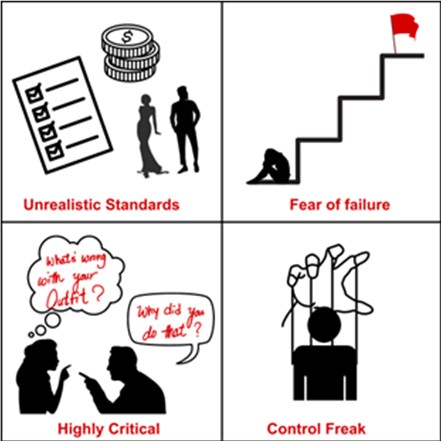
As perfectionists, we may often carry an invisible burden into our romantic relationships. This manifests in various ways such as having unrealistic standards. Sometimes we meticulously curate the ideal partner, convinced they must align with our rigid checklists. But reality rarely matches our fantasies, leaving us perpetually dissatisfied. The fear of failure can also weigh heavily on us. The mere thought of falling short or being rejected paralyzes us. We may withdraw, overthink every move, or demand constant reassurance – all in the name of self-protection.
Furthermore, our inner critic is often ruthless, and we may become highly self-critical. We may even project this critical mindset onto our partners, engaging in constant analysis and judgment. For example, a perfectionist partner may endlessly nitpick their significant other’s behavior, criticizing their communication style, their house-keeping habits, or the way they are dressed. Some perfectionists may also exhibit a strong rigidity in their thoughts and values, leading them to try and control their partners. The need to micromanage every aspect of the relationship robs both individuals of autonomy, and this constant overthinking and controlling may erode the trust and intimacy in the relationship while depriving both partners of freedom essential for a healthy partnership. This control-based approach stifles growth and breeds resentment.
The trap of dating perfectionism
So now that we recognize ourselves and the signs of dating with perfectionism. But how exactly does this mindset mess with our love lives and mental health?
Perfectionists tend to seek relentless control and may try to have everything perfectly aligned in their dating life. This preoccupation with order and control may stem from a deep-seated fear of uncertainty, vulnerability, and the unknown. We think that if we can plan every little detail, we can avoid potential disappointment or failure.
But here’s the thing – relationships can be inherently messy and unpredictable and require a delicate balance of compromise or giving in. When we try to orchestrate every step, we end up suffocating a relationship’s natural flow and evolution.
The perfectionist’s relentless pursuit of control can lead to a number of issues in dating:
- Unrealistic expectations: We may set the bar for our partners and relationships too high that it becomes virtually impossible to meet the standards. This can lead to constant disappointment and a never-ending cycle of dissatisfaction.
- Fear of intimacy: We may avoid deep emotional connections out of a fear of vulnerability and the possibility of being hurt. We may prioritize maintaining an image of perfection over allowing ourselves to be fully seen and known.
- Difficulty navigating conflict: When conflicts or challenges arise in a relationship, we may struggle to approach them with flexibility and problem-solving skills. Instead, we sometimes may get defensive, point fingers, and refuse to compromise. We may also engage in unproductive ‘point scoring’ rather than focusing on finding a mutually agreeable solution.
- Micromanaging behaviors: We may try to control every tiny little detail of a relationship, from scheduling dates to dictating how our partner should behave. This can suffocate the relationship and leave little room for spontaneity and mutual growth. Relationships need space to breathe.
- Burnout and resentment: The constant striving for perfection can be emotionally and mentally exhausting, leaving us feeling drained, disillusioned, and ready to throw in the dating towel for good.
Overcoming Perfectionist Tendencies
The good news is that there are ways to break free from any of your perfectionist tendencies and build more fulfilling connections.
In counselling, we can have the space to unpack the thoughts and behaviors fuelling your need for flawlessness. Counselling can be a powerful and game-changing tool, empowering you to approach your relationships more flexibly and adaptability. We may often dive deeper behind the unending quest for perfectionism. Through this process, you can cultivate genuine self-acceptance and bring more compassion to the table. A study by Rice and colleagues (2014) found that people who are super critical perfectionists towards themselves tend to be less satisfied in their relationships and have more conflict. Through acknowledging and addressing those perfectionist tendencies, you can start developing a healthier, more balanced approach to dating and relationships.
Some key strategies we may explore in the counselling process include:
- Challenging your unrealistic expectations: We work together to identify and reframe any sky-high standards you have for yourself and potential partners, embracing more realistic, adaptable goals.
- Embracing vulnerability: We practice letting go of the need for control and allowing ourselves to be emotionally vulnerable with a partner. This may involve slowly opening up about your fears, insecurities, and desires for the relationship. It can be challenging, and the counselling setting is specifically constructed to support this journey.
- Developing conflict resolution skills: This technique can allow us to learn healthy communication and conflict resolution techniques that prioritize mutual understanding, compromise, and problem-solving over rigid adherence to our perspective.
- Practicing self-compassion: By cultivating self-acceptance and compassion, recognizing that perfection is an unattainable and often harmful goal. And celebrating your growth and progress – even if it’s not “perfect.”
- Experimenting with imperfection: Deliberately engaging in activities or situations where you cannot control the outcome helps you build tolerance for discomfort and resilience. Again, this can take time, but in the long run, it is very valuable.
Beyond the counselling environment, there are other self-help resources and strategies that can help you navigate the challenges of perfectionism in dating beyond the counselling journey:
- Journaling: Regularly write about your thoughts, feelings, and experiences related to dating and your perfectionist tendencies. This can help you gain clarity and self-awareness.
But remember, it only works if you revisit your journals and reflect on your writing.
- Mindfulness practices: Engaging in mindfulness exercises, such as meditation or deep breathing, to cultivate a greater sense of presence and acceptance in the moment rather than being fixated on future outcomes.
- Boundary setting: Learn to set healthy boundaries in your relationships with yourself and your partner’s relationship. This can involve saying no to unreasonable demands or requests that compromise your values and self-respect. For example, you might set a boundary around the amount of time you’re willing to spend on dating apps or the types of behaviour you’re willing to tolerate from a partner.
- Seek supportive connections: Surround yourself with friends, family, or support groups who can provide a compassionate and non-judgmental space to explore your perfectionist tendencies and their impact on your dating life.
Remember, overcoming perfectionism in dating is a process, and being patient and kind to yourself. By cultivating self-respect and embracing imperfections, you can build a healthy dating mindset.
About the author:
This blog was written by DURA Hema, who is a summer intern at Red Door Counselling in 2024. She has recently completed her Master’s in Counselling. Her areas of interest include helping individuals make sense of their relationships with themselves and their partners, addressing perfectionism, and managing academic stress, especially among young individuals. With a background in psychology and counselling psychology, Hema is a compassionate and trustworthy individual. Her expertise and empathetic approach empower people to navigate the complexities of fostering greater self-awareness and fulfillment.
References:
Stoeber, J., & Otto, K. (2006). Positive conceptions of perfectionism: Approaches, evidence, challenges. Personality and Social Psychology Review, 10(4), 295-319.
– This review article discusses research showing that perfectionism is associated with lower relationship satisfaction. The authors explain that perfectionist tendencies can lead to setting unrealistic standards for partners, difficulty being vulnerable and intimate, and challenges in maintaining healthy, fulfilling relationships.
Macneil, C. A., & Hasty, M. K. (2005). Perfectionism and interpersonal problems. Behaviour Change, 22(2), 77-89.
– The researchers determined that perfectionistic tendencies, such as high personal standards and concern over mistakes , including excessive need for control, were linked to experiencing more interpersonal difficulties and relationship problems.
Shea, A. J., Slaney, R. B., & Rice, K. G. (2006). Perfectionism, impulsiveness, and adaptive/maladaptive tendencies in college students. The Psychology Record, 56(4), 559-574.
– This study demonstrated that maladaptive perfectionism, characterized by excessive self-criticism and concerns about mistakes, negatively impacted the quality and satisfaction of romantic relationships
– Maladaptive perfectionism, including setting unrealistically high standards, was linked to lower relationship satisfaction.
Haring, M., Hewitt, P. L., & Flett, G. L. (2003). Perfectionism, coping, and quality of intimate relationships. Journal of Marriage and Family, 65(1), 143-158.
– This study found that perfectionism, especially socially prescribed perfectionism, was linked to poorer conflict resolution and relationship quality.
Sherry, S. B., Hewitt, P. L., Flett, G. L., & Harvey, M. (2003). Perfectionism dimensions, perfectionistic attitudes, dependent attitudes, and depression in psychiatric patients and university students. Journal of Counseling Psychology, 50(3), 373-386.
– This study showed that maladaptive perfectionism was linked to higher levels of burnout, resentment, and depressive symptoms.
Rice, K. G., & Mirzadeh, S. A. (2000). Perfectionism, attachment, and adjustment. Journal of Counseling Psychology, 47(2), 238-250.
– This study revealed that perfectionists tend to have insecure attachment styles, which can contribute to relationship difficulties, such as fear of intimacy and difficulty trusting their partners.
Become a groupie: the benefits of group therapy.

Group therapy is occasionally offered as an adjunct to, or even instead of, individual therapy. Its worth trying it out.
I’ve been counselling individuals going through divorce for the past 8 years. Even for those clients seeking individual counselling, I often recommend that they join our therapeutic support group – the Iron Fairies – so that they can also get the benefit of group therapy. Individual therapy helps the individual understand their own patterns, deal with their ex-partner, self-soothe, as well as plan their personalised pathway forward. Group therapy is different. Being surrounded by others going through the process at the same time has added benefits. Group therapy helps.
I have asked members of the Iron Fairies to add their voices to this blog to help others better understand the benefit of being in the group.
The end of Isolation, and shame.
One important aspect is the end of isolation when you are going through a challenge. No matter if you are willing to consider group therapy to support you whilst you are going through divorce, overcome OCD, start sobriety or stay sober, or overcome childhood trauma, you will feel less isolated about your experience. When you meet others have walked the same road as you, even if their paths may differ from yours, you will feel more comforted.
There is stigma and shame associated with overcoming challenges. In group those feelings of shame fade away.
A few of our Iron Fairies members commented on how they felt about joining group:
“The group made me feel less alone, at a time when I didn’t know if my friends were able to support me during the breakdown of my marriage. The sense of grief and shock was enormous and the group was the first step to confronting my feelings.” SA
“Being a part of this group, which I would actually call a family, has made me feel 100% supported”. RA
“When I was going through my separation and divorce, I felt ashamed and alone. It felt as if no one else would understand the pain, the anger, the frustration. Meeting a group of women who were going through their own traumas made me see that I was not alone, and that together we could find strength to get through it.” SM
Gain important insights
At group, you can learn more about yourself and the challenge you are facing. Many psychological stressors have common key components, or require regular considerations/interventions, and it is helpful to learn about the process from those who have been there.
For example, alcohol cessation programmes not only help people see that their excuses to continue drinking are common to many of the people struggling to overcome substance misuse, they help individuals get through the minutes, hours, and days that they struggle with feelings of addition.
At Iron Fairies, individuals learn a lot from their process of divorce from their Iron Fairy sisters – including how to overcome common co-parenting challenges, building better boundaries with their exes as well as working collaboratively with your legal support system.
Some of our Iron Fairies have views on gaining important information:
“Going through divorce in HK is tough. Many women come to HK as trailing spouses and have been quietly forgotten in the background. When they suddenly find themselves staring divorce in the face, the panic about how to survive financially, what they will do for income, where they will live, what will happen to their children… is like a bomb going off right in front of them” . SM
“I feel that the legal system for divorce in Hong Kong is quite hands-off and women are often left in the dark, at the mercy of their former spouses. I would not want any other woman to go through the roller coaster of emotions that I went through, so I continue to help and support other women who are going through a divorce.” SA
Group therapy helps you feel better.
Psychological research supports that many mental health challenges can be well addressed. Dealing with the emotional rollercoaster experience of divorce, in the company of others can help group members better understand the work, and challenges, that they personally will need to undertake.
Our Iron Fairies definitely seem to feel better because of group:
“I continue to learn a lot from the women in the group about resilience, strength, trust and friendship. I’m happy to be part of something positive and it gives me strength.” SM
“Motherhood and parenting are frequent topics of the group. Almost all members of the group are mothers and we share our parenting struggles as we parent with an ex-partner. I have struggled with co-parenting, criticism from my ex and misogyny at being a divorced mother. What surprised me the most about the group was that all the members in a single session had also experienced the same criticisms and were also unfairly scrutinised. This was probably the biggest surprise to me, even after being in the group for so long.” SA
“Not only has this group shown me support but it has also provided me with a platform to help others in their healing journey. Helping others in this group made me realise I needed to start helping and supporting myself, this was therapy within itself.” RA
Group therapy is not just for you. You can help others.
Not only will you learn about yourself, but your experience could be of significant help to others. One of the beautiful surprises I had as the group therapist has been seeing women who were reluctant to stand up for themselves, encouraging others to be strong and brave. Eventually those cheerleaders-for-others gained sufficient confidence to stand up for themselves. This is one of the magic elements of group therapy.
Our Iron Fairies told us:
“Not only has this group shown me support but it has also provided me with a platform to help others in their healing journey. Helping others in this group made me realise I needed to start helping and supporting myself, this was therapy within itself.” RA
“One of the best parts is definitely the sense of empowerment and camaraderie I feel with the other Iron Fairies. We were all at different stages of our divorce, which allowed us to prepare ourselves for what to expect, and at the same time, support one another. We lifted each other up to become stronger, wiser, and more courageous in going through our respective processes.” BC
Group is open to invitations.
Unlike individual therapy, an effective group is something you can bring others, in the same situation, along to join. Many of our Iron Fairies were introduced to the group by another Iron Fairy. The group is a sisterhood, of women experiencing different stages of divorce, but supporting each other.
We asked our Iron Fairies, if they had recommended group to a friend:
“The Iron Fairies group is ‘the’ divorce support group for anyone thinking about or going through a divorce. Many of us have remained in the group to help others as well, so it is definitely a very worthwhile support group to be a part of, and to feel proud of. Again, kudos to Angela, and of course every member of the Iron Fairies for their sharing and encouragement.” BC
“I have recommended this group to others because Angela is spot on with her insights and the collective support and knowledge of the group really can help ladies who are in this predicament.” BM
“Group” is its own form of magic.
As a qualified and experienced counsellor and psychologist, I believe that group therapy offers something that individual therapy cannot. It is great to feel supported, understood by others who experience similar pain and challenges, all whilst being gentle pushed to better yourself and your situation. The members of Iron Fairies describe the group as a sisterhood, and it certainly feels like a friendly, supportive family.
One Iron Fairy, SM, sums up that for her group therapy actually started to make change possible again:
“My previous experience with “therapy” had been less than positive – I had no trust in the previous process so was somewhat skeptical about what it would bring. But I also realised that without trying therapy I had no other outlet to try to work through my problems. When I joined the Iron Fairies, my biggest surprise was to see a few people who I knew personally sitting in the same room, with similar problems, and I had had no idea they were going through this. This spoke volumes to me about how so many people go through this, put on a brave face, and are quietly dying inside. I knew then that I wanted to heal myself, and help heal others.” SM
If individual therapy isn’t your thing, or you want to add another dimension to your therapeutic journey, consider joining a therapy group. I will be writing more about the types of therapy groups that are available in Hong Kong soon. In the meantime, if you have queries about the Iron Fairies, or want to gain information about other therapy groups that exist in Hong Kong, drop me a line at Angelaw@reddoor.hk. Be well, get in the group.
_________________________
About the author: Angela Watkins is a qualified counsellor and psychologist who has run the Iron Fairies -a therapeutic support group for women going through divorce in Hong Kong since 2017.
Going through a relationship breakdown, separation or divorce can be one of the most emotionally challenging times of your life.
Whether you are leaving a difficult marriage or have simply agreed to part ways, the impact on your mental and physical wellbeing can be overwhelming at times. It should not be underestimated or ignored.
We understand that it can be an extremely isolating time and you need to talk with people about the fragile circumstances in which you find yourself. Support groups provide a safe and confidential space for people to speak openly about their feelings, without any judgement. Attending these groups can help reduce the isolation and loneliness created by divorce.
RED DOOR has been running the IRON FAIRIES – an English language therapeutic support group for women going through divorce for the past 7 years. The group is run in-person twice a month at our office in Central. For more information contact Angela at angelaw@reddoor.hk
Additionally, the Iron Fairies also has a WhatsApp group for people who have attended group in person.
When you come to Iron Fairies you are asked to bring HKD300 cash for the session. If you don’t come, you don’t pay.
Additionally, the Iron Fairies also has a WhatsApp group for people who have attended group in person. You cannot join the WhatsApp until you have meet Angela in person or come to one group in person.
| The IRON FAIRIES is a therapeutic group for women going through divorce. The group meets in person fortnightly on Monday nights 6:30-8pm at the office of RED DOOR in Central. The meetings are held on Monday nights and run from 6:30pm to 8pm. The meetings are held within the offices of RED DOOR Counselling. The address is Unit 301, 3rd Floor, SunWise Building, 112-114 Wellington Street, Central. Upcoming meeting dates: |
| 12 August 2024 – 6:30 to 8pm |
| 9 September 2024 – 6:30 to 8pm |
| 23 September 2024 – 6:30 to 8pm |
| 14 October 2024 – 6:30 to 8pm |
| 28 October 2024 – 6:30 to 8pm 11 November 2024 – 6:30 to 8pm 25 November 2024 – 6:30 to 8pm 9 December 2024 – 6:30-8pm |
Should you stay, or should you leave?

If you are experiencing challenges in your relationship, you may ask yourself, ” Should we split up?”
In essence, the decision to end a relationship is up to the people involved in that relationship. In a relationship involving two people, both people have the right to decide if a relationship is over. It takes two committed people to continue a relationship, but only one, wanting to leave, to end it.
If you are wondering if a relationship is, or should be over, here are some considerations you might like to think about:
1. What is the level of legal commitment attached to your relationship?

Is your relationship a casual relationship, a long-term commitment, or a marriage? Do you have children together? Do you have shared assets such a property together?
When you are married, or have shared assets, there is a legal element that needs to be considered when contemplating the ending of your relationship?
Whilst friends may give you advice in these situations, I strongly advise you to seek legal advice on matters that have legal consequences. It may not, in the long run, change your decision to stay or leave, but it help the conditions around which you agree to stay, or the planning around how or when you might leave.
2. Are both parties equally committed to the relationship?
Quiet quitting is not just a workplace phenomena. Is one person in your relationship demonstrating lack of interest in the relationship? Have you asked your partner if they can step up their level of commitment within your relationship, only to be pawned off with a weak, “Ill try” empty promise?

Do you believe that the level of commitment that you request from your relationship is a fair expectation? How about your partner, do they agree that your request is, in principle, a fair request?
As a counsellor I have seen many couples who struggle with unmet expectations, from how often each partner will look after children, to how many phone calls a week you can expect when your partner is travelling for work, for example. When you have a mismatched expectations, you may need some support to help navigate the negotiation.
If you have a partner who is not willing to commit to a level of attention within the relationship, and maybe you need to recognised that this is now your reality and address that this may not change. If your partner does not engage in the relationship as you would like, you have to decide will you settle for less than you’d like, or would it be helpful to end this relationship so that you can, in time, find a relationship that meets your expectations? Do you deserve better that you are getting? Are you hanging on in hope that things will change, when signs indicate that change is not coming? is the relationship over, but just not yet, finished? Could it be revitalized, and if so, could you consider help to explore how to make such changes possible? Continuing to have the same argument over commitment probably needs external help to resolve.
3. Is your relationship a habit rather than a partnership?

It is worth while considering if your relationship has become a habit, rather than a partnership with shared goals. Do you and your partner have time dedicated to being together, or do you operate more like friends or flatmates, simply coexisting with individual lives.
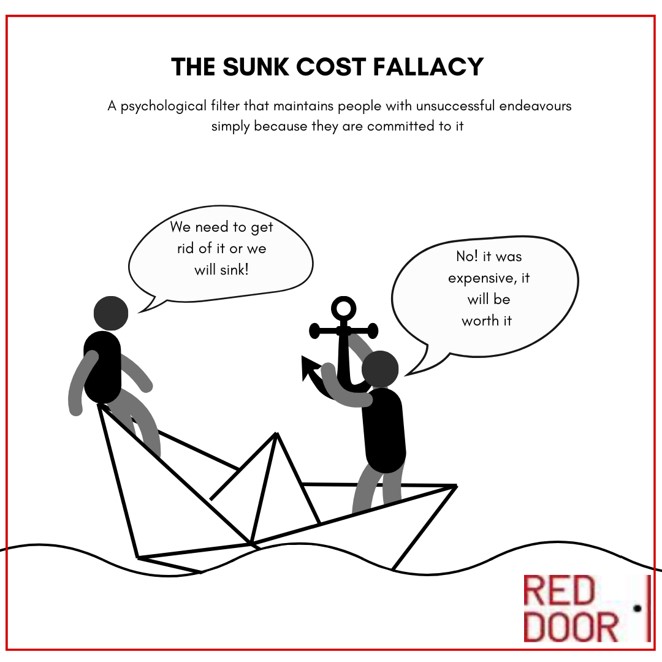
If that is the case, as yourself is this the type of relationship you think you want. Individuals stay in relationships simply because they have already invested years in that relationship. This viewpoint is often referred to as the sunk cost fallacy. The sunk cost fallacy is a psychological filter that maintains people within unsuccessful endeavors simply because they’ve committed resources (often time or money) to it. This ignores the understanding that things will not change by magic, especially in relationships.
An unsatisfactory relationship will remain unsatisfactory unless something significant changes. Normally that type of change involves couples counselling.
4. Is your relationship safe?

People can find it hard to leave unsafe relationships. Relationships where coercion, aggression, or manipulation are key elements are unsafe for one, maybe both, parties. Its difficult to face the reality that you have ended up in a situation that you may find shameful. What is worse is to stay in a relationship where your physical or psychological safety is threatened any longer than you have already. If you are willing keep a track of all instances where you have not felt safe, and share these details with someone you trust. Talk to friends, or a professional, about your experiences.
I would ask you to consider the question, “Would you be more safe outside of this relationship, living on your own, when compared to what your life is like in the relationship in the past 6 months?” If the answer to that question is yes, then you might want to think about taking a pause in your relationship so that you can have some time to reflect on this question, your safety, and your future.
5. Is your relationship healthy?

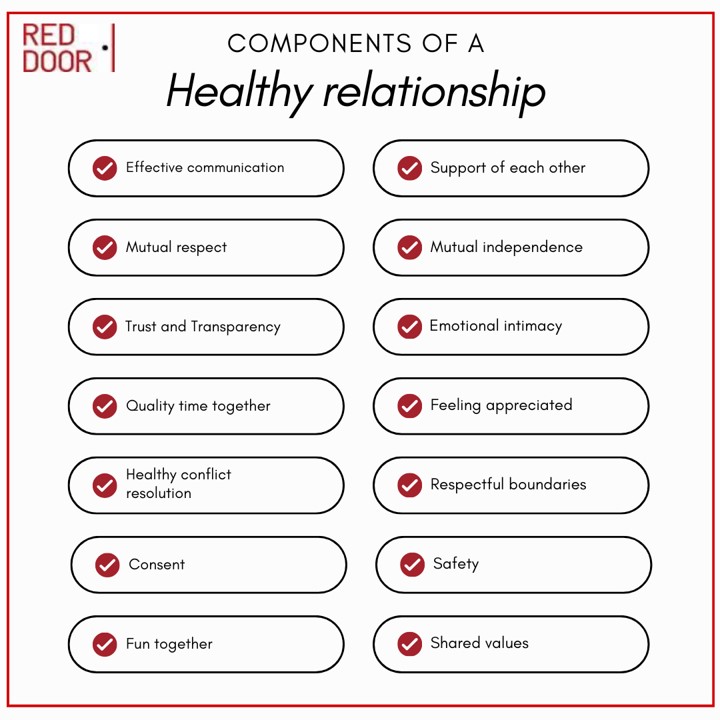
Most individuals have their own point of view regarding what constitutes a healthy relationship. It is worth taking a few minutes to write down what practices you believe are essential within a healthy relationship. Any relationship, not just your own. Think about the relationships you have experience of – your parents relationships, the relationships that you witness with your best friends.
Take this list and look at your own relationship. How does your relationship measure up? Are the areas where you score your relationship unfavorably, possible to change? With or without help? Whilst a relationship that doesn’t meet a checklist on healthy criteria is not necessarily a sign to call it quits, your audit can help you decide what needs to change in order for your relationship to be worthy of you staying.
6. Are you staying for someone else?
Sometimes a marriage is over, long before it is finished. Many couples stay together for the sake of the kids, not for their own individual satisfaction. If this is the state of your marriage, you are not alone. Some commentators in the divorce advisory space estimate that at least one in three marriage continues for the sake of the children.
If this describes you, have you contemplated what the alternative would look like? Have you sought advice on what a divorce or split could look like in terms of assets and expectations? Are you ready for a split once your child reaches the age of 18, or is the decision to stay for the kids, simply you avoiding the question of marital split in general?
7. Are you afraid to be alone?
I run a special support group for women going through divorce, the Iron Fairies. I fondly remember the words of one Iron Fairy about the topic of loneliness:
“I was so frightened to leave my marriage because I was scared of being alone. What I didn’t realise at the time is that I was alone in my marriage. No body came and sought me out. I may now be single, but I so much less lonely than I was in my unhappy marriage.”
We hold onto certain fears and stereotypes of what relationship split might look like. Shame. Forecast images of being destitute. This is not often the case. What I’ve learnt from years of working with women going through divorce is that many of them are often much happier once their divorce is complete. Much more than they expected at the outset.
Don’t stay in a relationship because you are afraid to be alone. You can work to build a network and support. Things can be better.
The decision to stay, or leave a relationship is deeply personal. Only you can decide. But also acknowledge if this is a decision you are avoiding, at cost to yourself and your future.
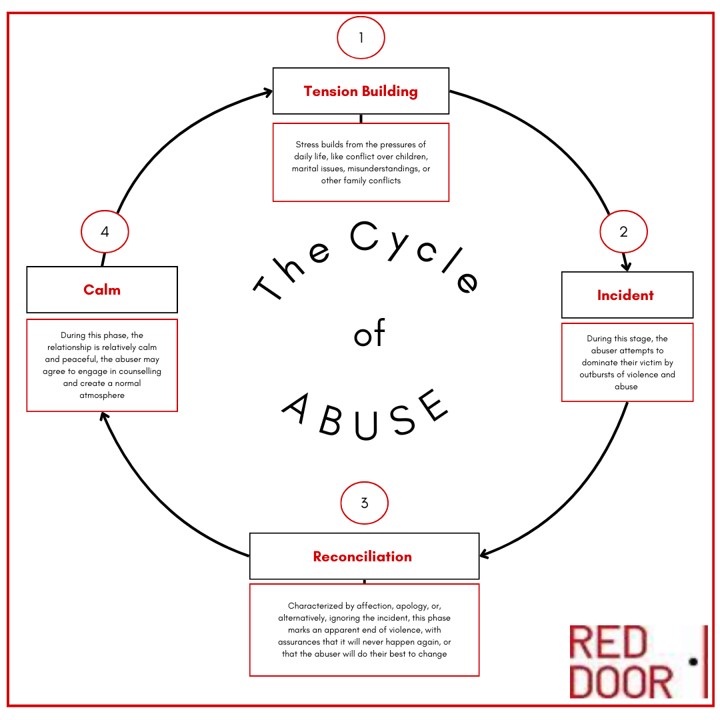
#relationships #relationshipbreakup #cycleofabuse #sunkcostfallacy #marriagebreakup #marriagerules #relationshipcommittment #breakup #leavingarelationship #leavingamarriage
About the author: Angela Watkins is a counsellor working out of RED DOOR Counselling Hong Kong. Angela is a couples’ counsellor as well as counsellor of individuals.
Small changes, big impact.

You might be surprised by the positive impact of a few small changes, or exercises, and how they may generate changes in how you react to the world, and therefore your mental health.
Sleep
When a new client comes in for a session, one of the first questions I might ask them is, “How are you sleeping?”
We each need 8-10 hours of sleep a night but few of us get that amount. Sometimes people brag about only needing 5 hours a night. Paradoxically these people are often snappy with colleagues. That is not a coincidence. To be able to be calm, we need to be well rested.
Sleep debt is a key ingredient of burnout. Burnout is a condition characterised by feelings of exhaustion or depletion, negative affect towards one’s job and feelings of dissociation.
Luckily the human species can catch up their individual sleep debt at the weekend, but this burnout-crash out cycle is not good for your health in the longer term.
Breathe
The implementation of calming breath techniques can help us calm down in the early steps of anxiety.
I personally use box breathing/ 4 Square techniques myself and with clients when I see their anxiety build up in session.
Regular use of breathing techniques won’t erase your anxiety, but it will help, in the short term, to elevate some the symptomology. That way each individual incident when you feel anxious, might be better managed.
Talk
Possibly you’ve heard “you should talk to someone”, and maybe you should. Thoughts expressed verbally create different reactions than those maintained inside the privacy of your head. When you feel overwhelmed reach out to a friend, colleague or professional to talk. People can’t know what you don’t communicate so share your experiences, the good and the difficult. People would rather give you a hour of their time, than have you suffer in silence.
Obviously, I am a big believer in the benefits of counselling (also referred to as talk therapy). Research also supports counselling with all types of populations – from stressed out professionals, to youth, to older people, to couples in conflict. Client – therapist rapport; how well the two-perspective work together, is essential for the best results.
So, if you have a negative experience with a counsellor in the past, consider that it was maybe simply a therapist – client mismatch rather than a testimony if counselling will work for you or not in the long term.
Focus on what matters
In an era of Instagram, you may find yourself comparing yourself to others, constantly building a larger and larger “to do list of things you believe you ‘should’ be doing in your life. .
Let’s try the opposite. By learning about your key values and what matters most to you can ‘let go’ of all the superfluous “to do”s that you’ve written in your life.
In counselling we use values checklist to start a discussion about who you are use family exercises to help you identify your key life goals as well as what you want or need to avoid. You can do some of the work yourself reading some coaching focused webpages, or talking with a counsellor.
Once you know what matters, can identify what attractions are really just ‘noise’ and have a stricter road map of who you are and want to be you will feel more able to prioritize your time more effectively. In counselling we use a few techniques to help refine what you want, from what is really essential for you to achieve. Sorting the ‘wants’ from the ‘musts’, helps people prioritise their time and energy.
Habits
Small habits soon accumulate into meaningful behaviours change. If you start a small habit change today, or even a medium habit, and keep at it you can accomplish great change in your life.
As derailed in the famous James Clear book. “Atomic habits”, the compounding effect of small chapters are amazing.
One technique I use frequently in counselling is “don’t break the thread.” Once you have decided on a small change imagine yourself add up a bead to a thread/string. Every day you add a bead to the thread and don’t break the thread. Otherwise, you need to start collecting beads from zero again.
This counting behaviour is the basis of many sober apps (e.g. I am sober) help you track a number of cessation behavioural changes.
How long does it take to form a habit. When we discuss this in counselling sessions, I recommend you plan for 3 months, or 100 days for real change to occur. You will truly feel different than if you only tackle one month of change.
Gain flexibility
The greatest small change you can help yourself with is to start training yourself towards greater cognitive flexibility.

Cognitive flexibility describes the ability to adjust your thinking to view and interpret situation from different perspectives. When we are inflexible, even rigid, we tend to construe situations as black and white, right and wrong, perfect or unacceptable. .
Being flexible is different from overthinking or second guessing a situation.
When we are working to be flexible, we first need to understand that in every situation we are telling ourselves a narrative. It is helpful for you to consider starting the description of any situation with the phrase, “the story I am telling myself” so that you can better appreciate that you are indeed, telling yourself a story.
Our personal narratives have significant power. When we continuously tell ourselves, ”You are stupid”, or, “You are not as good as other people” we poison our hope in ourselves. When you start to listen the narrative of your inner voice you may be surprised by how harsh that voice actually is. You have probably spent years allowing this inner critic to hold court, and pass down judgement within your head. You deserve the chance to set yourself free from your inner tyrant.
Some people might swing between feelings of superiority and inadequacy. This experience of pendulum self-esteem is unhealthy. You are not the best, or the worst. Accepting that you have strengths, and weaknesses, and are still ENOUGH, is freeing.
A key component of being cognitively flexible is to understand that you will understand that you may feel differently about a given situation, when you look at it from different perspectives.
For example, you could be urgent about on incident that happened today at work/ school. If I and you, “Will this indecent still upset you in a year?”, you may automatically start to perceive the importance of such an incident differently. Suddenly you are reminded that the humiliation or anger that you feel today will not last.
There are a number of questions that help build cognitive flexibility. You don’t have to talk through these questions with anyone else, but it can be helpful if you are open to exploring how tightly you hold onto certain narratives rather than exploring different perspectives.. Counsellors who focus on building cognitive flexibility may ask you some of the questions below.
A few questions that build cognitive flexibility.
- What would “winning look like in this situation?
- Will this situation incident be as important in a month?
- If you had more self-compassion, could you approach this situation differently?
- Is it possible you are over reacting in this situation?
Sometimes we have too many thoughts and we need to think less. As is the case with overthinking. A specific type of overthinking is rabbit warren thinking. In this situation, you fall from are “what if” catastrophic chasm to another. People who are guard at risk mitigation in their day jobs are often very good, and well trained, to develop this type of thinking. A type of thinking that might be helpful in one circumstance, can be problematic in another.
Sometimes when we have too many “what if” questions we need to find a way to think less. In order, to do this I work with clients to remind them to have the confidence that they CAN respond almost every situation. Therefore, you don’t need to constantly worry about identifying the situations in advance. Sometimes we can navigate our way to calm from wherever we land, we just need to have the confidence in ourselves to respond constructively.
Instead of worrying, “What if?”, you can simply tell yourself, “No matter what, I can respond”
Write
When is doubt, write. In am a strong proponent of journalling. I recommend journals with prompts over simply writing an account of your day.
Prompted journals provide a pathway to a deeper understanding of yourself. When we write out our thoughts, we give our brains that opportunity to see our thoughts on paper. This distance allows us the chance to utilise perspective building exercises.
Responding to prompts is a great method to help us build greater cognitive flexibility around incidents in our lives. Sometimes it helps to look at events that have hurt us, in challenging ways. Perhaps even find what we learnt from such situations. This doesn’t mean that we weren’t hurt, or that others have not been careless with our feelings, but also empowers us to take charge of the outcome of situations.
I hope you can consider to take up a challenge, to highlight one or two of these small changes. I promise you, it will have a big impact on your mental health.
—–
Note: part of this content was previously shared as a speech at an event for the the musicians foundation in March 2024.
#change #habits #sleep #creatingcalm #counselling #counseling #talktosomeone #valueschecklist #cognitiveflexibility #perspective #reflection #journalling
About the author: Angela Watkins is a counsellor and psychologist working with adults and teens. Angela has been named best therapist in Hong Kong. To contact Angela for an appointment email angelaw@reddoor.hk or message +852-93785428.
Finding your PRIDE

We’re about to embark on Pride month – thirty days to celebrate and commemorate Lesbian, Gay, Bisexual, Transgender and Queer (LGBTQ+) people, to recognise the impact LGBTQ+ people have had on history and culture, and to acknowledge the past and ongoing adversity the community faces.
Ok, I get it, let’s celebrate!
But why is this important and what does it have to do with mental health?
Well, consider this – 83% of LBGTQ+ people still hide their sexual orientation.[1]
Yes, societal attitudes towards sexual minorities have improved in the last few decades, and yes, LGBTQ+ visibility and rights have made progress. However, studies show that LGBTQ+ individuals, and especially LGBTQ+ youth, still face disproportionate mental health burdens with significantly higher rates of depression, anxiety, and suicidality. This isn’t because these individuals are inherently prone to poor mental health, but because LGBTQ+ people tend to have lower rates of self-acceptance and experience the effects of minority stress.
Minority stress is the chronic social stress that LGBTQ+ people are exposed to day-in-day-out, ranging from prejudice to negative stereotyping, hostility, harassment, rejection, limited rights from laws and policies, stigma, internalised homophobia – the list is long.
All these micro-aggressions mean something, they build and chip away at our self-esteem, our wellbeing, and positive development. This societal stigma, discrimination, and rejection from family and friends contributes to lower rates of self-acceptance amongst LGBTQ+ people, and in turn leads to higher rates of depression, anxiety, suicidality, and substance abuse in the community.
The Rainbow Reality
With these societal challenges, it’s not surprising that the vast majority of LGBTQ+ people are still hiding. However, living a hidden life and concealing one’s true identity is significantly associated with depression and negative psychological wellbeing.
So how do we reconcile with our identity and overcome the shame? How do we manage the stress of living in a society that often doesn’t accept or validate our identities, as well as the trauma of discrimination, bullying, harassment, and violence, plus the potential lack of support and acceptance from family and peers?
Where to Begin?
Changing societal norms is hard, although so many people are doing incredible work to improve equality. Putting this aside, we are able to create change within ourselves and we are in control of the way we understand and respond to our world.
The challenges that LGBTQ+ people face can lead to feelings of isolation, discrimination, rejection, shame, and low self-esteem. Exploring these thoughts and feelings about your identity can be difficult and uncomfortable. That’s where counselling can help, providing a safe space to do the hard work, with empathy and encouragement.
A counsellor can help you challenge your negative thoughts about your sexuality and instead engage in affirmation of your identity, visibility, and validation of your experiences. Evidence-based approaches such as cognitive-behavioural therapy (CBT) can help shift problematic thought patterns, and teach coping skills or alternative ways to think, behave, and react to situations and experiences.
The Road to Self-Acceptance
Regardless of sexual identity, mental wellbeing improves when we feel respected, valued and psychologically safe. Self-acceptance is the act of acknowledging who you are, in all your fabulous and flawed glory. It is an essential part of living a fulfilling life.
Sadly, research shows lower rates of self-acceptance among LGBTQ+ people. Importantly, low self-esteem is unlikely to blame for this lower rate of self-acceptance among LGBTQ+ people. Instead, the adverse opinions, prejudice, and victimization that many LGBTQ+ people face is what poses significant obstacles to self-acceptance.
It’s challenging to avoid internalizing negative society attitudes and ideas when constantly exposed to negative messaging about queer identity. These internalized messages have the potential to lead to increasing self-criticism and negative self-perceptions over time. Our individual lack of self-acceptance is ultimately caused by this social lack of acceptance.
But where to start?
Learn about the LGBTQ+ community, its history, and the challenges still being faced. There is culture and connection waiting for you. Validate and celebrate your identity and the diversity of the LGBTQ+ community. You belong here.
- Connect with others and build a support system
You are not alone. Find your own LGBTQ+ community, whether through in-person support groups or online. Surround yourself with people who accept you and support you, whether it’s friends, family, or allies. Join in Pride events and affirm your identity.
- Practice self-care and compassion
Be kind to yourself – we are always harder on ourselves and more generous with others. Take care of yourself physically and mentally. Eat well, sleep well, and engage in activities that bring you joy.
- Challenge negative thoughts and your inner critic
When we hear things frequently, we start to believe them. Identify your inner critic – that little voice inside your head that tells you you’re not good enough – and tell it to shut up. Replace negative self-talk with positive affirmations. Try journaling to identify problem patterns, reflect, and express yourself authentically.
- Identify your personal values and goals
Redefine yourself according to your own values. Embrace your authentic self and live your life in a way that feels true to you. Addressing self-blame and shame, affirming your own identity, and validating your experiences fosters self-acceptance and helps develop resilience against past, present, and future adversity.
- Doing the hard work
Don’t kid yourself, none of this is easy. Finding self-acceptance and establishing a positive identity is difficult, but it is a vital source of resilience. Counselling provides a supportive and safe space to explore feelings, process emotions, and develop coping strategies. It can help LGBTQ+ people better understand their sexual orientation and gender identity, and work through experiences of discrimination or rejection. Finding your pride is much deeper than a month on the calendar, true self-acceptance is key to improving mental wellbeing and a happier, healthier life.
So if you or someone you know is struggling with mental health challenges related to their LGBTQ+ identity, consider reaching out to a counsellor for support.
RESOURCES
Support and Spaces
- PrideLine 24hr hotline for LGBTQ+ support: https://prideline.tungwahcsd.org/servers.php?id=2&lang_id=2
- Queer Reads Library: LGBTQ+ mobile library: https://www.instagram.com/queer_reads_library/
- Mum’s Not Home: Queer Cafe in Yau Ma Tei: https://www.instagram.com/mumsnothome/
Communities
- Pink Alliance: https://pinkalliance.hk/
- Out in HK: LGBTQ+ outdoor adventures community: https://www.facebook.com/groups/outinhk
- Rainbow Families HK: https://www.facebook.com/groups/RainbowFamiliesofHK/
Events
- Pink Dot HK annual event (October): https://pinkdothk.com/
- HK Pride Parade (November): https://hkpride.net/
- HK Lesbian & Gay Film Festival (September): http://www.hklgff.hk/
About the author: This blog is written by Fiona Travers. Fiona works with adults, focusing on the following areas in her practice: LGBTQ+ challenges. Grief and bereavement. Fertility issues. Couples counselling.
Fiona is a part-time counsellor at RED DOOR who is currently on sabatical. Fiona’s counselling style is informed by two decades creating values and purpose-led brands in the corporate world. She is passionate about helping individuals build personal resilience and find their own sense of self in the world.
RED DOOR is committed to being a gender affirming and LGBTQ+ supporting practice. Contact the Red Door Reception to set up an appointment with one of our therapists contact reception@reddoor.hk or text 852-93785428.
[1] https://medicine.yale.edu/news-article/the-global-closet-is-hugevast-majority-of-worlds-lesbian-gay-bisexual-population-hide-orientation-ysph-study-finds/