
Welcome to our blog series, Love Matters, where counsellors Angela Watkins and Elizabeth Wu explore the complexities of relationships and love. Both Angela and Liz specialise in helping individuals navigate their romantic lives, with Angela also serving as a practising couples therapist.
Breaking up is never easy. It can evoke a whirlwind of emotions and leave us questioning our choices long after the decision has been made. In this month’s column, we address a topic frequently encountered in therapy—navigating the decision to break up. We explore essential questions that can guide this challenging process:
- How do you know the difference between a rough patch and a fundamental difference in compatibility?
- Should you ever quit a relationship because you’re not happy?
- What’s the difference between quitting and protecting yourself?
- Should you listen to outside opinions about breaking up?
- Can you love someone and still know you need to leave?
- What part does personal growth play in relationship breakups?
Join us as we delve into these questions, unpacking the emotions and considerations involved in ending a relationship. Together, we’ll foster understanding and growth in the wake of love lost, empowering you to make informed decisions that honor your well-being and future.
Question 1 : How do you know the difference between a rough patch and a fundamental difference in compatibility?
Liz:

Firstly it’s important to know that a good relationship does not mean an easy relationship, but it should be worth it to you. As a counsellor working with the Gottman Method, one key finding is that conflict itself is not really an indicator of relationship failure. You can have a lot of perpetual problems, meaning conflicts that never fully resolve, and remain in a deeply loving and committed relationship.
What does predict breakdown is the presence of what Gottman identified as the Four Horsemen: contempt, criticism, defensiveness, and stonewalling. Of these four, contempt is the most dangerous. Contempt means you are no longer engaging with your partner as an equal. You have, in some ways, begun to look down on them or lose respect for them. When contempt enters the relationship, the attack is no longer directed at the behaviour, it’s directed at the person behind it.
For me, a rough patch may involve fighting more than usual because life has placed enormous pressure on the relationship – new parenthood, financial strain, illness, or grief etc. You feel distant. The connection feels thin. But underneath all that turbulence, the element of respect remains. You still fundamentally believe your partner is a good person. You still carry a shared vision for your future, even if that vision is not the clearest right now.
Fundamental incompatibility looks a little different. It lives not in the fights themselves, but in what exists between them, a loneliness that doesn’t lift even when you’re in the same room. It is around your core values, when your beliefs around lifestyle, faith, relocation, parenthood etc. aren’t aligned.
The analogy I would use is a house. So if you have a rough patch, it’s kind of like you’re having a leaky roof or broken aircon. It’s annoying, it’s painful, it’s stressful, but with the right tools and willingness to work on it, you can fix it. But when you have a fundamental incompatibility, it’s when the foundation hasn’t been laid out. So you can renovate the house over and over, but the ground is still unstable.
Angela

Yeah, I love that. I had noted down three kinds of elements that matter in deciding if a situation is a “rough patch” or something more ominous
These are : duration, behaviour, and willingness to address.
Duration refers to how long the rough patch has been ongoing, bearing in mind that love can be reestablished if it was genuine in the first place. This embodies hope—the hope of rekindling what once was.
The behaviour component depends on what is included in the rough patch. For instance, violence is never acceptable. You set the rules that exist in your relationship, determining which rules are important to you. So, let’s say that monogamy is a rule in your relationship, and the rough patch involves a breakdown of that monogamy—that’s significant, as it’s your rule and therefore maybe more of an issue that will influence the longevity of the relationship. .
Then, the willingness to address these issues ties back to the concept you mentioned regarding the Gottman model: problems can exist, and conflict is normal between people in relationships. It is OK, especially if you are willing to talk about it constructively? If you are having difficulties in your relationship right now, are you willing to attend counselling for it? Or does someone in relationship actively avoid the discussion? If they prefer avoidance, I would classify this as a fundamental incompatibility issue because conflict is unlikely to be resolvable.
If you’re unable to discuss issues or have difficult conversations—even in a setting with a counsellor—then it raises questions about the stability of the relationship. Many couples attend counselling precisely because it helps ease the tensions of these discussions. The counsellor can help individuals stay regulated, maintain a respectful communication pattern and pacing for the conversations.
Liz
That is well said: if a core relationship rule hasn’t been broken and both partners are willing to work on the issue (whether through a couples counsellor or through honest talk with each other), and they both share the goal of improving the relationship, then that can be a rough patch.
Angela
You can have differences of opinion, that is normal. But partners still need to be respectful and kind to each other about your differences.
Question 2: Should you ever quit a relationship because you’re not happy?
Angela
I find this question a interesting because being “not happy” is largely a personal matter. I believe that you shouldn’t rely solely on your relationship for happiness. In fact, I strongly advocate for being comfortable and content while single as a prerequisite for entering a relationship in the first place. If you are not happy outside of a relationship, it’s likely that you won’t be happy within one either. This situation might indicate that there’s personal work you need to address in your life to overcome what is causing your unhappiness.
When couples come in for counselling, we often conduct individual sessions with each partner. During these sessions, I sometimes hear one partner express that the other is doing everything wrong, which is what the client usually expects us to address. However, the counsellor often redirects the focus to what the individual can do differently in the relationship.
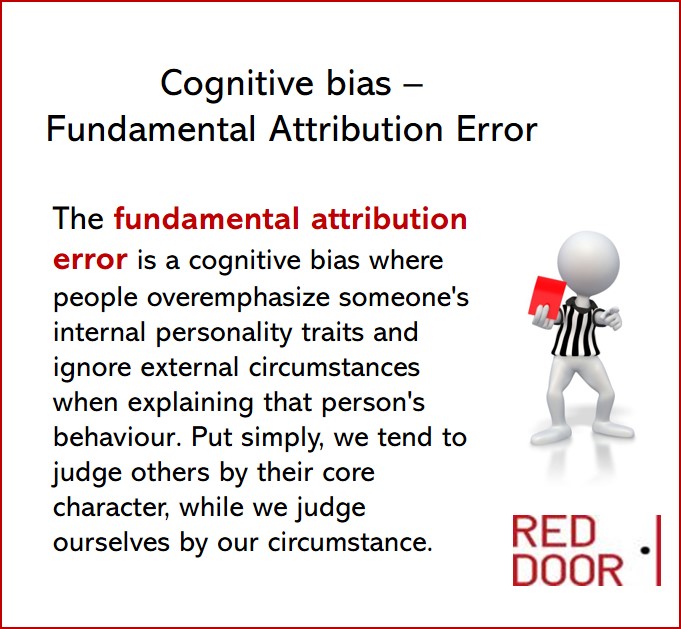
This is the fundamental attribution error: individuals often perceive their own behaviours as a result of external circumstances while blaming others for their actions. For example, someone might justify their frustration by citing a stressful day or bad weather, attributing their behaviour to these external factors. Meanwhile, they may label their partner’s failure to perform a task—like taking out the rubbish—as laziness or negligence. This cognitive distortion creates a skewed perspective in interpersonal relationships, where one partner views themselves as a victim of circumstance while perceiving the other as deliberately at fault.
Thus, when you say you’re not happy and attribute this to your partner’s actions, I hope it is enlightening for you when we discuss what you can change in your own situation.
Liz
These are great points to name. We often see couples arrive in the counselling room cataloguing what the other person is doing wrong. And one of the questions I like to ask is “What are you willing to do for the relationship that will help the both of you today?” Because it is never just about what the other person is doing, it takes two people to create the patterns we find ourselves in.
I think nowadays maybe because of modern media, sometimes we can place an almost impossible expectation on our partners – we want them to be our best friend, our passionate lover, our intellectual equal, our co-parent, our therapist, and our travel buddy, all at once. And when they inevitably fall short of that standard, we begin to wonder if we’ve chosen the wrong person.
So when it comes to considering whether you should leave because you’re not happy, I think a more apt question you can ask yourself is this: Am I unhappy in this relationship or am I unhappy in my life? Those are two different problems with two very different solutions. If you’re struggling with depression, anxiety, or unresolved trauma, leaving the relationship may not bring the relief you are seeking, you will simply carry that unhappiness into your next relationship. Ask yourself these honest questions before you act. Maybe the relationship needs to end, but also make sure you are solving the right problem.
Angela
I think another point to consider is the idea that our romantic relationships should fulfill multiple roles—like being our best friend, our sexual partner, and so on. This expectation is actually a very modern concept of relationships. Historically, relationships have evolved significantly, particularly in the wake of women’s liberation, which is a positive development. However, with this evolution has come an expectation for relationships to provide a level of fulfilment that wasn’t necessarily anticipated in the past.
For instance, marriage was often viewed as a type of contract, where each partner had specific roles to play, and the focus was more on functionality than on personal happiness. People didn’t expect to find happiness per se within these arrangements. The modern belief that romance must encompass everything is quite recent, and many individuals struggle because they hold onto this notion.
While I don’t think you shouldn’t desire a fulfilling relationship, it’s essential to recognise this perspective as a modern construct. It may require some realisation that relationships haven’t always functioned this way. This is a vision we aspire to create, but achieving it may require considerable effort.
Question 3: What’s the difference between quitting and protecting yourself?
Liz
I don’t like the word quitting “quitting” because it carries a feeling of shame around it. It implies failure, weakness, giving up while the mainstream romantic narratives centre around those who stayed and fought, the ones that endured. And while there is something beautiful about that commitment, the same narrative can be seen as a cage for people who should have left already. Speaking to people who ended up remaining, the answer has been not wanting to be seen as “the person that gave up”.
At the other end of that spectrum are people who leave at the very first sign of real intimacy or conflict, because closeness itself feels threatening. For those with avoidant attachment tendencies, real vulnerability can read as danger, and exit can be seen as protection, which in a way is self-sabotage. It’s that person that leaves just as the relationship is getting real.
How can you know what you’re doing? A question you can ask yourself is “Am I leaving because I am afraid of what this relationship is asking of me or am I leaving because this relationship is asking me to betray who I am”. One is out of fear, and one is out of wisdom.
If you have minimized who you are in order to keep the peace, no longer recognizing yourself, then that is beyond a rough patch. Emotional and psychological abuse are harder to identify than physical abuse, but they are no less damaging to the self.
If someone is undermining your sense of reality, isolating you from those that care for you, and using shame or fear to control your behaviour, then leaving is not quitting, but rather an act of survival.
I also want to mention something more subtle: for the person who is in a relationship that is not abusive, but that has over time asked them to betray their deepest needs, their voice or their sense of themselves. That is also worth protecting yourself from. That decision is worth being made without guilt. Sometimes love can be real, but it is not enough to build a life on.
Angela
I also have an issue with the word “quitting.” It implies something negative, but in reality, we’re simply trying to see what fits in a relationship. Especially as we evolve our concepts of relationships, why not adopt a “try before you buy” mentality? I dislike the term “quitting” because it suggests that you must be wholly committed. Of course, there are legal contracts like marriage that create different dynamics, but in non-marriage situations, it’s perfectly acceptable for things to not suit you anymore. It’s okay to leave a relationship if it doesn’t work for you.
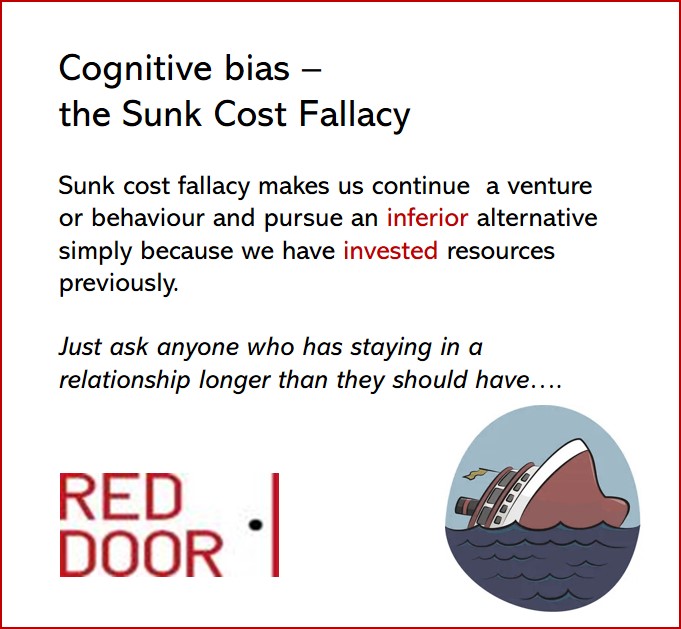
Another cognitive distortion relevant to relationships is the sunk cost fallacy. People tend to stay in relationships simply because they have invested time in them, hoping that things will somehow improve. We see this behaviour reflected in the investment world, where individuals hesitate to sell a plummeting stock because they don’t want to acknowledge their losses. However, the loss is already there. Similarly, remaining in a relationship for an unduly long time isn’t beneficial if it doesn’t genuinely support your personal growth.
When I say “benefit,” I refer to personal development rather than financial gain. Protecting yourself in a relationship can be challenging, as part of it involves vulnerability. The key question is whether someone else is overstepping a boundary. This concern naturally transitions us to the next topic: the relevance of outside opinions. If you’re apprehensive about protecting yourself, considering external perspectives can be helpful. However, you must be mindful of the sources of those opinions.
Question 4 : Should you listen to outside opinions about breaking up?
Angela
When it comes to outside opinions, I believe it’s important to consider three factors: who, how many, and what.
Who refers to the person you’re asking. For instance, when couples come into counselling, one partner may feel manipulated by the other. As a counsellor, part of my role is to discern how much of that manipulation is genuine versus how much is perceived or internally constructed based on the narratives they tell themselves. Our primary goal is to protect individuals in these relationships and ensure that the relationship is healthy, fostering a safe, warm, and rewarding environment for both partners.
Next, there’s how many people you ask. If ten people tell you your partner is “bad news,” it’s worth paying attention—this is a considerable amount of feedback. However, it’s crucial to consider what they are saying and the context of their concerns. For example, if ten people inform you that your boyfriend cheated on his last girlfriend, it doesn’t automatically mean he will cheat on you. While past behaviour can sometimes be indicative of future actions, it does not guarantee them.
This brings us to the what of the opinions shared. We need to be mindful of the specifics of what is being said. Research on infidelity suggests that when friends uncover information about infidelity, it becomes a prickly subject. Generally, married individuals or those in long-term relationships express a desire for friends to inform them of such issues. However, in practice, this can be a precarious situation. If a friend is willing to risk their relationship with you to disclose something that could potentially jeopardise the friendship, their perspective may be worth considering.
Liz
That is a tricky situation to find yourself in – getting information from someone you trust that has the potential to fundamentally alter your relationship. And what experience tells us is even though most people say they would want to be told, the reality of that disclosure often unfolds very differently from what they expected. It is not uncommon for the person receiving the information to end up choosing their partner, which is precisely why so many people hesitate to speak up in the first place.
Angela
You can certainly risk a friendship by disclosing information about infidelity, and I think people inherently understand that, which is why many are hesitant to speak up. However, it’s important to remember that if someone is unfaithful, it doesn’t automatically mean that the relationship has to end. There are ways to work through infidelity.
Infidelity can be a sign or symptom of various issues, including the overall health of the relationship, potential boredom, or unmet expectations. Often, it reflects unsaid conversations that need to be addressed. Therefore, infidelity in itself is not necessarily the end of a relationship; it’s more like a bump in the road rather than the end of the journey.
Liz
And this is where objectivity becomes hard. When we are emotionally close to someone, that closeness becomes our greatest source of intimacy and our source of blind spots. That isn’t a flaw but a nature of love. It is precisely why a perspective from someone we trust can offer something we cannot access from within it.
That said, what matters equally is the lens through which they see the world. If your mom’s primary concern is that you marry and settle down, her vision will be filtered through that anxiety. If a close friend is experiencing her own painful breakup, her perspective on your relationship will carry the shadow of her experience. People are not always objective, even when they love you deeply, and even when they mean well. But if you have multiple people in your life telling you the same thing, maybe that is something worth exploring.
Angela
Friends may not necessarily come with overt, malevolent agendas; however, that doesn’t mean their perspectives can’t be influenced by their own hopes for who you might be or the prevailing themes in their lives. It’s important to remember that people are not always objective.
Liz
Exactly. And ultimately, every person offering their opinion lives outside your relationship. They can see certain things with a clarity that you cannot, but they cannot feel what you feel from inside it. So the way I encourage people to approach outside opinions is this: treat them as data. Data worth taking seriously and analysing carefully. But you are the analyst.
Angela
I love that data to analyze. So yes, if you can take an clear unemotional approach to it, that would be really helpful.
Question 5 Can you love someone and still know you need to leave? What do you think?
Liz
The short answer is yes. We have been socialised – through movies, through books, and the stories we absorbed as children to believe that love conquers all! That if it is genuine enough, it will solve everything in its path. That is a beautiful story, but not the objective truth.
While love is important, it is one of the various ingredients needed. Love can exist with incompatibility, poor timing, different life visions, different zip codes, and with conflicting values. You can love someone with completely and still know, that the life they are building is not the life you want. You may love your partner and still recognise that their absolute certainty about not wanting children is something you cannot absorb into your future. Not because they aren’t loving enough, but because family can be so important to you that the absence would become a lifelong grief that that their love cannot overcome.
Leaving someone you love is a grief process. It does not feel clean or 100% the right thing to do, even when it is the right decision. You will miss them. You may question yourself. You may feel the loss of who you were together long after the relationship has ended. All of that is entirely normal. Choosing to leave someone you love does not make your love less real. It does not make you someone who failed or gave up. It makes you someone who was honest enough to acknowledge what you need, and courageous enough to act on it. In some ways, it is one of the most loving acts towards yourself, and for the person you are releasing to find something that fits them better.
Angela
One situation I occasionally observe in couples counselling is the challenge that arises when one partner has an addiction or substance abuse issue. The love is often still present, but one person is grappling with a powerful and destructive force. Couples have to confront the difficult question: can I remain in this relationship when this pattern exists?
For example, if one partner struggles with chronic alcohol misuse or drug addiction, it doesn’t mean that all instances of alcohol consumption or drug use will end in devastation. However, these situations often come with significant challenges. Partners frequently grapple with the reality that, while they love their significant other, the addiction introduces behaviours that complicate their relationship.
In such cases, one partner may think, “If she just loved me,” or “If he just loved me,” suggesting that their partner wouldn’t be constantly judging or policing their substance use. While these feelings are understandable, it’s crucial to recognise that the issue stems from one person’s struggle, yet it permeates the relationship, becoming a significant entity in its own right. The partner affected by addiction is often caught in the grip of a powerful force, complicating the dynamics of love.
In these circumstances, one partner may need to consider leaving as a means of self-protection. Although you may love your partner deeply, you must acknowledge that they could be on a destructive path. The belief that staying is synonymous with being a good partner can sometimes lead to detrimental outcomes. It’s essential to understand that, in certain situations, preserving your own well-being may require difficult decisions.
Liz
The dimension of mental health carries its weight here. When one partner is living with depression or addiction, there can be a gravitational pull toward one person’s suffering that, over time, asks the other person to disappear a little bit each day. The empathy exhaustion is real. The loneliness is real. And the guilt of naming it, of saying aloud that this is taking a toll on you, can feel hard when the person you love is suffering.
To the person in the supporting role: your needs do not disappear because someone you love is struggling. You are allowed to reach a limit. You are allowed to seek your own support, independent of what is happening in the relationship. You do not have to carry this alone. And seeking help for yourself is not a betrayal of your partner. It is how you sustain the capacity to love them at all.
Angela
I also think this ties back to the initial question about distinguishing between a rough patch and a fundamental incompatibility. If someone is actively working on themselves, whether they are addressing addiction or managing depression, you can see a pathway forward, and both partners can be part of that journey.
In my experience with couples counselling, particularly with addiction, I sometimes find that one partner wants to continue their problematic behaviour despite its negative impact on the relationship. They may be unwilling to acknowledge or address these issues. However, once they begin to confront their challenges, there is an opportunity for hope and healing for them, and the relationship
With mental health conditions, there can be a redemptive aspect when both partners are committed to growth.
It can be exhausting to support a partner with mental health struggles, but if they are genuinely doing their best, you might decide to stay with them. However, for anyone in this situation I would encourage the supporting party to seek counselling for themselves. It’s incredibly tough to be around someone who is facing mental health issues, and you shouldn’t have to navigate this alone. Please seek support, as it can make a significant difference.
Question 6: What part does personal growth play in relationships
Angela
I think one of the significant insights we can gain from relationships is their ability to reflect our personal growth. I really appreciated what you mentioned earlier about relationships serving as data points. If you find yourself repeatedly engaging in the same types of relationships, that serves as a crucial indicator—it’s a pathway to your next stage of personal development.
While we do have an obligation to our own growth, sometimes our relationships are the very data points that highlight areas for change. For instance, it’s quite common for young people to become involved with partners who overpromise and underdeliver. To be fair, this isn’t just limited to one gender; it can happen with anyone. Part of growing up is learning to distinguish between words and actions—realising that you should pay attention to what a person does rather than what they say.
This is a vital personal growth story. When you begin to see beyond the initial allure or “love bombing,” you start to notice the subtleties of how and when a person truly shows up for you. For instance, if your first experience with someone who overpromised and underdelivered lasted six months, and your next relationship was only three months, I see that as progress.
Moreover, if you choose not to pursue another relationship with someone who exhibits the same overpromising behaviour, that signifies even greater personal development.
Liz
For me, I can often read how much a person loves themselves based on the quality of the partner they choose. Not around the partner’s appearance or their status – I mean the quality. Around how that person treats them.
Personal growth in relationships can show up in specific and uncomfortable ways – for example, holding a boundary without immediately retreating because you are afraid of the other person’s relapse. It is arriving in the relationship already anchored in who you are, rather than losing yourself in the hope of becoming whoever your partner needs you to be. It is the ability to recognise the moment when anxious attachment has taken the wheel, when you are minimising your needs, quieting your voice, holding the relationship together – not out of love, but out of fear. Fear that if you stop, the relationship will not survive. Fear that you are not enough to be chosen for exactly who you are.
That is not love in its fullest expression. That is a very old fear, wearing love’s face.
At its core, so many of the patterns that repeat themselves in our romantic lives circle back to a fundamental question of self-worth. When we enter a relationship hoping it will confirm our value rather than arriving already knowing it, we become psychologically dependent on the survival of that relationship in a way that can lead us to carry weight that was never ours to carry alone.
The patterns you are seeing in your relationships are not evidence of failure. They are not proof that you are broken or destined to repeat this again. They are information. They are pointing to the place inside you that most needs tending. The work is not about becoming someone who doesn’t gets hurt, or making this mistake again. The work is about learning to analyse your own patterns with curiosity instead of shame, and beginning to make different choices. The capacity for change is there if you are willing to work on it.
Angela
That is a really good question to ask yourself.
If you would like to book a session with one of our relationship experts contact us via Whatsapp at 852-93785428.
Other blogs from the LOVE MATTERS series

