Understanding Rumination and Breaking the Cycle

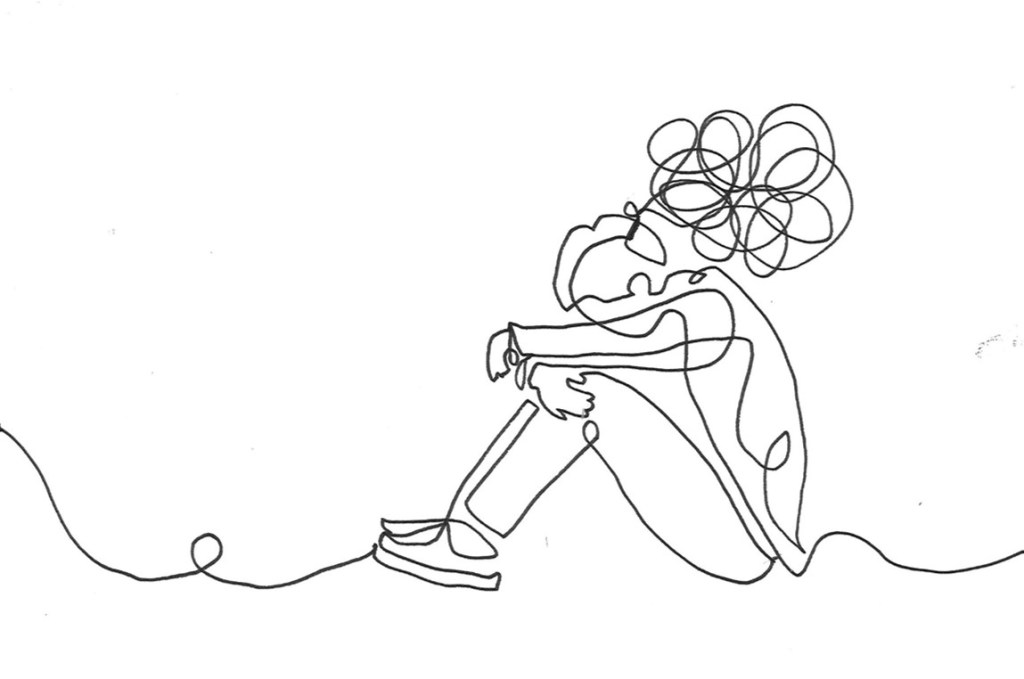
Rumination is a cognitive process that involves repeatedly focusing on the causes, consequences, and symptoms of distressing thoughts and feelings. While it is a common response to stress and adversity, excessive rumination can exacerbate mental health issues, including anxiety and depression. Understanding this phenomenon is crucial for breaking the cycle of rumination and promoting emotional well-being.

What is Rumination?

Rumination is defined as “a persistent focus on symptoms of distress and the implications of those symptoms” (Nolen-Hoeksema, 1991). It can be seen as a maladaptive coping mechanism, where you engage in repetitive thinking about problems without moving toward solutions. This cognitive pattern not only prolongs feelings of sadness but also leads to further emotional difficulties.

Research by Roelofs et al. (2009) highlights that rumination is linked to the onset and maintenance of various mood disorders. Their findings indicate that when you ruminate about negative emotions, you are more likely to experience prolonged depressive episodes. Suppressing emotions while continuing to ruminate creates a vicious cycle that heightens feelings of helplessness. Therefore, it is vital to break the cycle of rumination.

The Psychological Mechanisms Behind Rumination

Rumination is driven by several cognitive and emotional processes. It often stems from a desire to understand your thoughts and feelings better; however, this can paradoxically lead to intensified distress. Rumination occurs in two primary forms:

  1. Staying Stuck: This involves a passive focus on symptoms of distress, leading to feelings of hopelessness and exhaustion. If you don’t move away from rumination, it continues.
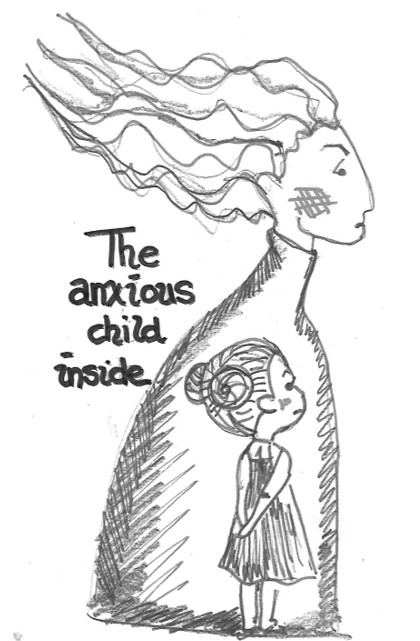
  2. Reflection: While reflection can be constructive and help you gain insight, it might become maladaptive when it transforms into procrastination or self-criticism. When your inner critic dominates, overriding your inner champion, you are likely to stay stuck, criticising yourself further.

Research by Nolen-Hoeksema et al. (2008) indicates that brooding is particularly associated with negative outcomes, such as increased depression severity and lower levels of psychological well-being.

Breaking the Rumination Cycle

Although rumination can feel inescapable, several evidence-based strategies can help you break this cycle:

  1. Cognitive-Behavioural Therapy (CBT): CBT focuses on identifying and challenging negative thought patterns. By reframing maladaptive thoughts and beliefs, you can reduce the intensity of ruminative thinking. Studies, including one by Hofmann et al. (2012), demonstrate CBT’s effectiveness in treating anxiety and depression by reducing rumination.
  2. Mindfulness-Based Interventions: Mindfulness encourages you to focus on the present moment, effectively reducing the tendency to ruminate. Research shows that mindfulness practices can decrease rumination and enhance emotional regulation (Keng, Smoski, & Robins, 2011). Techniques such as meditation or mindful breathing help you gain awareness of your thoughts without becoming entangled in them.
  3. Activity Scheduling: Engaging in meaningful activities can shift your focus away from ruminative thoughts. Researchers have found that scheduling enjoyable activities increases positive mood and decreases rumination (Teasdale et al., 2002). Creating a list of activities that bring you joy can be a practical step in breaking the cycle.
  4. Thought Logs: Using a thought log allows for cognitive restructuring. Research by Beck et al. (1979) emphasises the importance of identifying automatic thoughts through this practice. By recording negative thoughts and the situations that trigger them, you can better recognise cognitive distortions and construct rebuttals to help stop the power of the original rumination.
  5. Journalling: Writing about your thoughts and feelings can serve as a healthy outlet for processing emotions. Expressive writing has been found to reduce rumination and promote emotional clarity (Pennebaker & Chung, 2011). Maintaining a journal can help you articulate your thoughts and explore your feelings in a structured manner. Sometimes, a therapist will encourage you to respond to prompts to direct your thinking in specific ways.
  6. Self-Compassion: Neff (2003) introduced the concept of self-compassion as a counter to the harsh inner critic. Research has shown that self-compassion practices can reduce negative self-judgment and increase emotional resilience. Neff’s studies indicate that developing self-compassionate responses instead of critical self-talk leads to lower levels of anxiety and depression.
  7. Social Connectivity: Connecting with others can diminish feelings of isolation and provide different perspectives on distressing thoughts. A study by Rook (1984) showed that social support significantly reduces the likelihood of rumination. Reach out to friends, family, or support groups to facilitate this process.

Breaking the cycle of rumination is essential for improving mental health and emotional well-being. By employing evidence-based strategies such as cognitive-behavioural techniques, activity scheduling, mindfulness interventions, social support, journalling, and self-compassion, you can develop healthier cognitive patterns. As you recognise the destructive nature of rumination, equip yourself with effective tools to foster resilience and promote mental wellness.

References

  • Beck, A. T., Rush, A. J., Shaw, B. F., & Emery, G. (1979). Cognitive Therapy of Depression. New York: Guilford Press.
  • Hofmann, S. G., Asnaani, A., Vonk, I. J. J., Sawyer, A. T., & Fang, A. (2012). The Efficacy of Cognitive Behavioral Therapy: A Meta-Analysis. Cognitive Therapy and Research, 36(5), 427–440.
  • Keng, S. L., Smoski, M. J., & Robins, C. J. (2011). Effects of mindfulness on psychological health: A review of empirical studies. Clinical Psychology Review, 31(6), 1041–1056.
  • Nolen-Hoeksema, S. (1991). Responses to Depression: An Elaborated Process Model. Psychological Bulletin, 109(3), 500–503.
  • Nolen-Hoeksema, S., Wisco, B. E., & Lyubomirsky, S. (2008). Rethinking Rumination. Perspectives on Psychological Science, 3(5), 400–424.
  • Pennebaker, J. W., & Chung, C. K. (2011). Expressive writing: Connections to mental and physical health. In The Oxford Handbook of Health Psychology (pp. 417–437).
  • Rook, K. S. (1984). Situations of social isolation and the well-being of older adults. The Journal of Gerontology, 39(2), 166–175.
  • Roelofs, J., Huibers, M. J. H., & van der Wee, N. J. A. (2009). The relationship between rumination and depression: A longitudinal study. Psychological Medicine, 39(1), 27–35.
  • Teasdale, J. D., Moore, R. G., Hayhurst, H., & Tixier, M. (2002). Forming a new cognitive style: A model of cognitive therapy. Behaviour Research and Therapy, 40(9), 1043–1057.

Anxiety Attacks – Emergency responses

LiLiving with anxiety can feel like being inhabited by a monster that constantly whispers about your fears, insecurities, worthlessness, inevitable failures, and the catastrophes you may be creating. It is estimated that 13-14% of people in Europe live with anxiety. One symptom can be anxiety attacks; some individuals only realise they have been suffering from anxiety when they experience such an attack.

An anxiety attack differs from a panic attack. It is typically a response to a stressor—often a thought, feeling, or specific dread. People experiencing anxiety feel apprehensive and engulfed by fear. Their hearts may race, and they may feel short of breath. Often, individuals feel out of control and may become extremely tearful. A panic attack may include some of these symptoms, but it usually occurs without a clear stressor. Both can be terribly frightening. If you experience anxiety attacks, it is important to be prepared with an emergency response.

Here are some of my favourite techniques to respond when anxiety attacks occur..

Try this exercise when you feel anxious.

Breathing Exercises: Listen to the pattern of your breath when you feel anxious; it can provide clues about how best to respond to your anxiety. If you are hyperventilating—taking fast, shallow breaths, feeling faint, and fearing that you cannot catch your breath—try breathing into a paper bag. Breathing in and out using a paper bag will recycle air, returning carbon dioxide to your body, which will naturally help make your breath deeper and slower. Do this for a minute. If you do not feel better, try again for another minute.

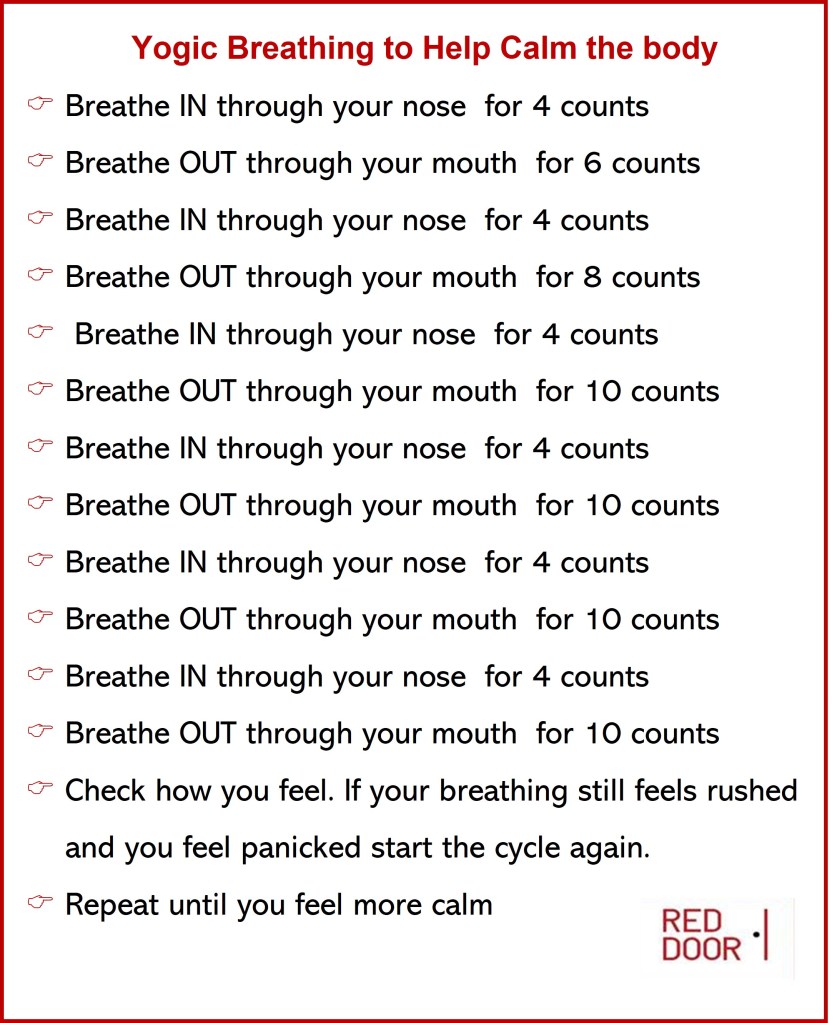
If you are not hyperventilating, you can use the calming breath technique. Breathing exercises, such as those used in yoga classes, are effective in reducing anxiety. One simple exercise that I use with clients involves counting inward and outward breaths to calm the mind. Breathe slowly in through your nose for a count of 4, then breathe out through your mouth for a count of 4. Repeat. Next, breathe in through your nose for a count of 4, and out of your mouth for a count of 6. Repeat. Finally, breathe in through your nose for a count of 4, then breathe out through your mouth for a count of 8. Repeat. Check to see if you feel better; if you don’t, repeat the exercise again, concentrating on the sensation of your breath.

Distraction Techniques: Distraction exercises help your parasympathetic nervous system override an anxious reaction. By simply refocusing your energy on elements of your environment, you can allow your underlying operating system to return to homeostatic (i.e., regular) breathing.

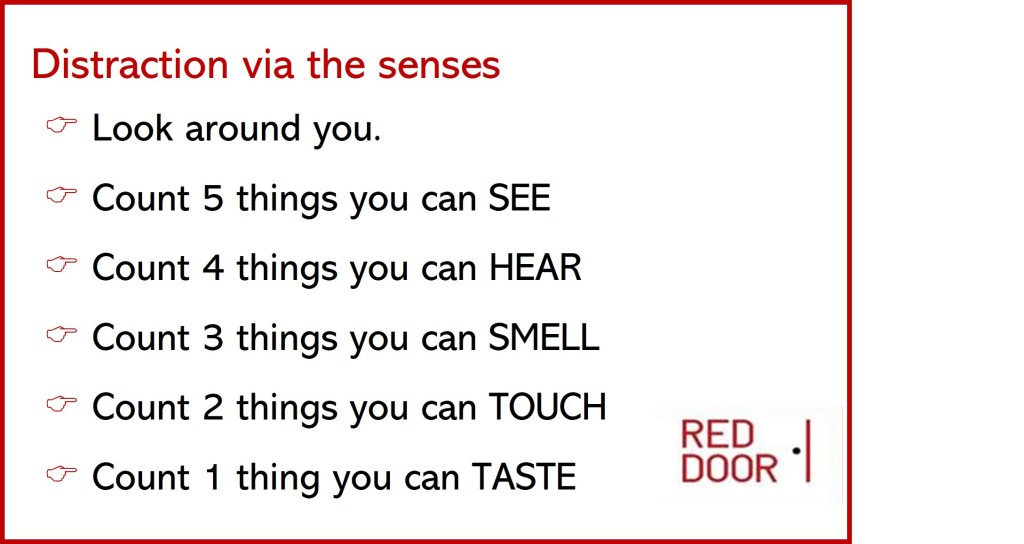
Use your senses to help calm your breathing

Use Your Senses: The most commonly used therapeutic technique involves engaging your senses to distract your busy mind. Identifying a number of items you can see, smell, hear, touch, and taste can help reset your body. For example, identify 5 things you can see, then 4 things you can hear, then 3 things you can smell, then 2 things you can touch, and finally, 1 thing you can taste. After this exercise, monitor your breathing again. Has it become less panicked?

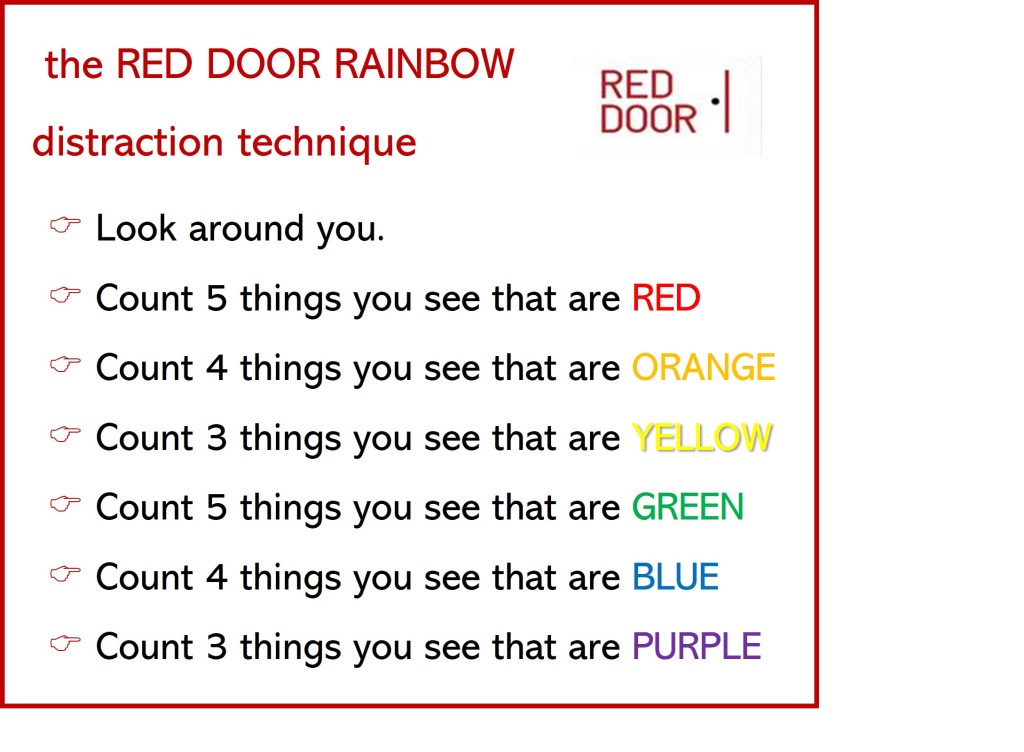
Since we work with numerous teens and children at RED DOOR, we also utilise the RAINBOW technique, often paired with our proprietary rainbow fidget toy, to help teens achieve quick calm. This technique can be performed without the fidget toy. Simply count objects in your immediate vicinity that are specific colours. You can keep track of the total number of objects or count a specified number of objects that are red, orange, yellow, green, blue, and black.

Physical Reset Activities: Distraction can also be achieved through physical “reset” activities, such as repeatedly snapping an elastic band against your wrist or performing sets of 10 jumping jacks.

Meditation/Relaxation: Meditation, when practised regularly, can help individuals reach a relaxed state more easily. Practice makes progress when it comes to meditation. If you are experiencing an anxiety attack, try to find somewhere to sit quietly or lie down. Then attempt progressive relaxation, also known as a body scan, which can be especially beneficial. Progressive relaxation soothes you as you tense and relax muscles, isolating and focusing exclusively on one group of muscles at a time. Begin with your toes and work your way up through your muscles to your head, focusing on relaxing the muscles around your chin and eyes. Guided progressive relaxations are available on Spotify, YouTube, and on CD.

Imagery: In the midst of an anxiety attack, use your active imagination to help alleviate stress. First, isolate the location within your body where you feel the greatest sensation of anxiety. Use imagery to help unwind and relax that spot. Cute, warm, and amusing images will be most beneficial. If you feel tension in your shoulders, imagine a group of kittens massaging the knots away. If you have butterflies in your stomach, envision yourself in your stomach with them

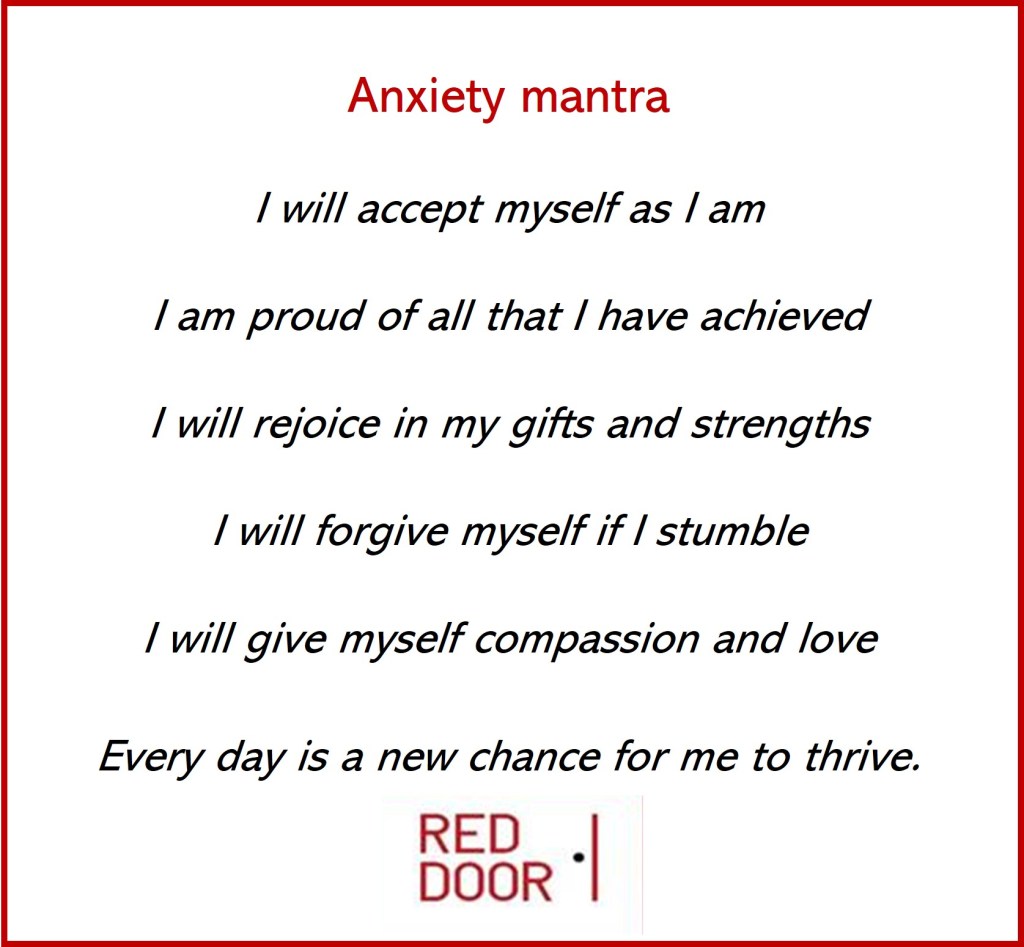
This mantra might help with your negative self-concept

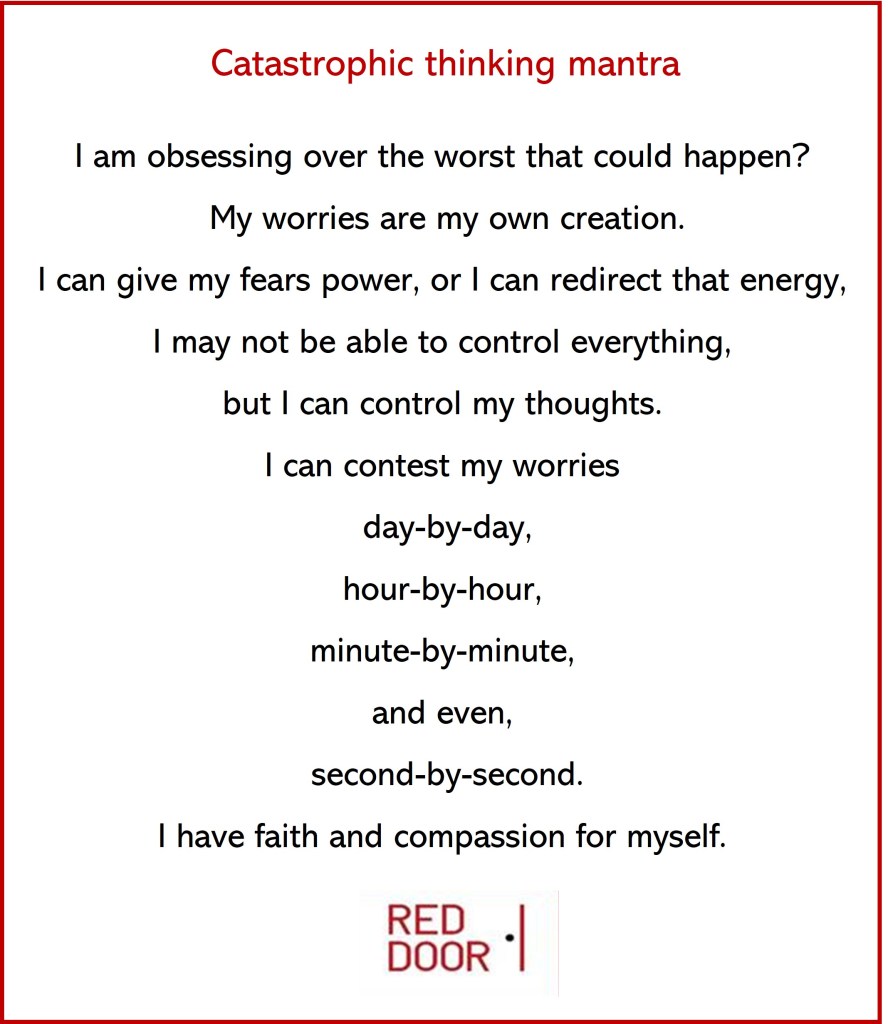
Mantras – Anxiety attacks are created by dreadful thoughts running through your mind. One way to settle these thoughts is to repeat a mantra. While there are mantras on the internet, you may benefit from one that you write specifically for yourself. The mantra should be full of words of kindness, understanding and love. The words “should” or “must” cannot be part of any mantra.

Centre yourself with art therapy techniques

While avoidance is not a long-term technique for managing anxiety, if you are ruminating or feeling a panic attack, distracting yourself with a change of scene or activity can help. Go for a walk, particularly in nature, to reset yourself. Try colouring, which I have detailed in a previous blog [https://reddoorhongkong.wordpress.com/2017/03/06/reasons-to-colour/ ], which involves both sides of the brain, stimulates creativity, and can help to calm the mind.   Even listening to some upbeat tunes at this time, get up and dance, just break the pattern of your anxiety for a moment to reset your emotional clock.

Talk to your anxiety – The long-term cognitive approach to anxiety is to create an internal dispute. Disputing your anxiety helps you reframe situations, see hope, and utilise self-compassion. If you experience anxiety ask yourself to challenge your view of the stressful situation – have you been overgeneralising, personalising, or catastrophizing? Is there an alternative way of looking at this issue? Sarah Wilson[2] , in her compendium of suggestions to utilise in one’s challenge with anxiety suggests an ancient adage, “ First make the beast beautiful”, meaning accept that your anxiety – it is something that originally may have been created to help you, but overtime has started to inappropriately misfire. When you make the anxiety beast beautiful you may say to yourself, “Thank you brain for alerting me to potential danger, but I know I am safe right now, you can go back to your guarding post”.  Developing the process of dispute is an area of action where a therapist can be of significant help. If you cannot create this dispute for yourself, utilise the resources of a counsellor.

Prolonged anxiety is extremely challenging to your health. If you have been struggling with anxiety for a while please seek the help of a counsellor or a doctor. They may recommend a combination of therapy and even medication to help lessen your anxiety. There is no shame in needing help. Take charge of your future.

Everyday is a new day for you to thrive. Start gently, start now.

 #mentalhealth #mantra #mindfulness #anxiety #reddoorcounselling #selfhelp #anxietyattack #treatmentanxiety #women

Sources

1: Prevalence –

2004: The ESEMeD/MHEDEA 2000 Investigators,2004, Prevalence of mental disorders in Europe: results from the European Study of the Epidemiology of Mental Disorders (ESEMeD) project

2011: https://www.theguardian.com/society/2011/sep/05/third-europeans-mental-disorder

2: Sarah Wilson, 2018, First we make the beast beautiful: A new journal through anxiety. Dey Street Books

__________________________________________________________________

Angela Watkins is a psychologist and counsellor at RED DOOR Counselling in Hong Kong. Her current clinical work focuses on parenting. relationships, anxiety, OCD, career change, stress management and divorce.