Anxiety in the time of a pandemic.

panic

Anxiety can be a crippling emotional challenge. As a psychologist and counsellor I work with clients dealing with their anxiety and I want to share some information about this condition and its management.

What spreads the contagion of anxiety?

  • Anxiety is made worse when it is fed. Searching for more information about what was making you anxious will usually increase your anxiety.
  • Rumour and mistruths exacerbate our experience of anxiety.
  • Sharing rumours on social media is the equivalent of sneezing in a crowded restaurant.  It spreads worry.
  • Waiting for normalacy to return is not practical. Pandemics take years to work out so please consider adjusting to a new normal of living with COVID-19 for now.

What cures anxiety in general and COVID 19

  • Challenge all sources of information. Media often include panic inciting headlines and bury calming information.
  • Acknowledge your anxiety – give it a voice, but not a megaphone. Talk to your anxiety as you would a worried child. Accept that it exists, how it might perceive the situation, and offer alternative ways of looking at the issue. Be kind to yourself.
  • Perspective is important. There are some benefits in this situation:When we asked what is positive fans often expressed that they were enjoying aspects of life that are now less hectic –sleeping in, spending time with kids, husbands coming home earlier, commutes taking less time, nice walks with their pets. We have seen the resurgence of cooking and home crafts.
  • Be careful when you share information. Search for facts, not rumours. Do not spread the contagion of panic. At the same time, share facts not opinions – seriously wear a mask.
  •  Panic buying possibly adds to your experience of panic. Sure if you need toilet paper buy a pack. Don’t buy 10 packs “just in case”.
  • Don’t judge those who leave, or those who stay in your area as the number of cases grows. People make the choices that they think are best for their family. In reality they, and you, probably will not contract the virus, and if they do they will survive.
  • Face down myths whenever you get the opportunity (https://www.who.int/emergencies/diseases/novel-coronavirus-2019/advice-for-public/myth-busters)
  • Practice being grateful. Gratitude allows you to stay positive
  • Challenge your thinking. We often employ cognitive filters when we interpret information and this can increase our anxiety. For example, if you tend to catastrophise situations it will possibly lead to exacerbated anxiety. Take a look at the following article which might help. (https://reddoorhongkong.wordpress.com/2019/03/28/change-the-view-challenging-your-thinking-filters/)

Working actively on your anxiety can help to reduce it. Sometimes talking to a professional might help. If you’d like to tackle your anxiety with Angela, or one of our other therapists, in Hong Kong, contact us at reception@reddoor.hk or SMS to 852-93785428.

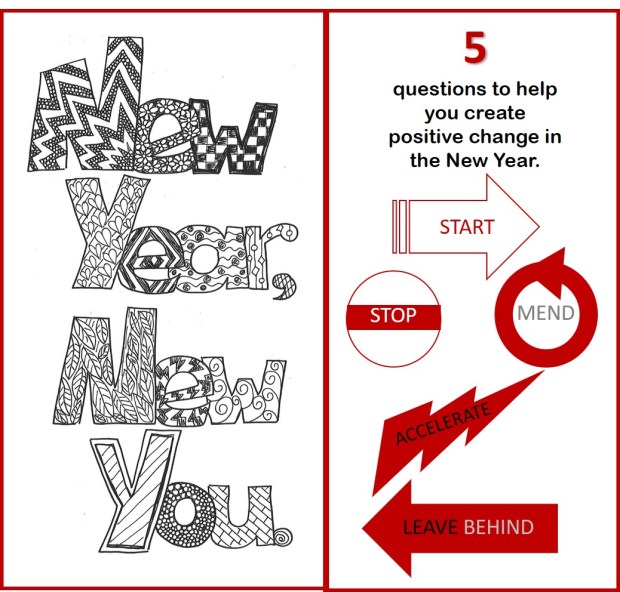
New You in the New Year: 5 questions to help you create positive change in the New Year.

new year new you

If you are receptive to the idea of setting New Year’s Resolutions but are undecided which resolutions will contribute real positive change to your life we have outlined 5 questions that we believe frame change that will introduce the most meaningful adaptions into your life in the New Year – creating a New You in the New Year.

startSTART. What one behaviour or habit could you start today that you will be thankful for in two to three years time? Perhaps you might considering undertaking a new area of study. Perhaps start a savings plan for that special vacation that you have been dreaming about. How about trying to eat properly, or commit to an exercise plan. Write down your options and consider which you would be most happy about in a few years time.

stopSTOP. I’m sure there is a at least one behaviour that you would benefit from LESS of in the New Year. Think about it, write about it. Consider something that you might consider to eliminate this year. Some ideas you might consider are to quit drinking, smoking, explore your propensity to explode in anger, feelings of jealousy, comparing yourself to others, procrastinations, over-eating, your addiction to technology, controlling others, or overworking.
Do you believe you CAN stop? If you believe, then what is holding you back? Have you tried to measure the impact your ‘STOP’ behaviour on your life, both in terms of financial implications, but also the repercussion on your personal life, your reputation, or your long-term health.

If you doubt if you can stop, then perhaps it might help to consider help. Sometimes a doctor, a counsellor, or even a good friend can help you brainstorm a way out. Try to visualise what your life might be like, if you can just STOP.

mendMEND. Are you holding onto old hurts or disappointments from the past that disrupt your ability to move forward? Is there a rift in an important relationship in your life that you are grieving?  Ask yourself could you mend some of these rifts or mend some of those hurts? One technique to think your way through these situation is to journal. (https://reddoorhongkong.wordpress.com/2017/03/22/six-fantastic-benefits-of-writing-a-journal/). Specific journal prompts might help you.

  •  Who or what event do you find it hard to mend in your mind? What wrong was done to you? Can you see this situation differently from a distance?
  •  Would there be a benefit to recover old friendships or relationships? Do you feel safe with that person? Can you better protect yourself in that relationship in the future?
  •  Are you still angry about events that have happened in the past. Write about that anger and other feelings. Why do those events continue to hurt you after all the time that has elapsed.

Some perspective and review may help you feel better. Always be kind to yourself in these evaluations. Also acknowledge some hurts are harder to heal. If you have experienced abuse, the mending to be done may not be of that abusive relationship but rather your relationship to yourself. If you need help, consider a counsellor.

accelerateACCELERATE. What positive practices do you engage in that you could accelerate, to your benefit, this year. If you want to be an artist, what commitment could you make this year that could make your dream become closer to reality. Perhaps you could commit to completing one piece of work a week. If you recently started your own business what key resources will you need to commit to getting this business off the ground. Are you working on this as many hours as it needs? Contemplate what activities bring you new clients – either directly or indirectly – and how can you pump up the volume on those tasks? Ideally, you are probably doing so many positive undertakings on a weekly basis, what could you DO MORE with real benefit to your goals?

leave behind.jpgLEAVE BEHIND. In the tradition of closing one door, so that another can open, consider leaving something, even someone, behind as the old year ends and a new one begins. Are you involved in relationships that are toxic to you or sabotage your achievement of your goals? Review the people and practices in which you engage, do they hinder or help you? What person or practice could you let go of, in order to let yourself really grow?

If you have detailed a behaviour in response to each of these 5 provocative questions, then you have the beginning of a game plan for a New You in the New Year.  Well done for spending this time reflecting about what will be of benefit to you. All the best for working on these behaviours in the next year. You should be proud of you.

#reddoor #newyear #Newyearresolutions #behaviorchange


Fighting Fair

fighting fairDisagreements are to be expected in any relationship. No two people see situations the same, or have completely the same goals. Resolving conflicts in a positive manner will make your relationship stronger, whilst unresolved battled and long-term contempt can erode your relationships’ chance of survival.
Are you fighting fair when you disagree? We outline the best recommendations given in therapy and highlight the work that we do with couples to help them move from belligerent brawling to fighting fair.


Agree on rules of engagement.

A set of rules will help keep an argument on track and less confrontational. Common recommendations might include:

  • Set a time to argue – don’t just ambush an argument onto your partner
  • Argue by mutual consent, and delay your discussion if you are tired or sick – a fair fight requires two able bodied members
  • Set a time limit to discuss a topic. If you don’t reach consensus in your time frame either agree to disagree, or take a break to allow each party to consider all of the points.
  • Physical violence is a no-no.
  • Remember words are weapons – stop hurting the people you love


Know and own your feelings.

When you are upset try to avoid to blame others for your feelings and experiences. You would be better to say “When you do …”, “I feel …” rather than label the behaviour. For example, “You are always late; you are so selfish” Rather say. “When you are late, I start to feel nervous”

Your feelings are yours. It is common to hear “You made me mad”. This phrasing attempts to deflect responsibility for your reaction off yourself, but your feelings are yours. That isn’t to say this supports legitimacy of your partners behaviour. People don’t make you mad, you get angry. It is your anger. I would challenge you to consider if you get angry in other situations, outside of your personal relationship. Use feeling words – I feel angry, sad rather than “you are so selfish”, “no wonder I’m angry”. Use I statements – “I feel angry …” rather than “You make me…”


Kitchen Sinking.

Keep any argument to the topic you have outlined to discuss. Kitchen sinking occurs when you pull old hurts and disagreements into the current topic under debate. If a number of issues have been accumulating, tackle them one at a time.


Point scoring is for bullies.

Your objective isn’t to WIN a fight. If one person wins, the other, even more importantly, the relationship loses. Allow your partner to save face. The purpose of fighting fair is to improve your experience within the relationship. Fighting fair, and resolving disagreements amicably and respectfully strengthens your relationship in the long term.


It takes two

Keep your fights between the two of you. Leave family and friends out of your argument. Poor relationship boundaries around your personal issues will have a negative impact on the quality of your long relationship. There is nothing more annoying than having others opinions included in a discussion. Imagine the scene where a partner says to another “Your mother agrees, we should have never gotten married” In particular DO NOT involve children in your arguments, that is deeply unfair to them. Obviously if physical aggression is involved privacy and boundaries are no longer sacred


Kindness is king.

Being kind and respectful is extremely helpful in a disagreement. Name calling, bringing up critical confidences in order to hurt another, swearing, making threats are distructive to your relationship. If you owe your partner an apology, then provide it. Some goodwill can go a long way. Issues which involve personal perception and opinion may be impossible to resolve. Agree to disagree if you can and respect this. I’ve seen many couples continue to fight after they’ve agreed to disagree, and that situation, rarely ends well.


Control-Alt-Delete.

Even if you have a bad fight you can start again without completely resolving the conflict. Sometimes if you start your day taking shots at each other, one of you can ask, “can we start this again”. You don’t need to continue a fight just because you started it. Respect the possibility to start again, but also commit to have the discussion again at another time. Control-Alt-Delete can’t simply be used to stonewall discussions.


Apologise.

If you are in the wrong, apologise. Even if you weren’t in the wrong, but behaved in a hurtful manner apologise. Also, if you are given an apology, accept it. Sometimes in counselling we see couples who do accept their partners apology because it covers only 8/10 things that they believed their partner did wrong. Accept an apology, even if it is incomplete. Once peace has been restored, discussion on areas of dispute will be more likely to be successful.


“Fighting fair” cannot involve abuse.

There is a difference between having disagreements and being in an abusive relationship. Abuse can be physical, financial or psychological. Physical abuse includes not only scratching, kicking, hitting and biting but also coerce your partner to have sex, putting your partner into a headlock or holding them against their will. Financial abuse and emotional abuse are less difficult to identify and confirm.

Its worth talking about what emotional abuse is not. It is not emotionally abusive to break up with a partner, or argue with your partner. It is not emotionally abusive when someone reacts to what you have done by stating that they are hurt. It is also not emotional abuse to speak one’s mind with honesty, perhaps more tact could be used, but it isn’t necessarily abuse. Partner’s fight, and often even yell. This doesn’t constitute abuse, unless it is done for the purpose of controlling another person.

Researchers Jacobson and Gottman have a questionnaire that can help you determine if you are being emotionally abused:www.fjcsafe.org/wp-content/uploads/2016/11/Emotional-Abuse-Questionnaire.pdf

While less commonly understood than other forms of abuse, financial abuse is one of the most powerful methods of keeping a person tied to an uneven or even abusive relationship. Financial abuse involves controlling a victim’s ability to produce or manage financial resources. Rarely do they have complete access to money and other resources. When they do have money, they often have to account for every penny they spend. If one partner is shopping for groceries and suddenly finds all cards have been cut off in response to a recent argument, this may be an indication of financial abuse.


If you get stuck, get help

If you find yourselves going around in circles on a topic you could consider couples counselling. Couples counselling will help you understand if the issue is the one you are arguing about or is actually a proxy for other unresolved issues, then help the couple work on those challenges.


Disagreements are to be expected in any relationship. Resolving conflicts in a positive manner is an indication of maturity and commitment. The next time you fight with your partner, reach for this list and keep your fight fair.

#fighting #relationships #arguments #fightfair #couplescounselling #abuse #reddoor

Work Hard – Stress Harder: Understanding the experience of stress among senior lawyers in Hong Kong.

work hard stress harder

The legal profession is seen as a robust and optimistic occupation where hard work pays off (5). What exactly is the payoff? If one looks beyond the cash remuneration, there are other costs that have not been factored including negative impacts on physical and mental health.

Being a lawyer is stressful (1). Productivity research from 2019 suggests that 63% of lawyers reported that they experience stress on a daily frequency. Academic research suggests that lawyers are exposed to high levels of occupational stress including role conflict, role overload, too much work, role ambiguity, or negative company politics, and feeling overly responsible for the work of others with heavy mental health consequences including alcohol misuse, depression and daily tension (2).

A few years ago the team at RED DOOR approached a number of senior lawyers in Hong Kong to better understand how the law profession was experiencing and coping with stress. This was ahead of the pandemic. I would expect that the results, which unsurprisingly, indicated that lawyers were stressed, would be consistent with the pre-pandemic trend.

Working in Hong Kong is stressful for many occupations, and it would make sense that lawyers in HK experience stress, had not been assessed, nor has the impact of this stress, and the components of this stress been well explored. Understanding the experience of stress among lawyers in Hong Kong has significant impact on training for lawyers, senior management within law firms, and human resource manager of senior law personnel, and on the mental health protection of professionals in high stress occupations.

Details of the methodology is attached at the end. In essence we summarised the experience of 30 senior lawyers in Hong Kong. Over ¾ of these lawyers were partners at their firms. They represent 21 international law firms in Hong Kong.

Insane work hours.

Hong Kong can lay claim to the #1 workaholic city in the world (3) with an average of 50.1 hours a week when it was compared to another 70 other international cities. Comparing this to the average number of work hours a week within OECD (4) countries (of 33.5 hours a week), Hong Kongers work an additional 16 hours a week.

Against this backdrop of excessive work hours, we explored the average work hours of HK lawyers. Among our benchmark survey the average work hours per week was over 55 hours a week. One ¼ of our lawyers worked less than 50 hours a week, and ¾ worked an average of more than 50 hours a week. Only one person worked less than 40 hours a week, but this was still 38 hours a week, so still more than the OECD average. What’s more is that due to a minor methodological error, we may have minimised the average hours a week. Our team made a rookie mistake in this benchmark survey. We set the maximum hours at 65+ hours a week. Thirteen percent of our respondents ticked the maximum number of hours. This means that our calculation of average hours was possibly less than the real numbers worked.

This means that, over a year,  HK lawyers work more than 250 hours more than their other, workaholic, local colleagues.

Whilst there is a common perception that working more hours means achieving more work, but research challenges this association. There are a authorial of research articles highlighting that working beyond 8-10 hours a day, is actually NOT associated with heightened productivity (5). In the legal profession these long hours may not make sense from a perspective of productivity, however since lawyer hours translate directly to client billing hours, there may be competing interests with lawyer’s mental health suffering as a consequence.

key findings 2

The experience of stress among HK lawyers.

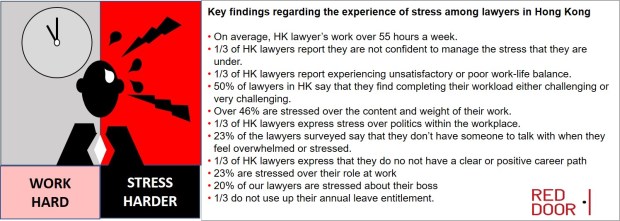
In addition to working extremely long hours there are some other significant findings regarding the experience of work-related stress from the RED DOOR Benchmark law and stress research.

  • 1/3 of HK lawyers report they are not confident to manage the stress that they are under.
  • 1/3 of HK lawyers report unsatisfactory or poor work-life balance.
  • 50% of lawyers in HK say that they find completing their workload challenging or very challenging.
  • Over 46% are stressed over the content and weight of their work.
  • 1/3 of HK lawyers express stress over politics in the workplace.
  • 23% of the lawyers surveyed say that they don’t have a supportive person to talk to when they feel overwhelmed or stressed.
  • 1/3 of HK lawyers express that they do no not have a positive career path
  • 23% are stressed over their role at work
  • 20% of our lawyers are stressed due to their boss
  • 1/3 do not use up their entire leave entitlement.

Therefore, we feel comfortable surmising that HK lawyers are under a considerable amount of stress.

What is contributing to HK lawyers’ experience of stress?

Long hours certainly contribute to stress. A positive correlation (0.55) indicates that as hours increase, experience of stress increases.

Confidence to deal with stress seems to be correlated (0.53) with positive expression of management of the experience of stress.  This echoes other research on the perception of stress. Yale psychologist Alia Crum (6) assessing banking employees found that those individuals who could see stress as a positive challenge that enhanced their lives and they could conquer helped people experience fewer negative impact from stress.

A positive work environment – which we said was comprised of having an open culture, access to CSR programmes, autonomy of employees, encouraging use of leave, flexibility of work hours when required, an open and inclusive atmosphere, fair and transparent financial remuneration and other non-financial rewards – was also associated with better experience of stress, and vice versa. More negatively rated workplaces were associated with higher experience of stress.

Limited sleep is associated with stronger experience of stress. Ten percent of our lawyers sleep less than 5 hours a night. An additional 43.3% sleep between 5 to 7 hours. Given the US National Institute of Health recommendation of 7-9 hours a night sleep for adults, more than half of our lawyers capture inadequate rest every night. Most people need adequate (7-9 hours) sleep in order to maintain performance and productivity (5) and consistently having less than this can be a risk to their mental health (7).

One particularly concerning suggestion is that those who have no one to talk to when they feel stressed or overwhelmed and its association to the expression of stress. Twenty-three percent, nearly ¼ of our lawyers, say they do not have this person. Of those lawyers, 83% experience higher levels of stress than other lawyers in our survey. This has a major impact in planning how we can best manage stress. Talking to someone helps. As a counsellor, I would also advise, talking to someone who is qualified to respond to your experience of stress and other co-morbid experiences (depression, anger, isolation) is heavily recommended.

Lawyers were also asked to express how frequently they felt some concerning other emotional experiences. Considerable lawyers experience other psychological feelings and behaviour, regardless of their experience of stress. Thirty percent say that they feel regularly or frequently depressed. Twenty percent withdraw from social situations or feel isolated. Twenty percent express troubles with anger. Ten percent say that they cry regularly or frequently. So, in addition to stress, many lawyers are experiencing emotions that cause them distress.

Engaging in negative behaviours. Our lawyers were provided with a range of positive and negative practices and asked to rate them in terms of the frequency in which they engaged in those behaviours. When these behaviours were divided into their clear negative or positive possible contributions or reactions to stress, and correlated to their experience of stress, we found that performing negative behaviours is correlated with negative reported experience of stress. This is stronger for our male lawyers than female (0.47 correlation). The most common negative behaviours that lawyers report that they engage in include: eating junk food (36.6%); drinking more than 2 drinks a day (30%); argue with your romantic partner (26.6); argue with their kids (20%); skip meals (20%); and have a cry (16.7).

Poor responses to stress. When asked how they respond we gave our lawyers a selection of ways to deal with stress. Many indicated some poor stress management responses as their most common behaviours: forty-three percent reported they would reach for a drink; twenty-three percent said they would reach for something to eat; ten percent said they would shout at the people around them; and ten percent said they would simply work more.

positive stress response.jpg

What do lawyers do well when responding to stress?

When asked how they respond we gave our lawyers a selection of ways to deal with stress. Many indicated positive stress management responses and to be celebrated: Sixty percent exercise regularly; forty-six percent spend time with their family; forty-three percent talk to a colleague; thirty-three percent talk to a friend; thirty percent seek time alone (which could be considered both a positive and negative response); and thirty percent decide it is time to leave the office.

What does this all mean?

What we have learnt from this benchmark survey is that HK lawyers are regularly experiencing stress. We need to be mindful of how we train lawyers to deal with stress and other psychological challenges that arise out of their work hours, work challenges and the behaviours they choose in response to stress. Specific stress management programmes would possibly help. It is important that these are relevant to HK and to the experience of lawyers here. For example, many stress management programmes include training on time management skills. Over 80 percent of our lawyers said that they were good at managing their own time, hence time management training is not required. This would mean that programmes that are not constructed with nuance for lawyers may be another tax on the time of lawyers, who are already working too many hours a week. Specific programmes within individual support requirements may be more effective.

Note: We will conduct a larger scale survey in 2024. If you are interested in participating in the survey or including your specific staff please contact Angela. If you would like to find out more about stress management practice options for yourself or others feel free to contact us at angelaw@reddoor.hk

About the Author: Angela Watkins is an experienced qualified counsellor and psychologist working out of the RED DOOR practice in Hong Kong. Angela specialises in the treatment of anxiety, depression, stress management, and career and lifestyle change.

#law #lawyers #stress #stressmanagement #occupationalstress #HongKong #performance #overwork #lackofsupport #worklifebalance #positiveworkenvironment #sleep #depression #anger #REDDOOR

Methodology: The Experience of stress among senior lawyers in Hong Kong – 2019 Benchmark Study.

HK lawyers experience of stress. 30 lawyers (17 men, 13 women) from 21 international firms working in HK. Over 76% are partners in the firms they work in. Surveys were completed in June and July 2019. 300 lawyers in Hong Kong were selected and contacted to participate in this research and completed an online survey which assessed experience of stress, sleep, reactions to stress, work place practices, hours worked, and access to support. For further information contact RED DOOR at angelaw@reddoor.hk

Cited references:

  • Protectivity research 2019
  • Hasnain, Nas and Bano, Stress and Well Being of Lawyers 2010.
  • UBS report on Cost of Living 2018
  • The OECD Better Life Report 2017
  • Harvard Business Review article The Research Is Clear: Long Hours Backfire for People and for Companies, Sarah Green Carmichael, 2015
  • Alia Crum (with P Salovey and S Achor) Rethinking Stress: The role of mindsets in determining the stress response.
  • Zhai, Zhang and Zhang – sleep duration and depression among adults: a meta-analysis. 2015

#careergoals #careerchange #occupationalstress #resiliency #careergoals #futureofwork #stress

Other great articles about career change

Face career change with courage. You can do it

https://reddoorhongkong.wordpress.com/facing-career-change-with-courage/

Future success is not an accident. Prepare yourself for the Future of Work

https://reddoorhongkong.wordpress.com/2017/08/09/defeating-fo-fow/

How to respond to career crisis

https://reddoorhongkong.wordpress.com/2018/07/11/start-me-up-responding-to-career-crisis/

Work stress – manage stress for Lawyers.

https://reddoorhongkong.wordpress.com/2019/11/27/work-hard-stress-harder-understanding-the-experience-of-stress-among-senior-lawyers-in-hong-kong

Get in the GROUP: The benefits of therapeutic support groups.

group therapy

There are numerous benefits from attending group therapy or therapeutic support groups regarding challenges you may experience with your mental health.

Group therapy, or therapeutic support groups, offer a type of psychological therapy that is run with a group of people rather than between an individual and a mental health professional. Usually members of the group are facing similar issues such as anxiety, addiction, divorce, or bereavement.

Recovery or Reduced experience of psychological stress:  Psychological research supports that many mental health challenges can be treated within an group context.

The end of Isolation:  Hearing about other peoples’ experience of anxiety, depression, addiction, or even bereavement, will help you feel less isolated by your experience of those psychological stressors.

Learn more about yourself: The process of therapy helps an individual explore not just the root and treatments of psychological challenges, but also how to identify and celebrate your strengths and future proof your mental wellbeing.

Help others: Helping other people in the group with their problems may help you with yours. It also feels great to help other people who may be struggling with issues similar to your own.

One last benefit worth mentioning is that you receive the benefit of the therapists advice. Qualified therapists specialise in changing behaviours and mindsets around particular psychological challenges. Group therapy is an economic alternative to individual therapy, and can, even be used as an alternative or in collaboration to one-to-one therapy.

______________

RED DOOR runs therapeutic divorce groups for the following individuals;

Divorce Survivors – our English speaking Divorce Survivors group has been running successfully for more than 2 years. If you are a woman going through divorce in Hong Kong join our group of women going through the process. I promise support and laughter, even when you have been crying. Run Monday evenings.

Anxiety Busters – our new group focused towards alleviating anxiety. You don’t need to suffer alone. Many people suffer from anxiety and therapy groups are often helpful to cope and recover from anxiety


If you would like to join one of our therapeutic groups, or provide information on groups that may be of benefit to you, please feel free to contact our reception for more details.

reception@reddoor.hk


#anxiety

#grouptherapy

#anxietybusters

#anxietytreatment


Modern Marriage Rules

marraige rules

Every marriage is unique but no marriage is without some troubles. Building a strong relationship helps you both weather the storm of stressful life events such as job loss, change in health, having (or not having) children, death of parents, with grace and support.

Here are our modern marriage rules in order to build the best long-term relationship that is possible in the age of the internet, business travel, and the future of work.


The TO DO list.

Laugh together

It is said that laughter is the best medicine, it is also the best glue to keep you and your partner connected. Even stressful horrible circumstances can be made more bearable when you laugh together about that problem. In therapy, when I ask couples when they were last happy together, it will almost always involve an episode where they were laughing about something.


Fight Fair

Quarrels do occur in all marriages, unless couples are actively avoiding conflict. It is important that you fight fair when you disagree. Do not include these derogatory weapons when you fight: name calling, stonewalling, gaslighting, or use of threats in order to win. The way to feel better with each other does not involve trying to make someone feel worse first. When you argue, focus on the topic at hand, try to share air time, spend as much time listening as you do speak, and if you can’t agree, take a break and then come back to the issue.


Stay intimate

This doesn’t just mean sex. When men talk about intimacy, they often seem to mean sex. For women, intimacy is broader including cuddling, hugging, small signs of affection, holding hands, as well as sex. When intimacy becomes only about sex, perhaps only one partner feels intimate.


Invest time and effort into your relationship

Your marriage partnership is probably the most important elective relationship that you enter in your lifetime. Regardless, many couples do not make time to be together, and drift apart over years and years. Dedicate time to your relationship (family time does not count). If you travel excessively put some dedicated time aside to talk to your partner, rather than squeeze in a call when you really can not talk or concentrate. Your partner needs to feel like a priority.

Having children can change the dynamic of your personal love relationship. Whilst it is important that you love your children, do not forget that your personal relationship is essential to the stability of your family.


Make a modern-day commitment

Commitment, and exclusivity, is important to remain close to each other. Even couples who have ‘open’ marriages have rules of what is considered an infraction of a commitment. Often what is expected from a commitment is not explicitly stated, and it may be of benefit to do so. Contacting old boyfriends, or having internet (Facebook) relationships, receiving special massages when you travel, all of these are possible infractions of commitment. Ask yourself, would your partner be happy if they knew all the details of what you are doing? If not, perhaps put yourself in check. Commitment also requires that you each feel like your partner is on your side with outside challenges. You may privately disagree, but if possible support your partner when they deal with conflicts at work, or even in their family of origin.


Learn from each other

Both of you can help each other become the best that you can be individually as well as a unit, and celebrate this. People’s career and personal goals change as they mature. . Remember the world of work is changing and you may need to prepare for multiple careers instead of one. Are you willing, able and flexible enough to support your partner in the new future of work? Working together as a business partners in your business of WE is just as important of your private business of ME


Self-Care

If you want a long life together, make sure that both of you take good care of your physical and mental health which will influence your ability to live a long life. If your partner is overweight, encourage them to lose weight by exercising with them. If your partner is experiencing job stress, encourage them to engage in therapy.


Express love everyday

Do not save expression of love for special occasions. Kindness, compliments and actions that make your partner feel special, even a text helps to maintain a positive atmosphere. Tell your partner why they make you proud, what you like about them most, what you admire about them. We often consider spreading kindness to others, but forget to focus on our partner first.


Understand your love language

The best way to convey your love for your partner is to express your love in the language of love that they prefer. The 5 languages of love include words of affirmation, gifts, physical touch, time sharing and acts of service (you can conduct an assessment of your style on the website of author Gary Chapman (www.5lovelanguages.com) . We want to receive love in the matter that we most appreciate. Understanding each other’s preferences is the ultimate form of respect.


Communicate

Learn to communicate in a purposeful manner. Monitor your communication style. Are you nagging your partner rather than talking? Do you use silence as a weapon?  Do you

avoid important conversations? These tactics help propagate misunderstanding and feelings of resentment or disappointment in your partner.

Learning to communicate can help you better deal with crisis.   If you have trouble talking without arguing practice active listening. Active listening involves taking turns to speak respectfully, without interruption. Before your partner can respond to your views, they must first summarize what they heard you say. Then they get to speak, you have to listen, without interruption. This process slows communication down and take the heat out of an argument by insuring that both parties have the chance to speak, be heard, and acknowledged for such.


Compromise

Marriage is not only about your happiness; it is about sharing the experience of living together. If one party in a marriage constantly gets their way, at the expense of the other, the relationship loses. Take turns picking vacation spots, taking a child to rugby, picking up dinner.


Just DON’T

Expect things to stay that same.

The world will change, and your lives will change, and your partner will change. Take note of the ways that you change and see if this can be aligned, or at least respected. Standing back and claiming that your partner changed and you didn’t, isn’t realistic or helpful.


Hate what you use to love

Often, we are drawn to people who are very different from ourselves. Sometimes after marriage we find those exact differences repel us instead of attract us. Appreciating that you are different people, and where you have come from, as we well as you are going, can help you respect each other’s’ differences again. Try to list 3-4 things you like about that difference rather than focusing on the things that you don’t like about it


Request perfection

Realising that your partner is not perfect, or as perfect as you once perceived them to be, can lead to criticism and unfair judgement. If your partner was once fit, and now isn’t, encourage them to be fit again, rather than tell them they are unattractive. We are all unique, and imperfect, as we should be.

If your best friend’s partner earns more, weighs less, is taller, stronger etc than your own partner, do not compare. No body every really knows what goes on in their friend’s marriages.


Resurrect and replay the past

The past is the past. Bringing up mistakes of the past is demoralising and detrimental. If you find yourself stuck repeatedly exploring old hurts you might like to consider counselling. You can learn from the past, but being stuck in the past, prevents you from building a positive future together.


Toxic negotiations.

When you argue with your partner using disrespectful descriptions of them will not help achieve your goals. Negotiation is not about complaining, blaming or bullying. If you want to negotiate appropriately, respect is an integral component if you want your relationship to benefit.


Rightly righteous.

Ask yourself, is it more important for you to win a fight, to be right, or to maintain a harmonious relationship. Being married involves some compromise rather than criticism. Delicate feedback is to be appreciated. Dial down the criticism. Admit and apologise when you are wrong.


Disparate division of labour.

Who does what, and when, is often the source of conflict in relationships? Not just cleaning, but also child care, organisation, bill payments, working outside of the home, all contribute to the labour that a family requires to keep running smoothly. When division of labour is uneven, or perceived to be unfair, resentment grows. Regular discussion and review of division of labour within the home is to be encouraged.


Me not We

Firstly, if one partner gets their way all of the time, or sets all of the family rules, this leads to an imbalance. A situation where what ME (I) wants becomes what WE do, leads to imbalance and resentment.

Secondly, it is said that marriage is the combination of two people who are whole in themselves, rather than the addition two people who are half of what they can be, making 1 unit. Whilst you must continue with your own self-development, you also need to understand that your relationship requires development as well. You need to make sure to develop as an individual, and spend time together developing a life together.


Substitutive intimacy

Seeking intimacy through pornography robs men of a real relationship and maligns masculinity within marriage. Marriage is for brave, real, and secure people. Accept no substitutes for real intimacy.


Your marriage is important, nurture it and it will flourish. Deprive it of attention, poison with criticism, delay sharing and caring, and it can not grow.


#marriagerules #romance #love #respect #intimacy #reddoor #rmentalhealthessentials

Boost your mental health

mental health

When we talk about mental health we refer to your psychological wellbeing. Mental health can be seen as a continuum, like you might see physical health. You may from time to time, have periods of compromised, or poor mental health. If you have poor mental health is not, necessarily, a permanent condition. In much the same way as you might have a physical issue such as diabetes, you can manage the underlying condition to such an extent that it does not impact your experience of health.

We may all experience a reduction in mental health at some point in our lives. Stressful life events such as divorce, family conflicts, financial problems, legal challenges, death of a loved one, loss of a job, or accidents, can have a significant impact on your ability to maintain positive mental health.

What can you do to help booster your mental health?

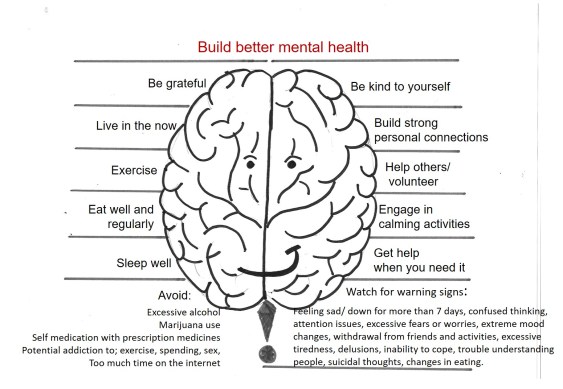
Just like your physical health you can protect your mental health with various practices such as

better mental healthEating well – eat well, and eat regularly. Make sure you stay hydrated

Exercise – moderate exercise is good for producing dopamine, known as the happiness drug

Kind words – use ONLY kind and growth mindset words with yourself. Do not label yourself as a loser.

Be grateful – being grateful keeps us grounded, and helps us realise we have, and are, enough

Live in the now – there is no point trying to relive the past, or worry about the future. All you have to control, and experience is today.

Build positive connections – our relationships to other people help buffer us from stressful life events.

Volunteer – helping others less fortunate than yourself will make you feel better about yourself, and help you gain some perspective on potential first world problems.

Calming activities – engage in activities such as colouring, journaling, mediation.

Sleep – make sure you get enough sleep

Get help – you don’t avoid the doctor when you feel physically unwell, so seek help if you feel that your mental health has been compromised.

Watch for the warning signs – monitor your moods over a few days, or longer. Everyone has bad days, see how long it takes you to bounce back. If you don’t seek help.

Avoid those chemicals and practices which compromise mental health.


#mentalhealth #selfhelp #counselling #reddoor #mentalhealthmatters

Divorce: the impact on women

impact of divorce image

Going through divorce is extremely stressful wherever you live.

This blog reflects my learnings as the counsellor leader of the IRON FAIRIES for the past 6 years and a proprietary survey  of  women’s experience of divorce in Hong Kong that was completed in 2019.

As a Hong Kong based practice, we were particularly concerned if the experience in Hong Kong appeared different from that experienced from women overseas. An initial comparison of women from HK and other countries (United States, United Kingdom, Australia and others) indicated strikingly similar patterns, indicating the impact of divorce is not strongly contingent on where you live. Regardless of location, over 75% of the women reported that the experience was stressful, and over 90% of those experiencing divorce felt significantly changed by the process.

impact figures

What concerns women during divorce?

During divorce women face a number of worries. Regardless of the stage of divorce (contemplating divorce, divorce in progress, completed divorce) the pattern of concern remains the same. The highest rated concern regards finances. This is probably not a surprize and much of the divorce process is spent discussing, divulging and dividing financial assets.

The second highest concern during the divorce process was the potential impact of the divorce on the children’s emotional wellbeing. Children are invariably affected by the process of divorce but as divorce is much more common than it has been in the past, better support for children can be made available. Collaborative co-parenting, therapy and respect for the child are extremely helpful. RED DOOR has blogs on this topic.

concernsduringdivorceThe third highest rated concern for women is their own emotional wellbeing during the divorce process. The divorce process is extremely emotionally taxing and a lot of the negative feelings can not be avoided. These can include feeling overwhelmed, ashamed, anxiety and depression. Women need support during this time, from friends, family and potentially professionals.  Personally, I recommend to join a support group if at all possible. Seeing other women navigating this trying time can be strangely comforting.

Other highly rated concerns for women experiencing divorce include worries about lifestyle changes and career changes. Lifestyle concerns are proxy responses for financial concerns, as changes in lifestyle are directly related to change in finances. Career change may involve the need to earn more, go back to work, gain greater financial independence, or take control of finances again.


Changes that were experienced because of divorce

changes after divorceOur respondents were asked how they perceived that they were changed as a consequence of going through divorce. We expected financial changes to be the highest rated experience but it was not. We consider that financial changes are expected so, potentially, less stressful than changes that were unexpected.

The biggest change women experienced was their level of independence. Some women stated they felt controlled in their marriages, and welcomed this independence. Others expressed that they were uncomfortable with this new sense of independence.

Women reported that their ability to cope with change had been altered. Given the frequently stressful experience of divorce many women were proud to have survived the process.

Women also reported experiencing changes in their career because of the divorce. Again, this could be perceived negatively or positively. It has been suggested in research that involvement in a new career can help people recover from divorce more positively. 

A whole blog will be dedicated to friendships during divorce. Changes in friendships was frequently experienced. Divorce is a stress-test for friendships. Friends who are determined to remain neutral rarely can. Feelings of betrayal by friends are common.

Unsurprisingly, women reported changes in family relations as a common experience. During divorce families are redesigned, in a new format. In laws may now become a greater or lesser part of the picture. The breakdown of family connections may exacerbate feelings of grief and isolation.


The best sources of support during divorce

sources of supportWomen were asked about the best sources of support they encountered during divorce. They rated 17 sources of support including established friends, new friends, lawyers, work colleagues, church, support groups and the like.

The most highly rated source of support was existing friends followed by members of family (parents, siblings and even children). A counsellor or psychologist was the next most important source of support. Among professional services explored (lawyer, mediator, financial advisor, private counsellor, support group, and accountants) individual therapy was considered the  most supportive.

One third of those surveyed had had the opportunity to join a divorce support group during the process of their divorce. All of the women who attended a support group said this was an important source of support.


Essential skills.

knowledgeOur divorcing women were asked what knowledge they would have liked to have at the beginning of the divorce process in order to improve their experience of divorce.

Maintaining emotional strength, building and maintaining positive self-esteem, and better understanding how to reinvent themselves were rated as the most “have liked to have” categories.

Aligned to this, being able to forgive was also rated highly. The process of divorce opens a box of darkness within women, often forcing women to explore other hurts in their lives. If this is the case for you, you may find individual counselling helpful.

Many of the women wish they understood  the ability to negotiate and understand finances and investment better even after divorce. As trust may have been compromised in the breakdown of the marriage, learning to trust a financial advisor can be a new challenge. Financial literacy during and after divorce is an important service for women during divorce.


The period of divorce has been called “crazy time” for good reason. It is extremely stressful for women, regardless where they live. Support in the form of family, friends and therapy, are solid protective connections. There is a lot to learn for women going through divorce, and many benefits from sharing information in support groups. RED DOOR runs the IRON FAIRIES – an English language therapeutic support group for women going through divorce. The group meets in person twice a month. Contact Angela angelaw@reddoor.hk if you would like more information. 

#divorce

#impactofdivorce

#women

#internationalwomensday

#reddoorcounselling

#divorceinHK

Lost in the language of Intervention:

Know your EIP, from your IEP, from your IDP, and from your IVP.

eipiepidpivpMany professions, including education and psychology, use acronyms to describe processes performed. For the parent of a child with special educational needs, a new language needs to be learned. And in addition to the language you will soon become a pseudo expert in terms and intervention strategies. Here is our quick guide to what some common terms mean and what you need to consider.

EIP – Early intervention programme.

The early intervention programme is usually written around the time of initial diagnosis. It will typically involve a form of assessment of your child relative to their same age peers in regarding to gross motor capabilities, fine motor skills, language use and communication skills, social behaviours, number knowledge. At this point of the programme you are quite likely to be overwhelmed with the amount of work that has to be done, and where to start. That is normal. Take a breath.

You may have received a diagnosis from a developmental paediatrician if your child is under 4 years old. If your developmental paediatrician doesn’t help you write a plan you can seek a psychologist who has experience in special educational needs to help you. There is a lot to do, and much to manage, utilise support whenever you can.

Essentially the goal is to plan out a series of intervention steps to help your child catch up. Early Intervention is key to setting your child with special needs onto a more favourable performance path.

Your expert should help you decide on the priorities that you will work on (and what you can leave for later). Depending on the disability that is being explored in relation to your child there should be a series of benchmark areas you want to consider – for example if your child is suspected of having autism, the programme may focus on language and communication development, certain behaviour modifications, emotional regulation around sensory situations, gross and fine motor development.

The term ABA (applied behaviour analysis) may be suggested. ABA has a bad rap as a sometimes-mindless intervention technique which can be disrespectful to the purpose of a child’s behaviours (especially stimming). There are alternative therapies such as Floortime which use similar techniques. In general, your child always deserves respect, so you set the course of intervention. I personally like ABA but do not believe that children should be forced to stop stimming behaviours or engage in extensive eye contact. So called normal people stim and avoid eye contact and we aren’t getting them to sit on their hands or look at us intently when we talk. The goal of intervention should be to stretch with respect.

The whole EIP process can overwhelming. Use an expert to help you break down the intervention strategy into smaller steps. This helps you break down the seemingly insurmountable task of “catching up” into smaller discrete, less soul destroying, steps,

Traps: there are three traps that I would like to highlight to parents.

1) Snake oil salespeople. Learning that your child has a disability (or may have a disability) is extremely stressful. Unscrupulous ‘experts’ may offer treatments which will cure your child. It may be tempting to jump on the magnetic therapy bandwagon. Find a community, in real life or online, who have travelled the road that you now find yourself on. As them about therapies and their efficacy for their children. Be informed.

2) Take  Well-wishers’ wishful thinking with a grain of salt. Paradoxically, the worse advice I got when my coming to terms with my daughter’s autism diagnosis was the well-wishing thoughts of some friends. They recounted stories of children they had heard of who spontaneously developed full language, and told me to relax and things would be fine, she would speak when she was ready.  I understood their desire to wish for the best for us, but their words are not practical support. Early intervention, as the words suggest, is most effective when it is EARLY. Don’t delay on suitable, reputable treatments. Ethical treatments do no harm to your child.

3) Early Intervention doesn’t mean constant intervention. In Hong Kong at least, I hear recommendations for children to receive 20-30 hours of ABA a week. I am sceptical that this many hour is necessary for a young child. If you are told that your child requires this extent of intervention ask for more details, and challenge if less hours could not achieve the same result. Consider EIP a series of activities to try between 3-6 years old. In the teen years you might consider a second wave of intervention – a maturing intervention programme.

The IEP – get your Individual Education Plan right.

When a child with a disability enters the school system, they may be offered an IEP. IT would be ideal if this was the case. An IEP sets standards regarding the functional performance of students. This performance can be academic or non-academic (for example communication, social skills, problem solving abilities, on task behaviour). These reports are usually updated 2-3 times a year and cover goals related to communication, language use, numeracy, and behavioural challenges. They are not easy documents to write, but regardless they need to be as meaningful as possible.

I have seen a few IEPs in my time and many of them miss some very important details, and run the risk of becoming mandatory checklists that work it being done, rather than that work is being done right.

Here are some guidelines for parents to get the most for their child out of an IEP:

The importance of benchmarks and expectations: The IEP should have include a comment regarding the child’s present level of performance. How is the child’s disability affecting their involvement in general education and how do we expect a child a child with this disability to perform? In this way a child can be measured relative to his same age peers and also against developmental expectations within our knowledge of that disability.

Knowledge about the specific disability, its symptoms, and the way it typically effects children is important. This allows us to set the all-important benchmark of achievement for a child. I’ve seen benchmarks left of IEPs because educators believe that it upsets parents to see that their child is behind. Whilst I understand the desire to be sensitive, it is helpful to see where your child is so that you know what needs to be done. Understanding that your child reads at the level of a child 2 years below them, will make you focus on reading ability for longer than you might with a typical child, and even into adulthood. I see many older teen children who have not engaged in reading for several years. It was simply assumed that they should stop reading logs when they left primary school, when continuing this primary practice would have been of enormous benefit.

The pathway should be part of the plan: IEPs can get caught up with minute detail without a plan for the big picture. An IEP benefits from including short term goals, probable benchmarks and longer-term goals (that can be changed).

Particularly when a child enters high school the parent should have the opportunity see the general plan for a child, if they will be considered for standardised exams, what kinds of indicators would we explore on the way. The IEP is not just for today, it is part of a plan to tomorrow.

Educators may not want to highlight a pathway element within the IEP that parents may be disappointed. Whilst this may be true, I am yet to meet a parent of a special needs child who doesn’t appreciate empathetic pragmatism. We simply need to see if xx can do this task by this age, in order to determine if he can try this exam route, or another.  My fear is when this is not clearly stated there can be ‘drift’, we wait to see what the child can do and then determine what exam (or not) to give them, rather than pushing children with disabilities as we would with typical children.  This can set our SEN children up to think they do not need to strive to do well.

Helicopter parents of SEN children are the opposite extreme, and just as problematic. Overmanaging disabled children teaches them that they are not responsible for themselves. Additionally, setting parent driven goals for children can stifle the development of an authentic skill for that child. My own girl with ASD decided she wanted to learn to sing when she was around 14. Two years later she is an accomplished singer both inside and outside school. This was a skill that seemingly fell out of the blue. I needed to give her the space to demonstrate that this was her path.  Having a clear pathway with check in points helps everyone involved keep a health(ier) perspective on the potential accomplishments of their child.

Meaningful behaviour assessed in a step by step manner: In order for an IEP to be useful the parent should be able to clearly see what their child is doing well, and what are the next couple of steps that teachers would like to see in their performance of growth areas.

Performance never occurs in a vacuum – it is contingent on certain conditions so these should be included. For example, if a child needs to stay on task during a writing assignment, they may receive instructions from the teacher at the outset, a visual guide to follow stuck to their desk, and the occasional prompt to keep them on task. For written work they may have a working scaffold provided or a set of instructions and it is important for the parent to understand these components as part of their child’s success.

The goals and assessments on an IEP must be meaningful:  The goal behaviours should be clear to all working with the child, and the steps required to achieve those goals clear to parent and educators alike. It is no point to say that certain math tasks are in line with the curriculum. That does not explain why it is important. For example, I read an IEP that said, “XX is familiar with money and can give correct change”, having worked with that child I can tell you she can give correct change if she knows the amount of change to give, and the coins in front of her are all of equal value (ie all $1.00). The understanding outlined does not help us really understand the tasks that this child needs to understand with money numeracy. Money numeracy is an important life skill as well as academic skill so we hope all children can learn this at school

Discrete steps need to be made clear, rather than simple global understanding so that the IEP has meaning. For example. If we identify some of the early steps of money math to be the following what tasks can this child perform.

  • First identify that different units exist and represent different values of money.
  • Learn how to add different values of money (full dollars only, no cents)
  • Learn how to subtract different values of money (full dollars only, no cents)
  • Ascertain if you have enough money to buy a single object (ie is the amount of money I have more or less that the price of that item)
  • Determine using subtraction the amount of change that would need to be given to by this single object. (full dollars only, no cents)
  • Identify the different units to represent the change that should be given (full dollars only, no cents).
  • The next step would be to determine this process for either a) buying two objects or b) using coins, to be determined by the child’s readiness a that the task above.

Whenever possible the tools that are being used should be listed and shared with the home environment.

Measurements of success: Whenever possible use numbers and assessments to help determine progress. Having data helps decide if a problem is really a problem or mastery has been accomplished.

For example, if a child is experiencing issues around emotional regulation, in particular becoming angry and shouting at teachers and classmate, deciding to include a goal on the IEP should be included. It would not be enough to expect these behaviours to be eliminated immediately. Observations off a few instances should provide meaningful measurements that help.  The main elements or consequences can be measured and the goal will be to reduce these, over a particular time set. A behavioural plan may be used in coordination with an IEP to capture this data.

Celebrate the positive: An IEP might help parents and teachers document the strengths that a child possesses as well as their weaknesses within the school environment. Strengths become more and more important as the child ages. When children are young intervention does not need to focus on their strengths, but from the teen years on, these strengths offer keys to the future.

Generalisation is considered: An IEP is usually written inside the context of a school, but opportunities to change behaviour and learn skills exist in more than one environment. The home and the school environment both need to be involved in planning activities. Mastery in one setting can not be assumed to generalise (ie be transferred) to another setting, or be treated as an afterthought. In the example above, where money skills are being taught, this should be echoed in the home or out of school environment. The child given chances to pay for a drink with coins at the store, to reinforce the behaviour learned at school.

The big picture – the IDP – Individual Development Plan

The IEP is usually a school-based document. The IDP is a general setting document. The IDP is like an extended IEP to include a snapshot of skills in multiple settings, more global goals, and additional categories. Usually a school contributes to an IDP through the IEP. The IDP will use that segment as a snapshot of education, but may add a variety of out of school classes depending on the child’s skills.

Comprehensive: An IDP will assess elements such as self-care, independence, emotional and behavioural regulation outside of school, social skills, theory of mind, and additional education to be considered.

Age related: As such an IDP may be written by a psychologist outside of school. Assessments such as measures of personal functioning, emotional wellbeing, intelligence, may be included. The purpose of an IDP is to ensure that the child continues to develop towards their greatest level of independence in life, future education, employment. As such an IDP is recommended when your child becomes a teen rather although they can be used at a earlier age as well. As part of the shaping of and IDP you may write an updated intervention plan, a maturing intervention plan. Additionally, you may consider to explore a discussion with specialists who focus on teens and adults rather than children. For example programmes in childhood may be focused towards compliance and control of stimming behaviours. As SEN teens develop they need to be more actively involved in the process and they may need to focus on essential executive functioning skills such as  maintaining appropriate friendships, understanding your strengths, communication in different contexts, self-confidence,  social focus, and expressive skills.

deficit vs strengthsChange of model of focus: As a psychologist working with children with special needs at all ages, I believe in working on a deficit model of interventions before the age of 13, and sometimes after that age moving to a strengths model.  What that means is that for younger children we look at how their performance (in any category) differs from their same age peer and we work to try to bring them within the expected boundaries of performance. We focus on the areas of DEFICIT. A strengths model expands our focus, and is more appropriate with older children when strengths have had a chance to appear. We do not stop looking at the areas that the teen needs to catch up, but we spend some of our resources expanding their STRENGTHS as well. This involves identifying areas of strength. When a child starts high school you may want to consider a maturing intervention plan, one that uses the strength model to help you decide new, and updated, areas of intervention.  A psychologist may help you identify these areas if you are not aware of these for your child.

The focus for an IDP are generally more global than an IEP, however the guidelines are much the same. Detail, data, and benchmarks remain essential. The focus on strengths and the pathway aspects are more important than they are in an IEP because the IDP creates a backbone of potential career and future education pathways.


The long-term plan – the Individual Vocation Plan

The IVP is sometimes referred to as an IEP (particularly in the United States) which can be very confusing. For the purpose of simplicity, I will use the term Vocation rather than Employment as this also incorporates what we know about the future of work, as well as the use of hobbies as well as job training to help build a career.  Many young adults and teens with disability leave school before they are fully cooked, and need support to decide what to do next, even if this includes going onto tertiary education.

 The need to plan. To better prepare the next generation of special educational adults, we as parents and educators need to provide ample services to those young adults as they launch from high school into the next stage of their careers. The majority of areas in which disabled individuals in Hong Kong find employment (hospitality, some retail, office work) unfortunately also carry a high risk of redundancy according to future of work analyses.

In Hong Kong, at this time, there is a gap for young adults who have different areas of strength and varying levels of motivation from those covered in the vocational channels on offer – perhaps they are great artists, mathematicians, photographers, early childhood teaching assistants, even have extremely good knowledge of music or ability to sing.

The IVP details: The Individual Vocational plan builds a customised plan around to help these young adults in particular*. It includes the following aspects:

  • The strengths of the person and potential careers which utilise these strengths. There may be more than one.
  • The future of work assessment for these careers – so that we focus on evolving or permanent jobs. Different formats of these jobs.
  • The soft skills and hard skills that are required for the jobs identified.
  • The performance of the child in these soft skills and hard skills. This will then include a lot of details regarding the process that the young person will need to undertake. What the learning mechanism will be. What will the key steps, assessment techniques be involved?
  • Prioritising skills (academic, professional, personal, organisational) that this young adult needs to develop to achieve these goals.They may need a basic entry level of English or Math in order to start their career in a suitable arena, and this needs to be made possible within a setting that also teaches the requisite social skills and independence skills. Private tutoring provides the content but not the context.
  • A timeline and proposed plan including potential work experience, future exams and key goals.
  • Certain independence and self-care skills may also be included, and these may be part of the IDP or the IVP depending on who is running the programme.

We launch teens and young adults into a world of work which can be overwhelming to navigate. We need to plan customised programmes that offer opportunities that fit with the future of work. For more information see our article on this topic. https://reddoorhongkong.wordpress.com/2019/03/21/whats-next-the-need-for-vocational-and-continuing-education-for-young-adults-with-special-educational-needs/

I hope that these terms are clearer to you now. Becoming a special needs parent will entitle you to an education that others never have to navigate. If you get confused reach out for professional support and the input of other parents. You are not alone.

*These kinds of plans are not frequently offered in Hong Kong by psychologists. I am happy that the RED DOOR team can provide this service, and does currently.

Other key articles you might find useful

About education of adults with SEN: https://reddoorhongkong.wordpress.com/2019/03/21/whats-next-the-need-for-vocational-and-continuing-education-for-young-adults-with-special-educational-needs/

#futureofwork #reddoor #mentalhealthessentials #individualeducationplan #earlyintervation #individualdevelopment #individualvocation #specialeducationalneeds #autism

What Mums worry about

mumworry

Following our recent assessment of mental health among women in Hong Kong, we explore what HK mothers are concerned about for their children. https://reddoorhongkong.wordpress.com/2019/03/08/supporting-the-mental-health-of-women-in-hong-kong/


Ninety-seven mums answered questions regarding their level of concern, with any of their children, regarding different psychological issues including eating disorders, depression, learning issues, poor self-esteem, experience of bad stress, friendship challenges, and even feeling suicidal.

The highest rated psychological experiences that mums worry about include:

mums worry 2

We’ll explore the top 5 of these conditions in this piece and provide some advice for anxious mums out there. We will write separate articles on each of these 10 issues in due course so watch out for these.

More than half of the mums sought professional assistance (from the school, from counselling, a doctor, or psychiatrist) if they had concerns. If you have persistent worries about your child, do consider seeking assistance.


Anxiety

Anxiety was rated as the strongest experienced among our mums, with a rating of 72/100. Over 3 quarters of responding mums mentioned that they were concerned about their child’s anxiety occasionally or frequently. Forty-three percent of our mums said that they frequently were concerned about their child’s experience of anxiety.

Anxiety is a normal experience in life, which can become problematic if kids become stuck feeling this way or experience excessive episodes of anxiety. Simplistically, most common psychological anxiety disorders among children include generalised anxiety disorder (when worry gets out of control), social anxiety disorder (afraid/embarrassed of being judged by others to a disruptive extent), and panic disorder (when fear overwhelms through panic attacks).

If you feel your child’s anxiety is becoming problematic you might like to seek help from their school or a counsellor. Other practices to remember include:

The goal is to manage anxiety, not eliminate it. Avoiding the thing that elicits anxiety reinforces the anxiety.

Set realistic and positive expectations for your child. If your child is avoiding school because of anxiety, work towards full attendance again from where you are. If they miss one day a school, first aim for one day a fortnight, then one a month, then none at all.

Respect your child’s feelings. Don’t tell them to just get over it. At the same time, help them review the situation. Help them explore ways to reframe situations and check their faulty filters. https://reddoorhongkong.wordpress.com/2019/03/28/change-the-view-challenging-your-thinking-filters/

Get the basics right – makes sure that their health is not compromised as this will exacerbate their experience of anxiety – make sure their diet, consumption of water, health amount of exercise and sleep are optimal. https://reddoorhongkong.wordpress.com/2019/03/15/get-your-teen-to-sleep/

Help your child develop a safety card or a coping kit of activities that help them calm down. For some ideas see our quick calm recommendations https://reddoorhongkong.wordpress.com/2019/03/13/achieving-quick-calm/

Model a healthy response to anxiety for your child to learn from. Please review your own anxiety responses, and work to show your child that you can overcome and manage anxiety,


Overuse of technology*

Mums were asked if they were concerned about their child’s use of technology, undertaking surfing or gaming activities for 2 or more hours a day. This separates the use of the internet for schoolwork from more casual use. Of the mums who responded to our survey, 69% of mums are concerned about their child’s overuse of tech, and 31% were frequently concerned about this.

The impact of so much unfettered access to technology over the long term has not yet been properly determined. It has been suggested that overuse of technology can rewire the brain and affect our ability to communicate. Too much use of technology can impact the sleep of your child, especially if they sleep (or don’t sleep) with a device in their room.

The silent addiction of social media, including virtual lives through Instagram can lead to confusion of sense of self, self-acceptance, perfectionism, loss of creativity, and potentially compromised safety. You might consider limiting social media time if your teen spends more than 1 hour a day on this activity, or seems to experience problems around their self-esteem.

Other problems that warrant attention or intervention include your child falling behind with schoolwork as a consequence of their time on devices; child seems to be escaping reality using the internet, your child frequently, avoiding face to face social activities in favour of internet time; aggression when devices are removed from the child; preoccupation with their social profile; child being ‘bored’ by any activity which is not online; or starting internet conversations with people they do not know.

Contrary to what your child might tell you, tech free time is not a form of abuse of deprivation. We need to teach our children to use technology responsibly. Family internet agreements and courses in cybersecurity may also be helpful to set boundaries, but these need a firm hand by the parent as children and teens are notoriously lax at maintaining time away from tech.

A word to the wise, children learn from their parents. We can’t ask children to do as we say, not what we do. Check your own mindless use of technology.  Demonstrate that you are able to put away your phone and have a face to face conversation.

* This is a significant topic and we promise a dedicated article on this topic in the near future.


Friendship challenges 

Friendship challenges were a concern for 69% of the mother’s surveyed. Over 29% of our mums are frequently concerned about their child’s experience of friendship challenges.

Common friendship challenges include:

Being excluded – being left out or suddenly excluded from a group. This may happen because of the dynamic of the group, or the skills (or lack of) within the child.

Being bullied – a major worry in schools in Hong Kong. We need to help children learn that good friends don’t bully.

Friends gone wile – as friends develop, and especially during the teen years, your child may become at odds with their friend’s behaviour. Drinking, drugs, self-harm can break relationships and create peer pressure. Helping children realise they don’t have to do the same as their friends can be a challenge.

Loneliness and trouble making friends – some children do not seem to know how to make more friends, and will require support to help them learn these skills.

Some advice: Conflicts with close friends are inevitable. Experimentation with social power will be a natural exploration of your child, and their friends.  This means that friendships, particularly between 10-16 years of age, can be quite rocky. Resiliency and social skills are extremely important skills to help develop in your child.

Remember your kids and even your teens need their parents. Know their friends, check up on their perception of friendships, encourage them to have a broad friendship base, teach them the rules of good friendships and model good friendship behaviours yourself.


Poor self-esteem 

Self-esteem starts to be demonstrated by children between the age of 5-7 years of age. Based on their perceived competency at school tasks, extra curricular activities, friendships and their place within the family, young children tend to hold rather inflated views of themselves. Over the following years, a child’s view of their value and competency help them navigate learning and life challenges.  Good self -esteem helps children take on risks. Conversely poor self-esteem can make children see themselves, and their competency, and their opportunity to conquer situations more negatively. no one is perfect, and we should be careful to imply to children that perfection is possible.

Building a healthy self-esteem is often the product of helping your child see themselves realistically and positively. For that purpose praise for your child should be specific, and around the effort behind success more than the result. Let your child fail occasionally, getting over disappointment is helpful to help your child realise they can be knocked down, and get back up again.

In Hong Kong children can be become entitled because they often do not need to contribute to the household. Having your child contribute to the house, via chores such as cooking dinner, looking after their rooms, learning to care for their own clothes, helps them develop a stronger sense of their self-worth.

Foster a growth mindset among your children. Let them learn to use the word ‘YET’. Rather than “I’m not good at math”, learn them to use the phrase “I am not good at math YET”.  Challenge any limit your child puts on themselves.

Additionally, let your child be a CHILD as long a possible. We can be mesmerised by our child’s desire for independence. Whilst your child can gain independence, remember and remind them, that they are still kids, and that there is no rush for them to grow up. They will be grown ups for a very long time.


Sad Mood 

Sad mood is different from depression. Our mothers could indicate depression or sad mood as a concern. Among our HK Mums, 66% sad that they were concerned about their child’s experience of sad mood, and 43% said they are frequently concerned about their child’s sad mood. Sad mood is considered a precursor to depression and as such you might want to consider a checklist of depression (below) to see if your child may be depressed rather than just sad.

Children, especially teens can experience sad moods due to disappointments over grades, friendships, and performance. They may struggle with feelings created in response to physical changes around puberty. They may feel sad due to issues around acceptance especially if they are working to build a stronger concept of who they are (their identity). Some kids are oversensitive. If your child is oversensitive, and frequently sad you may like to keep a closer eye on them for signs of depression.

Signs of depression – if your child experiences 3 or more of the following for more than a few months you may like to consider private or school counselling.

  • Your child expresses feelings of sadness/hopelessness
  • Your child is frequently irritable, hostile or expressing anger
  • Your child is frequently teary
  • Your child is withdrawing from friends and family
  • You notice changes in your child’s eating or sleeping behaviours
  • Your child is often restless or agitated
  • Your child expresses feeling of worthlessness or guilt
  • You’ve seen a drop in your child’s performance at school
  • Your child seems to lack motivation or enthusiasm
  • Your child seems to suffer from lack of energy or fatigue
  • Your child has difficulty concentration
  • Your child often has unexplained aches and pains
  • Your child expresses thoughts of death or suicide

Let your child express their feelings freely. Don’t tell them that they shouldn’t feel that way. Encourage therapy, actively listen, help them build coping strategies, and build strong support systems – within the family and their friends.


Mums worry about their kids. We are grateful to the wonderful mum who shared their concerns with us, and use the advice that we can provide to them.


#sadness #technologyoveruse #anxiety #mum #sadness #friendship #reddoor #mentalhealthessentials