Become a groupie: the benefits of group therapy.

Group therapy is occasionally offered as an adjunct to, or even instead of, individual therapy. Its worth trying it out.

I’ve been counselling individuals going through divorce for the past 8 years. Even for those clients seeking individual counselling, I often recommend that they join our therapeutic support group – the Iron Fairies – so that they can also get the benefit of group therapy. Individual therapy helps the individual understand their own patterns, deal with their ex-partner, self-soothe, as well as plan their personalised pathway forward. Group therapy is different. Being surrounded by others going through the process at the same time has added benefits. Group therapy helps.

I have asked members of the Iron Fairies to add their voices to this blog to help others better understand the benefit of being in the group.

The end of Isolation, and shame.

One important aspect is the end of isolation when you are going through a challenge. No matter if you are willing to consider group therapy to support you whilst you are going through divorce, overcome OCD, start sobriety or stay sober, or overcome childhood trauma, you will feel less isolated about your experience. When you meet others have walked the same road as you, even if their paths may differ from yours, you will feel more comforted.

There is stigma and shame associated with overcoming challenges. In group those feelings of shame fade away.

A few of our Iron Fairies members commented on how they felt about joining group:

“The group made me feel less alone, at a time when I didn’t know if my friends were able to support me during the breakdown of my marriage. The sense of grief and shock was enormous and the group was the first step to confronting my feelings.” SA

“Being a part of this group, which I would actually call a family, has made me feel 100% supported”. RA

“When I was going through my separation and divorce, I felt ashamed and alone.  It felt as if no one else would understand the pain, the anger, the frustration.  Meeting a group of women who were going through their own traumas made me see that I was not alone, and that together we could find strength to get through it.” SM

Gain important insights

At group, you can learn more about yourself and the challenge you are facing. Many psychological stressors have common key components, or require regular considerations/interventions, and it is helpful to learn about the process from those who have been there.

For example, alcohol cessation programmes not only help people see that their excuses to continue drinking are common to many of the people struggling to overcome substance misuse, they help individuals get through the minutes, hours, and days that they struggle with feelings of addition.

At Iron Fairies, individuals learn a lot from their process of divorce from their Iron Fairy sisters – including how to overcome common co-parenting challenges, building better boundaries with their exes as well as working collaboratively with your legal support system.

Some of our Iron Fairies have views on gaining important information:

“Going through divorce in HK is tough.  Many women come to HK as trailing spouses and have been quietly forgotten in the background.  When they suddenly find themselves staring divorce in the face, the panic about how to survive financially, what they will do for income, where they will live, what will happen to their children… is like a bomb going off right in front of them” . SM

“I feel that the legal system for divorce in Hong Kong is quite hands-off and women are often left in the dark, at the mercy of their former spouses. I would not want any other woman to go through the roller coaster of emotions that I went through, so I continue to help and support other women who are going through a divorce.”  SA

Group therapy helps you feel better.

Psychological research supports that many mental health challenges can be well addressed. Dealing with the emotional rollercoaster experience of divorce, in the company of others can help group members better understand the work, and challenges, that they personally will need to undertake.

Our Iron Fairies definitely seem to feel better because of group:

“I continue to learn a lot from the women in the group about resilience, strength, trust and friendship.  I’m happy to be part of something positive and it gives me strength.” SM

“Motherhood and parenting are frequent topics of the group. Almost all members of the group are mothers and we share our parenting struggles as we parent with an ex-partner. I have struggled with co-parenting, criticism from my ex and misogyny at being a divorced mother. What surprised me the most about the group was that all the members in a single session had also experienced the same criticisms and were also unfairly scrutinised. This was probably the biggest surprise to me, even after being in the group for so long.”  SA

“Not only has this group shown me support but it has also provided me with a platform to help others in their healing journey. Helping others in this group made me realise I needed to start helping and supporting myself, this was therapy within itself.” RA

Group therapy is not just for you. You can help others.

Not only will you learn about yourself, but your experience could be of significant help to others. One of the beautiful surprises I had as the group therapist has been seeing women who were reluctant to stand up for themselves, encouraging others to be strong and brave. Eventually those cheerleaders-for-others gained sufficient confidence to stand up for themselves. This is one of the magic elements of group therapy.

Our Iron Fairies told us:

“Not only has this group shown me support but it has also provided me with a platform to help others in their healing journey. Helping others in this group made me realise I needed to start helping and supporting myself, this was therapy within itself.” RA

“One of the best parts is definitely the sense of empowerment and camaraderie I feel with the other Iron Fairies. We were all at different stages of our divorce, which allowed us to prepare ourselves for what to expect, and at the same time, support one another. We lifted each other up to become stronger, wiser, and more courageous in going through our respective processes.” BC

Group is open to invitations.

Unlike individual therapy, an effective group is something you can bring others, in the same situation,  along to join. Many of our Iron Fairies were introduced to the group by another Iron Fairy. The group is a sisterhood, of women experiencing different stages of divorce, but supporting each other.

We asked our Iron Fairies, if they had recommended group to a friend:

“The Iron Fairies group is ‘the’ divorce support group for anyone thinking about or going through a divorce. Many of us have remained in the group to help others as well, so it is definitely a very worthwhile support group to be a part of, and to feel proud of. Again, kudos to Angela, and of course every member of the Iron Fairies for their sharing and encouragement.” BC

“I have recommended this group to others because Angela is spot on with her insights and the collective support and knowledge of the group really can help ladies who are in this predicament.” BM

Group” is its own form of magic.

As a qualified and experienced counsellor and psychologist, I believe that group therapy offers something that individual therapy cannot. It is great to feel supported, understood by others who experience similar pain and challenges, all whilst being gentle pushed to better yourself and your situation. The members of Iron Fairies describe the group as a sisterhood, and it certainly feels like a friendly, supportive family.

One Iron Fairy, SM, sums up that for her group therapy actually started to make change possible again:

“My previous experience with “therapy” had been less than positive – I had no trust in the previous process so was somewhat skeptical about what it would bring.  But I also realised that without trying therapy I had no other outlet to try to work through my problems.  When I joined the Iron Fairies, my biggest surprise was to see a few people who I knew personally sitting in the same room, with similar problems, and I had had no idea they were going through this.  This spoke volumes to me about how so many people go through this, put on a brave face, and are quietly dying inside.  I knew then that I wanted to heal myself, and help heal others.” SM

If individual therapy isn’t your thing, or you want to add another dimension to your therapeutic journey, consider joining a therapy group. I will be writing more about the types of therapy groups that are available in Hong Kong soon. In the meantime, if you have queries about the Iron Fairies, or want to gain information about other therapy groups that exist in Hong Kong, drop me a line at Angelaw@reddoor.hk. Be well, get in the group.

_________________________

About the author: Angela Watkins is a qualified counsellor and psychologist who has run the Iron Fairies -a therapeutic support group for women going through divorce in Hong Kong since 2017.

About the iron Fairies

Going through a relationship breakdown, separation or divorce can be one of the most emotionally challenging times of your life.

Whether you are leaving a difficult marriage or have simply agreed to part ways, the impact on your mental and physical wellbeing can be overwhelming at times. It should not be underestimated or ignored.

We understand that it can be an extremely isolating time and you need to talk with people about the fragile circumstances in which you find yourself. Support groups provide a safe and confidential space for people to speak openly about their feelings, without any judgement. Attending these groups can help reduce the isolation and loneliness created by divorce.  

RED DOOR has been running the IRON FAIRIES – an English language therapeutic support group for women going through divorce for the past 7 years. The group is run in-person twice a month at our office in Central.  For more information contact Angela at angelaw@reddoor.hk

Additionally, the Iron Fairies also has a WhatsApp group for people who have attended group in person.

When you come to Iron Fairies you are asked to bring HKD300 cash for the session. If you don’t come, you don’t pay.

Additionally, the Iron Fairies also has a WhatsApp group for people who have attended group in person. You cannot join the WhatsApp until you have meet Angela in person or come to one group in person.

The IRON FAIRIES is a therapeutic group for women going through divorce. The group meets in person fortnightly on Monday nights 6:30-8pm at the office of RED DOOR in Central. The meetings are held on Monday nights and run from 6:30pm to 8pm. The meetings are held within the offices of RED DOOR Counselling. The address is Unit 301, 3rd Floor, SunWise Building, 112-114 Wellington Street, Central.  Upcoming meeting dates:
12 August 2024 – 6:30 to 8pm
9 September 2024 – 6:30 to 8pm
23 September 2024 – 6:30 to 8pm
14 October 2024 – 6:30 to 8pm
28 October 2024 – 6:30 to 8pm  11 November 2024 – 6:30 to 8pm 25 November 2024 – 6:30 to 8pm 9 December 2024 – 6:30-8pm

Should you stay, or should you leave?

If you are experiencing challenges in your relationship, you may ask yourself, ” Should we split up?”

In essence, the decision to end a relationship is up to the people involved in that relationship. In a relationship involving two people, both people have the right to decide if a relationship is over. It takes two committed people to continue a relationship, but only one, wanting to leave, to end it.

If you are wondering if a relationship is, or should be over, here are some considerations you might like to think about:

1. What is the level of legal commitment attached to your relationship?

Is your relationship a casual relationship, a long-term commitment, or a marriage? Do you have children together? Do you have shared assets such a property together?

When you are married, or have shared assets, there is a legal element that needs to be considered when contemplating the ending of your relationship?

Whilst friends may give you advice in these situations, I strongly advise you to seek legal advice on matters that have legal consequences. It may not, in the long run, change your decision to stay or leave, but it help the conditions around which you agree to stay, or the planning around how or when you might leave.

2. Are both parties equally committed to the relationship?

Quiet quitting is not just a workplace phenomena. Is one person in your relationship demonstrating lack of interest in the relationship? Have you asked your partner if they can step up their level of commitment within your relationship, only to be pawned off with a weak, “Ill try” empty promise?

Do you believe that the level of commitment that you request from your relationship is a fair expectation? How about your partner, do they agree that your request is, in principle, a fair request?

As a counsellor I have seen many couples who struggle with unmet expectations, from how often each partner will look after children, to how many phone calls a week you can expect when your partner is travelling for work, for example. When you have a mismatched expectations, you may need some support to help navigate the negotiation.

If you have a partner who is not willing to commit to a level of attention within the relationship, and maybe you need to recognised that this is now your reality and address that this may not change. If your partner does not engage in the relationship as you would like, you have to decide will you settle for less than you’d like, or would it be helpful to end this relationship so that you can, in time, find a relationship that meets your expectations? Do you deserve better that you are getting? Are you hanging on in hope that things will change, when signs indicate that change is not coming? is the relationship over, but just not yet, finished? Could it be revitalized, and if so, could you consider help to explore how to make such changes possible? Continuing to have the same argument over commitment probably needs external help to resolve.

3. Is your relationship a habit rather than a partnership?

It is worth while considering if your relationship has become a habit, rather than a partnership with shared goals. Do you and your partner have time dedicated to being together, or do you operate more like friends or flatmates, simply coexisting with individual lives.

If that is the case, as yourself is this the type of relationship you think you want. Individuals stay in relationships simply because they have already invested years in that relationship. This viewpoint is often referred to as the sunk cost fallacy. The sunk cost fallacy is a psychological filter that maintains people within unsuccessful endeavors simply because they’ve committed resources (often time or money)  to it. This ignores the understanding that things will not change by magic, especially in relationships. 

An unsatisfactory relationship will remain unsatisfactory unless something significant changes. Normally that type of change involves couples counselling.

4. Is your relationship safe?

People can find it hard to leave unsafe relationships. Relationships where coercion, aggression, or manipulation are key elements are unsafe for one, maybe both, parties. Its difficult to face the reality that you have ended up in a situation that you may find shameful. What is worse is to stay in a relationship where your physical or psychological safety is threatened any longer than you have already. If you are willing keep a track of all instances where you have not felt safe, and share these details with someone you trust. Talk to friends, or a professional, about your experiences.

I would ask you to consider the question, “Would you be more safe outside of this relationship, living on your own, when compared to what your life is like in the relationship in the past 6 months?” If the answer to that question is yes, then you might want to think about taking a pause in your relationship so that you can have some time to reflect on this question, your safety, and your future.

5. Is your relationship healthy?

Most individuals have their own point of view regarding what constitutes a healthy relationship. It is worth taking a few minutes to write down what practices you believe are essential within a healthy relationship. Any relationship, not just your own. Think about the relationships you have experience of – your parents relationships, the relationships that you witness with your best friends.

Take this list and look at your own relationship. How does your relationship measure up? Are the areas where you score your relationship unfavorably, possible to change? With or without help? Whilst a relationship that doesn’t meet a checklist on healthy criteria is not necessarily a sign to call it quits, your audit can help you decide what needs to change in order for your relationship to be worthy of you staying.

6. Are you staying for someone else?

Sometimes a marriage is over, long before it is finished. Many couples stay together for the sake of the kids, not for their own individual satisfaction. If this is the state of your marriage, you are not alone. Some commentators in the divorce advisory space estimate that at least one in three marriage continues for the sake of the children.

If this describes you, have you contemplated what the alternative would look like? Have you sought advice on what a divorce or split could look like in terms of assets and expectations? Are you ready for a split once your child reaches the age of 18, or is the decision to stay for the kids, simply you avoiding the question of marital split in general?

7. Are you afraid to be alone?

I run a special support group for women going through divorce, the Iron Fairies. I fondly remember the words of one Iron Fairy about the topic of loneliness:

“I was so frightened to leave my marriage because I was scared of being alone. What I didn’t realise at the time is that I was alone in my marriage. No body came and sought me out. I may now be single, but I so much less lonely than I was in my unhappy marriage.”

We hold onto certain fears and stereotypes of what relationship split might look like. Shame. Forecast images of being destitute. This is not often the case. What I’ve learnt from years of working with women going through divorce is that many of them are often much happier once their divorce is complete. Much more than they expected at the outset.

Don’t stay in a relationship because you are afraid to be alone. You can work to build a network and support. Things can be better.

The decision to stay, or leave a relationship is deeply personal. Only you can decide. But also acknowledge if this is a decision you are avoiding, at cost to yourself and your future.

#relationships #relationshipbreakup #cycleofabuse #sunkcostfallacy #marriagebreakup #marriagerules #relationshipcommittment #breakup #leavingarelationship #leavingamarriage

About the author: Angela Watkins is a counsellor working out of RED DOOR Counselling Hong Kong. Angela is a couples’ counsellor as well as counsellor of individuals.

Small changes, big impact.

You might be surprised by the positive impact of a few small changes, or exercises, and how they may generate changes in how you react to the world, and therefore your mental health.

Sleep

When a new client comes in for a session, one of the first questions I might ask them is, “How are you sleeping?”

We each need 8-10 hours of sleep a night but few of us get that amount.  Sometimes people brag about only needing 5 hours a night.  Paradoxically these people are often snappy with colleagues.  That is not a coincidence.  To be able to be calm, we need to be well rested.

Sleep debt is a key ingredient of burnout.  Burnout is a condition characterised by feelings of exhaustion or depletion, negative affect towards one’s job and feelings of dissociation.

Luckily the human species can catch up their individual sleep debt at the weekend, but this burnout-crash out cycle is not good for your health in the longer term.

Breathe

The implementation of calming breath techniques can help us calm down in the early steps of anxiety.

I personally use box breathing/ 4 Square techniques myself and with clients when I see their anxiety build up in session.

Regular use of breathing techniques won’t erase your anxiety, but it will help, in the short term, to elevate some the symptomology. That way each individual incident when you feel anxious, might be better managed.

Talk

Possibly you’ve heard “you should talk to someone”, and maybe you should.  Thoughts expressed verbally create different reactions than those maintained inside the privacy of your head.  When you feel overwhelmed reach out to a friend, colleague or professional to talk.  People can’t know what you don’t communicate so share your experiences, the good and the difficult.  People would rather give you a hour of their time, than have you suffer in silence.

Obviously, I am a big believer in the benefits of counselling (also referred to as talk therapy). Research also supports counselling with all types of populations – from stressed out professionals, to youth, to older people, to couples in conflict.  Client – therapist rapport; how well the two-perspective work together, is essential for the best results.

So, if you have a negative experience with a counsellor in the past, consider that it was maybe simply a therapist – client mismatch rather than a testimony if counselling will work for you or not in the long term.

Focus on what matters

In an era of Instagram, you may find yourself comparing yourself to others, constantly building a larger and larger “to do  list of things you believe you ‘should’ be doing in your life. .

Let’s try the opposite.  By learning about your key values and what matters most to you can ‘let go’ of all the superfluous “to do”s that you’ve written in your life.

In counselling we use values checklist to start a discussion about who you are use family exercises to help you identify your key life goals as well as what you want or need to avoid.  You can do some of the work yourself reading some coaching focused webpages, or talking with a counsellor.

Once you know what matters, can identify what attractions are really just ‘noise’ and have a stricter road map of who you are and want to be you will feel more able to prioritize your time more effectively. In counselling we use a few techniques to help refine what you want, from what is really essential for you to achieve. Sorting the ‘wants’ from the ‘musts’, helps people prioritise their time and energy.

Habits

Small habits soon accumulate into meaningful behaviours change.  If you start a small habit change today, or even a medium habit, and keep at it you can accomplish great change in your life.

As derailed in the famous James Clear book. “Atomic habits”, the compounding effect of small chapters are amazing.

One technique I use frequently in counselling is “don’t break the thread.”  Once you have decided on a small change imagine yourself add up a bead to a thread/string. Every day you add a bead to the thread and don’t break the thread.  Otherwise, you need to start collecting beads from zero again.

This counting behaviour is the basis of many sober apps (e.g. I am sober) help you track a number of cessation behavioural changes.

How long does it take to form a habit.  When we discuss this in counselling sessions, I recommend you plan for 3 months, or 100 days for real change to occur. You will truly feel different than if you only tackle one month of change.

Gain flexibility

The greatest small change you can help yourself with is to start training yourself towards greater cognitive flexibility.

Cognitive flexibility describes the ability to adjust your thinking to view and interpret situation from different perspectives.  When we are inflexible, even rigid, we tend to construe situations as black and white, right and wrong, perfect or unacceptable. .

Being flexible is different from overthinking or second guessing a situation.

When we are working to be flexible, we first need to understand that in every situation we are telling ourselves a narrative. It is helpful for you to consider starting the description of any situation with the phrase, “the story I am telling myself” so that you can better appreciate that you are indeed, telling yourself a story.

Our personal narratives have significant power.  When we continuously tell ourselves, ”You are stupid”, or,  “You are not as good as other people” we poison our hope in ourselves.  When you start to listen the narrative of your inner voice you may be surprised by how harsh that voice actually is. You have probably spent years allowing this inner critic to hold court, and pass down judgement within your head. You deserve the chance to set yourself free from your inner tyrant.

Some people might swing between feelings of superiority and inadequacy. This experience of pendulum self-esteem is unhealthy. You are not the best, or the worst. Accepting that you have strengths, and weaknesses, and are still ENOUGH, is freeing.

A key component of being cognitively flexible is to understand that you will understand that you may feel differently about a given situation, when you look at it from different perspectives.

For example, you could be urgent about on incident that happened today at work/ school.  If I and you, “Will this indecent still upset you in a year?”, you may automatically start to perceive the importance of such an incident differently.  Suddenly you are reminded that the humiliation or anger that you feel today will not last.

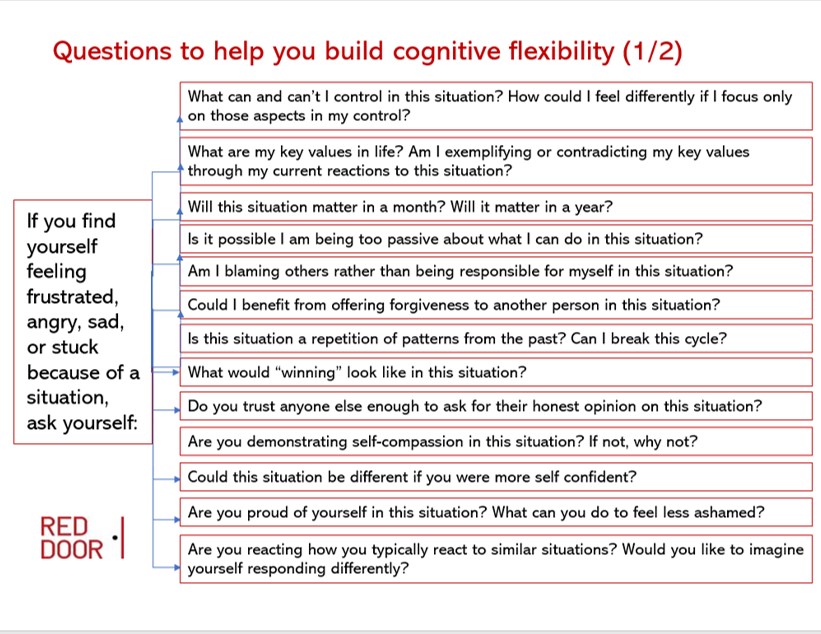
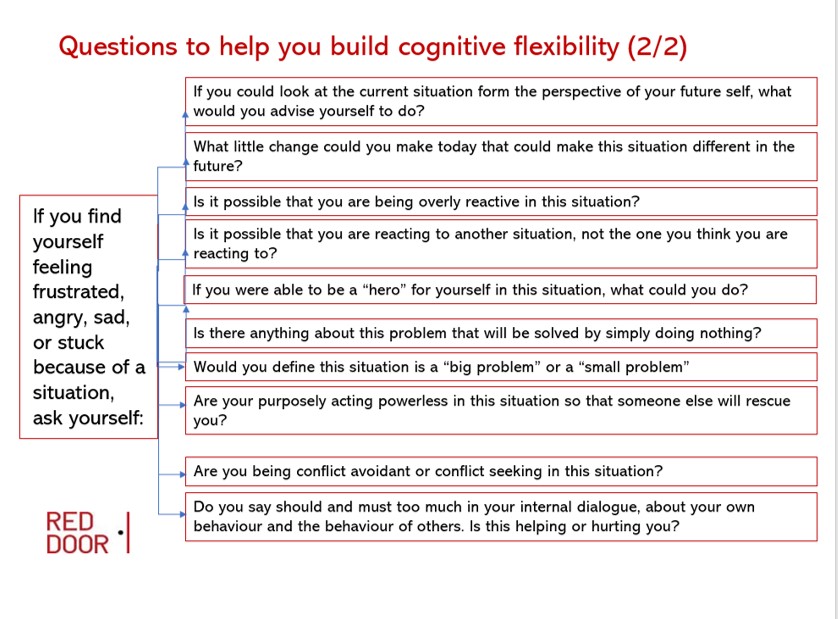
There are a number of questions that help build cognitive flexibility. You don’t have to talk through these questions with anyone else, but it can be helpful if you are open to exploring how tightly you hold onto certain narratives rather than exploring different perspectives.. Counsellors who focus on building cognitive flexibility may ask you some of the questions below.

A few questions that build cognitive flexibility.

  • What would “winning look like in this situation?
  • Will this situation incident be as important in a month?
  • If you had more self-compassion, could you approach this situation differently?
  • Is it possible you are over reacting in this situation?

Sometimes we have too many thoughts and we need to think less. As is the case with overthinking. A specific type of overthinking is rabbit warren thinking. In this situation, you fall from are “what if” catastrophic chasm to another.  People who are guard at risk mitigation in their day jobs are often very good, and well trained, to develop this type of thinking. A type of thinking that might be helpful in one circumstance, can be problematic in another.

Sometimes when we have too many “what if” questions we need to find a way to think less.  In order, to do this I work with clients to remind them to have the confidence that they CAN respond almost every situation. Therefore, you don’t need to constantly worry about identifying the situations in advance. Sometimes we can navigate our way to calm from wherever we land, we just need to have the confidence in ourselves to respond constructively.

Instead of worrying, “What if?”, you can simply tell yourself, “No matter what, I can respond”

Write

When is doubt, write. In am a strong proponent of journalling. I recommend journals with prompts over simply writing an account of your day.

Prompted journals provide a pathway to a deeper understanding of yourself. When we write out our thoughts, we give our brains that opportunity to see our thoughts on paper. This distance allows us the chance to utilise perspective building exercises.

Responding to prompts is a great method to help us build greater cognitive flexibility around incidents in our lives. Sometimes it helps to look at events that have hurt us, in challenging ways. Perhaps even find what we learnt from such situations. This doesn’t mean that we weren’t hurt, or that others have not been careless with our feelings, but also empowers us to take charge of the outcome of situations.

I hope you can consider to take up a challenge, to highlight one or two of these small changes. I promise you, it will have a big impact on your mental health.

—–

Note: part of this content was previously shared as a speech at an event for the the musicians foundation in March 2024.

#change #habits #sleep #creatingcalm #counselling #counseling #talktosomeone #valueschecklist #cognitiveflexibility #perspective #reflection #journalling

About the author: Angela Watkins is a counsellor and psychologist working with adults and teens. Angela has been named best therapist in Hong Kong. To contact Angela for an appointment email angelaw@reddoor.hk or message +852-93785428.

Finding your PRIDE

We’re about to embark on Pride month – thirty days to celebrate and commemorate Lesbian, Gay, Bisexual, Transgender and Queer (LGBTQ+) people, to recognise the impact LGBTQ+ people have had on history and culture, and to acknowledge the past and ongoing adversity the community faces.

Ok, I get it, let’s celebrate!

But why is this important and what does it have to do with mental health?

Well, consider this – 83% of LBGTQ+ people still hide their sexual orientation.[1]

Yes, societal attitudes towards sexual minorities have improved in the last few decades, and yes, LGBTQ+ visibility and rights have made progress. However, studies show that LGBTQ+ individuals, and especially LGBTQ+ youth, still face disproportionate mental health burdens with significantly higher rates of depression, anxiety, and suicidality. This isn’t because these individuals are inherently prone to poor mental health, but because LGBTQ+ people tend to have lower rates of self-acceptance and experience the effects of minority stress.

Minority stress is the chronic social stress that LGBTQ+ people are exposed to day-in-day-out, ranging from prejudice to negative stereotyping, hostility, harassment, rejection, limited rights from laws and policies, stigma, internalised homophobia – the list is long.

All these micro-aggressions mean something, they build and chip away at our self-esteem, our wellbeing, and positive development. This societal stigma, discrimination, and rejection from family and friends contributes to lower rates of self-acceptance amongst LGBTQ+ people, and in turn leads to higher rates of depression, anxiety, suicidality, and substance abuse in the community.

The Rainbow Reality

With these societal challenges, it’s not surprising that the vast majority of LGBTQ+ people are still hiding. However, living a hidden life and concealing one’s true identity is significantly associated with depression and negative psychological wellbeing.

So how do we reconcile with our identity and overcome the shame? How do we manage the stress of living in a society that often doesn’t accept or validate our identities, as well as the trauma of discrimination, bullying, harassment, and violence, plus the potential lack of support and acceptance from family and peers?

Where to Begin?

Changing societal norms is hard, although so many people are doing incredible work to improve equality. Putting this aside, we are able to create change within ourselves and we are in control of the way we understand and respond to our world.

The challenges that LGBTQ+ people face can lead to feelings of isolation, discrimination, rejection, shame, and low self-esteem. Exploring these thoughts and feelings about your identity can be difficult and uncomfortable. That’s where counselling can help, providing a safe space to do the hard work, with empathy and encouragement.

A counsellor can help you challenge your negative thoughts about your sexuality and instead engage in affirmation of your identity, visibility, and validation of your experiences. Evidence-based approaches such as cognitive-behavioural therapy (CBT) can help shift problematic thought patterns, and teach coping skills or alternative ways to think, behave, and react to situations and experiences.

The Road to Self-Acceptance

Regardless of sexual identity, mental wellbeing improves when we feel respected, valued and psychologically safe. Self-acceptance is the act of acknowledging who you are, in all your fabulous and flawed glory. It is an essential part of living a fulfilling life.

Sadly, research shows lower rates of self-acceptance among LGBTQ+ people. Importantly, low self-esteem is unlikely to blame for this lower rate of self-acceptance among LGBTQ+ people. Instead, the adverse opinions, prejudice, and victimization that many LGBTQ+ people face is what poses significant obstacles to self-acceptance.

It’s challenging to avoid internalizing negative society attitudes and ideas when constantly exposed to negative messaging about queer identity. These internalized messages have the potential to lead to increasing self-criticism and negative self-perceptions over time. Our individual lack of self-acceptance is ultimately caused by this social lack of acceptance.

But where to start?

Learn about the LGBTQ+ community, its history, and the challenges still being faced. There is culture and connection waiting for you. Validate and celebrate your identity and the diversity of the LGBTQ+ community. You belong here.

  • Connect with others and build a support system

You are not alone. Find your own LGBTQ+ community, whether through in-person support groups or online. Surround yourself with people who accept you and support you, whether it’s friends, family, or allies. Join in Pride events and affirm your identity.

  • Practice self-care and compassion

Be kind to yourself – we are always harder on ourselves and more generous with others. Take care of yourself physically and mentally. Eat well, sleep well, and engage in activities that bring you joy.

  • Challenge negative thoughts and your inner critic

When we hear things frequently, we start to believe them. Identify your inner critic – that little voice inside your head that tells you you’re not good enough – and tell it to shut up. Replace negative self-talk with positive affirmations. Try journaling to identify problem patterns, reflect, and express yourself authentically.

  • Identify your personal values and goals

Redefine yourself according to your own values. Embrace your authentic self and live your life in a way that feels true to you. Addressing self-blame and shame, affirming your own identity, and validating your experiences fosters self-acceptance and helps develop resilience against past, present, and future adversity.

  • Doing the hard work

Don’t kid yourself, none of this is easy. Finding self-acceptance and establishing a positive identity is difficult, but it is a vital source of resilience. Counselling provides a supportive and safe space to explore feelings, process emotions, and develop coping strategies. It can help LGBTQ+ people better understand their sexual orientation and gender identity, and work through experiences of discrimination or rejection. Finding your pride is much deeper than a month on the calendar, true self-acceptance is key to improving mental wellbeing and a happier, healthier life.

So if you or someone you know is struggling with mental health challenges related to their LGBTQ+ identity, consider reaching out to a counsellor for support.

RESOURCES

Support and Spaces

Communities

Events

About the author: This blog is written by Fiona Travers. Fiona works with adults, focusing on the following areas in her practice: LGBTQ+ challenges. Grief and bereavement. Fertility issues. Couples counselling.

Fiona is a part-time counsellor at RED DOOR who is currently on sabatical. Fiona’s counselling style is informed by two decades creating values and purpose-led brands in the corporate world. She is passionate about helping individuals build personal resilience and find their own sense of self in the world.

RED DOOR is committed to being a gender affirming and LGBTQ+ supporting practice. Contact the Red Door Reception to set up an appointment with one of our therapists contact reception@reddoor.hk or text 852-93785428.


[1] https://medicine.yale.edu/news-article/the-global-closet-is-hugevast-majority-of-worlds-lesbian-gay-bisexual-population-hide-orientation-ysph-study-finds/

Unmasking the Covert Narcissist: Signs to Look Out For

In these times of social media, dating apps, ghosting and gaslighting, the relationship game can be dark and full of horrors. We bump into strangers in bars and swipe right on apps based on just a few photos, and none of them come with referrals or reviews. How do you know if someone is capable of holding a healthy relationship, or if they are about to repeat a toxic cycle with you? When we are over-generous or have an insecure attachment style we can be quick to gloss over any warning signs that aren’t immediately identifiable and obvious. It’s perhaps easy to cut someone off when they are a demonstrable asshole, but what about someone smart enough to know they need to hide their manipulations?

Put another way, how do we spot a covert narcissist?

What is a covert narcissist?

It is not in and of itself narcissistic to put oneself first and prioritise one’s needs over those of a partner. We all have narcissistic traits. Rather, Narcissistic Personality Disorder is characterised by symptoms that include a sense of grandiosity, a lack of empathy, a fixation on how they are perceived by others and a preoccupation with beauty, power and/or success. They can also be resentful and envious, simultaneously believing others should be envious of them. NPD is a pervasive pattern of behaviours stemming from all of the aforementioned personality traits that ultimately impacts all areas of a person’s life and functioning.

Unlike a standard narcissist, a covert narcissist is higher in intelligence and savvy enough to know that their behaviour must be disguised lest society considers them ‘bad’. Overt narcissists tend to be louder, while coverts tend to be passive aggressive. Because the covert’s superiority complex actually stems from a sense of inferiority they lack self esteem. This is why, to boost their self-worth, it is extremely important to them that everyone sees them as the ‘nice guy / girl’. Thus they are more subtle in their psychological games and manipulations.

Coverts disguise their mistreatment as well-intentioned. They cultivate their image carefully to ensure no one will believe stories of their poor behaviour. If a narcissist is a 12-gauge shotgun, a covert is a pistol with a silencer attached.

The Facade

Before we go into the signs to look for, it’s important to understand where their behaviour originates from: a deep and urgent need for people to see them as an ‘amazing person’ at all cost. They are extremely preoccupied with their reputation and thus carefully develop a facade with which to interact with others. The covert’s most effective tactic is to play either the victim or the saviour.

The Victim. Being the victim generates the sympathy and attention they receive so they will wallow in self pity for as long as it is advantageous. Their stories have been spruced up to the point you might be shocked at how they have tolerated being so poorly treated by such awful people. They were so generous! So Kind! So taken advantage of! They sigh and mention that they’ve been treated like this several times. Being the victim also gives them a chance to martyr themselves in a demonstration of sacrifice.

The Saviour. There will be public displays of selflessness and generosity. Would a bad person do all these nice things? Would a bad person do so much for others? Would a bad person be so spiritual? The covert will grandly and publicly step up to save or help others. These grandiose performances are important in building and maintaining their public image. It also helps them wriggle out of any accusations of abusive behaviour from their ex’s.

Early warning signs

  1. They force connection quickly. Some examples include love bombing, mirroring or premature oversharing. This is to create an intense bond in an attempt to ‘lock you in’ far sooner than is normal. If you are dizzied by their romantic gestures, you are far more likely to tolerate their puzzling or abusive behaviour down the road. Narcissists cannot abide being rejected; they need to be the one that leaves, so they overwhelm you with commitment to ensure they are in control of when to end things. Love bombing is when they litter you early on with grand statements about the future, with declarations of adoration and commitment. They talk about a long and happy life together, almost at inopportune moments. You will be amazed, grateful and feel oh-so-lucky that they are falling head over heels for you. It can sound like, “this could be our last relationship”, “our children are going to be so beautiful”, “This is it, you’re the one.” “You should move in with me” or “how many children should we have?” and so on. Mirroring is when they reflect what you say to act as if they share your values, likes and opinions. This is to make you think “wow we have so much in common!”, whereas in reality this is a protocol for synthetic connection in the absence of a meaningful one. Premature oversharing is when the covert tells you deep, dark secrets that should be reserved for the closest of friends and family. This moment of vulnerability is designed to woo you into a false sense of connection, because they trust you! You’re different! They’ve confided in you! They will also make strangely-timed requests for intimate information about you; one minute you’re having a laugh then the next they suddenly gaze into your eyes and ask you when was the last time you cried. It will feel disjointed and inorganic, just not quite at the right moment. The covert had the line in their head and was waiting for an opening to use it on you.
  2. Prematurely buy you gifts or do big favours. Related to love bombing, the covert narcissist will buy generous gifts and do you extraordinary favours far too early in the relationship. Some can be very grand. Perhaps it’s a spa day, perhaps it’s a pair of shoes, or perhaps they volunteer to run a particularly time consuming errand for you. The key here is that it is far too early to engage in this behaviour and usually there is some public element about this (they will gift you in front of your friends, or tell their friends what they do for you). On top of seducing you, this also becomes ammunition they can use against you later. In their recantations you may very well become a ‘user’ or a ‘gold digger’, just like all their exes.
  3. All their exes wronged them. While overt narcissists will trash their ex’s without nuance, the covert narcissist is clever enough to throw in one or two generous comments towards their ex, so the covert doesn’t look unreasonable. Look out for whether all of their ex’s wronged them somehow, and whether the covert describes them contemptuously. “She was a really nice girl, but really self conscious because she wasn’t as educated as me and my friends.” It could look like “I can’t blame him for using me for my money, he wasn’t used to having any.” It can take the form of a compliment; “oh you’re so good at cooking! My ex wasn’t. She just didn’t have that sense.” Why do this? Because you will want to prove you are nothing like their ex’s.
  4. They’re ‘not like the other guys/girls’ The covert narcissist isn’t like all those other painfully average or awful people. They’re better than them! They’re nicer! Funnier! More sensitive! Unique! This desire to outflank rival men or women stems from their innate insecurity, which is conveyed as a superiority complex.  It can include them saying they are deeply empathetic, spiritual, an ally or a tomboy, and include a great deal of therapy-speak; but always includes not being like ‘the others’. Notice when they make dismissive criticism of a group of people or if they like to point out that they are a unique flower in a sea of mud. It could sound like, “oh she wasn’t used to being treated well by guys until she met me.”

Warning Signs in a Relationship

What if you’ve progressed past the dating stage and you’re in a relationship? It can happen to the best of us. For those of us who glossed over the warning signs it’s often because we talked ourselves out of our gut instinct. Maybe you’re in a vulnerable place right now, or maybe the covert triggered an insecure attachment style. Either way, here’s what to look out for:

  1. They can’t stop lying. They say all the right things but their actions don’t quite match their words. You keep catching them in small insignificant lies. They might tell you that they love you but they avoid holding your hand in public. There are exaggerations, bragging, and stories that make them look like a hero or a victim, but you find out later they weren’t quite true. They might squirm or ‘not remember’ when you ask them to be straightforward or to clarify a few details. Their lies might be complete fiction or based on a half-truth. Their actions leave you feeling confused and uncertain, and if this is paired with them telling you that you’re imagining things it can be very unsettling. It’s within these lies that the covert uses devaluation, gaslighting and triangulation to create the crazy in you. Phrases they might say: “I never said that”, “I don’t remember that”, “I think you have memory issues, you get confused really easily”, “wow your recent trauma has given you some real trust issues, you keep imagining I’m lying!”
  2. They insult you in a roundabout way. Smart coverts won’t insult you or others directly, they’ll use other peoples voices to do so. At first they may say that their friends are uneasy about you, then move to more overt criticisms ‘from their friends’. You will be unsure why their friends have a negative view of you, and you won’t be able to think of any moments you’ve offended them. But the covert will tell you they’re on your side against all their friends who dislike you. They might use your past against you (“Oh! I didn’t think someone like you would date women like that. That’s surprising”). Now you’ve become deeply insecure and desperate to keep this relationship afloat, against all the unwarranted criticism. Phrases they might say: “Katie is concerned about me. She thinks you’ve moved too fast”, “Gary thinks you have anger management issues” , “Jana thinks we should break up”, “my friends have noticed you’re really insecure”, “none of my friends like you, even though I tell them how great you are.”
  3. They dismiss your concerns. If and when you bring up an issue, share a need or express that they have hurt you, they scoff and say the issue is imagined. They may say it’s not a big deal or they dismiss it altogether. If you persist, they may say that you are responsible for their reaction, so really it’s your fault. You might have heard of the narcissist’s prayer? That didn’t happen. And if it did, it wasn’t that bad. And if it was, that’s not a big deal. And if it is, that’s not my fault. And if it was, I didn’t mean it. And if I did, you deserved it. – Dayna Craig Phrases they might say: “I didn’t realise you were so sensitive,” “I’m sorry that you misunderstood me,” “you’re overreacting,” “Oh I was just joking. I guess I’ll never joke around you ever again,” and “I only did xyz because you made me do xyz!”
  4. They’re surprisingly judgemental. For someone that fronts as empathetic and kind, they sure are critical about others. These comments can seem out of place or overly harsh and disguised as comments from other people. Usually they are reserved for anyone the covert is jealous of. They’re obsequious and overly-humble to important people (a boss, for example), but horrendously rude and dismissive to ‘unimportant’ people (a retail worker). Again, the covert insults people through others voices. Phrases they might say: “Oh, I heard only sluts are friends with Trish,” “Some people say Dave doesn’t deserve his job,” or “I’ve heard people say Tim isn’t a good leader.”
  5. When they mess up you comfort them. When they are in the wrong they become so self-deprecating that you end up comforting them (or even apologising!) instead of having them apologise to you. Did they get caught in a lie? It’s your fault because your response to their lies is ‘too much’ so they’re now afraid to be honest. Did they ditch an important event? You just don’t understand their stress levels right now, in fact you’re stressing them out. Did they stand you up? Well now they feel like the worst person in the world, and they’re just miserable that you’re upset they wronged you. At first you might think “wait why are they upset at me? didn’t they make the mistake?” but as time goes on and your self-esteem begins to crumble, you may find yourself apologising to them for causing them stress, or trying to comfort them so they don’t feel like a ‘bad person’ for wronging you. It might sound like: “Oh I guess I’m just the worst person in the world then,” “I only did that because I was scared of your reaction,” “I’m disappointed you have such a low opinion of me,” “I try so hard to be the perfect partner but I guess I’m just a terrible person.”
  6. They weaponise therapy. They seem like such sensitive souls. They’ve shared intimate details about their emotional pain, vulnerability and fears. They’ve done all the self-help work, read all the books, attended therapy and even joined self-discovery workshops. They have an extensive therapeutic vocabulary. They have harnessed the language of therapy to insult, shame, control and gaslight you. They act sensitive and fragile to distract you from the lies they are spinning or the damage they have done. They will demand a non-negotiable respect for their boundaries but have minimal or zero respect for yours. They throw around ‘bipolar’ to silence you. They use the secrets you’ve confided in them against you. They will use the entire dictionary to convince you that you are completely insane and need help just so they can get away with their lies. And if they can’t squirm out of it (i.e. been publicly busted) then they will tell you that they need you, and ask you to be responsible for their progress. It might sound like: “you always think I’m lying, it shows how severely you need therapy.” “You believe Steve over me? You are really broken and have trust issues.” I never said that, you made that up – you have a lot of self-reflection and work to do.” “You need to fix yourself before you date.” “You need to keep me accountable. Will you help me become a better person?” “I’m really disappointed you asked for a time out during our fight. I guess you don’t trust me enough to talk about issues.”
  7. They try to obliterate your reputation, friendships and finances. When the relationship gets rough or you go through the ‘break-up and make-up’ cycle, they will tell anyone and everyone that you are crazy, a user, an abuser, a gold-digger, bipolar, and the list goes on. They will beg you to never leave them, then they will tell others that you’re refusing to move out of their home. Some of these lies will be complete fiction, others might be based on a half-truth. You’ll start to wonder why their friends are so unfriendly. You’ll have discovered your partner said something terrible (and untrue) about you to several people, but when you confront them they deny all knowledge of it. This can include trying to paint you as mentally unwell amongst their social circles, as violent, or even try to sabotage you to people who know your colleagues and clients in an attempt to ruin you financially. Their dream is to be so influential that your clients fire you, mutual acquaintances choose the covert’s side, and you lose all future potential love interests.
  8. You’re engaging in reactive abuse. ‘Reactive abuse’ happens when victims are provoked until they react in kind to their abuser. It can look like yelling, being insulting and contemptuous, or even physical assault. Coverts want you to react so they enact warfare and push you to your limit to get you to snap, which they will then use to label you the abuser and they the victim. The covert will stay calm in an argument and act superior and condescending. They will not raise their voice (because how can it be abusive if they never raised their voice?). They will instead rely on devaluing tactics such as cruelty, insults, sarcasm and mockery. They will take your words and twist them beyond your recognition. They will tell you that you have imagined what they said or did. When you begin to raise your voice, the covert has won. Now you’re yelling at them! Now you’re being abusive! You’re irrational! You’re hysterical! They weren’t even yelling, and you can’t be reasoned with! You’re crazy! This abuse is insidious because it is difficult to identify and describe. The covert will never show this in public where they are the model of a great partner. They believe that as long as they speak softly no one can call them abusive. This can look like physically looming over you, asking non-stop for you to slap them and blocking you from leaving. But once you react, even slightly, they have the ammunition to tell everyone you beat them to the floor. Now you’re the violent one.

Woah I think I’m dating a covert narcissist!

If you think you are in a relationship with a covert narcissist, know that you are not crazy. Keep in mind that coverts try to lower your sense of self-worth so it becomes hard for you to leave them, because you feel you have nothing without them and would have no one without them. Covert’s actually have a strong fear of abandonment; they want to be the ones that leave when they’re done with you (I’m sure you’ve noticed they come crawling back if you break it off first) so stay strong in your resolve to end it.

If you need help ending a toxic relationship you can contact Kirsteen (the writer of this piece) for therapy centered around relationship wounds and break ups. We will do the work to raise your self-esteem, perform assertiveness training and look into your childhood family dynamics to understand what about your past experiences leave you vulnerable to toxic relationships. You can also reach out to your friends and family, rebuild your community (such as starting or re-starting hobbies) and journal what a loving and healthy relationship looks like to you, so you know what you do want.

When to seek counselling

If you find your feelings of sadness, hopelessness and apathy are overwhelming you then counselling would also be beneficial. If sad feelings start disrupting your daily life (cancelling plans, withdrawing from friends, calling in sick to work) or if you cannot see a way through this then counselling can also help. Counselling can help you build your self-worth to make it possible for you to choose yourself. It can help you lead a happier and fulfilling life by building your confidence and mapping out how to build a social support network.

Disclaimer

This blog is not intended for those in dangerous situations where one’s physical safety is compromised or at risk. If you are in danger please delete this blog from your browser history and contact a trusted friend, law enforcement official, lawyer or charity for help. You can also click here for a list of women’s shelters in Hong Kong.

About Kirsteen Thain – the author. .

Kirsteen Thain is a solution-focused psychotherapist and counsellor who provides individual and couples counselling, with specialisation in treatment support for body dysmorphia disorder, body image and appearance anxiety. She also treats interpersonal & relationship issues, insecure attachment, break ups, family of origin issues, low self esteem, people pleasing and assertiveness training, body image, anxiety and depression. To book a session with Kirsteen email reception@reddoor.hk. or send an SMS whatsapp to +852-93785428.

Other blogs about Narcissism from RED DOOR.

Divorce Missteps

Over the past 7 years I’ve supported a lot of individuals, particularly women, as they proceed through divorce. As a relationship counsellor I also work to help couples who wish to avoid the divorce process. I’ve learnt a thing or two about what makes the ending of a marriage better, or worse, for the parties involved. Its hard to watch people make mistakes in this journey, choosing actions that often make emotional recovery harder in the long run. If you are willing to learn the mistakes to avoid, here are some of  missteps that we encounter in helping navigating the divorce process.

Misstep 1: not being aware of your rights

Seeing a lawyer is expensive. However not knowing your rights in a divorce is a potential landmine. Without decent legal advice you run the risk of receiving careless and incorrect information about what you can negotiate in a divorce. Do not be threatened by your ex that, “We don’t need to use lawyers, we can just do this ourselves”. Often such statements precede unfair negotiations. Knowing your rights is your right, and is a must.

Misstep 2: Accepting divorce advice from your ex-partner instead of a professional

I’ve lost count of the number of times I encounter clients who accept what their ex-partner tells them what they are entitled to in a divorce. Your soon to be ex-partner does not get to define what your divorce outcome will look like.  This is particularly an issue in codependent relationships where one partner is used to listening to the advice or demands of their romantic partner without challenge. Seek legal advice. An initial consultation should suffice for you to better understand what you are entitled to fight for, and if it is in your interests to do so.

Misstep 3. Not considering or committing to couples counselling

As a couples’ counsellor we often encounter couples trying to decide if they should divorce or stay together. Counselling can help repair your relationship, in certain circumstances and it looks good to the court if you have tried to repair your relationship.

If you are BOTH willing to do the work, relationships CAN recover.

Relationships cannot recover when there is an ongoing affair or one party is continuing the divorce process at the same time as the counselling process. You can’t amputate a leg and reattach it at the same time. Coming to counselling to collect dirt on your partner does not work. Experienced couple counsellors will see through those tactics, and will often call them out. Counselling is used to see if sincere recovery can be made.

Misstep 4. Telegraphing your wants instead of negotiating.

It may sound contradictory to not communicate what you want out of your divorce. It is important that you don’t show “all your cards” until you are ready to make a deal.

The process of divorce is essentially a negotiation. In any negotiation you want to know what your adversary wants, before you let them what you want as part of your divorce settlements.

It may seem tempting to explain, “I just want a basic settlement and full custody of the kids”. But if you do this, you will have just told your ex what matters to you most. Do yourself a favor. Learn about negotiation skills, as if your life depended on it. Because your lifestyle going forward, does. I particularly like the teachings of Chris Voss on negotiation, and have clients who have used the Chris Voss negotiation techniques to break the patterns of fruitless negotiations that they had fallen into.

Misstep 5: Jumping into a new relationship too quickly.

The feelings of rejection often associated with divorce can be extremely painful. It can be tempting to avoid those feelings by jumping into a new relationship as fast as possible. This is a misstep.

Firstly, you need to heal from your previous relationship, not simply avoid the pain. I know this sucks.

Secondly, the impact of a new relationship can influence your negotiations in your divorce. If you have a partner who could be assumed to be paying some of your rent may impact your financial settlements.

Thirdly, children may be negatively impacted by your new relationship. It can be tempting, if you’ve fallen in love with another person, to rush into playing “happy families” with your children and your new partner. You chose your new partner. Your children didn’t. Sometimes children see the new partner as the reason for your marital breakdown, even if this wasn’t the case.

Resist the temptation to involve your new partner in your children’s lives, and even better, take a break from dating in the early months of your divorce.

Misstep 6: continue the conflict communications rather than seeking distance.

If you have had a relationship that has been full of conflict, and if you are used to constant conflict, you might be tempted to continue your continual arguments throughout your divorce process. I would argue, that it might be wise to explore an alternative to constant fighting.

If you had got along with your ex-partner, you probably wouldn’t be divorcing them. The declaration to divorce, can mean that you can STOP fighting. It takes only one party to stop fighting. Just stop. This might mean blocking your ex-partner, so that you don’t communicate with them, except through your lawyers, or only via slower communication channels such as email rather than immediate messaging platforms such a WhatsApp.

Involving your lawyers in all of your interpersonal conflict is a double-edged sword. You may need to use your lawyer to tell your partner to stop harassing you. But if you want the fighting to stop, you have to also agree to stop communicating with your ex-partner. Using third parties or apps to communicate such a parent coordinator person or app (such as the Family Wizard) can help break the cycle of conflict communication.

Misstep 7: Triangulation of children

It is very tempting to involve your children in your divorce. Bringing your child into divorce understanding or negotiations happens fairly often. After all, you are hurting and it would be helpful to you if they can see how much pain your ex-partner is causing you. This is a mistake. Your child is entitled to continue to enjoy their parental relationship without your experience influencing their view of their parent.

You don’t win if you turn your child against their other parent. All that happens is that your child loses. They lose the impact of that parent in their life, rather than the impact of your ex-romantic partner on you. They may begin to feel responsible for your emotional state – a reversal of the parent child relationship. Additional triangulation does not pay often pay in the long run. As children mature they will start to observe and appraise your behaviour throughout your divorce.  Later on, children do not appreciate the perception of being manipulated during divorce and this can be one of the reasons that they become estranged from their parents when they grow into adulthood.

You don’t have to hide your pain from your child. Be mindful not to involve them in understanding your pain to the extent that they feel obligated to champion of you. It isn’t fair. It isn’t healthy, for your children. They deserve to have two parents to love if this is being offered.  

Misstep 8: Allowing others to define your value.

Those going through the divorce process can feel diminished. Their marriage is over. This often feels bad, and it is common to feel feel like you have “failed”. Your ex-partner may extend those feelings of failure by telling you that the reason your marriage failed is because of your personal “failings”. They may even feel entitled to judge your competence as a parent.

Most of the women in our support group have been told that they are bad mothers. In every case I’ve encountered such accusations appear grossly misplaced. For those vulnerable individuals, being judged so harshly by their ex-partner can really be a blow. Remember these commentaries are often a  tactic to make you feel bad, and not based in reality. Especially the reality of your children.  You need to know your value, financially and personally.

It is time for you to know your value for yourself. Your value as a person is NOT determined by your ex, or anyone else besides yourself. Its time for you to work on you, so that you know who you are. Don’t let anyone else attempt to define your value. This is an area that people often seek counselling to help them overcome.

Misstep 9: Bad habits lead to compromised ability to cope, and vice versa.

Habits help build your health and over the long term determine how well you can navigate the divorce process. Regular self-medication, especially through alcohol, will erode your ability to cope. Conversely taking a positive approach to habits and your health at this time will be extremely helpful. Exercise, rest, sleep, eat healthily, all of these will help you better survive what is an incredibly stressful life event.

Misstep 10: Doing it alone.

Whilst many people feel ashamed that divorce is happening, the worse thing you can do is feel ashamed and remove yourself from support.

Even I have been delightfully surprised by the amazing value of group support during divorce.  Iron Fairies, our therapeutic support group for women going through divorce is seen as an amazing resource by all of the active members. Each of the women in the Iron Fairies is navigating their own divorce journey, and may feel trapped by their personal struggles, but at the same time, understand the challenges faced by other women, and amazingly suggest creative pathways forward for others, even when they feel ‘stuck’. Being able to help others, reminds group members that we all feel undone sometimes and that we can eventually navigate through these very uncomfortable circumstances. Having a friendly group to vent to can be extremely cathartic, especially if one of the expectations of that group is that you will continue your journey forward, at a glacial or racing pace.

Misstep 11: Wrongful resource allocation

There are a number of resources that you may involve in your divorce journey including a financial adviser, a lawyer, an accountant, a counsellor, a mediator, your family, a support group, and friends. It will be an expensive waste of time to use your lawyer as your counsellor. At a typical cost of USD 1000 per hour, you want to use your time consulting your lawyer as cleverly as possible. Save your crying time for friends, a support group, or a counsellor.

Additionally, divorce is a topic that many people have experience of, and have opinions about. Legal advice from friends can be completely wrong. They have no real obligation to ensure that the action or information they give you is in support of your rights. Please check your legal position with legal professionals.

Misstep 12: Allowing drama to impede or knock you off course.

It is quite possible that you ex will try to get you to delay or even stop the divorce process. Not because they want to reconcile, but because they want to delay or derail the divorce process for their own personal, and sometimes, financial ends. It takes quite a while for people to decide that they need to divorce their partner. Once this decision is made, please try to keep the divorce process moving forward.

You ex may try to delay you by making deals or threats such as, “Let’s meet and see if we can work this out between ourselves”, or, “If you proceed with the divorce I will do x, y, z.”. Ex- partners may try to derail the process by blowing up bombs to distract you from the momentum of divorce. For example, they may accuse you of having affairs, or acting in harassing fashion, or even being a poor parent. Don’t fall for these distractions if they are unfounded.

Once you have made this difficult decision to end your marriage, move steadily towards the exit. You can master the change that needs to happen, rather than allowing your ex-partner’s agenda to master you.

You CAN survive the divorce process. Especially if you avoid some of the pitfalls that make the journey more challenging.

Colour yourself calm.


colouring pix

You possibly enjoyed colouring pictures when you were a child. It is something you can revisit, with benefits, as an adult.

The current popularity of adult colouring books celebrates a return to encouraging our creativity, and embracing the sense of calmness that colouring can offer.

5 Reasons to colour:

Stress Reduction:  The mental focus which is required when colouring pictures – selecting colours, staying inside the lines, considering balance – can induce a meditative-like state. The heart rate is reduced and breathing becomes more calm. The repetitive nature of colouring calms even the busiest minds. Try it for just 10 minutes a day (with no distractions) and check how you feel afterwards.

Age Defying. Both physically and emotionally. It is good for you emotionally to play occasionally, and colouring is a form of such play. Additionally colouring helps to maintain manual dexterity, which is essential to growing older gracefully.

Boost Creativity. Break out of any creativity rut using colouring. Even if you do not think of yourself as an artist, simply selecting colours and designs helps to unleash a heightened connection to your ability to think creatively. Be ready for new ideas!

Brain Development. Colouring helps to develop greater skills of concentration and focus. Furthermore, both hemispheres of the brain are engaged, giving your brain a good ‘workout’.

Mini break. Colouring can create an mini break to calm and centre a person, even if you are feeling ok at the moment.  If you are experiencing anxiety, depression, obsessive compulsive tendencies, or difficulties managing stress, psychological research supports the use of colouring as a part of the therapeutic process.

You may also be wondering when is the best time to start colouring. There really isn’t a bad time to try colouring as a calming technique. I recommend that you give it a try the next time you are stressed, pressured, or feeling run down. At those times,  a colouring activity should help you to collect yourself. You might also consider colouring before your bedtime. Since watching TV and playing on devices has been associated with poorer sleep patterns, colouring could create a more relaxed mind-set, setting you up for a deeper, more refreshing night’s sleep.

I encourage you to try colouring, just for 10 minutes and day, to assess what calm and focus regular colouring can help you achieve.

_________________________________________________________________

Angela Watkins is a psychologist and counsellor at RED DOOR Counselling in Hong Kong. Her current clinical work focuses on parenting, family life, parenting SEN children, anxiety, OCD, career change, stress management and divorce. Angela has been named HK’s top therapist.

Anxiety Attacks – Emergency responses

Living with anxiety feels as if you are inhabited by a monster constantly whispering about your fears, insecurities and your worthlessness, your inevitable failures and the catastrophes which you can’t avoid and are probably creating. It is estimated that 13-14% of people in Europe [1] live with anxiety. One symptom is anxiety attacks. Some people only realise that they have been suffering from anxiety when they experience such an attack.

An anxiety attack differs from a panic attack. It is usually a response to a stressor – often a thought or feeling or specific dread. People feel apprehensive and full of fear. Their hearts may race and they may feel short of breath. Often people feel out of control and may become extremely tearful. A panic attack may include some of these symptoms, but usually occurs without a clear stressor. Both can be terribly frightening. If you experience anxiety attacks it is important that you are prepared with an emergency response.

Here are my favourite techniques to respond when anxiety attacks.

Try this exercise when you feel anxious.

Breathing exercises – Listen to the pattern of your breath when you are anxious. It can give you a clue as to how best to respond to your anxiety. If you are hyperventilating – taking fast, shallow breaths, feeling faint, and fearing that you can’t catch your breath, try to breath into a paper bag. Breathing in and out using a paper bag will recycle air, returning carbon dioxide to the body, which will naturally make the breath deeper and slower. Do this for a minute. If you don’t feel better, try again for another minute.

If you are not hyperventilating, you can use the calming breath technique. Breathing exercises such as those used in yoga classes are effective in reducing anxiety. One simple exercise I use with clients uses counting inward and outward breaths to calm the mind. Simply breathe slowly in through your nose for a count of 4, then breathe out of your mouth for a count of 4. Repeat. Then breathe in through your nose for a count of 4, and out of your mouth for a count of 6. Repeat. Then breathe in through your nose for a count of 4, then breathe out of your mouth for a count of 8. Repeat. Check to see if you feel better. If you don’t, repeat the exercise again, concentrating on the sensation of your breath.

Distraction exercises. Distraction exercises help your parasympathetic nervous system override an anxious reaction. By simply refocusing your energy to elements of your environment and allowing your underlying operating system to return to homeostatic (ie regular) breathing.

Use your senses to help calm your breathing

The most commonly used therapeutic technique asks the client to engage their senses to distract their busy minds. Identifying a number of items you can see, smell, hear, touch and taste can help you reset your body. Imagine 5 things you can see, then 4 things you can hear, then 3 things you can smell, then 2 things you can touch, and 1 thing you can taste. Then monitor your breathing again. Has it become less panicked?

Since we work with a number of teens and children at RED DOOR we also use the RAINBOW technique, often with our proprietary rainbow fidget toy, to help teens achieve quick calm. One can perform this technique without the fidget toy. Simply you count objects in your near vicinity which are specific colours. You can count the number of objects, or a specified number of objects that are red, orange, yellow, green, blue and black.

Distraction and can also be created with some physical “reset” activities such as repeatedly snapping an elastic band against the wrist or performing sets of 10 jumping jacks.

Meditation/Relaxation – Mediation, when practiced regularly, can help people reach a relaxed state more easily. Practice makes progress when it comes to mediation. If you are experiencing an anxiety attack, try to find somewhere to sit quietly or lie down. Then try progressive relaxation, also known as a body scan, which can be especially helpful. Progressive relaxation soothes as you tense and relax muscles – isolating and focusing exclusively on one group of muscles at a time. Begin with your toes, and work up through your muscles to your head, where you may focus on relaxing the muscles around your chin and eyes.  Guided progressive relaxations are available on Spotify, YouTube, and on CD.

Imagery – In the throes of an anxiety attack use your active imagination to help your de-stress. First, isolate the location within your body where you feel the greatest sensation of anxiety. Use imagery to help unwind and relax that spot. Cute, warm, and amusing imagery will be of the greatest help. If you feel tension in your shoulders imagine a collective of kittens massaging the knots away. If you feel butterflies in your stomach – imagine yourself in your stomach with them, asking each to settle on your arms and flutter no more. One client recently expressed her fear of butterflies, so, using imagery, we collected the butterflies and they turned into Golden Retriever puppies, ready for a cuddle.

This mantra might help with your negative self-concept

Mantras – Anxiety attacks are created by dreadful thoughts running through your mind. One way to settle these thoughts is to repeat a mantra. While there are mantras on the internet, you may benefit from one that you write specifically for yourself. The mantra should be full of words of kindness, understanding and love. The words “should” or “must” cannot be part of any mantra.

Centre yourself with art therapy techniques

While avoidance is not a long-term technique for managing anxiety, if you are ruminating or feeling a panic attack, distracting yourself with a change of scene or activity can help. Go for a walk, particularly in nature, to reset yourself. Try colouring, which I have detailed in a previous blog [https://reddoorhongkong.wordpress.com/2017/03/06/reasons-to-colour/ ], which involves both sides of the brain, stimulates creativity, and can help to calm the mind.   Even listening to some upbeat tunes at this time, get up and dance, just break the pattern of your anxiety for a moment to reset your emotional clock.

Talk to your anxiety – The long-term cognitive approach to anxiety is to create an internal dispute. Disputing your anxiety helps you reframe situations, see hope, and utilise self-compassion. If you experience anxiety ask yourself to challenge your view of the stressful situation – have you been overgeneralising, personalising, or catastrophizing? Is there an alternative way of looking at this issue? Sarah Wilson[2] , in her compendium of suggestions to utilise in one’s challenge with anxiety suggests an ancient adage, “ First make the beast beautiful”, meaning accept that your anxiety – it is something that originally may have been created to help you, but overtime has started to inappropriately misfire. When you make the anxiety beast beautiful you may say to yourself, “Thank you brain for alerting me to potential danger, but I know I am safe right now, you can go back to your guarding post”.  Developing the process of dispute is an area of action where a therapist can be of significant help. If you cannot create this dispute for yourself, utilise the resources of a counsellor. For more information see our post on this topic https://reddoorhongkong.wordpress.com/2020/09/07/talk-to-your-anxiety/

Prolonged anxiety is extremely challenging to your health. If you have been struggling with anxiety for a while please seek the help of a counsellor or a doctor. They may recommend a combination of therapy and even medication to help lessen your anxiety. There is no shame in needing help. Take charge of your future.

Everyday is a new day for you to thrive. Start gently, start now.

 #mentalhealth #mantra #mindfulness #anxiety #reddoorcounselling #selfhelp #anxietyattack #treatmentanxiety #women

Sources

1: Prevalence –

2004: The ESEMeD/MHEDEA 2000 Investigators,2004, Prevalence of mental disorders in Europe: results from the European Study of the Epidemiology of Mental Disorders (ESEMeD) project

2011: https://www.theguardian.com/society/2011/sep/05/third-europeans-mental-disorder

2: Sarah Wilson, 2018, First we make the beast beautiful: A new journal through anxiety. Dey Street Books

__________________________________________________________________

Angela Watkins is a psychologist and counsellor at RED DOOR Counselling in Hong Kong. Her current clinical work focuses on parenting. relationships, anxiety, OCD, career change, stress management and divorce.

Breaking free from narcissistic manipulation.

We rarely see narcissists in person in the counselling setting. More often, the client in the chair, the person coming for counselling, is seeking understanding or support because of the actions of another person, and the other person may be a narcissist.

If you have had the misfortune to have been in a relationship with a narcissist, you may understand this situation.  The counselling client, the narcissists dance partner, comes to counselling because they have lost almost all sense of themselves, they have been broken down and recognise that they can’t seem to make their partner happy, or get what they need from their relationship. Their partner may have told them that they are ‘crazy’, and that everything difficult in the relationship is their fault. They will have been told that the relationship is exceptional, unique, only they, can really, understand each other. Rather than a compliment this language is used to separate the dance partner, from reality and other sources of realistic support. After all, “Other people aren’t like us, we are special and as such, you need to prove this to me constantly”. If this sounds like your relationship experience, read on, you may he been dating a narcissist.

These days, it seems everyone is being accused of being a narcissist, and there may be some truth in this assertion.

In a world where we are encouraged to regularly display our best selves on social media, we can become rather self-involved. Social media and reality shows encourage narcissistic behaviour. Narcissist are very concerned with their image and like attention. Additionally, we are often socialised as to our unique or special nature. Whilst each of us is different from one another, if you have been raised to believe that you are different in a way that makes you superior to others, rather than simply not the same, you may have crossed the line and become narcissistic.

One can be mildly or moderately or extreme expressions of narcissism. If you have mild narcissistic tendencies these may be a product of one’s emotional development and can change over time. When we refer to a proper “Narcissist”, those people have not only a tendency to express most narcissistic traits, and especially those indicating desire for authority over others, and sense of superiority, and this is consistent over time.

There are various online assessments of narcissism. They are not fully diagnostic tools, but may help you understand how self-involved, or needing of adoration you are on a narcissistic scale.

If you would like to assess your own level of narcissism we have tried and our comments on those tests. It is my personal preference to explore those who provide rating style questions rather than either/or suggestions because more subtle preferences can be counted, and discounted accordingly.

Characteristics of narcissists.

Whilst this is not a diagnostic checklist, you may find that a narcissist has many of the following traits:

  • Unrealistic grandiose sense of self image. Remember Narcissism was once referred to as “megalomania”.
  • Speaking mostly about themselves, reinforcing a narrative where they are superior to others or under-appreciated.
  • Incredibly self-centred with lack of empathy for others.
  • Value power and fame for themselves.
  • Arrogant.
  • Think the rules don’t apply to them.
  • Demand constant attention or adoration.
  • Constantly look to promote themselves.
  • Highly sensitive to criticism, yet at the same time…
  • Quick to criticise and judge others.
  • Feel special and unique, and probably superior to others.
  • Feel entitled to have the best of what is on offer.
  • Will respond with dysregulated emotional responses when questioned – extreme anger, sulking, punishment.
  • Avoidance of personal responsibility for their poor reactions to situations.
  • Deceitful and manipulative.

A true narcissist will exhibit most of these traits, not just one or two.

Narcissists lack empathy and are often quick tempered. As such, they frequently use manipulative techniques, such as gaslighting, to take advantage of others. Whilst not all people who gaslight are narcissists, narcissists almost always use gaslighting as one of their tools to control people in their lives. For more on gaslighting see our blog on surviving gaslighting highlighted at the end of this article.

For the person in a relationship with the narcissist there are innumerable costs, especially to their self-esteem. If any of these situations seem familiar, consider if you need to break free:

  • Narcissists refuse to take responsibility for their actions so be prepared that most problems you have will be your fault. You might hear dialogue such as, “You made me so angry when you accused me of lying. Sure, I came home late and you didn’t know who I was with, and when I told you that I was out with Tim, you said that you were told that he was already at home by his partner. I can’t be responsible for your lack of trust in our relationship. Actually, you need help!”
  • Narcissists’ sense of grandiosity means that they cannot reflect on their own limitations. They may even lecture you on a topic that they have little knowledge of. Be prepared to encounter several lectures not based in reality.
  • You will become confused if your relationship is healthy, or actually really damaging. Narcissists use techniques such as love bombing to win you over. They may tell you that you and they are soulmates and that you are destined to be with each other. This ‘sounds’ like your relationship is superior to others. Don’t fall for this manipulation. It takes time to develop real trust and intimacy. True emotional intimacy cannot be rushed. If you fall for this, later you may find these techniques turned against you as a means to control you. For example, “I thought we were soul mates, but apparently you can’t give up an evening with your family in order to stay home with me. I guess I was wrong”.
  • Narcissists dismiss other people’s achievements. If you succeed your narcissistic partner may dismiss your achievement as luck, or even take responsibility for your success themselves.
  • The world rotates around the narcissist and their self-image. Acts of kindness will need to be acknowledged effusively. They may plan your birthday party, but everyone at the event will know and they will expect you to make a speech publicly stating your appreciation.  
  • A narcissist will be sensitive to any form of criticism. It is unthinkable that the world around them is failing to understand their greatness. If told that they need to reconsider their behaviour, consider alternative ways of performing a task, they will react quickly, often with anger. They may obsess over plans for vengeance and revenge. This will not usually directly be applicable to their partners, after all they choose you because they believe that you are adoring, however your family, your friends or, even your counsellor, may become candidates for such retribution, if those people dare to raise questions over the narcissist’s behaviours.
  • A narcissist may become very sensitive if you are not providing them with enough praise. In this instance they may consider insufficient admiration as a form of criticism.
  • Rules do not apply to them. Narcissists can break social rules because the typical rules do not apply to them.
  • They will often brag about their connections, popularity, and perceived importance. It is important to them that others see them as superior.

How do you spot a narcissist?

You have to be watching – both them and yourself.

In essence a narcissist is a control freak who needs to orchestrate the feeding of their compulsion for adoration and attention. As such they will use a variety of manipulation techniques to establish that you will be feeding their insatiable appetite for attention.

You can use the above list or narcissistic traits, and set of scenarios to think about if your partner is a narcissist. If you are with a narcissist, it is also because they have been able to manipulate you. You are their chosen partner in a dance of control and manipulation.

Take a good look at yourself. Narcissists are attracted to people they can manipulate. Individuals who are people pleasers, are overly empathetic, are conflict avoidant, who often seek the approval of others instead of relying on their own self-confidence, and generally have self-doubt are more likely to be the chosen partners of narcissists.

If you believe you have some of these traits, you may need to work on yourself. Self-help programmes and counselling could help you build better boundaries and protect your mental health.

How to break free from a narcissist?

Many a meme will tell you that you need to go “No contact” with a narcissist. Essentially life with a narcissist will have you questioning reality. “Up” is only up, if they say it is. As a consequence, individuals coming out of narcissistic relationships are often very confused about what is real, and how to make decisions for themselves. Freeing your mind of the pollution of narcissistic manipulation requires that you break contact with the person muddling the environment to create an atmosphere dedicated to their need for attention.

In a formal recovery process, your counsellor will want you to take charge of your decisions and own your own feelings. You can be okay, even if someone around you is not okay. Only by owning your own decisions in life, and understanding that you are not the source of other people’s happiness, can you truly break free from being susceptible to narcissistic manipulation in future.  

They will want you to reconnect to reality without the narcissist. You have been conditioned to see the world, and particularly other people, including yourself, through a lens that the narcissist provides. You need to start seeing the world through your own eyes again. Discussing what you like, what makes you comfortable and uncomfortable, and rediscovering your sense of self.

Your counsellor will encourage you to spend time rebuilding yourself – separate yourself from what you have been told to ‘do’ or ‘be’. Spend some time considering what makes you feel good about yourself, what actions and activities help you feel strong. You determine who you are and what you do. The narcissist will have installed themselves into the centre of your world. Once you have dislodged this parasite, you have to install yourself as the master of your life.

In addition, your counsellor will encourage you to develop new networks checking yourself to stop repeating co-dependent patterns from the past. New contacts should allow you, even encourage you, to make decisions for yourself. Friends that repeatedly tell you to go back to the narcissist possibly don’t see the manipulation at play. If those contacts cannot respect that you need to separate from someone dominating you, t term mental health build a supportive, sane, network – you may need to build a completely new network separate from the people connected to your narcissistic partner. Don’t go back to the narcissist, simply because others cannot see through the manipulative tactics being used.

If you would like to break free from narcissistic manipulation, consider counselling. You need to have a trained and trustworthy advisor, who can help you become your own person again. You want to build yourself into an independent thinker again. So that you can avoid falling into the trap of another narcissist in future.

About the author

Angela Watkins is a counsellor working out of RED DOOR Counselling in Hong Kong. Angela works with adults and teens on a variety of topics including identity, relationships, trauma, , anxiety, change, and family of origin issues.

Learn more about gaslighting: https://reddoorhongkong.wordpress.com/2023/01/26/surviving-gaslighting/

Non diagnostic tests for narcissism

https://www.mind-diagnostics.org/narcissism-test

https://psychcentral.com/quizzes/narcissistic-personality-quiz#1


Your mental health matters – protecting your mental health in a world experiencing a mental health crisis.

Hong Kong’s mental health crisis has escalated dramatically since the COVID-19 pandemic, but alarmingly, troubling trends were already in motion. The World Health Organization now estimates over 1 billion people worldwide battle mental health conditions requiring support, underscoring an urgent global concern (WHO, 2025).

Locally, data from the Hong Kong Jockey Club Centre for Suicide Research and Prevention at the University of Hong Kong reveals a grim reality: suicide rates in Hong Kong have surged more than 22% since 2011, with suicide tragically the leading cause of death among those aged 15 to 24. A startling 1 in 4 youths in this age group face mental health challenges, with academic pressure topping their stressors, followed closely by work demands. Nearly 20% experienced suicidal thoughts within the past year (HKFP, 2023).

The workforce is also under immense psychological strain. An overwhelming 87% of Hong Kong employees report feeling stressed, with one in five describing this stress as unmanageable (Cigna 360 Hong Kong Well-being Survey, 2025). Work-related pressures, uncertain futures, and social isolation are key contributors, especially among young professionals and Gen Z, the most affected demographic facing elevated anxiety, depression, and burnout.

Mental health is far more than the absence of illness. The WHO defines it as a dynamic state of emotional, psychological, and social well-being that enables people to cope with everyday stresses and thrive. It exists on a continuum, shaped not only by challenges like job loss or divorce but also by positive transitions such as marriage.

Recognizing warning signs early is critical:

Physical symptoms like racing heart, fatigue, muscle pain, or sleep disturbances often signal unmanaged stress activating the body’s fight-or-flight response.

Emotionally, mood swings, irritability, persistent sadness, and feelings of hopelessness warn of deeper struggles.

Cognitive red flags include overthinking, poor concentration, and decision-making difficulties.

Socially, withdrawal, loneliness, and changes in interaction patterns indicate potential burnout.

The urgent takeaway: mental health demands deliberate, daily care. It’s essential to check in regularly with oneself—acknowledging feelings, understanding limits, and crafting protective strategies. Self-care isn’t indulgent; it’s vital. Simple habits like scheduling downtime, practicing mindfulness, engaging in positive self-talk, and nurturing sleep can fortify resilience.

Stress management is equally crucial—setting boundaries, saying no, breaking tasks into manageable chunks, and celebrating small victories help keep stress from becoming overwhelming. Lifestyle choices matter too: regular exercise, outdoor time, nutrition, hydration, and conscious digital detoxes bolster mental resilience.

Lastly, nobody should suffer in silence. Seeking support from trusted friends, family, support groups, and mental health professionals is a sign of strength, not weakness. Talking about struggles makes them more manageable—a truth captured by the saying, “What is shareable is bearable.”

Hong Kong’s mental health landscape not beyond hope. With awareness, proactive care, and compassion—for oneself and others—individuals can move from merely surviving to truly thriving in these challenging times.


The counsellors at Red Door are here to support you if you are not sure who to turn to or would value objective and unbiased guidance. Alternatively, below are a selection of resources and hotlines in Hong Kong to support you in starting a conversation. Please share this and help to raise visibility so that this information can reach more people.

Alcoholics Anonymous Hong Kong

https://www.aa-hk.org/

9073 6922

Emotional Support Hotline – The Samaritan Befrienders

2389 2223 – Mon-Fri 6.30-10pm (English)

2389 2222 – 24 hours (Cantonese)

Suicide Prevention Hotline – The Samaritans

2896 0000 – 24 hours (Multilingual support)

#worldmentalhealthday #mentalhealthawareness #mentalhealthsupport #mentalhealth #wellbeing #selfcare #stressmanagement #anxietyrelief #breakthestigma

About the author.

Contact the RED DOOR reception to set up an appointment with Tanya. reception@reddoor.hk

References

Cigna. (2023, November). 2022 Cigna 360 Global Well-Being Survey [Press release]. https://www.cigna.com.hk/iwov-resources/docs/en/about-cigna/news/2022-Cigna-360-Global-Well-Being-Survey-Reveals-9-in-10-in-Hong-Kong-are-Stressed-and-Burnt-Out-EN.pdf

Mok, L. (2023, May 12). Up to 25% of young Hongkongers have suffered from mental health disorders, HKU research reveals. Hong Kong Free Press. https://hongkongfp.com/2023/05/12/up-to-25-of-young-hongkongers-suffered-from-mental-disorders-hku-research-reveals/#:~:text=inHong%20Kong-,Up%20to%2025%25%20of%20young%20Hongkongers%20have%20suffered%20from%20mental,stress%20from%202019%20to%202022.

The Samaritan Befrienders Hong Kong. (2023). The Samaritan Befrienders Hong Kong 2022 annual report: Empowering the inner-self. https://sbhk.org.hk/wp-content/uploads/2023/07/2022-Annual-Report-2.pdf

World Health Organization. (2022). COVID-19 pandemic triggers 25% increase in prevalence of anxiety and depression worldwide. https://www.who.int/news/item/02-03-2022-covid-19-pandemic-triggers-25-increase-in-prevalence-of-anxiety-and-depression-worldwide