ADDICTION 101: Breaking Free

addictionFor most people, irrespective of whoever they are and whatever they may have done in their lives, understanding addiction is difficult. People define and think about addiction in very different ways, depending on their experiences and point of view, leading to a vast array of theories about potential causes, and approaches to the treatment of addiction.

Features of addiction include compulsive behaviour, lack of control and proliferation of harm in many, if not all aspects of that person’s life.  Addiction is present in many peoples’ lives, and in a many different forms.  It may be related to substance abuse or compulsive behaviours, and range in strength from mild to severe.   Patterns of addiction can change depending on life stage, and behaviours may be time-limited, intermittent or persistent.

The causes of addiction can be influenced by any number of biological, psychological, social and cultural factors, and are perhaps as unique and individual as the person they concern.  It’s a complex issue and so not uncommon to feel troubled, baffled and frustrated when trying to find ways of dealing with the situation.

The good news is that much can be done to try to improve the situation.  If you think you might be struggling with addiction problems yourself or are worried about someone you know, here are some important things to remember.

You are not alone Help is often available.  Healthcare providers are a good place to start learning about addiction and the types of help that are available.  Healthcare websites will often signpost to additional sources of information.  There may support groups that work in your area, or you may know people that have struggled with addiction in the past.  Talk to as many people as you can, and find out what advice and support can be accessed online and face-to-face. For adults in Hong Kong, support groups exist such a Alcoholics Anonymous, Narcotics Anonymous, SMART recovery. Whilst we don’t have as many groups as may be available in the US or the UK, in response to COVID, many support groups have moved online. If you look online, you may be able to join a support group for your particular addiction or compulsion based elsewhere. .

Share the load.It is important that the person with addiction, and people close to them, acknowledge that there is a problem and work together to find a way of managing the situation in the long and short term. Rather than one person working to solve the challenge, there is a team. Remember there will almost certainly be occasional setbacks and unexpected developments, but don’t give up, accept that the path may not be as you originally planned, but your destination remains the same.   Think about other people who can be of support you at times like this – maybe family members, friends and specialist support groups.  Just as we might surround ourselves with others who have similar addictions as part of maintaining our addiction, think about spending more time with people who have healthier coping strategies and a positive approach to life.  Look around for role models that can inspire you in your path away from addiction.

Manage your expectations –  Don’t be too disappointed if a one-size fits all, simple solution fails to materialise.  In most cases, addictive behaviour will be the result of combination of factors, individual to that person, and will require a holistic and bespoke approach. Your path out of an addictive situation may need to be as unique as you are.

Consider the underlying issues  People may turn to substance abuse, or other unhealthy behaviours, as a way to cope with undiagnosed developmental or mental health conditions, environmental stressors or negative patterns of thought.   Addictive behaviour may be symptomatic of unknown or unacknowledged struggles. It is worthwhile to think about your needs – those that have been met and those that remain unmet – so that you develop a plan that is beyond your compulsive behaviours, but makes you feel more whole and functional in the long run.

Think about potential development opportunitiesMost people will experience a hedonistic rush at some point in their lives, and although like the sensation, will not go on to develop addictive habits.  Evolution equipped us with a need to seek out pleasure and minimise pain, but unfortunately not everyone has the ability to control their behaviour all the time, and in every situation. Sometimes, we all need a little help to develop important coping skills such impulse control and self-regulation. At the very least forgive yourself your past failings, and think about what you would like to do differently in the future. The past is like a distant country with the border closed, it cannot be changed, but your future is yours to determine.

And finally, keep your eye on the prize.  Recovery from addiction may be a long and ongoing process but if successful, more than worthwhile.   Feeling free to enjoy all that life has to offer, and having the confidence to deal with the inevitable challenges, in much better and healthier ways, just might be the best gift you can give to another yourself, and your loved ones.

Suggested links:

http://www.nhs.uk/Livewell/Addiction/Pages/addictionhome.aspx

https://www.healthdirect.gov.au/what-is-addiction

https://www.samhsa.gov/find-help/national-helpline

#reddoor

#addiction

#recovery

#alcohol

#mentalhealthessentials

#mental health 

Future success is no accident. Preparing for the future of work.

Following the COVID-19 impact on the world economy and, as such, the world of work, we expect a number of downsizing activities to increase. Are you ready to shore up your job, or plan for a new career, should the need arise.

future of workAs psychologists, the team at RED DOOR sat down to explore some of the trends and consider how we can better prepare ourselves, our clients and our children, to face the future of work with courage rather than fear?


The rise of the machine

Within the plethora of reports on the future of work, there is one resounding gloomy forecast – potential future unemployment. Oxford researchers, Frey and Osborne’s 2013 report, “The Future of Employment” explored the likelihood of different professions being taken over by computer algorithms within the next 20 years. They estimate that 47 percent of jobs in the US are at high risk.

Jobs as we know them, may soon to be a thing of the past. Automation of our job functions, potential loss of employment to machines, disenfranchisement and potential loneliness for those who cannot adapt, and difficulty to even secure an initial step into the world work for many young adults, are frequently predicted features detailed in reports of the future of work.

Bloomberg Businessweek rated the job automation risk for hundreds of jobs – another interesting analysis (link at end of this blog) . Many jobs, especially those which do not require university education, are at risk. Even jobs requiring a degree are at risk. For example, whilst Human resources managers may have a less than 1% chance of having their jobs automated, but human resources assistants, the step below manager, are rated as having have a 90% possibility of their job being automated by machine. Many occupations seemingly face significant chance of change – Financial advisors 73%; Marketing specialists 61%, Lab technicians 94%, insurance underwriters 99, and accountant/auditors 94%.  Some professions face smaller risks and these industries may be the preferred industries for tomorrow’s students – some low risk jobs include special education teachers 1.6%; physician surgeon >1%; engineers 1.4%; and CEOs 1.5%. One-job-for-life already is a trend of the past, but soon one-career-for-life may soon be as well.


Human resistance

Psychological research helps us to understand that preparing appropriately for stressful events minimises the negative impact of that stress.   Being mentally prepared is half the battle to beating fear over the future of your work.  It simply boils down to the memorable words of Franklin Roosevelt, “The only thing we have to fear is fear itself”. Once we break down the future of work into potential helpful activities and thought patterns, employees and parents can better prepare the changes ahead.


8 ways to build future success – recession proofing your career path 

1)    Become a portfolio poster child

The concept of a job for life is already in declining, now even one-career-for-life is no guarantee. How are people suppose to come to terms with this new era of uncertainty?

One solution exists in the practice of reframing (turning negative commentary into positive thoughts). For example, in the future most employees may become portfolio style workers, working project by project, in much the same way a freelancer may work today. The difference from today is that this will be the norm rather than the exception.  Change of attitudes can take time, so some of the negative attitudes that society may hold toward work which is project based, discontinuous career paths, periods of unemployment, may take time to change. You are poster child this process of change.  Be brave, don’t be dictated to by out-dated attitudes.

Reframing circumstances will help so that you remain at the psychological helm of your career. Instead of viewing yourself as cast adrift, imagine yourself as the captain of your new enterprise, of the company called YOU. As such every project adds some new skill or learning to your growing corporation. Your new goal establishes YOU into a constantly growing, preferred partner for any project that comes to the market, which is now global rather than local.

Also remember that employers will also be affected by this uncertainty. Employees will have flexibility to “vote with their feet”, and then hit with a big stick if they are unhappy. Every disenchanted employee has a voice as loud as their personal network (virtual and otherwise), and the growth of rating websites such as glassdoor.com which detail employee’s negative (and positive) experiences, will be a growing concern for employers. Soon ratings of employers will be as common as ratings of employees.


2)    Be a brand ambassador for YOU

In a heavily interconnected world, one person can drive significant dialogue, a relatively new phenomenon. In business, we often silence our public personas least we attract negative attention to our employers. As workers become their own brand, their individual voices, capabilities, online personality become important brand elements. We already see avenues such as LinkedIn becoming popular job candidate search engines, and this is set to continue.

In addition to the image that you build online which employers can find, you need to maintain a positive mental framework about yourself and your ability. Building positive self-perceptions is an essential component of resiliency under uncertainty. You may consider reading the work of optimism and happiness researcher Martin Seligman, or thought reframing expert Albert Ellis. These psychologists teach how to change the thinking processes behind your current circumstances and use techniques to help move people out of their self-defeating, self- limiting or pessimistic thought patterns. If you want more help, seek a counsellor, as much of our work addresses this phenomenon.


3)    Net-your-work

It won’t be what you know but who you know that will be important in the future of work. As individual brands, portfolio workers, our networks, virtual and otherwise will be extremely important. It’s time to brush on the key elements of social skills, your best elevator pitch, friends you can lean on, and connections you can learn from. This is not a time to be shy and reticent. Remember you may never meet your employer or co-workers in real life.  The future of work contains risks of loneliness as we become separated from face to face interaction, building your self-esteem and confidence will be extremely helpful, to continue to build positive connections.


4)    Mobilize for mobility

Work environments have become completely virtual. You you may never meet your co-workers on Zoom. Workers will be truly independent of work places. This trend will affect you greatly if you have traditionally made your closest friends within work environments, or you need a lot of hand holding to get achieve project goals. If you tend to make most of your friends at work, start thinking now where you will build future friendships. If you have needed a lot of support and reinforcement there has never been an easier time to find a mentor, virtual or otherwise, get onto LinkedIn and start shopping. It may not be your work boss, as it may have been in the past.

Additionally, platforms for selling work are expanding – see upwork.com; indeed.com; and of course, LinkedIn, now you are part of a global workforce. The world of work is actually becoming bigger.


5)    I before A, rather than A before I.

Much of the reports on the future of work that have been published have highlighted the use of AI (Artificial Intelligence) to replace the work of humans. Much of the hope vested into AI focuses on the eradication of disease and poverty and the conquest of climate change. However even whilst AI is still in its infancy, it not hard to see which direction the wind is blowing in terms of changes to human employment.  Computers will play an increasingly important role in our professional lives, particularly in areas where large amount of data is analysed in order to decide on actions such as medicine, accountancy, marketing, and financial products.

Thomas Friedman, suggests that we need to think of the aspects of Intelligent Assistance (IA) that will be part of our job experience. Embracing this technology is an essential component of securing your job future. Surrender nostalgic perceptions of the “good old days”. Look into your industry and how technology is advancing and enabling, and learn to harness the tech that is being developed to play a role. Taking charge of this change helps protect you from being replaced by technology altogether.


6)    Consider your resilience and motivation.

Friedman suggest that the motivational divide will be a stronger predictor of success in the evolving world of work, rather than the digital divide. The digital divide will decrease as we embrace technology and also it becomes simplified by ‘drag-and-drop’ software. The really important component is motivation, and I believe even more, resilience.

Psychological research into human motivation implies that the highly motivated and lowly motivated  are not driven by the same forces. When we construct measures to address low motivation in the workforce, the result is a workforce which is neutral, not highly motivated. Highly motivated people are driven by internal factors such as desire to accomplish goals, and a drive to achieve more. Hygiene factors such as finances or health care are not enough to drive the highly motivated. What gets you out of bed to get to work now? If you are driven only by your pay check you may look to guides on self-motivation to prepare yourself. If you don’t know where to start a counsellor or a coach may help.

Resilience is an aligned skill to motivation –  you are resilient you are better able to face the stressful slings and arrows that one encounters in a lifetime.  In order to assess your current level of resiliency take our checkup test in the attached blog. https://reddoorhongkong.wordpress.com/the-resiliency-rx-check-in-to-check-up/ . Both resilience and motivation can be taught, to children and adults. Don’t give up.


7)    Commit to becoming a Life-Long-Learner

The question we frequently ask children, “what will you be when you grow up?”, will soon become redundant. Friedman in his latest book, “Thank you for being Late”, suggests that one cannot be a lifelong employee if you do not commit to be lifelong learner. As lifelong learners, we will constantly be reshaping our capabilities and knowledge. We won’t achieve the aforementioned “grow up”, stage. Rather the new question will be, “what career do you plan to tackle first?”

Training and upskilling will be continuous and our careers will change with this. Think about what could help you adapt to the future of work – learning a new language, technology, communication style. Courses are available on key sites such udacity.com and various open university sites, and even specific universities for older individuals such as the University for the third stage: http://www.u3a.org.uk.


8)    Personal performance metrics

The future of work is less about you performing KPIs (Key performance metrics) and more about you achieving your personal performance metrics. Having a well-rounded view of success in work, and life, will be essential in the future.

If financial recompense is your only current measure of success, you may wish to take a moment to think about what really matters and makes you happy.  We need to judge a job, and ourselves, by broader metrics including success at projects, the activities we do in our free time, our sense of purpose, how we contribute to family and society, what makes us happy, what we are passionate about. Work is one element of what you do and you can no longer summed up in a business card.


Ready, get set, go.

The race toward the future of work is already in progress, you can be prepared, so start to tackle this to do list. Fear of the future of work can be overcome. In the immortal words of Mark Twain, “Courage is the resistance to fear, mastery of fear, not the absence of fear”.


angelaw@reddoor.hk; http://www.reddoor.hk

#futureofwork

#motivation

#workfromhome

#resilience

#redundancy

#counsellinginhongkong

#reddoorcounselling

#careergoals

#occupationalstress

#stress


Other great articles about career change

Face career change with courage. You can do it

https://reddoorhongkong.wordpress.com/facing-career-change-with-courage/


Future success is not an accident. Prepare yourself for the Future of Work

https://reddoorhongkong.wordpress.com/2017/08/09/defeating-fo-fow/


How to respond to career crisis

https://reddoorhongkong.wordpress.com/2018/07/11/start-me-up-responding-to-career-crisis/


Work stress – manage stress for Lawyers.


https://reddoorhongkong.wordpress.com/2019/11/27/work-hard-stress-harder-understanding-the-experience-of-stress-among-senior-lawyers-in-hong-kong/


——————————————————–

Further reading

Bloomberg Businessweek article on job automation.

https://www.bloomberg.com/graphics/2017-jobs-automation-risk/

Frey and Osborne’s survey on the future of employment

http://www.oxfordmartin.ox.ac.uk/downloads/academic/The_Future_of_Employment.pdf

McKinsey report on technology and jobs

http://www.mckinsey.com/global-themes/employment-and-growth/technology-jobs-and-the-future-of-work

PWC report on workforce shifts forecasted.

http://www.pwc.com/gx/en/services/people-organisation/publications/workforce-of-the-future.html



The Making of a Focused Mind: The Benefits of Mindfulness

mindfulness

The Making of a Focused Mind: The Benefits of Mindfulness.

When our mind is full and busy, a feeling of calmness seems impossible to achieve.

A peaceful calm mind is more able to creatively tackle the challenges that life presents in our life path.

People have been practicing mindfulness for thousands of years.  Unfortunately, there have been relatively few formal academic studies conducted on mindfulness practiced by teens and children when compared with adults. The handful of studies into the benefits of mindfulness suggest generally positive effects including decreasing anxiety and increasing cognitive performance.  Four reasons to consider mindfulness training for children and teens include Firstly a greater self-awareness and the ability to self-regulation, the development of compassion  and stress management skills and  finally a needed break from screen time and an introduction to a new perceptive . Of course, the development of healthy practices in youth helps prepare individuals for the stress and strains of young adulthood.

Self-awareness and Self-regulation – leading to stronger ability to take charge

Mindfulness helps to develop greater personal awareness. Its practice teaches youth to be more aware of their thought processes and reactions in the present moment. So instead of racing ahead in a negative thought cycle a child is more likely to be able to think in a more removed manner, noticing patterns in their reactions and being able to view situations in terms of their typical reactions and the potential costs and benefits of those reactions in the past. This ‘mindful overview” promotes understanding of being in charge of one own emotions and behaviours. This also encourages children to have a stronger sense of their own responsibility and ability to take charge of situations – including their studies and friendships.

Compassion and the attraction of personal ethics 

The practice of regular mindfulness/meditation can promote compassion. Having the ability to be compassionate with oneself is just as important as being compassionate towards friends and family. Having compassion and empathy is associated with stronger resiliency and emotional intelligence which are now considered very important skills in the job market.  In developing compassion for others and self, children are asked to reflect on their own values and identity. Reflecting on research conducted by the University of Michigan, Dr Michele Borba indicates that having a strong sense of personal ethics is considered an advantage to demonstrate in key university applications and interviews.

Understanding anxiety and stress

During mindfulness practice students are taught to tune in and listen to their bodies, how it feels, where they feel tension, and how to release tension in specific areas. This skill is extremely helpful when understanding how each individual process and holds stress within their bodies. Being mindful of the presence of anxiety and stress in the body is associated with stronger stress management skills during latter years.

The end of a love affair: Breaking children’s devotion to screen time and social identities.

Technology has had a huge impact on the day to day lives of our youth.  Computers, Mobile Phones, iPads, online TV providing 24/7 entertainment, and are altering children’s experiences during their formative years. Today’s youth have access to instant information (and misinformation) which is something particular to this generation.

While ‘screens’ have many benefits they also place new demands on youth that can have negative effects. The developing brains of youth are potentially negatively affected by some issues raised by a frequently or constantly online lifestyle.The practice of mindfulness can help to mediate some of the negative impact.For example, the impact of social media on youth culture and perceptions of self. Mindfulness asks children and teens to experience their reactions to postings and requests and be able to be more reflective of the communication taking place and its worth to them. Whilst screen time increases, face to face interaction, and the ability to manage real world emotions and empathise with others can be reduced. The practice of mindfulness promotes personal understanding and knowledge, and an greater empathy towards others rather than artificial connection.

Additionally, whilst learning mindfulness practice students are challenged to fully experience each moment of their lives, through all of their senses, and to question those instances where they are performing activities which are simply distractions from experiencing life ( for example surfing the net, likes, games etc, which are essentially bubble-gum for the mind). Mindfulness encourages participants to look within and observe what sensations they might prefer to have instead of those experienced (or avoided) during screen time. Awareness of activities and how these activities contribute to our enjoyment of life, is helpful in making a decisive shift to activities with greater life experience impact.

#reddoor

#teenmentalhealth

#mindfulness

#screentime

#anxiety

Walking on sunshine – get the most out of your vacation

How can you build stronger mental health during your vacation.

The RED DOOR team have the following 5 suggestions to help you walk on sunshine during your vacation :

Reduce, reuse, rejoice: Often we simplify our lives when we travel, less things, we reuse and wear items again and again. This time is valuable to consider what is important and how we can create a life involving suffocation by stuff-o-cation. Enjoy having less, and ask yourself, does having things (as many as you have at home) really give you satisfaction, or are you satisfied with less than you expect. It’s a wonderful situation to reflect on. Sometimes in simplifying our stuff, we also find simplicity.

Do more of what makes you happy: Spend time thinking about the things that really make you happy in life. When was the last time you felt happy? Does it involve time with friends, accomplishing a project, sitting and reading a good book, conquering a mountain (or at least a sand dune). Now that you are out of the hustle and bustle of the city, and the associated frenetic desire to be constantly busy, take a moment to list the 5 things that have made you happy, and think about how you are going to increase those instances in your life when you return. Make a plan. Write it down on a postcard, and send it to yourself as a reminder when you get home.

Play, and all its benefits, await: There is something to be learnt from the animal kingdom. Even animals who live in demanding environments, where they compete for food and the opportunity to mate, still find time to play. As children, we inherently understand the need for play, in all its purposelessness. Neurological research indicates that play (in children) is associated with better sleep and brain development. As adults, we have may have rationalised away the need to play, potentially to our detriment. According to research, even for adults, play can boost creativity, improve relationships with people, foster trust, is associated with better mood, and serves as a relief against stress. Break out a colouring book, go outside and run around with your pet, or kid (or both), break out the clay, or set up some board games. See if you can build up yourself, and some positive memories as well.

Say sorry for the things you said in Winter: when the sun is shining and you are relaxed, take a moment to think about things you may regret to have done when you were stressed or feeling under the weather. Can you consider sending an apology to someone you have treated unfairly. Can you even consider forgiving someone who maybe even doesn’t deserve it, simply to move the weight of this situation from your psyche? Sometimes it seems impossible to apologize, or forgive, but ask yourself if holding on to this hurt is holding you up? If you can’t forgive the object of your hurt, then at least spend some time forgiving yourself for wanting a situation to be different that it was, or is. Then, let the sun rise on a new day when you potentially feel “over it”.

Have the greatest summer romance of all. Fall in love with yourself again. Write 5 affirmations a day about things you did WELL during the day, or positive feelings you had. Start a journal entry with “when I love myself, I will …”. Forgive yourself for being human if you made mistakes. Every day is a chance to start a new.

For those of you dashing out of town, have a great vacation, be renewed, get replenished. Enjoy.

If you have feedback on this blog, or would like to learn more about establishing happiness habits, overcoming hurts and learning to care for yourself, please email Angela at angelaw@reddoor.hk

All Write Already! The Psychology of writer’s block.


All write ready

ALL WRITE ALREADY!

“I should write a book about my life”, “I definitely have at least one book in me”. How many times have you heard such statements from friends, or even said them yourself (guilty!).

According to a recent article by the BBC on the future of artificial intelligence suggests, that by 2049 artificial intelligence programmes will be able to generate a potential bestselling novel without human help. You have 30 years to be that unique voice before the proliferation of synthesised selling sensations.

Despite this apparent deadline, most of us cannot, or have not, produced our book. Instead writer’s block, scribe-suspension, author-angst, and poet-procrastination, abounds. There are a few psychological reasons for this, and I wanted to tackle some so that we can all, finally, rise to our keyboards and drown the world with a thousand voices.

The greatest story never told: Psychological elements of writer’s block
The Perfection Inflection:

Writing is perhaps one of the only professions where you don’t need a special licence, training, certificate, or even your parents’ blessing, to perform. All you have to do is write. For those with perfectionist tendencies (and there are many) there-in lies the problem.

The promise of the novel, the untold story, has the potential of being the greatest novel never written. Once you commit to putting words on a page, the bubble if burst. What sits on the page, is now a statement of your capabilities, your values, your standards. It is a reflection of you, and as such, can be judged. We respond by retracting deep to our creative-ego protecting shell, suspending the actual writing so that we can ponder the organic nature of our novel even further. After all, you can’t fail if you don’t try. You can’t be judged on something others have not seen, and therefore don’t really have the intellect to fully appreciate.

I believe that perfectionism is one of the great psychological challenges of our time, it stops people from being all that they can be, and attempting success because of the potential cost of failure. Imagine what you could do if you knew that you could not fail? Then imagine that failing does not matter, because in reality, it often does not. If people are going to judge you, they will do so if you write a book, or you don’t. The only critic that really exists is the one self-embedded in your head that whispers to you, in moments of weakness, that you are not good enough and that if you ‘fail’, you are unworthy, and maybe even unlovable. It’s time for you to put that voice and fear to bed, or even better, into the trash. Just think what you could accomplish if you didn’t need its permission. Quite simply, you don’t.

The Busy Priority :

“If only I had the time to write, but I am just so busy”. I fall foul of this common excuse myself. I am forever busy. Busy sorting out my kid’s school homework and activities, the house, the dogs, the cats, my wardrobe, work, cooking, talking with clients, going to work, coming home from work. So, so busy,that I don’t have the time to write. Does this sound like you? Then stop and perform a brief audit of your time. In Hong Kong in particular “busy” is a commonly lauded badge of honour. We love to be considered busy. But ask yourself, “What am I busy doing?” Once you have a list of the activities in the day, audit them. Do they make you happy? Are you doing too much for someone else? If so, why? No really, WHY? Can you section off 30 minutes a day to sit and write? If not, is it because writing is not important to you? If writing is important to you, and you are important to you, then you can find the time. If you aren’t important to you, come and see me, we need to sort that out! 😉

Defying Discipline:

Having read several articles and books about writing books, the number one predictive skill required to produce a book is, wait for it, writing on a regular basis As Anne Lamott details in her wonderful book, Bird by Bird, a book is the product of producing is one paragraph after another paragraph, one chapter after another. The magic of being a writer, is in the discipline, not the mystery. Can you be disciplined? If so that is wonderful, so get cracking. If you can’t, then that is also interesting. Are you defined as being a rebel against routine. If this describes you, then in a moment of quiet, can you ask yourself, “Why?”. Perhaps it is because you are a free spirit and what to float with the tide, or is there something else underneath the freedom surface. Is this, perhaps another form of perfectionism, the book I won’t write is the best book ever. Unfortunately, the book you don’t write is just that, the book you don’t write.

Ready, steady, write.
And now for the good news. You can move past these barriers by using some of the educational and psychological tools (with OR without the help of a counsellor to help you overcome your perfectionism).

Writing a book is estimated to require 500 writing hours. Even if you write 1000 words a day it will may take a minimum three to four months to produce a 75,000 word book. It’s a daunting task.

Break free from writer’s block.
Set Interim goals and rewards:

Setting small goals, breaking down your writing into smaller components will stop you feeling overwhelmed by the task at hand. Small rewards after every 30 minutes of writing, and every 2000 words will keep you motivated. This is the basis of every successful behavioural star chart, and if you set this system up properly, will help keep you motivated as well.

Limit distractions:

Turn off the phone. No email. Writing isn’t easy (and may sometimes be extremely hard) so force yourself to stay focused until your 30 mins, or 500 words, or whatever your interim goal is, has been completed. Whilst many people think that multitasking makes them more effective, efficiency experts advise do one thing at a time and give it your full focus.

Make it public:

Public posting and sharing of goals has been used in many psychological research studies to increase or decrease specific target behaviours. Make your goal public and you have made a statement that you are willing to measure against your goal. Form a writing club, set goals together, or set up an executive writing board, who you need to report back to regarding your weekly or monthly achievements. This invites supportive pressure into your writing life and schedule. In addition to holding you accountable to your promise to yourself, you will quite possibly receive more from this support than you expected.

Write naked:

Metaphorically, not literally. Write from your soul, do not worry about perfecting your first draft. Just write. No one is watching, no one is judging. You don’t need to show anyone what you have written until you are ready. So often when we start to talk or write the automatic thoughts that we have trained into our psyche start to judge and calculate the potential catastrophes that may occur if things are not perfect. Be naked, write unencumbered, let the words flow, and worry about dressing it up later.

Now hopefully you are ready to start you book. All you need to do is get out of your own way. I look forward to hearing about your progress.

Feedback on this blog, or questions about perfectionism and motivation can be addressed to angelaw@reddoor.hk


#perfectionism

#reddoor

#writersblock

#writing

#mentalhealth

FOMO! Read this now!

FOMO

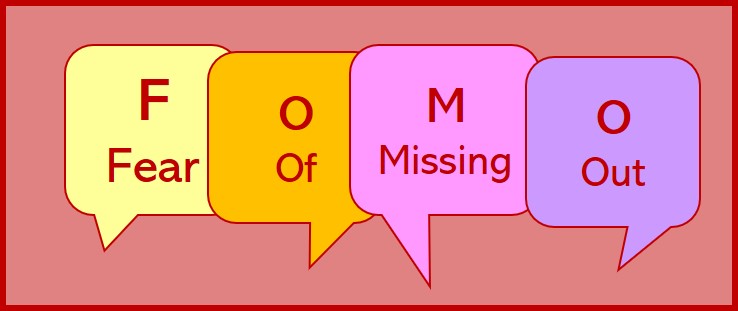
Gotcha. Don’t worry – it turns out you are not alone. Many people suffer from “Fear of Missing Out” (FOMO). No wonder – thanks to social media, we are constantly being berated: “Subscribe! Keep up to date with the latest! Download the app! You’re missing out! Save money! Make smarter choices! Have smarter kids! Dress better! Eat better. Live longer!”

While social media provides more opportunities to connect to others, it offers so many that we simply cannot manage them all. We each have to give some of them a miss. But some become caught in FOMO, defined as “a pervasive apprehension that others might be having rewarding experiences from which one is absent”, driving a desire for connection that can become self-defeating.

FOMO is a modern disorder, fuelled by social media and such platforms such as Facebook and Instagram, which invite users to look into the lives of others to see what they are doing. The key word is “into” the lives of others – you are not in the picture so you must be left out. You Loser! This also entices us to compare our lives to those pictured.

You begin to feel anxious, questioning yourself. Why am I not doing that? Why was I not invited? Why am I not having those adventures? Why am I not having that much fun? Did I make bad choices in my life? You may feel insecure, inferior, resentful, even envious. In the comparison game, there is always one guarantee, you will lose. You have knowingly entered a game which will consume your self-esteem and fuel potential feelings of worthlessness.

It turns out that FOMO is nothing new, even though the word was only officially added to the Oxford Dictionary until 2013. Consider this: “that he had developed the typical . . . neurosis …namely that Something had happened, or is about to happen, in the next street, and they will not know about it until it is too late …. This haunting fear of of missing a fragment of reality ….” That was written in 1958. Balthazar, Lawrence Durrell, 1958

The result is the same – you are left preoccupied by finding the illusive activity or experiencing that will make you feel alive. Counterintuitively, this may lead to noncommittal behaviour – you don’t want to say yes to the Leasts when the Mosts may invite you to something much more exciting. You can keep your options so open that you may end up with none.

With all this judging, FOMO leaves people comparing themselves to others, making them less fulfilled and satisfied with their own lives. FOMO is a vicious circle because as you chase a future experience, you are missing out on the present. If you are not engaged in your relationships, your life, you really are missing out.

The key to curbing FOMO is simple and two fold. First, stop missing out on what’s right in front of you – the experience you are having right now, even if that experience is a simple as reading this article. You can’t be with your friends and family if you are busily on your device seeing if someone else is doing anything better. Which proves that yes, there really only is only one of you and you can only be in one place at one time. Yes, even you. Second, stop playing the comparison game. Remember that people’s shared social lives are all beauty and no beast. No one is happy, funny and fabulous all the time – even though it may look that way. And don’t let advertisers fool you – nothing you can buy will stop FOMO.

Rather than freaking out – be in your moment. It’s the only one you can’t miss. Cherish it.

And remember – YOLO (You only live once) so live your life in the way that will make you most happy.


#reddoor

#FOMO

#YOLO

#comparison

Facing career change with courage

Red Door - time to change

Creating career change

It’s time for us to start making our life plans match our life spans. Most people start their first full time job in their 20s. The age of retirement in most advanced nations is between 6- and 65 years of age. This means, that for the average adult, you work life span should be around 40 years long.  You will change significantly during these four decades – experiences such as having children, moving countries, experiencing the death of a parent, the end of a marriage, experiencing significant changes in health – will shape you into a different person from who you were when you began your career building journey. Given these changes, and the enormous changes in the shape and future of the workforce, it is wise to accept that one career may not cover your whole work life. That’s OK. There are many years, and many opportunities to consider career change.

Here is our advice if you need to change career – weather you decide to jump into something new, or were pushed from where you were once settled.

If you’ve recently lost your job:

There are a number of euphemisms to describe the job loss – redundancy, right sizing, down-sizing. These are all impersonal terms and do not capture the emotional journey associated with job loss. The financial arrangements aside, please remember that job loss is a considerable personal stress and you will likely experience stages of grief including shock, bargaining, anger, denial and eventually, acceptance. It is a period that can test our resilience, and can lead to feeling of loss of self.

In Hong Kong, many of us define ourselves through the jobs we hold, and job loss can create a personal sense of worthlessness which may lead to the temptation to withdraw from other people. Please don’t do this. Isolation will possibly exacerbate negative self-talk and the much needed “normalisation” which follows the exit from your employer.  Remember during their work lifespans, many  people experience job loss outside of their control, this experience, whilst important  is not personal and unique to you. Start on the project to replace your job will help you move from the negative feelings associated with job loss, into a more positive feeling.

Finding another job:

You will not find the perfect job by accident. If you are looking for a similar role to the one you held previously, even though you are probably well-qualified, remember that the process of looking for a job has changed dramatically in the past 10, or even 5 years. In a tight job market, employers have their choice of job applicants, and will not see the need to invest capital to advertise available positions in the paper. They may only post open positions on their own websites, or not communicate obviously about available positions at all. The traditional process of sending your standard CV and application letter in response to an advertisement is not the only route to securing your new position. You need to update your application process to include proactive and online aspects, differentiation, utilising your network, and considering the big picture.

The online aspects include not just looking on line, but also having a good online profile on sites such as LinkedIn. It is essential to have a powerful LinkedIn profile. If you are not sure how to maximise your profile on LinkedIn there are workshops and experts who help with this specific self-marketing skill. Some advice they will give you is to provide a professional photo of yourself, include key aspects of your CV, list key achievements and get as many recommendations as possible. Play up any performance metrics that you can that indicate how you have contribute to the bottom line in your previous company, whatever savings you made or revenue you contributed. In a tight employment market, employers are looking to ensure secure appointments and these numbers provide comfort.

To differentiate yourself from plenty of other applicants take a moment to run a personal self-inventory of your skills and attributes. Be kind yourself at this time, this is not a time to beat yourself up. If you are not able to frame your attributes in a positive light consider investing in a coach or a counsellor to help you better see and list your strengths. Consider, how are you different from other applicants? Are you more experienced that others? If so, then help a potential employer understand the potential benefit of your experience. If you are younger,  you may wish to highlight your fresh youthful approach to challenges, as what separates you from others.

Many applicants find their next job through their network rather than in response to an advertisement. Utilizing your network is the way to find the jobs that nobody (yet) knows about. If you can apply for the job before it becomes available you have a special advantage. Any meeting of new people may be treated as the first stage of a job interview, so have your ‘elevator pitch’ that is your 2-3 sentence summary of who you are and your differentiation – well rehearsed.

It can be difficult to remain positive if your ego has been hurt by your current job frustrations or job loss.  However remember job stress and job loss are not rare or exceptional, just state the facts in a non-emotive manner. You have nothing to be ashamed of – just focus on the positive rather than list a litany of complaints about your previous job.

Finding a mentor through your current contacts, or through networking, can also be helpful to get a new job, or a promotion. More senior personnel in your industry can identify the key attributes you need to add to your CV or help you navigate the politics of your industry.

Keep the big picture in mind when applying for a new job. Whilst you may put your complete heart and soul into every application, remain pragmatic.  Job applications are a numbers game, so play the long game. Employers have a wealth of applicants for every available position, so if you are not the final candidate, continue the process. If feedback is available then ask for it. It will help you note if your applications need to be reframed to highlight particular skills, or they had a particular type of candidate in mind.

Do yourself a favour and commit to applying for 30 or more jobs. This way you can focus on job search as a process and a project, improving each application as you go. Eventually you will be successful.

Following your heart – suggestions to completely change your career: 

Given the length of your life span, you might consider changing career completely. It would make sense that you have two to three careers over a 50 year work span.

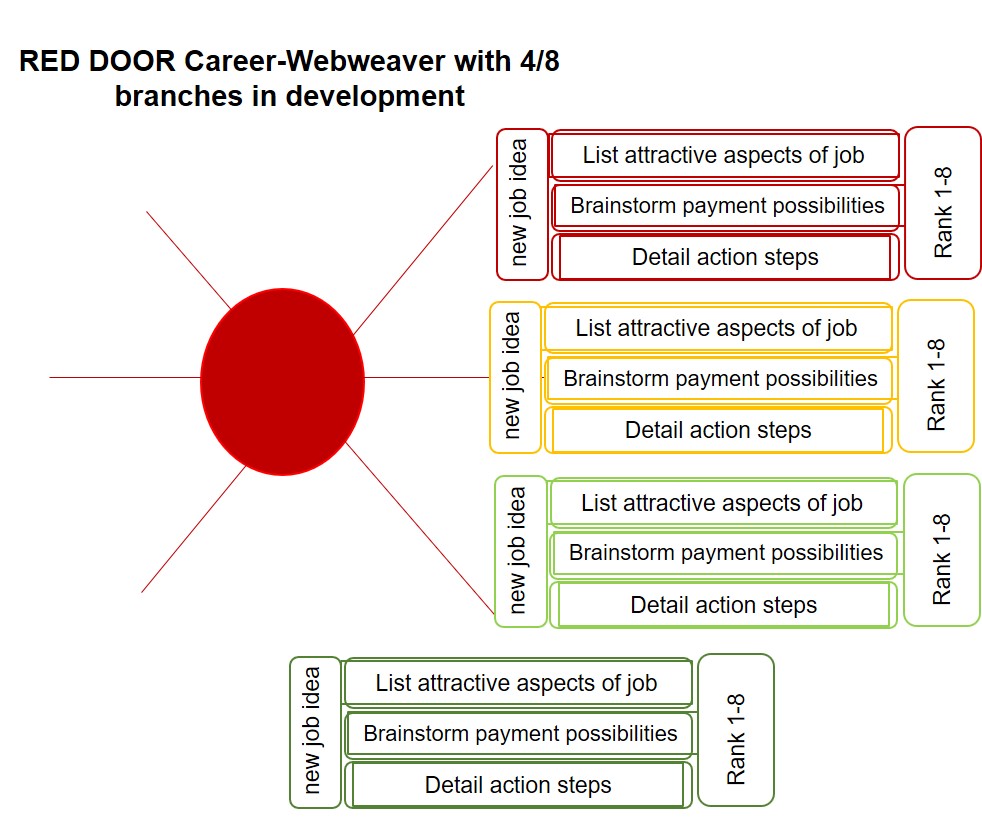
Do you know what you would like to do next? If not you can use some pen and paper tools to help brainstorm potential futures for you to consider. In coaching sessions we use eight pronged spider diagram (which we call the  career-webweaver) to discuss at least 8 career change options with clients. We use this larger number deliberately to help people break out of the idea restrictions they may have imposed on themselves.

For one of the eight options I usually ask the client, “What job would you do for no pay?” This identifies what your real passions are. Can you turn your passion into a career?

Once the 8 slots are filled we start further information what is attractive about each of the jobs listed, we assess in what ways they could potentially make money from each of these activities, and list additional information or training which would be required to reach those goals. At this stage of the  each of the opportunities, and how they could make money from those activities. Usually two to three of the options start to look more possible when they are ranked from 1-8 in terms of the clients interest. Some of the ideas can even be combined into an entire new possibility.

career webweaver

Many of the skills you have already are transferable to another industry – creativity, ability to write, budgeting skills, and project management – are helpful skills within a number of different careers.

If you desire considerable career change I have two recommendations for you. Firstly, you remain dedicated to your course of change. Whilst friends and family may mean well, they may try to save you from the difficulty of change, but may be inadvertently advising you to follow someone else’s dream, which may have been a pattern from your past that you may wish to break out of.

Secondly I urge you to consider your current and future metrics of success. If financial recompense is your only measure of success, career change will be particularly challenging. Try to think about what other currencies really matter to you – it might be knowing that you contribute to society, the satisfaction of being your own boss, spending more time with your family, flexible work scenarios, and even the thrill of creating something new. Also list the price you pay personally to stay in your current job – endless workplace politics, career stagnation – this list is what you potentially “save” when you leaving your current job.

Some final advice

Career change can be scary, but it can also be exciting. You are not finished developing yet, I hope you never are!

#CareerChange

#CareerCrisis


Angela Watkins is a psychologist and counsellor at RED DOOR Counselling in Hong Kong. Her current clinical work focuses on adults in the areas of career change, loss of direction, burnout, relationship, depression, OCD, anxiety, perfectionism, the experience of divorce, family challenges,  and parenting special needs children.

A teen’s tale: Confessions of a suicide attempter

Help

A teen’s tale: Confessions of a suicide attempter.

WARNING: the blog below addresses a very sensitive topic, teen suicide. Whilst we believe that talking about teen suicide is an important component in the prevention of future suicide attempts, it is completely up to your personal discretion to read the blog, and discuss it with your teen.

The case below is a social story: a real-life example of one girl’s journey through a suicide attempt, and her eventual recovery. The purpose of producing such a story is to provide a framework to potentially discuss teen suicide with your teen. The reason we include a real case, is that it details one person’s real, imperfect journey through life. You will be able to see in the case of Cynthia, all the hopes that her parents would have had for her, and at the same time the feelings of hopelessness she had for herself. The reason we do not use a recent case is that we want the case to have enough emotional distance from our teen that they are not wrapped up in the media mayhem aspect of current events, and can review the situation with a bit more detachment.

The case of Cynthia is a real case, about a real girl, now a woman, called Cynthia, a Hong Kong girl who went to an international high school in Hong Kong. Below you will find a number of questions constructed by the RED DOOR team to help frame your discussion with your teen. The goal of that discussion is that you engage with your teen about that topic and help to reflect on the case. You don’t need to tell your teenager what to think. Contrary to rumours, you cannot “plant the idea” of suicide in the head of another person. Whilst exposure to suicide (ie of a friend or relative) can increase a person’s individual risk, it isn’t a risk to the whole public and rather highlights the need for those individuals to receive the appropriate counselling to help them in this particularly challenging area of grief and bereavement.

After reviewing this story, and perhaps reading it with your teen, you might discuss:

Social story questions:

  1. Why do you think Cynthia felt so bad? Can you imagine feeling like Cynthia did?
  2. What do you think her parents could have done differently?
  3. What could Cynthia have done differently?
  4. Now Cynthia is an adult and having a full and fun life, how did she lose sight of that when she was a teenager?
  5. If you were Cynthia, what would you want your parents to know?
  6. When Cynthia went back to school, what could have made her experience easier?
  7. What would you do if you thought one of your school mates was contemplating suicide?
  8. Have you ever felt so bad that you thought it would be easier to be dead? Did the feeling pass? If you felt that way again what would you tell yourself to help you get through that moment?

You may be surprised, or worried, if your teen identifies with Cynthia and her feelings. If you feel your teen may be depressed or contemplating suicide, we have recommendations at the end of this article.

I was the girl who attempted suicide. My personal story, by Cynthia.

When I was sixteen I was a very unhappy teenager. I felt like I didn’t want to be here anymore. I just wanted everything to stop. I felt that I wouldn’t be missed by my family or my friends. I had feelings like I didn’t ask to be born, I didn’t like who I was. I want teenagers today to know that it’s not a good idea (to contemplate suicide) and even if I help only one person then telling my story will be completely worthwhile

When I was young, I was confused about my identity. I was born in England and when I was five we came back to Hong Kong and my family put me into a Chinese school. I was from a traditional Chinese family where I was expected to be obedient. I was labelled a naughty and disobedient child, I was physically and verbally punished. Looking back, I was just a normal kid.

I had a few holidays in Canada to visit my grandparents and one year we went I was left there and told I would now be attending school there. My mother had just had a new baby and I felt that I was now no longer wanted. I felt like I was being abandoned. I said I didn’t want to be left there but I was told that I needed to stay with my grandparents. I felt unloved and started having suicidal thoughts. My grandparents couldn’t talk to me.

At thirteen I came back to Hong Kong after asking my parents to bring me back as I was really homesick. When I returned it wasn’t as I expected. I didn’t feel part of my own family. My mum was pregnant again, this time with my brother, and there was an eight-year gap between my sister and I. By then I was used to a very western culture and I was now back in a Chinese culture. Yet again I felt like the black sheep of the family. I started self-harming (cutting) around this time, and made some weak attempts at suicide by taking pills and drinking cleaning products. My system would not be defeated by these attempts, and each time I woke up the next day, still alive, feeling sick and hating myself even more.

I thought that turning sixteen years old was going to herald a big change in my life and that everything would be different, finally all good. I was thinking ‘sweet sixteen’ was something to look forward to, but it arrived and I wasn’t any happier. I wanted to be like my friends. It felt that they were able to do more than me and my family didn’t want me to be like them. I had to beg to be allowed to go to school camp. I felt that my family hated me. I also had the pressure of school exams and I wasn’t very good at school. I felt that I was dumb, stupid or lazy. Every time my parents were not happy with me it would be discussed at the dinner table and I was publicly shamed and I would throw my chop sticks down and run to my room. One night I decided to end my misery once and for all. I felt I was the only person in the world who felt this way.

I waited for my family to fall asleep. I got a knife out of the drawer in the kitchen and went back to my bedroom. It was a school night. I proceeded to do what I planned to do. I really wanted to finish myself off. It was not just a cry for help. It was final. I was just so unhappy. I didn’t want to be there. I didn’t think anyone would care if I lived or died or notice and even if they did, I thought that time could easily heal them. I stabbed myself – my wrists and my stomach with the big kitchen knife.

I didn’t die. I remember opening my eyes and seeing my father’s panicked face. I was so tired and couldn’t talk properly or keep my eyes open and I was falling in and out of consciousness. Every time I woke up I was in a different room (in a hospital) and there were bright lights and people rushing around me. I finally woke up in a hospital ward of a government hospital, with other patients around me. I realised that I had not succeeded in my mission. I was in a lot of pain and shocked when I looked down to the mass of dressings and tubes coming out of my stomach. There was a nurse there and she coldly said to me whilst changing my dressings that the doctors deliberately sewed me up with a big and ugly scar after my operation, to serve as a deliberate and permanent reminder of what I had done.

I was in hospital for about a month. I remember that the head master of my high school came to visit me and wrote me a wonderful inspiring letter that I still have to this day. My father arranged a counsellor for me but I didn’t go for very long as I wasn’t willing to tell him what I was thinking.

Before my suicide attempt I probably seemed a lot like other teenagers. I remember we all complained about our home lives with each other. But I felt that my friends got to do what they wanted to do whilst I felt I had very limited freedom. I knew I didn’t feel right, and shouldn’t feel this way. No one had ever talked to me about depression. I think it was viewed as abnormal, something that only happened to crazy people. I kept telling myself that I wasn’t from a dysfunctional family; we were not financially deprived, so why did I feel so rotten? My feelings didn’t make sense to me. I didn’t feel like I could get any help from anywhere.

When I returned to school, my classmates were very quiet with me and looked at me like I was an alien. They knew about what had happened but they, and I, didn’t know how to bring the topic up in a constructive way. So many kept their distance, but I know they were all talking about me. I was an embarrassment, it was shameful. People didn’t talk about it. It’s a crime to commit suicide so once again I felt like a disappointment and naughty and that I couldn’t succeed at anything.

My close friends protected me as much as they could but we were often in different classes so I was often alone. When I was alone I felt self-conscious, people often whispering, teasing me and asking me to show my scar. I knew everyone knew. I found some teachers were overly cautious and they were very nice to me telling me to take my time and to leave the classroom if I needed to. The headmaster reached out to me, he was a person I could go and talk to, and I am very grateful that he was so supportive toward me.

Now I look back at those events from the perspective of an adult. Had I killed myself, I would have missed out on more friendships, my four children, love and marriage. I would have missed bringing another life onto this earth and watching my own children grow up, and have great lives as well. Everything is a different experience and you have got to enjoy it.

I have never forgotten what I did. I look at my scars every day. I was ashamed by my scars until a couple of years ago and now I see them as my journey through my life. I used to cover up my wrists with bracelets but I don’t now as I am not ashamed. I feel I can leave it all behind and be myself now so I got a tattoo, it’s a cherry blossom in full bloom. It’s a traditional Chinese style as most of my life I struggled with my Chinese identity, but now I am immensely proud of my history. The branch of this beautiful blossom purposely starts on top of the scar on my wrist. From great pain, has grown great beauty. I accept myself and fully express myself. I no longer feel the need to be accepted by others. I am me and I am happy and I love myself.

When you are a teenager you feel any minor crisis like falling out with a friend or boyfriend problems are major catastrophes. When as an adult you listen to teenagers’ problems you think

they are not serious issues however when you are that teenager and experiencing those things you feel the world is crushing you, it hurts so much.

Teenage me was a girl who thought she on her own. She couldn’t reach out and express herself. I didn’t understand then that there was still so much to see and that I wasn’t on my own, I wasn’t the only person suffering. I couldn’t reach out and be understood. If I could go back in time and advise her, I would want her to have some patience with herself and life. I would let her know that she would grow out of those feelings, in time, and have a good life.

I want any teenager feeling sad, lonely, or struggling, to know that whatever they are going through will pass. Everything has a beginning and everything has an end. You start feeling something (negative) but that feeling will pass. But I learnt the hard way that suffering on your own is not healthy or useful. I found that that talking to people is the best thing to do. By talking to people and receiving counselling it can relieve the burden and give relief. Don’t be embarrassed about your strong feelings.

I want parents of teens to understand that the vital key is to communicate with your children and please, do not judge them. Do not compare them with others and accept who they are. If you have values explain why you hold them but allow your children to be their own person. If they want to experiment do not say they cannot – find some form of work around so that you can build trust in them.

Please let any teenager you know that if they feel a compulsion to take their own life they need to be aware that the feelings won’t last and they will have different experiences in the future. There will always be hardships and as you get older you will learn to cope better in a crisis. The children who are labelled naughty just want to express themselves, be seen, feel heard, but don’t know how to. It is our job as adults to help when we can.


We thank Cynthia and are especially grateful for her honesty and sharing.

Is your child at risk?

If you feel that your teen is at risk of suicide or has contemplated suicide.

Do not leave them alone. Your objective is to keep them safe until the feelings pass.

Contact one of the supports below or the counsellor at your child’s school.

24-hour hotline at Suicide Prevention Services: +852 2382 0000

24-hour hotline at Samaritan Befrienders Hong Kong: +852 2389 2222.

If you feel your teen has been depressed for a protracted period of time, and expresses feelings of hopelessness and helplessness consider counselling for your teen.

Below are a series of suicide warning signs. Watch your teen, grow together, stay close, communicate.

Suicide Warning signals

Be aware that the following factors may be a warning sign for risk of suicide

  • Depression and other mental health disorders
  • Noticeable change in behaviour, high anxiety or agitation
  • Talking, writing, or communicating about suicide or death
  • Inability to sleep
  • Buying a gun
  •  Past suicide attempts
  • Substance use (drugs and alcohol)
  • Contagion (experience a friend/ relative who attempted or committed suicide)

The power of reflection: Six reasons to start a journal

Reflection blog

Writing a journal, or journaling, will improve your mental well being.  Research indicates that those who express themselves in a journal require less visits to the doctor for their health, than those who don’t.

Expressive writing (writing about your thoughts, reactions to situations, experiences, negative life events) is a self-reflective tool with tremendous power. By exploring emotional moments in our lives, we are forced to examine who we are, our values, our relationships, and ultimately, who we want to become.

Whilst the standard journal style is to detail your day, with comments and reflections of your experiences, there are other formats that are also helpful – responding to prompts, interweaving drawings with words. All of these styles are beneficial. It doesn’t matter if you handwrite or type a journal. It is however important that you write only for yourself, and that it is kept in a private secure place.

Start a journal today, you won’t regret it. Here are some of the benefits:

Cheap therapy: Without putting counsellors out of a job, the first benefit is that journaling is that it is a form of free therapy for which all types of people can benefit emotionally. Writing about stressful events helps the writer experience the event at a distance, with some much needed detachment, which helps one review and come to terms with unsettling events. You can rewrite your experience from various perspectives, you can use the reflection to re-examine your feelings.

Resolve conflicts:Resolve conflicts: Writing about your unresolved conflicts with others can help to clarify your own perspective on events, as well as leave you open to reinterpretation of your views, and those of the other party/ parties. Even writing about your emotional reaction inside a dispute is helpful therapy for yourself, as long as you are kind to yourself and non-judgmental. Even if you realise you have done “wrong” inside a dispute, you can use this format to look for reasons for forgiveness or reconciliation.

Access all areas: Journaling increases your self-awareness and your ability to reflect on your decision making style. For example you may start to see your internal voice on the page telling you that you MUST and SHOULD be doing things in a certain manner. Ask yourself, especially if you are an adult, why should you or must you do anything? If you record your mood over the course of many days you will be able to assess when you feel better or worse, and how many days you have felt strong and capable as opposed to sad or disconnected. This can help you decide if you can change those behaviours alone, or you would like to search for some additional help.

Stress Buster: When we have too many to dos running around in our heads, as well as heavy expectations that we put on ourselves, we can become overwhelmed. Writing a journal at this time will help you focus, calm your heart rate, and allow you to negotiate with your inner “shoulda-coulda-woulda” voice to help you challenge what items you really need to complete to keep you on your life plan, versus what is just ‘noise’.

Problem solved: When you write out a problem your analytical mind is able to reinterpret the situation from a less emotional perspective, hence we are likely to be able to see different opportunities to challenge situations. If you have a problem to solve, challenge yourself to write of five different solutions to the problem, even include the ludicrous. Even consider to challenge your view of the “problem”. Could it be reframed into an opportunity for you? To grow, to learn, to get ahead, to accept? Simply processing ideas has a way of helping structure a liveable solution.

Increase your sense of gratitude: A positive by product of recounting your experiences is that you also get to acknowledge the sources of support that exist in your life, and the parts of life which are good. If you don’t find this naturally occurring, you can even add a section in your journal – to celebrate three things that you are grateful in every diary entry.

Where to start? If you have a current stressful event or previous trauma, you might find writing about these a place to start. The most valuable entries often start with a personal question such as “what worries me most at this time?”


Angela Watkins is a psychologist and counsellor at RED DOOR Counselling in Hong Kong Her current clinical work focuses on adults in the areas of, depression, the experience of divorce, anxiety, perfectionism, career change, loss of direction, burnout, relationship and family challenges, OCD, and parenting special needs children. She regularly recommends journaling to her clients in their therapeutic journeys. Angela has won awards as the best therapist in Hong Kong. 

#Journal

#SelfTherapy

#MentalHealth