Facing career change with courage

Red Door - time to change

Creating career change

It’s time for us to start making our life plans match our life spans. Most people start their first full time job in their 20s. The age of retirement in most advanced nations is between 6- and 65 years of age. This means, that for the average adult, you work life span should be around 40 years long.  You will change significantly during these four decades – experiences such as having children, moving countries, experiencing the death of a parent, the end of a marriage, experiencing significant changes in health – will shape you into a different person from who you were when you began your career building journey. Given these changes, and the enormous changes in the shape and future of the workforce, it is wise to accept that one career may not cover your whole work life. That’s OK. There are many years, and many opportunities to consider career change.

Here is our advice if you need to change career – weather you decide to jump into something new, or were pushed from where you were once settled.

If you’ve recently lost your job:

There are a number of euphemisms to describe the job loss – redundancy, right sizing, down-sizing. These are all impersonal terms and do not capture the emotional journey associated with job loss. The financial arrangements aside, please remember that job loss is a considerable personal stress and you will likely experience stages of grief including shock, bargaining, anger, denial and eventually, acceptance. It is a period that can test our resilience, and can lead to feeling of loss of self.

In Hong Kong, many of us define ourselves through the jobs we hold, and job loss can create a personal sense of worthlessness which may lead to the temptation to withdraw from other people. Please don’t do this. Isolation will possibly exacerbate negative self-talk and the much needed “normalisation” which follows the exit from your employer.  Remember during their work lifespans, many  people experience job loss outside of their control, this experience, whilst important  is not personal and unique to you. Start on the project to replace your job will help you move from the negative feelings associated with job loss, into a more positive feeling.

Finding another job:

You will not find the perfect job by accident. If you are looking for a similar role to the one you held previously, even though you are probably well-qualified, remember that the process of looking for a job has changed dramatically in the past 10, or even 5 years. In a tight job market, employers have their choice of job applicants, and will not see the need to invest capital to advertise available positions in the paper. They may only post open positions on their own websites, or not communicate obviously about available positions at all. The traditional process of sending your standard CV and application letter in response to an advertisement is not the only route to securing your new position. You need to update your application process to include proactive and online aspects, differentiation, utilising your network, and considering the big picture.

The online aspects include not just looking on line, but also having a good online profile on sites such as LinkedIn. It is essential to have a powerful LinkedIn profile. If you are not sure how to maximise your profile on LinkedIn there are workshops and experts who help with this specific self-marketing skill. Some advice they will give you is to provide a professional photo of yourself, include key aspects of your CV, list key achievements and get as many recommendations as possible. Play up any performance metrics that you can that indicate how you have contribute to the bottom line in your previous company, whatever savings you made or revenue you contributed. In a tight employment market, employers are looking to ensure secure appointments and these numbers provide comfort.

To differentiate yourself from plenty of other applicants take a moment to run a personal self-inventory of your skills and attributes. Be kind yourself at this time, this is not a time to beat yourself up. If you are not able to frame your attributes in a positive light consider investing in a coach or a counsellor to help you better see and list your strengths. Consider, how are you different from other applicants? Are you more experienced that others? If so, then help a potential employer understand the potential benefit of your experience. If you are younger,  you may wish to highlight your fresh youthful approach to challenges, as what separates you from others.

Many applicants find their next job through their network rather than in response to an advertisement. Utilizing your network is the way to find the jobs that nobody (yet) knows about. If you can apply for the job before it becomes available you have a special advantage. Any meeting of new people may be treated as the first stage of a job interview, so have your ‘elevator pitch’ that is your 2-3 sentence summary of who you are and your differentiation – well rehearsed.

It can be difficult to remain positive if your ego has been hurt by your current job frustrations or job loss.  However remember job stress and job loss are not rare or exceptional, just state the facts in a non-emotive manner. You have nothing to be ashamed of – just focus on the positive rather than list a litany of complaints about your previous job.

Finding a mentor through your current contacts, or through networking, can also be helpful to get a new job, or a promotion. More senior personnel in your industry can identify the key attributes you need to add to your CV or help you navigate the politics of your industry.

Keep the big picture in mind when applying for a new job. Whilst you may put your complete heart and soul into every application, remain pragmatic.  Job applications are a numbers game, so play the long game. Employers have a wealth of applicants for every available position, so if you are not the final candidate, continue the process. If feedback is available then ask for it. It will help you note if your applications need to be reframed to highlight particular skills, or they had a particular type of candidate in mind.

Do yourself a favour and commit to applying for 30 or more jobs. This way you can focus on job search as a process and a project, improving each application as you go. Eventually you will be successful.

Following your heart – suggestions to completely change your career: 

Given the length of your life span, you might consider changing career completely. It would make sense that you have two to three careers over a 50 year work span.

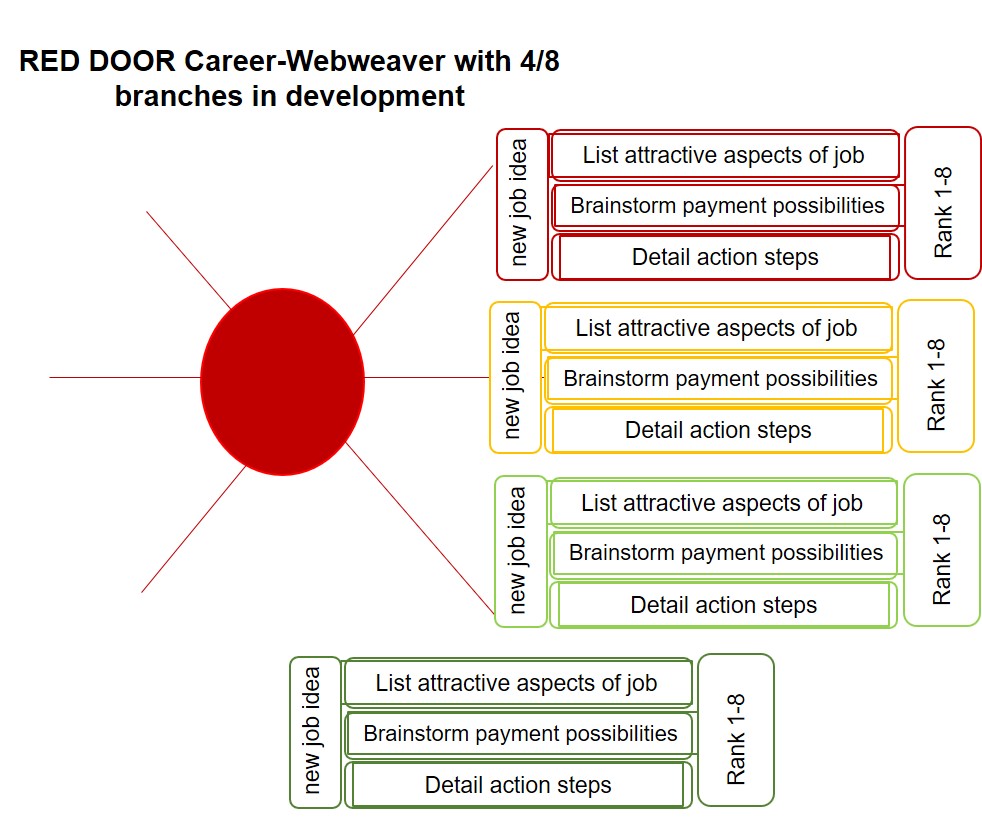
Do you know what you would like to do next? If not you can use some pen and paper tools to help brainstorm potential futures for you to consider. In coaching sessions we use eight pronged spider diagram (which we call the  career-webweaver) to discuss at least 8 career change options with clients. We use this larger number deliberately to help people break out of the idea restrictions they may have imposed on themselves.

For one of the eight options I usually ask the client, “What job would you do for no pay?” This identifies what your real passions are. Can you turn your passion into a career?

Once the 8 slots are filled we start further information what is attractive about each of the jobs listed, we assess in what ways they could potentially make money from each of these activities, and list additional information or training which would be required to reach those goals. At this stage of the  each of the opportunities, and how they could make money from those activities. Usually two to three of the options start to look more possible when they are ranked from 1-8 in terms of the clients interest. Some of the ideas can even be combined into an entire new possibility.

career webweaver

Many of the skills you have already are transferable to another industry – creativity, ability to write, budgeting skills, and project management – are helpful skills within a number of different careers.

If you desire considerable career change I have two recommendations for you. Firstly, you remain dedicated to your course of change. Whilst friends and family may mean well, they may try to save you from the difficulty of change, but may be inadvertently advising you to follow someone else’s dream, which may have been a pattern from your past that you may wish to break out of.

Secondly I urge you to consider your current and future metrics of success. If financial recompense is your only measure of success, career change will be particularly challenging. Try to think about what other currencies really matter to you – it might be knowing that you contribute to society, the satisfaction of being your own boss, spending more time with your family, flexible work scenarios, and even the thrill of creating something new. Also list the price you pay personally to stay in your current job – endless workplace politics, career stagnation – this list is what you potentially “save” when you leaving your current job.

Some final advice

Career change can be scary, but it can also be exciting. You are not finished developing yet, I hope you never are!

#CareerChange

#CareerCrisis


Angela Watkins is a psychologist and counsellor at RED DOOR Counselling in Hong Kong. Her current clinical work focuses on adults in the areas of career change, loss of direction, burnout, relationship, depression, OCD, anxiety, perfectionism, the experience of divorce, family challenges,  and parenting special needs children.

A teen’s tale: Confessions of a suicide attempter

Help

A teen’s tale: Confessions of a suicide attempter.

WARNING: the blog below addresses a very sensitive topic, teen suicide. Whilst we believe that talking about teen suicide is an important component in the prevention of future suicide attempts, it is completely up to your personal discretion to read the blog, and discuss it with your teen.

The case below is a social story: a real-life example of one girl’s journey through a suicide attempt, and her eventual recovery. The purpose of producing such a story is to provide a framework to potentially discuss teen suicide with your teen. The reason we include a real case, is that it details one person’s real, imperfect journey through life. You will be able to see in the case of Cynthia, all the hopes that her parents would have had for her, and at the same time the feelings of hopelessness she had for herself. The reason we do not use a recent case is that we want the case to have enough emotional distance from our teen that they are not wrapped up in the media mayhem aspect of current events, and can review the situation with a bit more detachment.

The case of Cynthia is a real case, about a real girl, now a woman, called Cynthia, a Hong Kong girl who went to an international high school in Hong Kong. Below you will find a number of questions constructed by the RED DOOR team to help frame your discussion with your teen. The goal of that discussion is that you engage with your teen about that topic and help to reflect on the case. You don’t need to tell your teenager what to think. Contrary to rumours, you cannot “plant the idea” of suicide in the head of another person. Whilst exposure to suicide (ie of a friend or relative) can increase a person’s individual risk, it isn’t a risk to the whole public and rather highlights the need for those individuals to receive the appropriate counselling to help them in this particularly challenging area of grief and bereavement.

After reviewing this story, and perhaps reading it with your teen, you might discuss:

Social story questions:

  1. Why do you think Cynthia felt so bad? Can you imagine feeling like Cynthia did?
  2. What do you think her parents could have done differently?
  3. What could Cynthia have done differently?
  4. Now Cynthia is an adult and having a full and fun life, how did she lose sight of that when she was a teenager?
  5. If you were Cynthia, what would you want your parents to know?
  6. When Cynthia went back to school, what could have made her experience easier?
  7. What would you do if you thought one of your school mates was contemplating suicide?
  8. Have you ever felt so bad that you thought it would be easier to be dead? Did the feeling pass? If you felt that way again what would you tell yourself to help you get through that moment?

You may be surprised, or worried, if your teen identifies with Cynthia and her feelings. If you feel your teen may be depressed or contemplating suicide, we have recommendations at the end of this article.

I was the girl who attempted suicide. My personal story, by Cynthia.

When I was sixteen I was a very unhappy teenager. I felt like I didn’t want to be here anymore. I just wanted everything to stop. I felt that I wouldn’t be missed by my family or my friends. I had feelings like I didn’t ask to be born, I didn’t like who I was. I want teenagers today to know that it’s not a good idea (to contemplate suicide) and even if I help only one person then telling my story will be completely worthwhile

When I was young, I was confused about my identity. I was born in England and when I was five we came back to Hong Kong and my family put me into a Chinese school. I was from a traditional Chinese family where I was expected to be obedient. I was labelled a naughty and disobedient child, I was physically and verbally punished. Looking back, I was just a normal kid.

I had a few holidays in Canada to visit my grandparents and one year we went I was left there and told I would now be attending school there. My mother had just had a new baby and I felt that I was now no longer wanted. I felt like I was being abandoned. I said I didn’t want to be left there but I was told that I needed to stay with my grandparents. I felt unloved and started having suicidal thoughts. My grandparents couldn’t talk to me.

At thirteen I came back to Hong Kong after asking my parents to bring me back as I was really homesick. When I returned it wasn’t as I expected. I didn’t feel part of my own family. My mum was pregnant again, this time with my brother, and there was an eight-year gap between my sister and I. By then I was used to a very western culture and I was now back in a Chinese culture. Yet again I felt like the black sheep of the family. I started self-harming (cutting) around this time, and made some weak attempts at suicide by taking pills and drinking cleaning products. My system would not be defeated by these attempts, and each time I woke up the next day, still alive, feeling sick and hating myself even more.

I thought that turning sixteen years old was going to herald a big change in my life and that everything would be different, finally all good. I was thinking ‘sweet sixteen’ was something to look forward to, but it arrived and I wasn’t any happier. I wanted to be like my friends. It felt that they were able to do more than me and my family didn’t want me to be like them. I had to beg to be allowed to go to school camp. I felt that my family hated me. I also had the pressure of school exams and I wasn’t very good at school. I felt that I was dumb, stupid or lazy. Every time my parents were not happy with me it would be discussed at the dinner table and I was publicly shamed and I would throw my chop sticks down and run to my room. One night I decided to end my misery once and for all. I felt I was the only person in the world who felt this way.

I waited for my family to fall asleep. I got a knife out of the drawer in the kitchen and went back to my bedroom. It was a school night. I proceeded to do what I planned to do. I really wanted to finish myself off. It was not just a cry for help. It was final. I was just so unhappy. I didn’t want to be there. I didn’t think anyone would care if I lived or died or notice and even if they did, I thought that time could easily heal them. I stabbed myself – my wrists and my stomach with the big kitchen knife.

I didn’t die. I remember opening my eyes and seeing my father’s panicked face. I was so tired and couldn’t talk properly or keep my eyes open and I was falling in and out of consciousness. Every time I woke up I was in a different room (in a hospital) and there were bright lights and people rushing around me. I finally woke up in a hospital ward of a government hospital, with other patients around me. I realised that I had not succeeded in my mission. I was in a lot of pain and shocked when I looked down to the mass of dressings and tubes coming out of my stomach. There was a nurse there and she coldly said to me whilst changing my dressings that the doctors deliberately sewed me up with a big and ugly scar after my operation, to serve as a deliberate and permanent reminder of what I had done.

I was in hospital for about a month. I remember that the head master of my high school came to visit me and wrote me a wonderful inspiring letter that I still have to this day. My father arranged a counsellor for me but I didn’t go for very long as I wasn’t willing to tell him what I was thinking.

Before my suicide attempt I probably seemed a lot like other teenagers. I remember we all complained about our home lives with each other. But I felt that my friends got to do what they wanted to do whilst I felt I had very limited freedom. I knew I didn’t feel right, and shouldn’t feel this way. No one had ever talked to me about depression. I think it was viewed as abnormal, something that only happened to crazy people. I kept telling myself that I wasn’t from a dysfunctional family; we were not financially deprived, so why did I feel so rotten? My feelings didn’t make sense to me. I didn’t feel like I could get any help from anywhere.

When I returned to school, my classmates were very quiet with me and looked at me like I was an alien. They knew about what had happened but they, and I, didn’t know how to bring the topic up in a constructive way. So many kept their distance, but I know they were all talking about me. I was an embarrassment, it was shameful. People didn’t talk about it. It’s a crime to commit suicide so once again I felt like a disappointment and naughty and that I couldn’t succeed at anything.

My close friends protected me as much as they could but we were often in different classes so I was often alone. When I was alone I felt self-conscious, people often whispering, teasing me and asking me to show my scar. I knew everyone knew. I found some teachers were overly cautious and they were very nice to me telling me to take my time and to leave the classroom if I needed to. The headmaster reached out to me, he was a person I could go and talk to, and I am very grateful that he was so supportive toward me.

Now I look back at those events from the perspective of an adult. Had I killed myself, I would have missed out on more friendships, my four children, love and marriage. I would have missed bringing another life onto this earth and watching my own children grow up, and have great lives as well. Everything is a different experience and you have got to enjoy it.

I have never forgotten what I did. I look at my scars every day. I was ashamed by my scars until a couple of years ago and now I see them as my journey through my life. I used to cover up my wrists with bracelets but I don’t now as I am not ashamed. I feel I can leave it all behind and be myself now so I got a tattoo, it’s a cherry blossom in full bloom. It’s a traditional Chinese style as most of my life I struggled with my Chinese identity, but now I am immensely proud of my history. The branch of this beautiful blossom purposely starts on top of the scar on my wrist. From great pain, has grown great beauty. I accept myself and fully express myself. I no longer feel the need to be accepted by others. I am me and I am happy and I love myself.

When you are a teenager you feel any minor crisis like falling out with a friend or boyfriend problems are major catastrophes. When as an adult you listen to teenagers’ problems you think

they are not serious issues however when you are that teenager and experiencing those things you feel the world is crushing you, it hurts so much.

Teenage me was a girl who thought she on her own. She couldn’t reach out and express herself. I didn’t understand then that there was still so much to see and that I wasn’t on my own, I wasn’t the only person suffering. I couldn’t reach out and be understood. If I could go back in time and advise her, I would want her to have some patience with herself and life. I would let her know that she would grow out of those feelings, in time, and have a good life.

I want any teenager feeling sad, lonely, or struggling, to know that whatever they are going through will pass. Everything has a beginning and everything has an end. You start feeling something (negative) but that feeling will pass. But I learnt the hard way that suffering on your own is not healthy or useful. I found that that talking to people is the best thing to do. By talking to people and receiving counselling it can relieve the burden and give relief. Don’t be embarrassed about your strong feelings.

I want parents of teens to understand that the vital key is to communicate with your children and please, do not judge them. Do not compare them with others and accept who they are. If you have values explain why you hold them but allow your children to be their own person. If they want to experiment do not say they cannot – find some form of work around so that you can build trust in them.

Please let any teenager you know that if they feel a compulsion to take their own life they need to be aware that the feelings won’t last and they will have different experiences in the future. There will always be hardships and as you get older you will learn to cope better in a crisis. The children who are labelled naughty just want to express themselves, be seen, feel heard, but don’t know how to. It is our job as adults to help when we can.


We thank Cynthia and are especially grateful for her honesty and sharing.

Is your child at risk?

If you feel that your teen is at risk of suicide or has contemplated suicide.

Do not leave them alone. Your objective is to keep them safe until the feelings pass.

Contact one of the supports below or the counsellor at your child’s school.

24-hour hotline at Suicide Prevention Services: +852 2382 0000

24-hour hotline at Samaritan Befrienders Hong Kong: +852 2389 2222.

If you feel your teen has been depressed for a protracted period of time, and expresses feelings of hopelessness and helplessness consider counselling for your teen.

Below are a series of suicide warning signs. Watch your teen, grow together, stay close, communicate.

Suicide Warning signals

Be aware that the following factors may be a warning sign for risk of suicide

  • Depression and other mental health disorders
  • Noticeable change in behaviour, high anxiety or agitation
  • Talking, writing, or communicating about suicide or death
  • Inability to sleep
  • Buying a gun
  •  Past suicide attempts
  • Substance use (drugs and alcohol)
  • Contagion (experience a friend/ relative who attempted or committed suicide)

The power of reflection: Six reasons to start a journal

Reflection blog

Writing a journal, or journaling, will improve your mental well being.  Research indicates that those who express themselves in a journal require less visits to the doctor for their health, than those who don’t.

Expressive writing (writing about your thoughts, reactions to situations, experiences, negative life events) is a self-reflective tool with tremendous power. By exploring emotional moments in our lives, we are forced to examine who we are, our values, our relationships, and ultimately, who we want to become.

Whilst the standard journal style is to detail your day, with comments and reflections of your experiences, there are other formats that are also helpful – responding to prompts, interweaving drawings with words. All of these styles are beneficial. It doesn’t matter if you handwrite or type a journal. It is however important that you write only for yourself, and that it is kept in a private secure place.

Start a journal today, you won’t regret it. Here are some of the benefits:

Cheap therapy: Without putting counsellors out of a job, the first benefit is that journaling is that it is a form of free therapy for which all types of people can benefit emotionally. Writing about stressful events helps the writer experience the event at a distance, with some much needed detachment, which helps one review and come to terms with unsettling events. You can rewrite your experience from various perspectives, you can use the reflection to re-examine your feelings.

Resolve conflicts:Resolve conflicts: Writing about your unresolved conflicts with others can help to clarify your own perspective on events, as well as leave you open to reinterpretation of your views, and those of the other party/ parties. Even writing about your emotional reaction inside a dispute is helpful therapy for yourself, as long as you are kind to yourself and non-judgmental. Even if you realise you have done “wrong” inside a dispute, you can use this format to look for reasons for forgiveness or reconciliation.

Access all areas: Journaling increases your self-awareness and your ability to reflect on your decision making style. For example you may start to see your internal voice on the page telling you that you MUST and SHOULD be doing things in a certain manner. Ask yourself, especially if you are an adult, why should you or must you do anything? If you record your mood over the course of many days you will be able to assess when you feel better or worse, and how many days you have felt strong and capable as opposed to sad or disconnected. This can help you decide if you can change those behaviours alone, or you would like to search for some additional help.

Stress Buster: When we have too many to dos running around in our heads, as well as heavy expectations that we put on ourselves, we can become overwhelmed. Writing a journal at this time will help you focus, calm your heart rate, and allow you to negotiate with your inner “shoulda-coulda-woulda” voice to help you challenge what items you really need to complete to keep you on your life plan, versus what is just ‘noise’.

Problem solved: When you write out a problem your analytical mind is able to reinterpret the situation from a less emotional perspective, hence we are likely to be able to see different opportunities to challenge situations. If you have a problem to solve, challenge yourself to write of five different solutions to the problem, even include the ludicrous. Even consider to challenge your view of the “problem”. Could it be reframed into an opportunity for you? To grow, to learn, to get ahead, to accept? Simply processing ideas has a way of helping structure a liveable solution.

Increase your sense of gratitude: A positive by product of recounting your experiences is that you also get to acknowledge the sources of support that exist in your life, and the parts of life which are good. If you don’t find this naturally occurring, you can even add a section in your journal – to celebrate three things that you are grateful in every diary entry.

Where to start? If you have a current stressful event or previous trauma, you might find writing about these a place to start. The most valuable entries often start with a personal question such as “what worries me most at this time?”


Angela Watkins is a psychologist and counsellor at RED DOOR Counselling in Hong Kong Her current clinical work focuses on adults in the areas of, depression, the experience of divorce, anxiety, perfectionism, career change, loss of direction, burnout, relationship and family challenges, OCD, and parenting special needs children. She regularly recommends journaling to her clients in their therapeutic journeys. Angela has won awards as the best therapist in Hong Kong. 

#Journal

#SelfTherapy

#MentalHealth