Lost in the language of Intervention:

Know your EIP, from your IEP, from your IDP, and from your IVP.
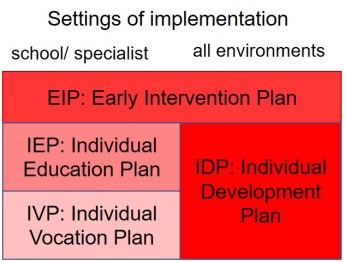
eipiepidpivpMany professions, including education and psychology, use acronyms to describe processes performed. For the parent of a child with special educational needs, a new language needs to be learned. And in addition to the language you will soon become a pseudo expert in terms and intervention strategies. Here is our quick guide to what some common terms mean and what you need to consider.

EIP – Early intervention programme.

The early intervention programme is usually written around the time of initial diagnosis. It will typically involve a form of assessment of your child relative to their same age peers in regarding to gross motor capabilities, fine motor skills, language use and communication skills, social behaviours, number knowledge. At this point of the programme you are quite likely to be overwhelmed with the amount of work that has to be done, and where to start. That is normal. Take a breath.

You may have received a diagnosis from a developmental paediatrician if your child is under 4 years old. If your developmental paediatrician doesn’t help you write a plan you can seek a psychologist who has experience in special educational needs to help you. There is a lot to do, and much to manage, utilise support whenever you can.

Essentially the goal is to plan out a series of intervention steps to help your child catch up. Early Intervention is key to setting your child with special needs onto a more favourable performance path.

Your expert should help you decide on the priorities that you will work on (and what you can leave for later). Depending on the disability that is being explored in relation to your child there should be a series of benchmark areas you want to consider – for example if your child is suspected of having autism, the programme may focus on language and communication development, certain behaviour modifications, emotional regulation around sensory situations, gross and fine motor development.

The term ABA (applied behaviour analysis) may be suggested. ABA has a bad rap as a sometimes-mindless intervention technique which can be disrespectful to the purpose of a child’s behaviours (especially stimming). There are alternative therapies such as Floortime which use similar techniques. In general, your child always deserves respect, so you set the course of intervention. I personally like ABA but do not believe that children should be forced to stop stimming behaviours or engage in extensive eye contact. So called normal people stim and avoid eye contact and we aren’t getting them to sit on their hands or look at us intently when we talk. The goal of intervention should be to stretch with respect.

The whole EIP process can overwhelming. Use an expert to help you break down the intervention strategy into smaller steps. This helps you break down the seemingly insurmountable task of “catching up” into smaller discrete, less soul destroying, steps,

Traps: there are three traps that I would like to highlight to parents.

1) Snake oil salespeople. Learning that your child has a disability (or may have a disability) is extremely stressful. Unscrupulous ‘experts’ may offer treatments which will cure your child. It may be tempting to jump on the magnetic therapy bandwagon. Find a community, in real life or online, who have travelled the road that you now find yourself on. As them about therapies and their efficacy for their children. Be informed.

2) Take  Well-wishers’ wishful thinking with a grain of salt. Paradoxically, the worse advice I got when my coming to terms with my daughter’s autism diagnosis was the well-wishing thoughts of some friends. They recounted stories of children they had heard of who spontaneously developed full language, and told me to relax and things would be fine, she would speak when she was ready.  I understood their desire to wish for the best for us, but their words are not practical support. Early intervention, as the words suggest, is most effective when it is EARLY. Don’t delay on suitable, reputable treatments. Ethical treatments do no harm to your child.

3) Early Intervention doesn’t mean constant intervention. In Hong Kong at least, I hear recommendations for children to receive 20-30 hours of ABA a week. I am sceptical that this many hour is necessary for a young child. If you are told that your child requires this extent of intervention ask for more details, and challenge if less hours could not achieve the same result. Consider EIP a series of activities to try between 3-6 years old. In the teen years you might consider a second wave of intervention – a maturing intervention programme.

The IEP – get your Individual Education Plan right.

When a child with a disability enters the school system, they may be offered an IEP. IT would be ideal if this was the case. An IEP sets standards regarding the functional performance of students. This performance can be academic or non-academic (for example communication, social skills, problem solving abilities, on task behaviour). These reports are usually updated 2-3 times a year and cover goals related to communication, language use, numeracy, and behavioural challenges. They are not easy documents to write, but regardless they need to be as meaningful as possible.

I have seen a few IEPs in my time and many of them miss some very important details, and run the risk of becoming mandatory checklists that work it being done, rather than that work is being done right.

Here are some guidelines for parents to get the most for their child out of an IEP:

The importance of benchmarks and expectations: The IEP should have include a comment regarding the child’s present level of performance. How is the child’s disability affecting their involvement in general education and how do we expect a child a child with this disability to perform? In this way a child can be measured relative to his same age peers and also against developmental expectations within our knowledge of that disability.

Knowledge about the specific disability, its symptoms, and the way it typically effects children is important. This allows us to set the all-important benchmark of achievement for a child. I’ve seen benchmarks left of IEPs because educators believe that it upsets parents to see that their child is behind. Whilst I understand the desire to be sensitive, it is helpful to see where your child is so that you know what needs to be done. Understanding that your child reads at the level of a child 2 years below them, will make you focus on reading ability for longer than you might with a typical child, and even into adulthood. I see many older teen children who have not engaged in reading for several years. It was simply assumed that they should stop reading logs when they left primary school, when continuing this primary practice would have been of enormous benefit.

The pathway should be part of the plan: IEPs can get caught up with minute detail without a plan for the big picture. An IEP benefits from including short term goals, probable benchmarks and longer-term goals (that can be changed).

Particularly when a child enters high school the parent should have the opportunity see the general plan for a child, if they will be considered for standardised exams, what kinds of indicators would we explore on the way. The IEP is not just for today, it is part of a plan to tomorrow.

Educators may not want to highlight a pathway element within the IEP that parents may be disappointed. Whilst this may be true, I am yet to meet a parent of a special needs child who doesn’t appreciate empathetic pragmatism. We simply need to see if xx can do this task by this age, in order to determine if he can try this exam route, or another.  My fear is when this is not clearly stated there can be ‘drift’, we wait to see what the child can do and then determine what exam (or not) to give them, rather than pushing children with disabilities as we would with typical children.  This can set our SEN children up to think they do not need to strive to do well.

Helicopter parents of SEN children are the opposite extreme, and just as problematic. Overmanaging disabled children teaches them that they are not responsible for themselves. Additionally, setting parent driven goals for children can stifle the development of an authentic skill for that child. My own girl with ASD decided she wanted to learn to sing when she was around 14. Two years later she is an accomplished singer both inside and outside school. This was a skill that seemingly fell out of the blue. I needed to give her the space to demonstrate that this was her path.  Having a clear pathway with check in points helps everyone involved keep a health(ier) perspective on the potential accomplishments of their child.

Meaningful behaviour assessed in a step by step manner: In order for an IEP to be useful the parent should be able to clearly see what their child is doing well, and what are the next couple of steps that teachers would like to see in their performance of growth areas.

Performance never occurs in a vacuum – it is contingent on certain conditions so these should be included. For example, if a child needs to stay on task during a writing assignment, they may receive instructions from the teacher at the outset, a visual guide to follow stuck to their desk, and the occasional prompt to keep them on task. For written work they may have a working scaffold provided or a set of instructions and it is important for the parent to understand these components as part of their child’s success.

The goals and assessments on an IEP must be meaningful:  The goal behaviours should be clear to all working with the child, and the steps required to achieve those goals clear to parent and educators alike. It is no point to say that certain math tasks are in line with the curriculum. That does not explain why it is important. For example, I read an IEP that said, “XX is familiar with money and can give correct change”, having worked with that child I can tell you she can give correct change if she knows the amount of change to give, and the coins in front of her are all of equal value (ie all $1.00). The understanding outlined does not help us really understand the tasks that this child needs to understand with money numeracy. Money numeracy is an important life skill as well as academic skill so we hope all children can learn this at school

Discrete steps need to be made clear, rather than simple global understanding so that the IEP has meaning. For example. If we identify some of the early steps of money math to be the following what tasks can this child perform.

  • First identify that different units exist and represent different values of money.
  • Learn how to add different values of money (full dollars only, no cents)
  • Learn how to subtract different values of money (full dollars only, no cents)
  • Ascertain if you have enough money to buy a single object (ie is the amount of money I have more or less that the price of that item)
  • Determine using subtraction the amount of change that would need to be given to by this single object. (full dollars only, no cents)
  • Identify the different units to represent the change that should be given (full dollars only, no cents).
  • The next step would be to determine this process for either a) buying two objects or b) using coins, to be determined by the child’s readiness a that the task above.

Whenever possible the tools that are being used should be listed and shared with the home environment.

Measurements of success: Whenever possible use numbers and assessments to help determine progress. Having data helps decide if a problem is really a problem or mastery has been accomplished.

For example, if a child is experiencing issues around emotional regulation, in particular becoming angry and shouting at teachers and classmate, deciding to include a goal on the IEP should be included. It would not be enough to expect these behaviours to be eliminated immediately. Observations off a few instances should provide meaningful measurements that help.  The main elements or consequences can be measured and the goal will be to reduce these, over a particular time set. A behavioural plan may be used in coordination with an IEP to capture this data.

Celebrate the positive: An IEP might help parents and teachers document the strengths that a child possesses as well as their weaknesses within the school environment. Strengths become more and more important as the child ages. When children are young intervention does not need to focus on their strengths, but from the teen years on, these strengths offer keys to the future.

Generalisation is considered: An IEP is usually written inside the context of a school, but opportunities to change behaviour and learn skills exist in more than one environment. The home and the school environment both need to be involved in planning activities. Mastery in one setting can not be assumed to generalise (ie be transferred) to another setting, or be treated as an afterthought. In the example above, where money skills are being taught, this should be echoed in the home or out of school environment. The child given chances to pay for a drink with coins at the store, to reinforce the behaviour learned at school.

The big picture – the IDP – Individual Development Plan

The IEP is usually a school-based document. The IDP is a general setting document. The IDP is like an extended IEP to include a snapshot of skills in multiple settings, more global goals, and additional categories. Usually a school contributes to an IDP through the IEP. The IDP will use that segment as a snapshot of education, but may add a variety of out of school classes depending on the child’s skills.

Comprehensive: An IDP will assess elements such as self-care, independence, emotional and behavioural regulation outside of school, social skills, theory of mind, and additional education to be considered.

Age related: As such an IDP may be written by a psychologist outside of school. Assessments such as measures of personal functioning, emotional wellbeing, intelligence, may be included. The purpose of an IDP is to ensure that the child continues to develop towards their greatest level of independence in life, future education, employment. As such an IDP is recommended when your child becomes a teen rather although they can be used at a earlier age as well. As part of the shaping of and IDP you may write an updated intervention plan, a maturing intervention plan. Additionally, you may consider to explore a discussion with specialists who focus on teens and adults rather than children. For example programmes in childhood may be focused towards compliance and control of stimming behaviours. As SEN teens develop they need to be more actively involved in the process and they may need to focus on essential executive functioning skills such as  maintaining appropriate friendships, understanding your strengths, communication in different contexts, self-confidence,  social focus, and expressive skills.
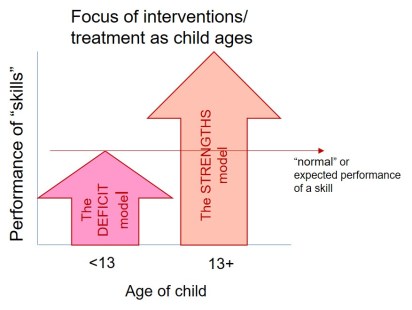
deficit vs strengthsChange of model of focus: As a psychologist working with children with special needs at all ages, I believe in working on a deficit model of interventions before the age of 13, and sometimes after that age moving to a strengths model.  What that means is that for younger children we look at how their performance (in any category) differs from their same age peer and we work to try to bring them within the expected boundaries of performance. We focus on the areas of DEFICIT. A strengths model expands our focus, and is more appropriate with older children when strengths have had a chance to appear. We do not stop looking at the areas that the teen needs to catch up, but we spend some of our resources expanding their STRENGTHS as well. This involves identifying areas of strength. When a child starts high school you may want to consider a maturing intervention plan, one that uses the strength model to help you decide new, and updated, areas of intervention.  A psychologist may help you identify these areas if you are not aware of these for your child.

The focus for an IDP are generally more global than an IEP, however the guidelines are much the same. Detail, data, and benchmarks remain essential. The focus on strengths and the pathway aspects are more important than they are in an IEP because the IDP creates a backbone of potential career and future education pathways.


The long-term plan – the Individual Vocation Plan

The IVP is sometimes referred to as an IEP (particularly in the United States) which can be very confusing. For the purpose of simplicity, I will use the term Vocation rather than Employment as this also incorporates what we know about the future of work, as well as the use of hobbies as well as job training to help build a career.  Many young adults and teens with disability leave school before they are fully cooked, and need support to decide what to do next, even if this includes going onto tertiary education.

 The need to plan. To better prepare the next generation of special educational adults, we as parents and educators need to provide ample services to those young adults as they launch from high school into the next stage of their careers. The majority of areas in which disabled individuals in Hong Kong find employment (hospitality, some retail, office work) unfortunately also carry a high risk of redundancy according to future of work analyses.

In Hong Kong, at this time, there is a gap for young adults who have different areas of strength and varying levels of motivation from those covered in the vocational channels on offer – perhaps they are great artists, mathematicians, photographers, early childhood teaching assistants, even have extremely good knowledge of music or ability to sing.

The IVP details: The Individual Vocational plan builds a customised plan around to help these young adults in particular*. It includes the following aspects:

  • The strengths of the person and potential careers which utilise these strengths. There may be more than one.
  • The future of work assessment for these careers – so that we focus on evolving or permanent jobs. Different formats of these jobs.
  • The soft skills and hard skills that are required for the jobs identified.
  • The performance of the child in these soft skills and hard skills. This will then include a lot of details regarding the process that the young person will need to undertake. What the learning mechanism will be. What will the key steps, assessment techniques be involved?
  • Prioritising skills (academic, professional, personal, organisational) that this young adult needs to develop to achieve these goals.They may need a basic entry level of English or Math in order to start their career in a suitable arena, and this needs to be made possible within a setting that also teaches the requisite social skills and independence skills. Private tutoring provides the content but not the context.
  • A timeline and proposed plan including potential work experience, future exams and key goals.
  • Certain independence and self-care skills may also be included, and these may be part of the IDP or the IVP depending on who is running the programme.

We launch teens and young adults into a world of work which can be overwhelming to navigate. We need to plan customised programmes that offer opportunities that fit with the future of work. For more information see our article on this topic. https://reddoorhongkong.wordpress.com/2019/03/21/whats-next-the-need-for-vocational-and-continuing-education-for-young-adults-with-special-educational-needs/

I hope that these terms are clearer to you now. Becoming a special needs parent will entitle you to an education that others never have to navigate. If you get confused reach out for professional support and the input of other parents. You are not alone.

*These kinds of plans are not frequently offered in Hong Kong by psychologists. I am happy that the RED DOOR team can provide this service, and does currently.

Other key articles you might find useful

About education of adults with SEN: https://reddoorhongkong.wordpress.com/2019/03/21/whats-next-the-need-for-vocational-and-continuing-education-for-young-adults-with-special-educational-needs/

#futureofwork #reddoor #mentalhealthessentials #individualeducationplan #earlyintervation #individualdevelopment #individualvocation #specialeducationalneeds #autism

What Mums worry about

mumworry

Following our recent assessment of mental health among women in Hong Kong, we explore what HK mothers are concerned about for their children. https://reddoorhongkong.wordpress.com/2019/03/08/supporting-the-mental-health-of-women-in-hong-kong/


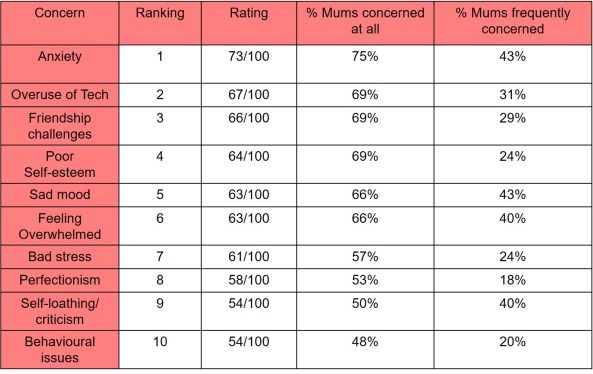
Ninety-seven mums answered questions regarding their level of concern, with any of their children, regarding different psychological issues including eating disorders, depression, learning issues, poor self-esteem, experience of bad stress, friendship challenges, and even feeling suicidal.

The highest rated psychological experiences that mums worry about include:

mums worry 2

We’ll explore the top 5 of these conditions in this piece and provide some advice for anxious mums out there. We will write separate articles on each of these 10 issues in due course so watch out for these.

More than half of the mums sought professional assistance (from the school, from counselling, a doctor, or psychiatrist) if they had concerns. If you have persistent worries about your child, do consider seeking assistance.


Anxiety

Anxiety was rated as the strongest experienced among our mums, with a rating of 72/100. Over 3 quarters of responding mums mentioned that they were concerned about their child’s anxiety occasionally or frequently. Forty-three percent of our mums said that they frequently were concerned about their child’s experience of anxiety.

Anxiety is a normal experience in life, which can become problematic if kids become stuck feeling this way or experience excessive episodes of anxiety. Simplistically, most common psychological anxiety disorders among children include generalised anxiety disorder (when worry gets out of control), social anxiety disorder (afraid/embarrassed of being judged by others to a disruptive extent), and panic disorder (when fear overwhelms through panic attacks).

If you feel your child’s anxiety is becoming problematic you might like to seek help from their school or a counsellor. Other practices to remember include:

The goal is to manage anxiety, not eliminate it. Avoiding the thing that elicits anxiety reinforces the anxiety.

Set realistic and positive expectations for your child. If your child is avoiding school because of anxiety, work towards full attendance again from where you are. If they miss one day a school, first aim for one day a fortnight, then one a month, then none at all.

Respect your child’s feelings. Don’t tell them to just get over it. At the same time, help them review the situation. Help them explore ways to reframe situations and check their faulty filters. https://reddoorhongkong.wordpress.com/2019/03/28/change-the-view-challenging-your-thinking-filters/

Get the basics right – makes sure that their health is not compromised as this will exacerbate their experience of anxiety – make sure their diet, consumption of water, health amount of exercise and sleep are optimal. https://reddoorhongkong.wordpress.com/2019/03/15/get-your-teen-to-sleep/

Help your child develop a safety card or a coping kit of activities that help them calm down. For some ideas see our quick calm recommendations https://reddoorhongkong.wordpress.com/2019/03/13/achieving-quick-calm/

Model a healthy response to anxiety for your child to learn from. Please review your own anxiety responses, and work to show your child that you can overcome and manage anxiety,


Overuse of technology*

Mums were asked if they were concerned about their child’s use of technology, undertaking surfing or gaming activities for 2 or more hours a day. This separates the use of the internet for schoolwork from more casual use. Of the mums who responded to our survey, 69% of mums are concerned about their child’s overuse of tech, and 31% were frequently concerned about this.

The impact of so much unfettered access to technology over the long term has not yet been properly determined. It has been suggested that overuse of technology can rewire the brain and affect our ability to communicate. Too much use of technology can impact the sleep of your child, especially if they sleep (or don’t sleep) with a device in their room.

The silent addiction of social media, including virtual lives through Instagram can lead to confusion of sense of self, self-acceptance, perfectionism, loss of creativity, and potentially compromised safety. You might consider limiting social media time if your teen spends more than 1 hour a day on this activity, or seems to experience problems around their self-esteem.

Other problems that warrant attention or intervention include your child falling behind with schoolwork as a consequence of their time on devices; child seems to be escaping reality using the internet, your child frequently, avoiding face to face social activities in favour of internet time; aggression when devices are removed from the child; preoccupation with their social profile; child being ‘bored’ by any activity which is not online; or starting internet conversations with people they do not know.

Contrary to what your child might tell you, tech free time is not a form of abuse of deprivation. We need to teach our children to use technology responsibly. Family internet agreements and courses in cybersecurity may also be helpful to set boundaries, but these need a firm hand by the parent as children and teens are notoriously lax at maintaining time away from tech.

A word to the wise, children learn from their parents. We can’t ask children to do as we say, not what we do. Check your own mindless use of technology.  Demonstrate that you are able to put away your phone and have a face to face conversation.

* This is a significant topic and we promise a dedicated article on this topic in the near future.


Friendship challenges 

Friendship challenges were a concern for 69% of the mother’s surveyed. Over 29% of our mums are frequently concerned about their child’s experience of friendship challenges.

Common friendship challenges include:

Being excluded – being left out or suddenly excluded from a group. This may happen because of the dynamic of the group, or the skills (or lack of) within the child.

Being bullied – a major worry in schools in Hong Kong. We need to help children learn that good friends don’t bully.

Friends gone wile – as friends develop, and especially during the teen years, your child may become at odds with their friend’s behaviour. Drinking, drugs, self-harm can break relationships and create peer pressure. Helping children realise they don’t have to do the same as their friends can be a challenge.

Loneliness and trouble making friends – some children do not seem to know how to make more friends, and will require support to help them learn these skills.

Some advice: Conflicts with close friends are inevitable. Experimentation with social power will be a natural exploration of your child, and their friends.  This means that friendships, particularly between 10-16 years of age, can be quite rocky. Resiliency and social skills are extremely important skills to help develop in your child.

Remember your kids and even your teens need their parents. Know their friends, check up on their perception of friendships, encourage them to have a broad friendship base, teach them the rules of good friendships and model good friendship behaviours yourself.


Poor self-esteem 

Self-esteem starts to be demonstrated by children between the age of 5-7 years of age. Based on their perceived competency at school tasks, extra curricular activities, friendships and their place within the family, young children tend to hold rather inflated views of themselves. Over the following years, a child’s view of their value and competency help them navigate learning and life challenges.  Good self -esteem helps children take on risks. Conversely poor self-esteem can make children see themselves, and their competency, and their opportunity to conquer situations more negatively. no one is perfect, and we should be careful to imply to children that perfection is possible.

Building a healthy self-esteem is often the product of helping your child see themselves realistically and positively. For that purpose praise for your child should be specific, and around the effort behind success more than the result. Let your child fail occasionally, getting over disappointment is helpful to help your child realise they can be knocked down, and get back up again.

In Hong Kong children can be become entitled because they often do not need to contribute to the household. Having your child contribute to the house, via chores such as cooking dinner, looking after their rooms, learning to care for their own clothes, helps them develop a stronger sense of their self-worth.

Foster a growth mindset among your children. Let them learn to use the word ‘YET’. Rather than “I’m not good at math”, learn them to use the phrase “I am not good at math YET”.  Challenge any limit your child puts on themselves.

Additionally, let your child be a CHILD as long a possible. We can be mesmerised by our child’s desire for independence. Whilst your child can gain independence, remember and remind them, that they are still kids, and that there is no rush for them to grow up. They will be grown ups for a very long time.


Sad Mood 

Sad mood is different from depression. Our mothers could indicate depression or sad mood as a concern. Among our HK Mums, 66% sad that they were concerned about their child’s experience of sad mood, and 43% said they are frequently concerned about their child’s sad mood. Sad mood is considered a precursor to depression and as such you might want to consider a checklist of depression (below) to see if your child may be depressed rather than just sad.

Children, especially teens can experience sad moods due to disappointments over grades, friendships, and performance. They may struggle with feelings created in response to physical changes around puberty. They may feel sad due to issues around acceptance especially if they are working to build a stronger concept of who they are (their identity). Some kids are oversensitive. If your child is oversensitive, and frequently sad you may like to keep a closer eye on them for signs of depression.

Signs of depression – if your child experiences 3 or more of the following for more than a few months you may like to consider private or school counselling.

  • Your child expresses feelings of sadness/hopelessness
  • Your child is frequently irritable, hostile or expressing anger
  • Your child is frequently teary
  • Your child is withdrawing from friends and family
  • You notice changes in your child’s eating or sleeping behaviours
  • Your child is often restless or agitated
  • Your child expresses feeling of worthlessness or guilt
  • You’ve seen a drop in your child’s performance at school
  • Your child seems to lack motivation or enthusiasm
  • Your child seems to suffer from lack of energy or fatigue
  • Your child has difficulty concentration
  • Your child often has unexplained aches and pains
  • Your child expresses thoughts of death or suicide

Let your child express their feelings freely. Don’t tell them that they shouldn’t feel that way. Encourage therapy, actively listen, help them build coping strategies, and build strong support systems – within the family and their friends.


Mums worry about their kids. We are grateful to the wonderful mum who shared their concerns with us, and use the advice that we can provide to them.


#sadness #technologyoveruse #anxiety #mum #sadness #friendship #reddoor #mentalhealthessentials


The Write Way – get free daily journal pages from RED DOOR.

journal image

Research indicates that those who express themselves in a journal require less visits to the doctor for their health, than those who don’t. How about you give it a try? RED DOOR is willing to supply 30 RED DOOR Journal pages to people enrolling in our Write Way project before the end of April 2019.*

Expressive writing (writing about your thoughts, reactions to situations, experiences, negative life events) is a self-reflective tool with tremendous power. By exploring emotional moments in our lives, we are forced to examine who we are, our values, our relationships, and ultimately, who we want to become.

*All you have to do is write to us to register. We will send you a brief questionnaire to complete at the beginning, and again at the end of your 30-day journal writing exercise. We believe that writing a journal for 30 days may help you achieve a greater sense of self-reflection, kindness towards yourself, and higher sense of contentment. All you need to do is commit to 30 days of journal writing. You don’t have to share your writing with anyone. These pages will be just for your private thoughts. It is important that you write only for yourself, and that it is kept in a private secure place.

The Write Way project uses specific journal prompts to encourage particular types of reflections around specific issues such as coping with anxiety, going through divorce, dealing with stress, desire to learn more about yourself, and overcoming depressed mood. Some examples are featured within this article.

Here are some of the potential benefits of writing a journal.

Cheap therapy: Without putting counsellors out of a job, the first benefit is that journaling is that it is a form of free therapy for which all types of people can benefit emotionally. Writing about stressful events helps the writer experience the event at a distance, with some much-needed detachment, which helps one review and come to terms with unsettling events. You can rewrite your experience from various perspectives, you can use the reflection to re-examine your feelings.

Resolve conflicts: Writing about your unresolved conflicts with others can help to clarify your own perspective on events, as well as leave you open to reinterpretation of your views, and those of the other party/ parties. Even writing about your emotional reaction inside a dispute is helpful therapy for yourself, as long as you are kind to yourself and non-judgemental. Even if you realise you have done “wrong” inside a dispute, you can use this format to look for reasons for forgiveness or reconciliation.

Access all areas: Journaling increases your self-awareness and your ability to reflect on your decision-making style. For example, you may start to see your internal voice on the page telling you that you MUST and SHOULD be doing things in a certain manner. Ask yourself, especially if you are an adult, why should you or must you do anything? If you record your mood over the course of many days you will be able to assess when you feel better or worse, and how many days you have felt strong and capable as opposed to sad or disconnected. This can help you decide if you can change those behaviours alone, or you would like to search for some additional help.

Stress Buster: When we have too many to dos running around in our heads, as well as heavy expectations that we put on ourselves, we can become overwhelmed. Writing a journal at this time will help you focus, calm your heart rate, and allow you to negotiate with your inner “shoulda-coulda-woulda” voice to help you challenge what items you really need to complete to keep you on your life plan, versus what is just ‘noise’.


Problem solved: When you write out a problem your analytical mind is able to reinterpret the situation from a less emotional perspective, hence we are likely to be able to see different opportunities to challenge situations. If you have a problem to solve, challenge yourself to write of five different solutions to the problem, even include the ludicrous. Even consider to challenge your view of the “problem”. Could it be reframed into an opportunity for you? To grow, to learn, to get ahead, to accept? Simply processing ideas has a way of helping structure a liveable solution.


Increase your sense of gratitude: A positive by product of recounting your experiences is that you also get to acknowledge the sources of support that exist in your life, and the parts of life which are good. If you don’t find this naturally occurring, you can even add a section in your journal – to celebrate three things that you are grateful in every diary entry.


Sounds promising? Then give the RED DOOR Write Way project a try. Send your email to Angela at angelaw@reddoor.hk to enrol. The Write Way project uses specific journal prompts to encourage particular types of reflections around specific issues so you might like to inform Angela which issues you would like help with so we can send you the best set for your circumstances.

Topics covered include: coping with anxiety, going through divorce, dealing with stress, desire to learn more about yourself, and overcoming depressed mood.


  • RED DOOR  reserves the right to refuse to send journal pages to individuals if their problems are beyond the scope of journal writing, or we have exceeded 100 applicants for this project.


What’s NEXT? The need for vocational and continuing education for young adults with Special Educational Needs.

further education

When we look at options of services to extend the skill development of teens and adults after they finish school in HK is thankfully being expanded, but still has a long way to go.

Good people are doing good work, but the data on employment opportunities remains depression. Currently post school programmes are provided by  YES, Watchdog, and the Nesbitt Centre all of which do a great job, but there are still areas of need not covered.

In general, it’s not a great time to be a young adult (disabled or otherwise)!

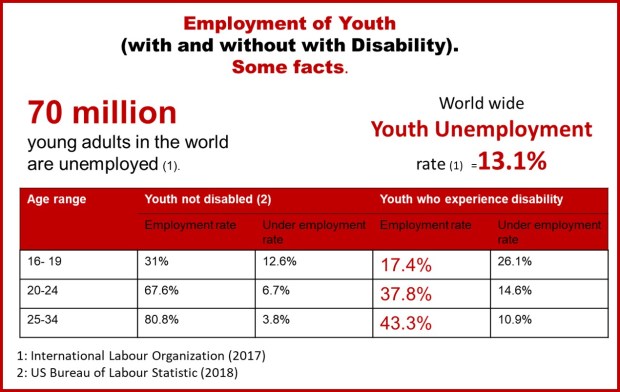
Exploring data from International Labour Organization (2017 data in the link below), global employment trends for growth 2017 suggests the global unemployment rate was 13.1%. The youth population (disabled or otherwise) represents more than 70 million people globally are experiencing unemployment – they are neither in employment or in further education. Young adults are 3 times as likely to be unemployed than older adults. Young people need to be prepared to be educated but still be unemployed. This applies to all young adults, and affects the disabled in a disproportionate format. The future of the world of work is the topic of many fantastic books at the moment and will have a major impact on those already in work, and the next generation of college and school graduates.

It’s even worse if you have a disability.

Exploring US data from the Bureau of Labour Statistics (link below) the disabled experience less employment than those who have no disability and are young.

youthemploy2
• For those 16-19 years old and disabled only 17% are employed, and 26% are underemployed
• For those 20-24 years old and disabled only 37% of that population are employed, and 14.6% are underemployed.
• For those 20-25 years old and disabled only 43% of that population are employed, and 10.9 % are underemployed.
There are often barriers for those with disability to gain access to suitable employment, including prejudice and misconceptions among employers, difficulty accommodating people’s physical or work schedule needs, the type of disability including the health implications, the ability to act a in socially expected manner, academic or task related competencies, and of course having the right skills. Part of the solution to this problem is adequate education of employers (thank you to the SENsational consultancy in Hong Kong http://www.senconsultancyltd.com)
To better prepare the next generation of special educational adults, we as parents and educators need to provide ample services to those young adults as they launch from high school into the next stage of their careers. The majority of areas in which disabled individuals in Hong Kong find employment (hospitality, some retail, office work) are covered by certain centres and the SHINE organisation as well. (please see Sassy article link at the end).

Careers need to built around specific strengths of the individuals

The gap exists for children who have different areas of strength and varying levels of motivation – perhaps they are great artists, mathematicians, photographers, early childhood teaching assistants, even have extremely good knowledge of music or ability to sing. For them, and many others they not only require a more customised style of vocational training not previously available in HK. What is also important, they may have finished school without their education being complete. They may need a basic entry level of English or Math in order to start their career in a suitable arena, and this needs to be made possible within a setting that also teaches the requisite social skills and independence skills. Private tutoring provides the content but not the context. Quite simply, these kids, need the continue a concept of school until they are more fully cooked.

A new hope for the future – worth considering.

One area of employment growth which I believe has enormous potential is the area of self-employment or entrepreneurship.  Self-employment for people with special educational needs may help build career success within the future world of work. Portfolio work – working on various projects, and different arenas – in a freelancing capacity might be suit them more. What parents and their young adults need is a customised plan to help create these opportunities. This will be the backbone of the soon to be formed Next Academy. Careers developed around the strengths of individuals – artists, mathematicians, photographers, artists, which may involve further training, further therapy, and personalised business development plans.

In collaboration with their families and their community, young adults with disability can start to build a strong plan to identify their strengths, and vocations which celebrate those strengths. I am not saying its going to be easy. I’m simply pointing out that its necessary and possible.

#Specialeducationalneeds #downsyndrome #autism #continuingeducation #reddoor #nextacademy #vocationaltraining #youthunemployment #unemploymentdisabled
If you would like to know more about our plans for the NEXT ACADEMY please contact Angelaw@reddoor.hk.

Note- RED DOOR will host an evening event on 4 December 2019 to discuss NEXT ACADEMY and individualised education for Adults with SEN.

—————————————————–
Useful links:
The International Labour Organization

Click to access wcms_600465.pdf

If you want to know more about the future of work – see our blog: Future success is no accident; preparing for the future of work. https://reddoorhongkong.wordpress.com/2017/08/09/defeating-fo-fow/
the bureau of labour statistics comparing the rates of employment and underemployment in the US.
https://www.bls.gov/news.release/disabl.nr0.htm

For a list of educational services for SEN in HK
https://www.sassymamahk.com/special-needs-education-services-and-resources-in-hong-kong/

The box of darkness: Dealing with painful “gifts”.

someonelovedThe American poet, Mary Oliver wrote of her experience of death in the poem “The Uses of Sorrow”: “Someone I loved once gave me a box full of darkness. It took me years to understand that this too, was a gift.”
I use this  quote at frequently in therapy with clients, especially those who are navigating the painful paths initiated by the actions of a loved one, a spouse who walks out, a broken friendship, the death of someone special. In our moments of shock and grief, it is indeed like we have been given a box of darkness to unpack and cope with. So painful and debilitating, action seems pointless and enormously necessary at the same time.

Divorce, loss of significant relationships, death of a loved one, can swallow you up emotionally.

The most surprising thing for many going through those situations is the amount of other psychological struggles that can be brought up as a consequence of a single life event. Significant life events such as those mentioned have a tendency to unleash other problems and insecurities of the past. It is possible to ignore your co-dependencies, or low self-esteem, or perfectionist ideologies when the sun is shining, but once you are caught in the grasp of shock and sorrow, other pains and self-doubts find their way out of the shadows. Such is the box of darkness.

The lovely poem highlights the opportunity for hope that exists in turmoil. When all these problems overwhelm you, it is time to reach out for help. Good friends, a therapist, even writing a journal can help you navigate this abyss.

As many of you know I run a therapeutic divorce groups for women going through divorce. I see repeatedly, how the shocking end of a marriage can throw capable, loving women into cascades of self-doubt, self-loathing, deep worry and ruminations of revenge. As the group work their way through sharing experiences and psychological elements each one starts to move forward, slowly but surely, and quite quickly in the case of some. I know its hard, and I encourage these women to explore all aspects of themselves during divorce. Explore your relationships to your spouse, your family of origin, to money, to things, to status. These boxes of darkness, eventually produce stronger, more human, more authentic, kinder women. Forged from painful flames to be sure, but remarkable and resilient.

#boxofdarkness  #therapy #death #divorce #worldpoetryday #mentalhealth #mentalhealthessentials #reddoor

Get your teen to sleep.


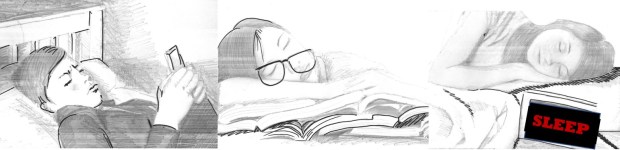
teensleep2Schools often report that they see exhausted children coming through their gates every morning. Whilst there are arguments that the school day should start later, and that this would be of benefit to a lot of teens, the practicalities seem to make this not possible for now. We often have to work within reality, so helping teens adapt to the demands of their school schedule and get enough sleep in time to go to school refreshed is important.

Teens need to get around 9 hours of sleep a night. Many teens do not get this amount of sleep, and there are many reasons they do not get enough sleep. Given that learning is their job, they need to have the opportunity to optimise their ability to learn. Sleep is essential to maintain both physical and mental health.

The need to rest is evolutionary. Inactivity allows us to conserve energy, repair our mental and physical systems, rejuvenate our minds and bodies, process the events and lessons from the day, and maintain neuroplasticity (the ability to use all parts of our brain to continue to learn). Sleep is essential for teens to optimise their performance when they are awake.

There are various theories regarding the purpose of dreams, but all support the concept that REM sleep (dream sleep) is somehow important. It seems that REM sleep may act towards mental housekeeping – sorting events from short term memory to long term memory, building neural pathways to improve our procedural capabilities (knowing how to perform a task) and process our emotional responses to situations. A good nights’ sleep allows us to tidy away yesterday and face each new day ready to take charge

Lack of sleep compromises one’s ability to concentrate and respond rationally. Mood swings, irritability, problems learning, and increased risk of accidents are all associated with sleep debt or deprivation. When we deprive ourselves of an optimal amount sleep our personal sleep debt accumulates. Hence you may find that you spend the weekend attempting to pay back this sleep debt, and live in a compromised state every other day.

Over the long term, physical ailments occur if you do not receive enough sleep. Conditions attached to sleep debt and deprivation includes diabetes, weakened immunity systems, high blood pressure, lowered sex drive, heart conditions, and mental health issues such as clinical depression and heighted stress responses.

So the importance of sleep is clear, but getting teens to go to bed can be extremely difficult. Mention bedtime routines among parents of teens, and you will experience the universal rolling of eyes in exhaustion.  Our guidelines for parents include the following


Encouraging healthy sleep patterns for your teen.

Remember that YOU are the parent. The teenage years are a welcome reprieve after the constant care required through infancy and childhood. Your offspring can now dress themselves, travel independently, and organise themselves (occasionally). But teenagers aren’t fully cooked, and still require active support. Especially around boundaries of healthy and unhealthy behaviours. Whilst sleep and bedtime are bound to be the topic of many a parent teen conflict, I encourage you that this battle is well worth fighting for (verbally).

Set a regular bed time and help your teen keep to it. Having a regular bedtime trains your body to start to wind down in a trained fashion. Given that teens require 9 hours sleep, in order for them to rise well rested at 7am they need to be in bed, asleep by 10am. Do not rely only on the weekend to catch up on sleep.

Encourage naps.  Children resist napping as they get older. Try to encourage your teen to take a nap occasionally.

Break bad behaviours. Screens provide light and stimulate teens minds, in the worst way. In order to help your teen wind down for bedtime encourage them to put down their devices at least an hour before their bedtime. Be prepared to have a fight. No parent I know has installed tech free time, without an old-fashioned toddler worthy temper tantrum.  

Ready, Steady: Encourage your teen to get themselves ready for the next day the night before school, rather than in the morning. This will allow them to wake without stress, and go to bed assured that they are ready for the next day.

Turn up the calm. Taking a bath, writing in a journal, colouring pictures, drinking cocoa, listening to music, reading in bed all encourage the body to start to relax. Use the hour, or half hour before bed time to train your teen’s body to get ready to rest. Children who suffer from anxiety may benefit from guided mediations (on CD or tape or Ipod, not on the internet)  

 The bed as a nest.  A tidy room with minimal clutter, blackout curtains, weighted blankets all enhance the feeling of being settled in bed.

Reinforce positive sleep behaviours. When your teen goes to bed on time or get up in a good mood make sure that you make note. No teenager will admit it, but your praise is still important.

We have a new generation of people with our teens. We are raising a generation of people who have never NOT had access to the internet. Many of them carry and posses a personal computer or phone by the age of 12. They are, in the first world at least, privileged, unlikely to go hungry, can create a completely artificial self-image, have limitless mentors (both positive and negative. They will face a world of work beyond our experience, with many unknowns. So many things have changed. The need for sleep has not. Our new world teens, still the guidance of their new world parents.


#sleep #teens #mentalhealth  #rest #selfcare #sleepdeprivation #sleepdebt #sleeptrainning #mentalhealthessentials  #reddoor

Sleep training for adults.

adult sleep

Adults sometimes have the tendency to forget to take care of themselves. The first and foremost self-care act one can undertake is to ensure that we have enough sleep. We are exposed to various workaholic CEOs highlighting their choice to be productive at work, over catching the right amount of rest. Very few people benefit from emulating these sleepless elite. Getting enough sleep is extremely important to maintain both physical and mental health.

Adults (25-60) need between seven to nine hours of sleep a night. Do you get at least 7 hours of quality sleep?

The need to rest is evolutionary. Inactivity allows us to conserve energy, repair our mental and physical systems, rejuvenate our minds and bodies, process the events and lessons from the day, and maintain neuroplasticity (the ability to use all parts of our brain to continue to learn). Sleep is essential for adults to optimise their performance when they are awake.

There are various theories regarding the purpose of dreams, but all support the concept that REM sleep (dream sleep) is somehow important. It seems that REM sleep may act towards mental housekeeping – sorting events from short term memory to long term memory, building neural pathways to improve our procedural capabilities (knowing how to perform a task) and process our emotional responses to situations. A good nights’ sleep allows us to tidy away yesterday and face each new day ready to take charge

Lack of sleep compromises one’s ability to concentrate and respond rationally. Mood swings, irritability, problems learning, and increased risk of accidents are all associated with sleep debt or deprivation. When we deprive ourselves of an optimal amount sleep our personal sleep debt accumulates. Hence you may find that you spend the weekend attempting to pay back this sleep debt, and live in a compromised state every other day.

Over the long term, physical ailments occur if you do not receive enough sleep. Conditions attached to sleep debt and deprivation includes diabetes, weakened immunity systems, high blood pressure, lowered sex drive, heart conditions, and mental health issues such as clinical depression and heighted stress responses.

The benefit of achieving the optimal amount of sleep on a consistent basis include living longer, having a stronger immune system, rejuvenation of the skin and beauty, greater creative capabilities, improved productivity and concentration. The world is facing a global pandemic, so we need to be at our strongest to fight off this infection. So, what are you waiting for? Go to bed.

If only it was so easy?

Sleeping issues take time to develop and take time to overcome. A simple solution is to utilise sleeping medications. These medications are usually not intended for long term use as they can be addictive. They are best to help overcome acute sleep problems, is to learn to develop healthy sleep patterns.

Sleep training: the adult edition. Multiple books detail how to train babies and infants to fall and stay asleep. Just as you have to consistently practice sleep practices with children, repetition is important to achieve results with adults. Every time you break healthy sleep patterns (travelling, staying out late, all nighters at work) you may have to start your sleep training again


Building better sleep

Step 1: Sleep logs. You want to know what your sleep is like so that you have a baseline. In addition to your bedtime and wake up time, which should give you the number of hours you had at rest, you may want to rate your sleep. You can give yourself a score out of five – 1 point for achieving each of the following:

1 point if you fall asleep quickly – within 20 minutes of going to bed

1 point if you only experienced minor night time waking – you may be aware that you woke up, but fall back to sleep quickly, not need to get out of bed, or check your phone.

1 point if you are aware that you dreamed. You don’t need to be able to remember the content, but only if you had some dreams during sleep

1 point if you slept more than 7 hours

1 point if you woke in the morning feeling refreshed (within the first hour of waking).

Recording the quality of your sleep is as important as the quantity of your sleep.

Monitor for a few weeks whilst you try various other steps

Step 2: set a regular bed time. Having a regular bedtime trains your body to start to wind down in a trained fashion. Go to bed/ sleep at the latest by 11 pm. Try to wake up when you can experience morning light – so in Hong Kong that is around 7am. If you need to wake up at a specific time, plan your bedtime to be at least 8 or 9 hours ahead of that time.

Step 3: minimise stimulants ahead of bedtime.  This doesn’t only mean coffee or cola drinks, this includes screen time, TV, social media. Stop using devices an hour before bedtime. These devices keep your mind awake.  Instead use this time for calming activities

Step 4: Maximise calm activities and a calm routine. Taking a bath, writing in a journal, colouring pictures, drinking cocoa, listening to music, reading in bed, and massaging your muscles start to help your body obtain a resting state ahead of bed, and convey to your mind and body that sleep is coming.

Step 5: Build a nest. A tidy room with minimal clutter, blackout curtains, weighted blankets all enhance the feeling of being settled in bed.

Step 6: Eliminate mental clutter. As you go to bed consider how are you going to clear your mind. If you wake with ideas during the night, keep a pad and pen beside the bed so that you can jot down a prompt for the idea and go back to sleep immediately. Writing a journal before you go to bed is a wonderful exercise to empty your mind of worries gathered during the day. Praying and celebrating what you are grateful for also helps you create a sense of mental calm before you go to bed. For more information on the benefits of journaling see our blog on this issue. ( https://reddoorhongkong.wordpress.com/2017/03/22/six-fantastic-benefits-of-writing-a-journal/)

Step 7: catch up on debts. Sleeping for one single period, at night is a human evolutionary practice created in response to the world of work. In some cultures, and among other species, multiple periods of sleep is the norm. Consider a siesta occasionally, and see if napping is a benefit to you. This may help you catch up on your sleep debt, or help you recharge your batteries.


One last note – whilst much of the focus of this article is focused toward achieving enough sleep, there are also health problems related to sleeping too much. Oversleeping can be caused by other health problems, but also contributes to health problems. If you regularly sleep more than 10-12 hours a day please consult your doctor. Oversleeping has been associated with heart disease, diabetes, pain, obesity, depression and sleep apnoea. Too much sleep also impairs your cognitive function, so try to monitor your sleep, and look to set up healthy waking and sleeping patterns.


#sleep #mentalhealth  #rest #selfcare #sleepdeprivation #sleepdebt #sleeptrainning #mentalhealthessentials  #reddoor

Learn to (better) control your emotions.


emotions

As human begins, we may never have complete control over what we feel, but we do have a lot more influence over how we feel than you might have been told. Adults are expected to be able to manage their emotions – especially strong negative emotions such as anxiety, fear, and anger. Yet all of us have experienced instances where we’ve become overwhelmed with emotions and not felt as if we could control our actions around those feelings. We may in those instances act in a regrettable fashion, not go to an event where we were expected, miss the opportunity to travel, lashed out at a friend or family member.

How do we learn to keep our emotions in check? The key is emotional regulation and learning emotional self- regulation techniques. These skills allow you to manage your emotional reactions to the world. These are the skills of people who respond with emotion to a situation but do not continue to harbour or escalate those emotions beyond the initial expression (except in the case of bereavement where prolonged emotion may be expected). You can assess your self-regulation abilities in online tools (http://sciences.ucf.edu/psychology/myemotions-hxus/) which explains two important components of regulation – your ability to frame and reframe around your emotions (reappraisal) and your tendencies to supress emotion rather than express it (suppression).

If you have difficulty regulating your emotions you may need to utilise short term and longer-term sustainable solutions


Short term solutions.

Opportunities to create a quick sense of calm may be helpful to utilise when you are feeling strong negative emotions (https://reddoorhongkong.wordpress.com/2019/03/13/achieving-quick-calm/) including breathing, repeating mantras, drinking water, colouring, journaling, listening to music, counting, exercise and stretching.

One strategy that can help you in the heat of the moment may be to utilise the STOPP tool outlined by psychologist Carol Vivyan. Essentially the STOPP is a mnemonic to remind you to.

S: Pause, take a break, slow down the events that are unfolding

T: take a breath.

O: Observe yourself, the situation, your reactions, your expectations of others.

P: Look at the situation from a matter of perspective – is this really an emergency, is action really required right now, will it be better for you to walk away from the situation or stay engaged.

P: Proceed with caution. Choosing to no react will help maintain your reputation and credibility. Walk away if you can.

https://www.getselfhelp.co.uk/stopp.htm


Sustainable changes for long-term emotional regulation

To deal with to deal with emotional regulation include understanding and labelling emotions, exploring thought patterns, practicing mindfulness and cognitive reframing.  Build long term reflection skills.

Emotional monitoring Emotional monitoring is the backbone of mindfulness study. There are many tools to help people correctly identify and label emotions, whilst separating those that are primary emotions (those that occur immediately in reaction to an event) from those that are secondary – your reactions to the primary emotions, or emotions that linger longer because of thought patterns.

Physical experiences such as tension, butterflies in the stomach, headache, clenched jaw are observed and recorded.  Correctly helping identify the expression and experience of an emotion helps the client associate particular thoughts patterns associated with those emotions, or simply help them notice that they feel emotions they thought they had “lost”. Many people confuse feeling anxious with feeling angry and hence respond by lashing out, rather than behaviours that may help them calm down.

Thought patterns are essential to associate with certain emotions. These thought patterns may have been learnt over many years and may include catastrophising (this is the worst thing ever!), negative comparisons (She is so cool, I am such a loser), and mind reading (see my blog on common thinking errors). Essentially people are taught to catch these thinking patterns in action and reflect upon them from alternative perspectives. They may be asked to keep a log of negative events and how they felt about those events so that they can be discussed in terms of creating a more rational perspective on the situation being reviewed.

Some of the specific tools to assess emotional regulation (such as the CERQ- the cognitive emotion regulation questionnaire) helps to identify the cognitive strategies and thought patterns that people use in situations. As such you can identify the elements and thought patterns that might me making you feel the way you do.

For example, you may have a specific difficulty to blame yourself when things go wrong, or not accept that something bad has happened. You may find yourself caught up in rumination traps, where you cycle through events again and again to understand your feelings and how you got to this point (even if this is not achievable and the situation are the consequence of other people’s decisions or actions). You may or may not be able to refocus or reappraise the situation in a way that helps you overcome feelings (gaining perspective, seeing that this happens to a lot of people not just you, realise this could not be avoided).

Practicing Mindfulness helps individuals become more aware of their thought patterns, their emotions, their reactions, and the thoughts and feelings that they hold about certain events. Being mindful requires individuals to live in the present, not the past or the future. Taking this approach allows them to assess situations more empathetically with less self-judgment. Skills such as learning to observe, describe and be aware of your surroundings are taught, as well as practice assessing situations from a position of no judgement, being observant, and looking for effective outcomes  https://reddoorhongkong.wordpress.com/2017/07/05/the-making-of-a-focused-mind-the-benefits-of-mindfulness-for-children-and-teens/

Once thought patterns and perspectives have been regularly assessed cognitive reframing and discourse can be utilised to teach a new set of responses. When you catch yourself overreacting to situations, ask yourself, could other outcomes be possible, can you be kinder to yourself in this situation, can you show empathy rather than anger. Create a dialogue that helps you look at yourself in a non-judgemental but still accountable manner. Do not use terms such a “should” or “I must”. Instead use language such as “I can”.

In the long term you may like to create long term reflection building tools. These activities help build not only reflection, but stronger mental health capabilities. Remember practice makes progress. These activities include: writing a journal, meditation, therapy with a counsellor, ensuring you have enough sleep, walking and talking to yourself, and of course, sharing your experiences with close friends.


There is a lot you can do to better manage your emotions and your reactions. Activities such as self-medication (especially through alcohol), self-harm, and escaping into your social persona through internet addiction, do NOT help. If you have been using these behaviours to help you manage strong emotions try some of the recommendations in this article. If you continue to struggle, please consider therapy. Good luck.


#reddoor  #mentalhealthessentials #emotionalintelligence #emotionregulation #mindfulness #mentalhealth #selfhelp #angermanagement #anxiety

Achieving Quick Calm

10calm

Here are 10 techniques to achieve a quick calm when you feel strong negative emotion or feel overwhelmed. 

1.       Take action – go for a quick jog, or perform 20 jumping jacks. Since you have to change your thinking you will find that you can distract yourself from your emotions for, just long enough, to catch your breath and, start to, consider your thoughts.

2.       Repeat a mantra – any quick phrase that reminds you to stay calm. For example, “let it slide off me like water off a duck’s back”. “I am enough”, “Its okay not to be okay”.

3.       Drink a glass of water.  If one glass is not enough, drink another glass.

4.       Counting – count backwards from 100. Simply focusing on another activity creates a break in the momentum of a situation and allows your thoughts to be distracted.

5.       Progressive relaxation exercises. Remove yourself from the situation and work on progressive relaxation tension and release activities. Progressive relaxation soothes the body as you tense and relax muscles – isolating and focusing exclusively on one group of muscles at a time. Begin with your toes, and work up through your muscles to your head, where you may focus on relaxing the muscles around your chin and eyes.

6.       Draw a picture, or colour a picture – draw a picture of your feelings, or of anything. Drawing a picture allows you to catch a breath and engage your creative mind. https://reddoorhongkong.wordpress.com/2017/03/06/reasons-to-colour/

7.       Music – listen to 5 minutes of calming music, or music that cheers your mood.

8.       Stretch – stretch your body out, spend 3-5 minutes releasing tension from your body.

9.       Strawberry and Candle breathing. Close your eyes and imagine yourself holding a strawberry. Breathe in and smell the strawberry. Breath in completely. Then blow out air, like you are blowing out a candle, a steady stream of air. Do this 10 times.

10.   Journal – journaling is an exceptional model to provide self-therapy. Even in a time of strong emotion, writing about your emotions can help you start to solve the situation as you write. You don’t need to share your thoughts.


Is living in Hong Kong bad for your mental health? Benchmark survey – English speaking women in Hong Kong.

hkgoodorbadbecause....

Whilst there is no significant difference between the number of men and women that experience a mental health problem, some mental health challenges are more common in women that in men. These typically include depression, anxiety,  self-harm, eating disorders, and some personality disorders.

RED DOOR, a psychology and counselling practice based in Hong Kong, recently ran a brief survey among English speaking women in Hong Kong exploring the experience of various mental health challenges and issues among that population. Over 120 women responded to this call for feedback. Whilst this is a small number compared to the size of the population, this research is not a measure of prevalence, rather than identifying those issues that are most commonly reported.

The 120 women were asked about their personal experience of mental health issues, their concerns for their children (if they have children) and their overall perception of Hong Kong in terms of being a positive or negative location in terms of supporting/compromising mental health.


Comparing good or bad (not including people who said it was neutral) more women rated the experience as BAD for their mental health than GOOD. Many reasons were cited as explanations of HK being challenging to your mental health.

HK IS BAD BECAUSE...

Many of these should be concerning to local government, employers, educators and health professionals.  It seems that HK is seen as a place where people are under a lot of pressure, do not have all the sources of support they may require, but can find alternative self-medicating (drugs/ alcohol) options too easy to pursue. We will continue to explore this area.


What mental health issues do HK women experience?

The most common mental health challenges women experience in Hong Kong include feeling overwhelmed, experiencing bad stress, regular sleep disturbances and feeling anxiety. These concerns were experienced regularly or often according to the ratings.

women and stress

Other challenges experienced occasionally include feelings of poor self-esteem, experiencing sad mood and depression, perfectionism, marital discord, disordered eating, obsessive thought patterns, and consuming more alcohol than advised.

It is important that women get good advice how to deal with each of these challenges and we promise to communicate advice on each of these topics in our next series of blogs. Some brief advice for each includes

Feeling Overwhelmed.

Feeling overwhelmed is part of life, and will happen occasionally, but if you feel overwhelmed frequently you make like to follow some of the following advice, either on your own or in collaboration with a counsellor.

Thought patterns. We all hold some thinking patterns/ errors that exacerbate our experience of stress. If you are a catastrophic thinker, meaning you tend to think the worst things will happen, you plan 5-6 steps ahead in terms of awful things that might happen, you will experience more overwhelming experiences of anxiety.

What to remember: Repeat a few reminders to yourself. a) You’ve probably been here before, and survived, and maybe even managed such a situation with success. b) Some situations work out without you having to do (or decide) anything. Sitting for a moment is usually a good thing. c) You can’t control everything, but you can trust in your ability to respond to situations in a proactive and positive manner. And lastly, d) take each day one at a time, don’t worry to much about tomorrow, think about what you need to do today.

Add some perspective: Sometimes you ned to change your way of thinking. You might need to rewrite a situation using terms such as “at least” or “yet”. For example if you believe everything is going against you, you an use the phrase “at least” to put some hope or context into the situation. For example, “Everything is going wrong today. At least, I have my lovely dog to pat at the end of it. At least the day is over and I can relax now. At least I can tell my friends about it.” The “yet” phrase helps you look at your own capabilities with greater hope and humility. For example, “I can’t manage my finances, YET. ”

All of these elements in addition to slowing your thinking down, writing elements to be grateful for , and asking for support will help.

Bad Stress

Some stress can be motivating and galvanising. Prolonged stress (Chronic) or extreme levels of stress (Acute) is extremely detrimental to your health – mental health and physical health. Some thought elements that help you quickly include.

Thought patterns. We all hold some thinking patterns/ errors that exacerbate our experience of stress. In addition to catastrophic thinking, comparing, should-ing, blaming and overgeneralising all exacerbate our experience of stress in a situation.

Negotiation skills at work are essential. Do you have too much to do. How can you decrease your workload? Can you negotiate your workload?

Prioritising during the day, and in your career, is important so that you are spending time and effort on those activities which are of most benefit to you and your plans, and bringing you closer to your goals.

Lifestyle elements such as sleep, avoiding self medication and addictive practices, and eating and exercise all will improve your ability to deal with stress.

Sleep Disturbances

Women in HK mention that they often experience disturbances in their sleep. Even adults need about 8 hours of sleep a night. Try to get to bed before midnight, and create a positive bedtime routine which helps you get to sleep. This would include no screen time an hour ahead of bed time, take a relaxing bath or have a cup of cocoa, read in bed. In essence wind down, and tell your mind and body that you are preparing to power down.

If necessary you can consider sleep aids, homeopathic or medical. Be sure to take sleeping medications under the care of a physician.

Anxiety

Anxiety is one of the most common mental health issues for both men and women, adults and children. Learning to deal with anxiety may include medication, but often involves therapy, especially cognitive behavioural therapy techniques. Consider to see a counsellor if you are experiencing anxiety on a regular basis. A treatment plan often includes monitoring, thinking pattern assessment, thought log and training in relaxation and meditation techniques. For some quick advice check out our previous blog on anxiety.

Women in Hong Kong require support for these challenges. Whilst support groups and counselling services exist, there seems to be a need for much more, available services.

#mental health #internationalwomensday #HongKongmentalhealth #anxiety #stress #women


If you need therapy and find the cost a barrier  consider finding a therapeutic support group as an alternative. These groups are usually much cheaper, and also have the benefit of the group dynamic to help members.

RED DOOR runs a divorce therapeutic support group, and is interested to provide therapy groups to those experiencing anxiety or low self-esteem. If you are interested to join such a group contact us at reception@reddoor.hk.