
We rarely see narcissists in person in the counselling setting. More often, the client in the chair, the person coming for counselling, is seeking understanding or support because of the actions of another person, and the other person may be a narcissist.
If you have had the misfortune to have been in a relationship with a narcissist, you may understand this situation. The counselling client, the narcissists dance partner, comes to counselling because they have lost almost all sense of themselves, they have been broken down and recognise that they can’t seem to make their partner happy, or get what they need from their relationship. Their partner may have told them that they are ‘crazy’, and that everything difficult in the relationship is their fault. They will have been told that the relationship is exceptional, unique, only they, can really, understand each other. Rather than a compliment this language is used to separate the dance partner, from reality and other sources of realistic support. After all, “Other people aren’t like us, we are special and as such, you need to prove this to me constantly”. If this sounds like your relationship experience, read on, you may he been dating a narcissist.
These days, it seems everyone is being accused of being a narcissist, and there may be some truth in this assertion.
In a world where we are encouraged to regularly display our best selves on social media, we can become rather self-involved. Social media and reality shows encourage narcissistic behaviour. Narcissist are very concerned with their image and like attention. Additionally, we are often socialised as to our unique or special nature. Whilst each of us is different from one another, if you have been raised to believe that you are different in a way that makes you superior to others, rather than simply not the same, you may have crossed the line and become narcissistic.

One can be mildly or moderately or extreme expressions of narcissism. If you have mild narcissistic tendencies these may be a product of one’s emotional development and can change over time. When we refer to a proper “Narcissist”, those people have not only a tendency to express most narcissistic traits, and especially those indicating desire for authority over others, and sense of superiority, and this is consistent over time.
There are various online assessments of narcissism. They are not fully diagnostic tools, but may help you understand how self-involved, or needing of adoration you are on a narcissistic scale.
If you would like to assess your own level of narcissism we have tried and our comments on those tests. It is my personal preference to explore those who provide rating style questions rather than either/or suggestions because more subtle preferences can be counted, and discounted accordingly.
Characteristics of narcissists.
Whilst this is not a diagnostic checklist, you may find that a narcissist has many of the following traits:
- Unrealistic grandiose sense of self image. Remember Narcissism was once referred to as “megalomania”.
- Speaking mostly about themselves, reinforcing a narrative where they are superior to others or under-appreciated.
- Incredibly self-centred with lack of empathy for others.
- Value power and fame for themselves.
- Arrogant.
- Think the rules don’t apply to them.
- Demand constant attention or adoration.
- Constantly look to promote themselves.
- Highly sensitive to criticism, yet at the same time…
- Quick to criticise and judge others.
- Feel special and unique, and probably superior to others.
- Feel entitled to have the best of what is on offer.
- Will respond with dysregulated emotional responses when questioned – extreme anger, sulking, punishment.
- Avoidance of personal responsibility for their poor reactions to situations.
- Deceitful and manipulative.
A true narcissist will exhibit most of these traits, not just one or two.
Narcissists lack empathy and are often quick tempered. As such, they frequently use manipulative techniques, such as gaslighting, to take advantage of others. Whilst not all people who gaslight are narcissists, narcissists almost always use gaslighting as one of their tools to control people in their lives. For more on gaslighting see our blog on surviving gaslighting highlighted at the end of this article.
For the person in a relationship with the narcissist there are innumerable costs, especially to their self-esteem. If any of these situations seem familiar, consider if you need to break free:
- Narcissists refuse to take responsibility for their actions so be prepared that most problems you have will be your fault. You might hear dialogue such as, “You made me so angry when you accused me of lying. Sure, I came home late and you didn’t know who I was with, and when I told you that I was out with Tim, you said that you were told that he was already at home by his partner. I can’t be responsible for your lack of trust in our relationship. Actually, you need help!”
- Narcissists’ sense of grandiosity means that they cannot reflect on their own limitations. They may even lecture you on a topic that they have little knowledge of. Be prepared to encounter several lectures not based in reality.
- You will become confused if your relationship is healthy, or actually really damaging. Narcissists use techniques such as love bombing to win you over. They may tell you that you and they are soulmates and that you are destined to be with each other. This ‘sounds’ like your relationship is superior to others. Don’t fall for this manipulation. It takes time to develop real trust and intimacy. True emotional intimacy cannot be rushed. If you fall for this, later you may find these techniques turned against you as a means to control you. For example, “I thought we were soul mates, but apparently you can’t give up an evening with your family in order to stay home with me. I guess I was wrong”.
- Narcissists dismiss other people’s achievements. If you succeed your narcissistic partner may dismiss your achievement as luck, or even take responsibility for your success themselves.
- The world rotates around the narcissist and their self-image. Acts of kindness will need to be acknowledged effusively. They may plan your birthday party, but everyone at the event will know and they will expect you to make a speech publicly stating your appreciation.
- A narcissist will be sensitive to any form of criticism. It is unthinkable that the world around them is failing to understand their greatness. If told that they need to reconsider their behaviour, consider alternative ways of performing a task, they will react quickly, often with anger. They may obsess over plans for vengeance and revenge. This will not usually directly be applicable to their partners, after all they choose you because they believe that you are adoring, however your family, your friends or, even your counsellor, may become candidates for such retribution, if those people dare to raise questions over the narcissist’s behaviours.
- A narcissist may become very sensitive if you are not providing them with enough praise. In this instance they may consider insufficient admiration as a form of criticism.
- Rules do not apply to them. Narcissists can break social rules because the typical rules do not apply to them.
- They will often brag about their connections, popularity, and perceived importance. It is important to them that others see them as superior.
How do you spot a narcissist?
You have to be watching – both them and yourself.
In essence a narcissist is a control freak who needs to orchestrate the feeding of their compulsion for adoration and attention. As such they will use a variety of manipulation techniques to establish that you will be feeding their insatiable appetite for attention.
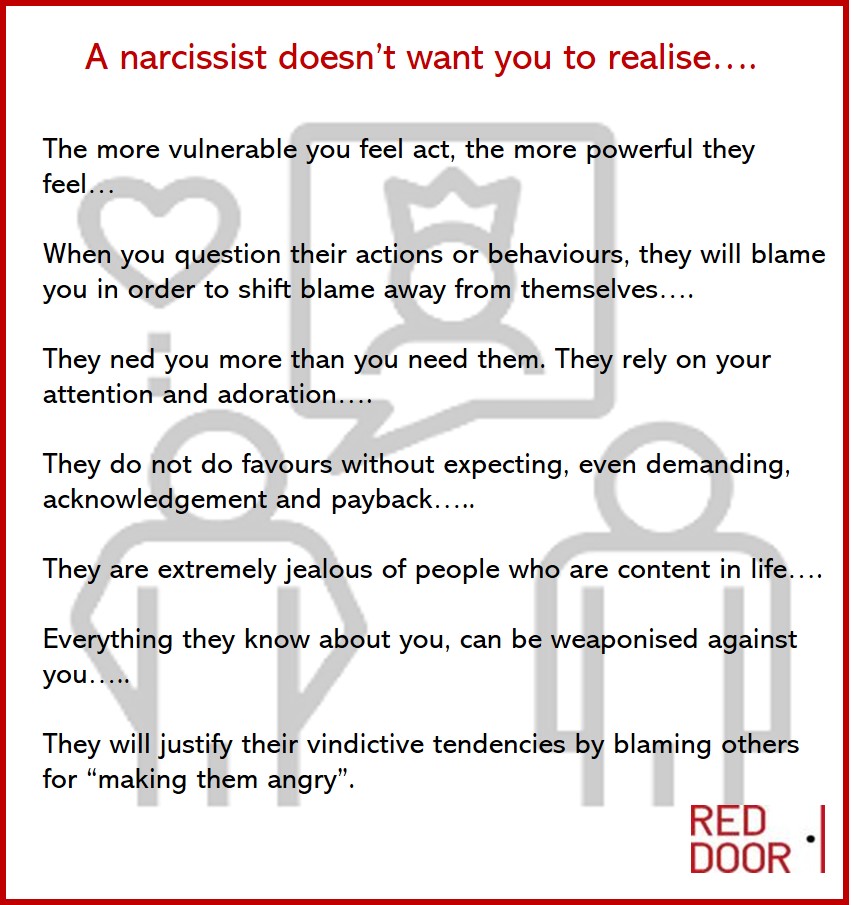
You can use the above list or narcissistic traits, and set of scenarios to think about if your partner is a narcissist. If you are with a narcissist, it is also because they have been able to manipulate you. You are their chosen partner in a dance of control and manipulation.
Take a good look at yourself. Narcissists are attracted to people they can manipulate. Individuals who are people pleasers, are overly empathetic, are conflict avoidant, who often seek the approval of others instead of relying on their own self-confidence, and generally have self-doubt are more likely to be the chosen partners of narcissists.
If you believe you have some of these traits, you may need to work on yourself. Self-help programmes and counselling could help you build better boundaries and protect your mental health.
How to break free from a narcissist?
Many a meme will tell you that you need to go “No contact” with a narcissist. Essentially life with a narcissist will have you questioning reality. “Up” is only up, if they say it is. As a consequence, individuals coming out of narcissistic relationships are often very confused about what is real, and how to make decisions for themselves. Freeing your mind of the pollution of narcissistic manipulation requires that you break contact with the person muddling the environment to create an atmosphere dedicated to their need for attention.
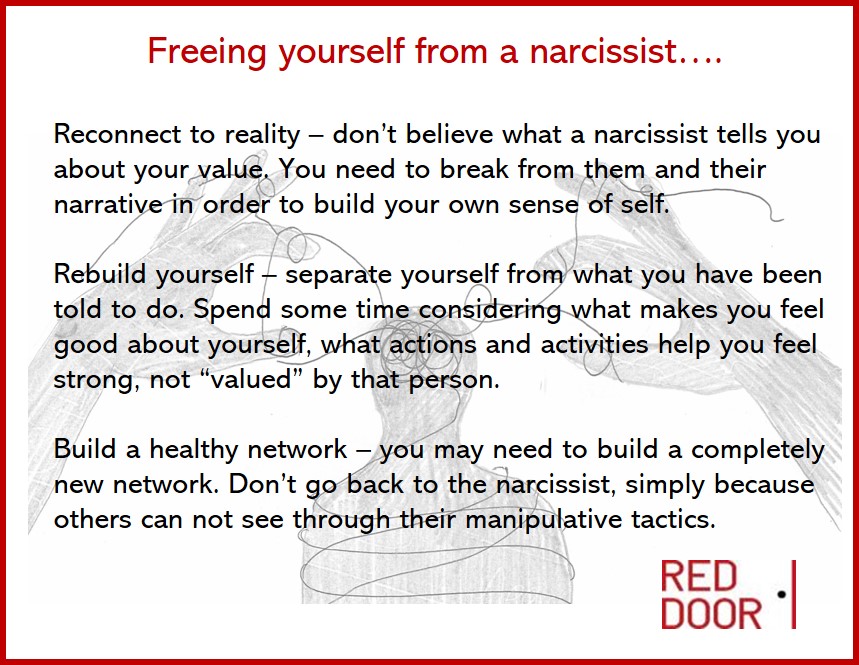
In a formal recovery process, your counsellor will want you to take charge of your decisions and own your own feelings. You can be okay, even if someone around you is not okay. Only by owning your own decisions in life, and understanding that you are not the source of other people’s happiness, can you truly break free from being susceptible to narcissistic manipulation in future.
They will want you to reconnect to reality without the narcissist. You have been conditioned to see the world, and particularly other people, including yourself, through a lens that the narcissist provides. You need to start seeing the world through your own eyes again. Discussing what you like, what makes you comfortable and uncomfortable, and rediscovering your sense of self.
Your counsellor will encourage you to spend time rebuilding yourself – separate yourself from what you have been told to ‘do’ or ‘be’. Spend some time considering what makes you feel good about yourself, what actions and activities help you feel strong. You determine who you are and what you do. The narcissist will have installed themselves into the centre of your world. Once you have dislodged this parasite, you have to install yourself as the master of your life.
In addition, your counsellor will encourage you to develop new networks checking yourself to stop repeating co-dependent patterns from the past. New contacts should allow you, even encourage you, to make decisions for yourself. Friends that repeatedly tell you to go back to the narcissist possibly don’t see the manipulation at play. If those contacts cannot respect that you need to separate from someone dominating you, t term mental health build a supportive, sane, network – you may need to build a completely new network separate from the people connected to your narcissistic partner. Don’t go back to the narcissist, simply because others cannot see through the manipulative tactics being used.
If you would like to break free from narcissistic manipulation, consider counselling. You need to have a trained and trustworthy advisor, who can help you become your own person again. You want to build yourself into an independent thinker again. So that you can avoid falling into the trap of another narcissist in future.
About the author
Angela Watkins is a counsellor working out of RED DOOR Counselling in Hong Kong. Angela works with adults and teens on a variety of topics including identity, relationships, trauma, , anxiety, change, and family of origin issues.
Learn more about gaslighting: https://reddoorhongkong.wordpress.com/2023/01/26/surviving-gaslighting/
Non diagnostic tests for narcissism
https://www.mind-diagnostics.org/narcissism-test
https://psychcentral.com/quizzes/narcissistic-personality-quiz#1
 Start your Red Door Journey