You possibly enjoyed colouring pictures when you were a child. It is something you can revisit, with benefits, as an adult.
The current popularity of adult colouring books celebrates a return to encouraging our creativity, and embracing the sense of calmness that colouring can offer.
5 Reasons to colour:
Stress Reduction: The mental focus which is required when colouring pictures – selecting colours, staying inside the lines, considering balance – can induce a meditative-like state. The heart rate is reduced and breathing becomes more calm. The repetitive nature of colouring calms even the busiest minds. Try it for just 10 minutes a day (with no distractions) and check how you feel afterwards.
Age Defying.Both physically and emotionally. It is good for you emotionally to play occasionally, and colouring is a form of such play. Additionally colouring helps to maintain manual dexterity, which is essential to growing older gracefully.
Boost Creativity.Break out of any creativity rut using colouring. Even if you do not think of yourself as an artist, simply selecting colours and designs helps to unleash a heightened connection to your ability to think creatively. Be ready for new ideas!
Brain Development.Colouring helps to develop greater skills of concentration and focus. Furthermore, both hemispheres of the brain are engaged, giving your brain a good ‘workout’.
Mini break. Colouring can create an mini break to calm and centre a person, even if you are feeling ok at the moment. If you are experiencing anxiety, depression, obsessive compulsive tendencies, or difficulties managing stress, psychological research supports the use of colouring as a part of the therapeutic process.
You may also be wondering when is the best time to start colouring. There really isn’t a bad time to try colouring as a calming technique. I recommend that you give it a try the next time you are stressed, pressured, or feeling run down. At those times, a colouring activity should help you to collect yourself. You might also consider colouring before your bedtime. Since watching TV and playing on devices has been associated with poorer sleep patterns, colouring could create a more relaxed mind-set, setting you up for a deeper, more refreshing night’s sleep.
I encourage you to try colouring, just for 10 minutes and day, to assess what calm and focus regular colouring can help you achieve.
Angela Watkins is a psychologist and counsellor at RED DOOR Counselling in Hong Kong. Her current clinical work focuses on parenting, family life, parenting SEN children, anxiety, OCD, career change, stress management and divorce. Angela has been named HK’s top therapist.
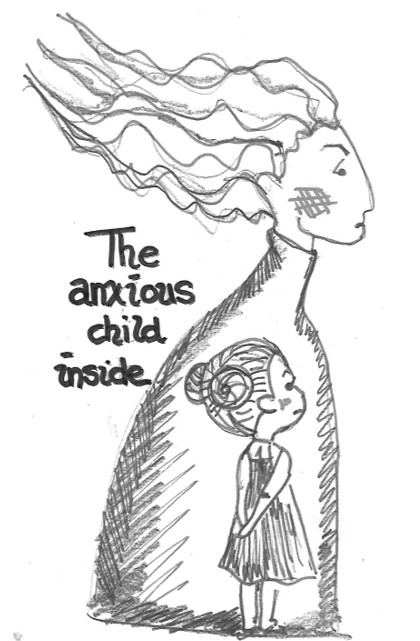
Living with anxiety feels as if you are inhabited by a monster constantly whispering about your fears, insecurities and your worthlessness, your inevitable failures and the catastrophes which you can’t avoid and are probably creating. It is estimated that 13-14% of people in Europe [1] live with anxiety. One symptom is anxiety attacks. Some people only realise that they have been suffering from anxiety when they experience such an attack.
An anxiety attack differs from a panic attack. It is usually a response to a stressor – often a thought or feeling or specific dread. People feel apprehensive and full of fear. Their hearts may race and they may feel short of breath. Often people feel out of control and may become extremely tearful. A panic attack may include some of these symptoms, but usually occurs without a clear stressor. Both can be terribly frightening. If you experience anxiety attacks it is important that you are prepared with an emergency response.
Here are my favourite techniques to respond when anxiety attacks.
Try this exercise when you feel anxious.
Breathing exercises – Listen to the pattern of your breath when you are anxious. It can give you a clue as to how best to respond to your anxiety. If you are hyperventilating – taking fast, shallow breaths, feeling faint, and fearing that you can’t catch your breath, try to breath into a paper bag. Breathing in and out using a paper bag will recycle air, returning carbon dioxide to the body, which will naturally make the breath deeper and slower. Do this for a minute. If you don’t feel better, try again for another minute.
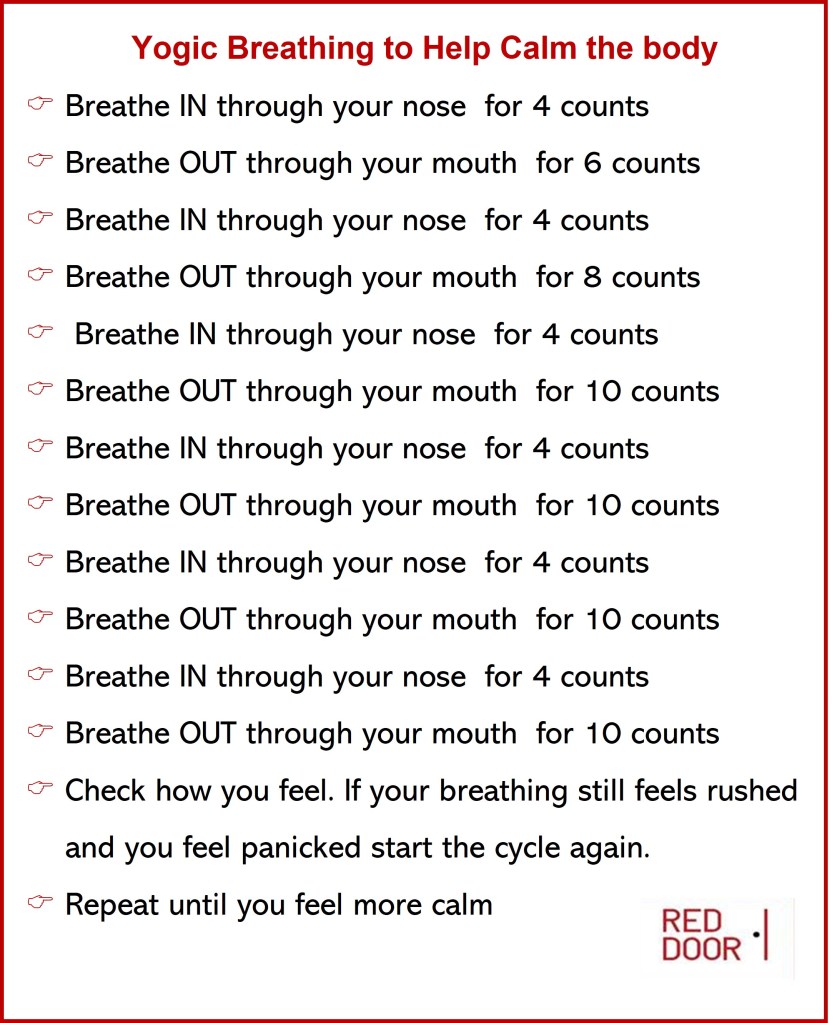
If you are not hyperventilating, you can use the calming breath technique. Breathing exercises such as those used in yoga classes are effective in reducing anxiety. One simple exercise I use with clients uses counting inward and outward breaths to calm the mind. Simply breathe slowly in through your nose for a count of 4, then breathe out of your mouth for a count of 4. Repeat. Then breathe in through your nose for a count of 4, and out of your mouth for a count of 6. Repeat. Then breathe in through your nose for a count of 4, then breathe out of your mouth for a count of 8. Repeat. Check to see if you feel better. If you don’t, repeat the exercise again, concentrating on the sensation of your breath.
Distraction exercises. Distraction exercises help your parasympathetic nervous system override an anxious reaction. By simply refocusing your energy to elements of your environment and allowing your underlying operating system to return to homeostatic (ie regular) breathing.
Use your senses to help calm your breathing
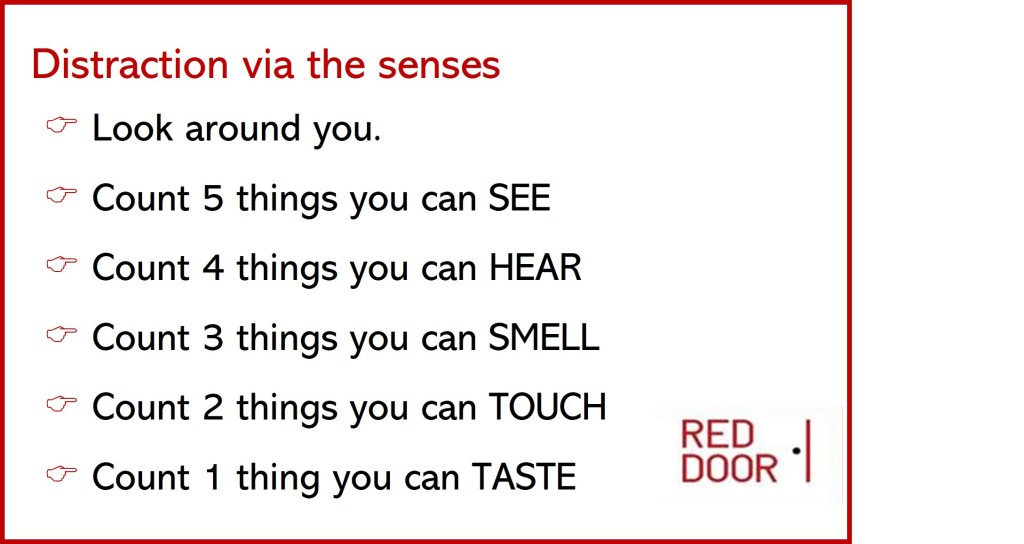
The most commonly used therapeutic technique asks the client to engage their senses to distract their busy minds. Identifying a number of items you can see, smell, hear, touch and taste can help you reset your body. Imagine 5 things you can see, then 4 things you can hear, then 3 things you can smell, then 2 things you can touch, and 1 thing you can taste. Then monitor your breathing again. Has it become less panicked?
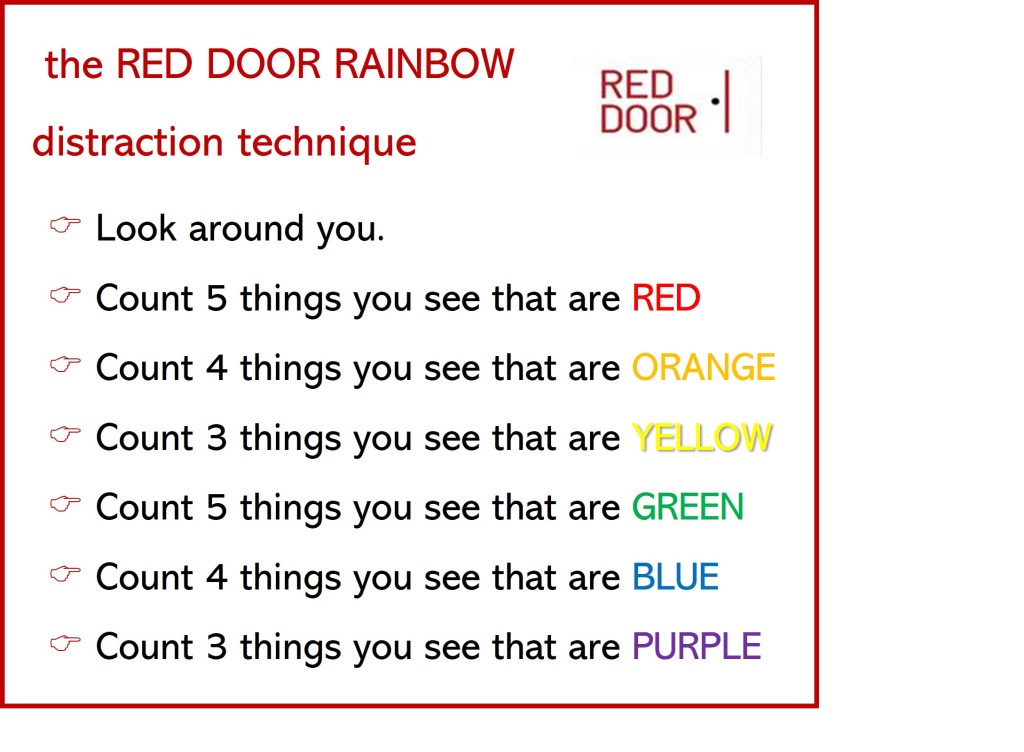
Since we work with a number of teens and children at RED DOOR we also use the RAINBOW technique, often with our proprietary rainbow fidget toy, to help teens achieve quick calm. One can perform this technique without the fidget toy. Simply you count objects in your near vicinity which are specific colours. You can count the number of objects, or a specified number of objects that are red, orange, yellow, green, blue and black.
Distraction and can also be created with some physical “reset” activities such as repeatedly snapping an elastic band against the wrist or performing sets of 10 jumping jacks.
Meditation/Relaxation – Mediation, when practiced regularly, can help people reach a relaxed state more easily. Practice makes progress when it comes to mediation. If you are experiencing an anxiety attack, try to find somewhere to sit quietly or lie down. Then try progressive relaxation, also known as a body scan, which can be especially helpful. Progressive relaxation soothes as you tense and relax muscles – isolating and focusing exclusively on one group of muscles at a time. Begin with your toes, and work up through your muscles to your head, where you may focus on relaxing the muscles around your chin and eyes. Guided progressive relaxations are available on Spotify, YouTube, and on CD.
Imagery – In the throes of an anxiety attack use your active imagination to help your de-stress. First, isolate the location within your body where you feel the greatest sensation of anxiety. Use imagery to help unwind and relax that spot. Cute, warm, and amusing imagery will be of the greatest help. If you feel tension in your shoulders imagine a collective of kittens massaging the knots away. If you feel butterflies in your stomach – imagine yourself in your stomach with them, asking each to settle on your arms and flutter no more. One client recently expressed her fear of butterflies, so, using imagery, we collected the butterflies and they turned into Golden Retriever puppies, ready for a cuddle.
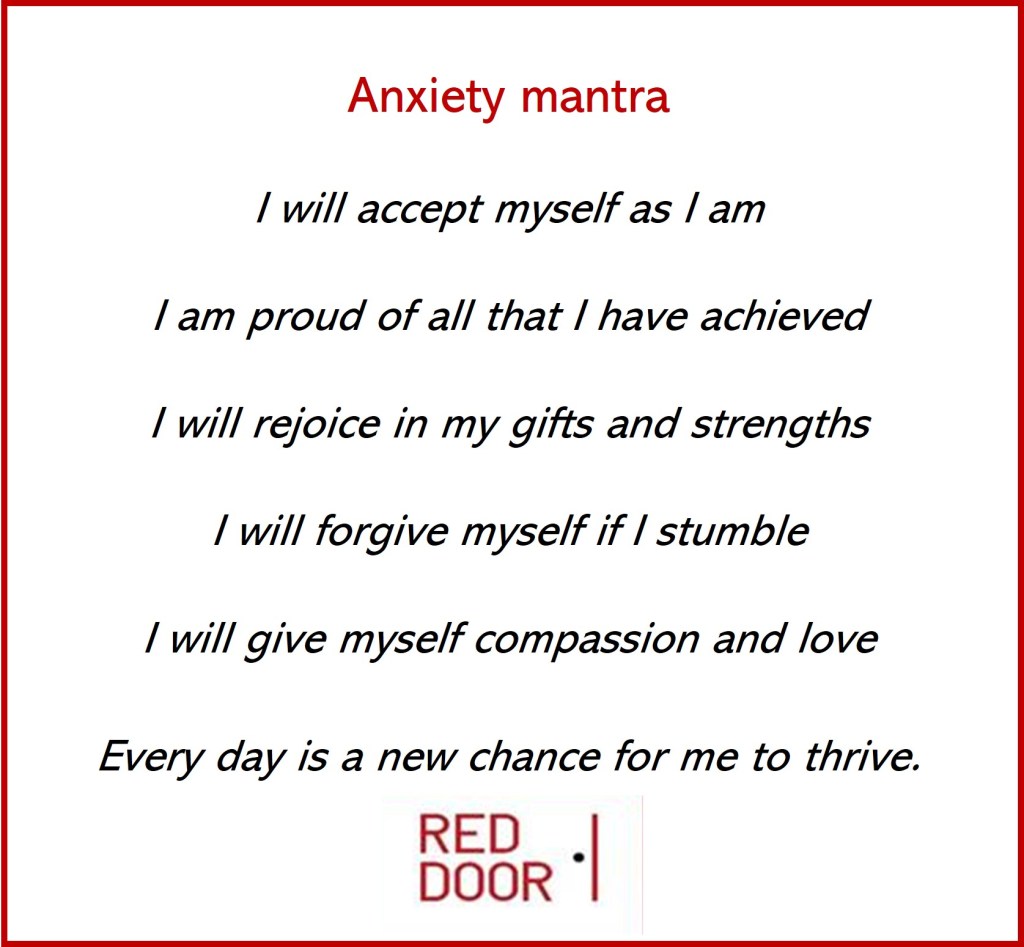
This mantra might help with your negative self-concept
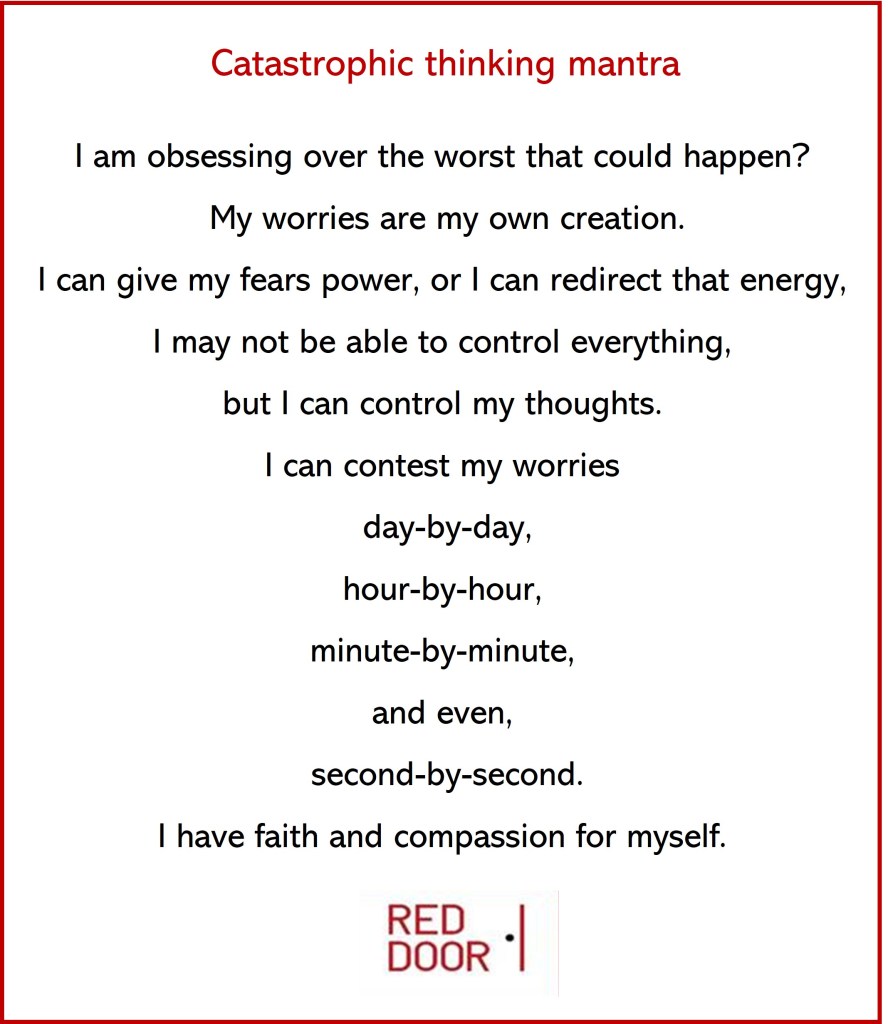
Mantras – Anxiety attacks are created by dreadful thoughts running through your mind. One way to settle these thoughts is to repeat a mantra. While there are mantras on the internet, you may benefit from one that you write specifically for yourself. The mantra should be full of words of kindness, understanding and love. The words “should” or “must” cannot be part of any mantra.
Centre yourself with art therapy techniques
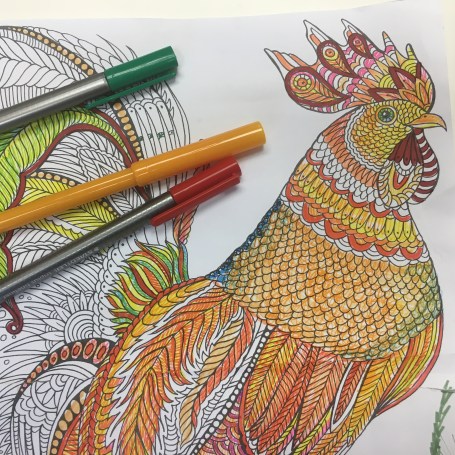
While avoidance is not a long-term technique for managing anxiety, if you are ruminating or feeling a panic attack, distracting yourself with a change of scene or activity can help. Go for a walk, particularly in nature, to reset yourself. Try colouring, which I have detailed in a previous blog [https://reddoorhongkong.wordpress.com/2017/03/06/reasons-to-colour/ ], which involves both sides of the brain, stimulates creativity, and can help to calm the mind. Even listening to some upbeat tunes at this time, get up and dance, just break the pattern of your anxiety for a moment to reset your emotional clock.
Talk to your anxiety – The long-term cognitive approach to anxiety is to create an internal dispute. Disputing your anxiety helps you reframe situations, see hope, and utilise self-compassion. If you experience anxiety ask yourself to challenge your view of the stressful situation – have you been overgeneralising, personalising, or catastrophizing? Is there an alternative way of looking at this issue? Sarah Wilson[2] , in her compendium of suggestions to utilise in one’s challenge with anxiety suggests an ancient adage, “ First make the beast beautiful”, meaning accept that your anxiety – it is something that originally may have been created to help you, but overtime has started to inappropriately misfire. When you make the anxiety beast beautiful you may say to yourself, “Thank you brain for alerting me to potential danger, but I know I am safe right now, you can go back to your guarding post”. Developing the process of dispute is an area of action where a therapist can be of significant help. If you cannot create this dispute for yourself, utilise the resources of a counsellor. For more information see our post on this topic https://reddoorhongkong.wordpress.com/2020/09/07/talk-to-your-anxiety/
Prolonged anxiety is extremely challenging to your health. If you have been struggling with anxiety for a while please seek the help of a counsellor or a doctor. They may recommend a combination of therapy and even medication to help lessen your anxiety. There is no shame in needing help. Take charge of your future.
Everyday is a new day for you to thrive. Start gently, start now.
2004: The ESEMeD/MHEDEA 2000 Investigators,2004, Prevalence of mental disorders in Europe: results from the European Study of the Epidemiology of Mental Disorders (ESEMeD) project
Angela Watkins is a psychologist and counsellor at RED DOOR Counselling in Hong Kong. Her current clinical work focuses on parenting. relationships, anxiety, OCD, career change, stress management and divorce.
We rarely see narcissists in person in the counselling setting. More often, the client in the chair, the person coming for counselling, is seeking understanding or support because of the actions of another person, and the other person may be a narcissist.
If you have had the misfortune to have been in a relationship with a narcissist, you may understand this situation. The counselling client, the narcissists dance partner, comes to counselling because they have lost almost all sense of themselves, they have been broken down and recognise that they can’t seem to make their partner happy, or get what they need from their relationship. Their partner may have told them that they are ‘crazy’, and that everything difficult in the relationship is their fault. They will have been told that the relationship is exceptional, unique, only they, can really, understand each other. Rather than a compliment this language is used to separate the dance partner, from reality and other sources of realistic support. After all, “Other people aren’t like us, we are special and as such, you need to prove this to me constantly”. If this sounds like your relationship experience, read on, you may he been dating a narcissist.
These days, it seems everyone is being accused of being a narcissist, and there may be some truth in this assertion.
In a world where we are encouraged to regularly display our best selves on social media, we can become rather self-involved. Social media and reality shows encourage narcissistic behaviour. Narcissist are very concerned with their image and like attention. Additionally, we are often socialised as to our unique or special nature. Whilst each of us is different from one another, if you have been raised to believe that you are different in a way that makes you superior to others, rather than simply not the same, you may have crossed the line and become narcissistic.
One can be mildly or moderately or extreme expressions of narcissism. If you have mild narcissistic tendencies these may be a product of one’s emotional development and can change over time. When we refer to a proper “Narcissist”, those people have not only a tendency to express most narcissistic traits, and especially those indicating desire for authority over others, and sense of superiority, and this is consistent over time.
There are various online assessments of narcissism. They are not fully diagnostic tools, but may help you understand how self-involved, or needing of adoration you are on a narcissistic scale.
If you would like to assess your own level of narcissism we have tried and our comments on those tests. It is my personal preference to explore those who provide rating style questions rather than either/or suggestions because more subtle preferences can be counted, and discounted accordingly.
Characteristics of narcissists.
Whilst this is not a diagnostic checklist, you may find that a narcissist has many of the following traits:
Unrealistic grandiose sense of self image. Remember Narcissism was once referred to as “megalomania”.
Speaking mostly about themselves, reinforcing a narrative where they are superior to others or under-appreciated.
Incredibly self-centred with lack of empathy for others.
Value power and fame for themselves.
Arrogant.
Think the rules don’t apply to them.
Demand constant attention or adoration.
Constantly look to promote themselves.
Highly sensitive to criticism, yet at the same time…
Quick to criticise and judge others.
Feel special and unique, and probably superior to others.
Feel entitled to have the best of what is on offer.
Will respond with dysregulated emotional responses when questioned – extreme anger, sulking, punishment.
Avoidance of personal responsibility for their poor reactions to situations.
Deceitful and manipulative.
A true narcissist will exhibit most of these traits, not just one or two.
Narcissists lack empathy and are often quick tempered. As such, they frequently use manipulative techniques, such as gaslighting, to take advantage of others. Whilst not all people who gaslight are narcissists, narcissists almost always use gaslighting as one of their tools to control people in their lives. For more on gaslighting see our blog on surviving gaslighting highlighted at the end of this article.
For the person in a relationship with the narcissist there are innumerable costs, especially to their self-esteem. If any of these situations seem familiar, consider if you need to break free:
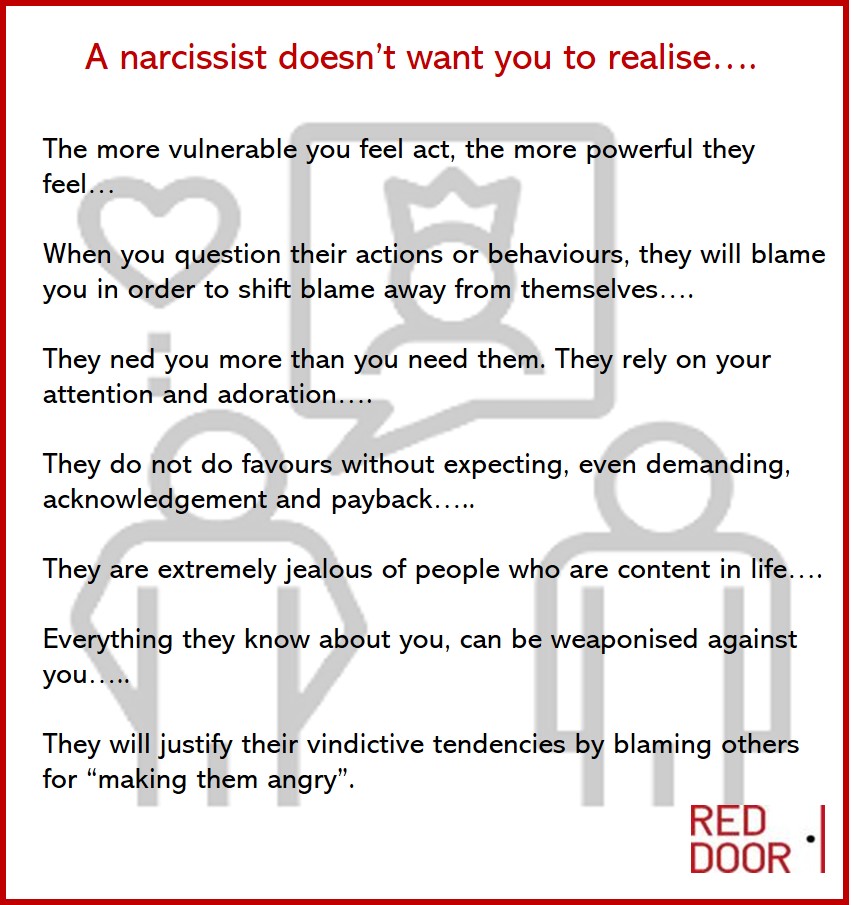
Narcissists refuse to take responsibility for their actions so be prepared that most problems you have will be your fault. You might hear dialogue such as, “You made me so angry when you accused me of lying. Sure, I came home late and you didn’t know who I was with, and when I told you that I was out with Tim, you said that you were told that he was already at home by his partner. I can’t be responsible for your lack of trust in our relationship. Actually, you need help!”
Narcissists’ sense of grandiosity means that they cannot reflect on their own limitations. They may even lecture you on a topic that they have little knowledge of. Be prepared to encounter several lectures not based in reality.
You will become confused if your relationship is healthy, or actually really damaging. Narcissists use techniques such as love bombing to win you over. They may tell you that you and they are soulmates and that you are destined to be with each other. This ‘sounds’ like your relationship is superior to others. Don’t fall for this manipulation. It takes time to develop real trust and intimacy. True emotional intimacy cannot be rushed. If you fall for this, later you may find these techniques turned against you as a means to control you. For example, “I thought we were soul mates, but apparently you can’t give up an evening with your family in order to stay home with me. I guess I was wrong”.
Narcissists dismiss other people’s achievements. If you succeed your narcissistic partner may dismiss your achievement as luck, or even take responsibility for your success themselves.
The world rotates around the narcissist and their self-image. Acts of kindness will need to be acknowledged effusively. They may plan your birthday party, but everyone at the event will know and they will expect you to make a speech publicly stating your appreciation.
A narcissist will be sensitive to any form of criticism. It is unthinkable that the world around them is failing to understand their greatness. If told that they need to reconsider their behaviour, consider alternative ways of performing a task, they will react quickly, often with anger. They may obsess over plans for vengeance and revenge. This will not usually directly be applicable to their partners, after all they choose you because they believe that you are adoring, however your family, your friends or, even your counsellor, may become candidates for such retribution, if those people dare to raise questions over the narcissist’s behaviours.
A narcissist may become very sensitive if you are not providing them with enough praise. In this instance they may consider insufficient admiration as a form of criticism.
Rules do not apply to them. Narcissists can break social rules because the typical rules do not apply to them.
They will often brag about their connections, popularity, and perceived importance. It is important to them that others see them as superior.
How do you spot a narcissist?
You have to be watching – both them and yourself.
In essence a narcissist is a control freak who needs to orchestrate the feeding of their compulsion for adoration and attention. As such they will use a variety of manipulation techniques to establish that you will be feeding their insatiable appetite for attention.
You can use the above list or narcissistic traits, and set of scenarios to think about if your partner is a narcissist. If you are with a narcissist, it is also because they have been able to manipulate you. You are their chosen partner in a dance of control and manipulation.
Take a good look at yourself. Narcissists are attracted to people they can manipulate. Individuals who are people pleasers, are overly empathetic, are conflict avoidant, who often seek the approval of others instead of relying on their own self-confidence, and generally have self-doubt are more likely to be the chosen partners of narcissists.
If you believe you have some of these traits, you may need to work on yourself. Self-help programmes and counselling could help you build better boundaries and protect your mental health.
How to break free from a narcissist?
Many a meme will tell you that you need to go “No contact” with a narcissist. Essentially life with a narcissist will have you questioning reality. “Up” is only up, if they say it is. As a consequence, individuals coming out of narcissistic relationships are often very confused about what is real, and how to make decisions for themselves. Freeing your mind of the pollution of narcissistic manipulation requires that you break contact with the person muddling the environment to create an atmosphere dedicated to their need for attention.
In a formal recovery process, your counsellor will want you to take charge of your decisions and own your own feelings. You can be okay, even if someone around you is not okay. Only by owning your own decisions in life, and understanding that you are not the source of other people’s happiness, can you truly break free from being susceptible to narcissistic manipulation in future.
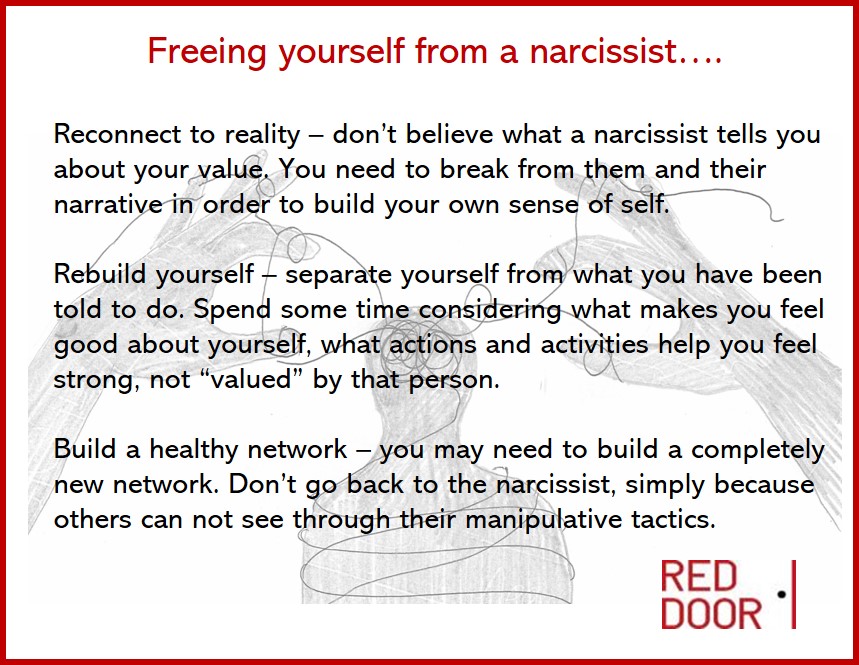
They will want you to reconnect to reality without the narcissist. You have been conditioned to see the world, and particularly other people, including yourself, through a lens that the narcissist provides. You need to start seeing the world through your own eyes again. Discussing what you like, what makes you comfortable and uncomfortable, and rediscovering your sense of self.
Your counsellor will encourage you to spend time rebuilding yourself – separate yourself from what you have been told to ‘do’ or ‘be’. Spend some time considering what makes you feel good about yourself, what actions and activities help you feel strong. You determine who you are and what you do. The narcissist will have installed themselves into the centre of your world. Once you have dislodged this parasite, you have to install yourself as the master of your life.
In addition, your counsellor will encourage you to develop new networks checking yourself to stop repeating co-dependent patterns from the past. New contacts should allow you, even encourage you, to make decisions for yourself. Friends that repeatedly tell you to go back to the narcissist possibly don’t see the manipulation at play. If those contacts cannot respect that you need to separate from someone dominating you, t term mental health build a supportive, sane, network – you may need to build a completely new network separate from the people connected to your narcissistic partner. Don’t go back to the narcissist, simply because others cannot see through the manipulative tactics being used.
If you would like to break free from narcissistic manipulation, consider counselling. You need to have a trained and trustworthy advisor, who can help you become your own person again. You want to build yourself into an independent thinker again. So that you can avoid falling into the trap of another narcissist in future.
About the author
Angela Watkins is a counsellor working out of RED DOOR Counselling in Hong Kong. Angela works with adults and teens on a variety of topics including identity, relationships, trauma, , anxiety, change, and family of origin issues.




 Start your Red Door Journey