About The Iron Fairies

RED DOOR Counselling: Group Counselling for women going through divorce in Hong Kong.

RED DOOR has been running The Iron Fairies – an English-language therapeutic support group for women going through divorce – for the past 9 years. The group meets in person twice a month at our office in Central.

Whether you are leaving a difficult marriage or have simply agreed to part ways, the impact on your mental and physical wellbeing can be overwhelming at times. This should not be underestimated or ignored. Going through a relationship breakdown, separation, or divorce can be one of the most emotionally challenging periods of your life.

We understand that this can be an extremely isolating time, and you may need to talk openly about the fragile circumstances you are facing. Support groups provide a safe and confidential space to express your feelings without judgement. Attending these groups can help alleviate feelings of isolation and loneliness associated with divorce.

The group is lead by an experienced counsellor who works as a marriage counsellor, individual counsellor, family therapist, divorce coach, and parental coordinator.

Cost – HKD 300 per session you attend. Please bring cash when you come

Frequency – Iron Fairies runs 2 x a month, usually on one Monday night and one Fridya night. The latest schedule is at the end of this page.

Time – THe group runs 6:30-8pm

Location: RED DOOR Counselling , Unit 301, 3rd Floor, SunWise Building, 112-114 Wellington Street, Central

Added value: , The Iron Fairies has a WhatsApp group for women who have attended a session in person. You can only join the WhatsApp group after meeting Angela in person or attending a session.

Please note: You must have made the decision to divorce before joining The Iron Fairies.

Upcoming sessions

Session dates and outlines

Monday 13 October 2025 – Grief created by divorce – structured group

Friday 24 October 2025 – structured group topic – representing yourself in court

Monday 10 November 2025 – unstructured group – general catch up

Friday 27 November 2025 – structured group – setting goals for today and beyond

Monday 8 December 2025 – unstructured group – potential Christmas celebration

Understanding Parental Alienation in Divorce: What It Is, Why It’s Harmful, and How to Address It

Divorce can be a challenging and emotional process for everyone involved—especially for children. One of the often overlooked but deeply damaging issues that can arise during and after divorce is parental alienation. Understanding what it is, why it’s harmful, and what you can do about it is crucial for protecting your child’s well-being and maintaining healthy relationships.

What is Parental Alienation?

Parental alienation occurs when one parent, whether intentionally or unintentionally, influences a child to reject or distance themselves from the other parent. This can happen through harmful behaviours such as bad-mouthing the other parent, restricting contact, or fuelling negative feelings towards them. This creates a conflict of loyalty that the child must unfairly navigate.

It may manifest as the child refusing to spend time with the targeted parent, rejecting their messages or gifts, or expressing unfounded suspicions or hatred. It is developmentally important that a child has the opportunity to build a relationship with both parents.

While some disagreements during divorce are normal, parental alienation involves manipulative tactics that distort the child’s perception of the other parent, often to the benefit of the alienating parent.

Why Is Parental Alienation Harmful?

The effects of parental alienation are profoundly damaging—for both the child and the targeted parent:

  • Emotional Trauma: Children subjected to parental alienation may experience confusion, guilt, depression, or anxiety. They often feel torn between their parents and may suffer identity issues.
  • Damaged Parent-Child Relationship: The targeted parent’s relationship with the child can deteriorate, leading to feelings of loss, rejection, and helplessness.
  • Long-term Effects: Parental alienation can impact a child’s ability to form healthy relationships in the future, fostering distrust or difficulties in trusting others. Children coerced into manipulation through triangulation may also face issues with co-dependency in their own romantic relationships.
  • Academic Impact: The emotional challenges at home can lead to social withdrawal at school and impair the child’s academic performance.

Additionally, parental alienation can escalate conflict, prolong legal battles, and create a toxic environment detrimental to the child’s development. It costs parents financially and harms the child’s mental health.

What Can You Do About Parental Alienation?

If you suspect or know that parental alienation is happening, here are some steps you can take:

  1. Recognise the Signs
    Be alert to behaviours such as your child refusing contact without valid reasons, parroting negative comments about you, or being manipulated into rejecting you. Keep track of any changes in your child’s attitude or behaviour.
  2. Maintain Communication with Your Child
    Keep open, honest, and age-appropriate conversations. Reassure your child of your love and support, and encourage them to share their feelings freely. Even if they refuse to see you, keep the door open with cards or small gestures.
  3. Seek Professional Help
    A family therapist or mental health professional experienced in parental alienation can work with your child and help you address the situation. Requesting family therapy as part of the divorce process may benefit everyone. Collaborating with your ex-partner — with the child’s best interests at heart — is often helpful.
  4. Refrain from Bad-Mouthing the Other Parent
    Avoid speaking negatively about the other parent in front of your child. Instead, promote a positive relationship and emphasise that they are loved by both parents. Be particularly sensitive if you inadvertently ask your child to pick sides—that’s unfair. Your child is entitled to both a mum and a dad, and they should not feel forced to choose one to feel secure.
  5. Document Incidents
    Keep records of any concerning behaviours, communications, or instances of alienation. This documentation can be useful if legal intervention becomes necessary.
  6. Consult Legal Professionals
    If parental alienation affects custody arrangements or the child’s safety, consult a solicitor specialising in family law. Courts can sometimes order counselling, supervised visitation, or other measures to protect the child’s best interests.
  7. Prioritise the Child’s Well-Being
    Above all, focus on your child’s emotional health. Create an environment of love, stability, and open communication wherever possible. Remember, in divorce, strive to be the best parent you can be.

I often advise parents to imagine their child, in the future, telling their partner about the story of their childhood. Consider how they might say, “The thing I most admired about my mum is ________,” or “Even when things got tough, I respect that my dad did ________.” How would you feel if your child believed you turned them against their other parent just to protect your feelings?

Final Thoughts

Parental alienation is a serious issue that can have lasting effects on a child’s mental health and family relationships. Recognizing the signs and taking proactive steps can help preserve the bond between children and their targeted parent. Remember, seeking help from professionals and keeping the child’s best interests at heart are key to overcoming these challenges.

If you’re facing parental alienation, know that support is available. You don’t have to navigate this difficult situation alone—reach out to legal and mental health professionals to help you and your child through this process.

What You Can Do If Your Divorce Involves Financial Abuse

Divorce is often an emotionally challenging process. For some, it can become even more complicated when financial abuse is involved. Financial abuse is a form of control and manipulation that can leave victims drained, confused, and vulnerable—making the divorce process even more difficult. It may have existed throughout the marriage or only surfaced during separation. Unfortunately, many women in Hong Kong struggle to fund their divorce due to financially abusive behaviors by their ex-partners. Knowing what steps to take is essential.

What Is Financial Abuse?

Financial abuse occurs when one partner uses money or financial resources to exert power and control over the other. During divorce, these tactics can escalate, hindering the victim’s ability to achieve financial independence or protect their assets.

Common tactics of financial abuse include:

  • Withholding money or access to funds to prevent one party from leaving or maintaining control
  • Controlling all financial decisions, even after separation
  • Stealing, hiding, or manipulating assets
  • Refusing to pay shared debts or expenses
  • Sabotaging credit scores or financial opportunities to limit future borrowing or employment options
  • Using money demands as leverage in family matters—e.g., withholding access to children unless paid for holidays or other demands

Recognizing the Signs of Financial Abuse During Separation or Divorce

Be alert for these warning signs:

  • Sudden changes in access to bank accounts or funds
  • Neglect or refusal to pay shared bills
  • Lack of awareness about joint financial details
  • Manipulation or withholding of financial information
  • Feeling intimidated or threatened regarding money matters
  • Demands for financial arrangements tied to child care or visitation

Awareness of these signs is the first step toward taking action and protecting yourself.

How to Protect Yourself During Divorce — 10 Essential Considerations

If you suspect or know you are experiencing financial abuse, consider these steps to safeguard your financial well-being:

1. Gather Financial Documentation
Start collecting all relevant records—bank statements, tax returns, pay stubs, property deeds, loan documents—as early as possible. Store copies securely, in a safe physical location or encrypted digital storage inaccessible to your partner.

2. Open Personal Financial Accounts
If you share accounts, consider opening your own bank and credit accounts. This helps establish your own financial independence.

3. Seek Legal Advice
Consult with a lawyer experienced in divorce and financial abuse cases. A knowledgeable lawyer can guide you on protecting assets, understanding your legal rights, and pursuing remedies if abuse occurs.

4. Develop a Safety Plan
If you feel threatened or unsafe, create a safety plan that includes emergency contacts, a safe place to stay, and steps to take if your situation escalates. Never hesitate to prioritize your safety and that of your children.

5. Document Everything
Keep detailed records of agreements and communications with your ex-partner. Save emails, texts, or messages threatening your finances or demanding inappropriate arrangements. Share these with your lawyer, especially if protective orders are necessary.

6. Secure Your Financial Future
Work with legal counsel to ensure a fair division of assets and debts. Engage a financial advisor to understand your financial standing and plan ahead. Consider consulting a career coach or counselor about building a side income or expanding your vocational skills to foster long-term independence.

7. Limit Shared Access
Change passwords and restrict access to shared accounts. Avoid sharing sensitive financial information unless absolutely necessary, especially during legal proceedings.

8. Consider Protective Orders
In cases of coercion or control, requesting a protective order can provide legal safeguards. While lawyer fees may seem high, they often offer the best approach to balancing your needs and securing your rights.

9. Focus on Your Future
Despite the difficulties, actively work toward a new, secure future for yourself and your family. Support from legal professionals, support organizations, and mental health counselors can make this journey more manageable.

10. Seek Support
Divorce is tough, and facing it alone makes it harder. Reach out to friends, family, or support groups. In Hong Kong, RED DOOR’s Iron Fairies offers therapeutic support specifically for women going through divorce, helping them find healing and empowerment. For more about Iron Fairies, check out the related blog links below.

About the author: Angela Watkins is a counsellor and psychologist working out of RED DOOR Counselling Hong Kong. Angela runs the Iron Fairies, Hong Kong’s therapeutic support group for women going through divorce.

Other blogs you might find useful

Your mental health contributes to your longevity

Does your mental health and  emotional health contribute to living a long happy life?

Most of us know some of the elements that contribute to our physical health and potential longevity such as maintaining healthy weight, managing your cholesterol, regular exercise, and preventative checking for cancers.

Emotional health and physical health are closely intertwined in ways that mainstream medicine is starting to recognise. Part of being healthy will require good emotional mental health.

Making positive choices can contribute to greater longevity, and more enjoyment in life. Conversely, some choices, and conditions unfortunately can take time away, and make time harder for us.

In this article we look at those conditions and behaviours that can give us more time, and also take time from us. We don’t control exactly how much time we have on earth, but we can have some power on our time we have, and how enjoyable that time is.

Losing time – conditions that compromise our ability to live long, fruitful lives.

Our emotional health, and threats to our emotional health, can compromise our longevity. Whilst a psychiatric condition such as stress, depression, anxiety, may have developed because of your circumstances, they are not your fault. However dealing with those conditions becomes your responsibility.

Psychiatric disorders

Serious mental illnesses such as psychosis, bipolar disorder, schizophrenia can leave individuals more prone to suicide, and also more likely to being placed in situations where their physical safety may be compromised. Whilst these conditions are usually quite rare, compared to depression and anxiety, illnesses such a bipolar or schizophrenia disorder appear in about 0.5 of most countries populations [3]. In Hong Kong, documentation of these disorders is not current, but reports as recent as 2017, detail that requests for psychiatric services continues to grow from 187,000 requests in 2011-2012 to 220,000 cases in 2015-2016 [2]. And these numbers predate the COVID pandemic.  The COVID pandemic may have exacerbated negative mental health situations for many people in Hong Kong,

The presence of a serious psychiatric disorder adds to the individual, and their family’s’ experience of stress and depression. Additionally, it is difficult to medically treat these conditions so people who are hospitalised may possibly be over medicated, and many of these medications can cause harm to the individual (whilst they are also calming them). Balancing the benefit/cost of psychiatric medications is a complicated situation.

Depression

We use the term “depression” so flippantly we often forget that being depressed for some people is a long term, severe illness which robs them of all enjoyment, and sometimes leads individuals to thoughts of death. Depression affects about 3% of the population of Hong Kong [2].

Unfortunately, around 1000 people choose to take their lives in Hong Kong every year (1) . All of these deaths are tragedies. Its worth noting that, on average, 20% of the suicides in Hong Kong are people over the age of 65 years of age, and about 13% are individuals under 24 years of age. We need to take depression in individuals seriously and provide comprehensive treatment, especially for these more vulnerable populations.

Depression can lead to a fast death, but it can also contribute to a slow death. For individuals with persistent and severe depression some of the aspects of their depressive experience will affect their physical health to the extent that this can influence their physical health and possibly length of life, even in the absence of suicidal ideation or tendencies.

Such behaviours include lethargy, especially long periods, in bed, poor eating habits (both too much and too little) and the impact of poor self-care and hygiene. These are common elements of depression and maintain depression, and have negative impact on blood pressure, metabolism, movement and overall physical health.

People who are persistently depressed need help. The condition of depression is corrosive and controlling over the thought patterns of those trapped in this situation. Some depressed people seem think that they will wake up one day and be motivated to feel better. They are simply waiting for motivation to “kick in”. This is not what happens. Recovery from depression takes work under expert guidance.

Treatment of depression can involve medication, talk therapy, and behavioural interventions. If you  have been feeling any of the following symptoms for more than a few weeks, I urge you to contact a counsellor or GP to discuss treatment options.

Symptoms of depression:

  • Persistent sad, anxious, or “empty” feeling mood
  • Irritability
  • Feelings of hopelessness or pessimism
  • Excessive fatigue
  • Loss of interest or pleasure in hobbies and activities
  • Difficulty sleeping, early morning awakening, or oversleeping
  • Changes in appetite or weight
  • Perpetual feelings of guilt, worthlessness, or helplessness
  • Difficulty focusing, remembering, and inability to make decisions
  • Somatic aches or pains, – headaches, cramps, or digestive problems without a clear physical cause
  • Feeling physically heavy and moving more slowly
  • Thoughts of death or suicide, or even just wishing to not be alive anymore.

Stress

Being stressed is a emotional mental health challenge that may affect your longevity and the quality of enjoyment you experience. Being stressed can place undue stress on your heart. Stressful events can be sudden stressful life events such as seeing an accident or the death of a loved one. Sometimes stress is more chronic, an accumulation and persistence of stressful events such as relationship split up, moving house, and a stressful job. A common assessment of stress, Holmes-Rahe-Stress-inventory [4] can help you check if your experience of stress is at such a level that it is likely that you will start experiencing challenges to your physical health.

Unfortunately, those under excessive stress can doubling impact on their physical health through associated compromising lifestyle choices, such a avoidance of exercise, poor diet, poor sleep and self-medication through pills or substances. All of these behaviours make the experience of stress worse, and also threaten the physical health of a person.


Substance addictions

Alcohol, nicotine, cocaine, stimulates, beta blockers – all of these can be dangerous to our physical health. Introducing dangerous levels of toxins into our bodies on a regular basis, can affect the way our body processes these toxins. Additionally, addiction itself, to behaviours and substances traps us in a cycle of shame that can lead to depression.  Taking a break from alcohol and other addictive substances can be, literally, lifesaving for many people.

Adding time – choices that can extend life, and the enjoyment of it.

Good help.

Individuals can have a propensity to think to muddle through when they are anxious, stressed or depressed. Something about your lifestyle, thinking processes, or stress levels, is quite possibly prohibiting you from seeing stressful situations realistically. An expert, outside of yourself, can help you see that situation in the way that helps you better process what what has happened, and what can be done. Sometimes individuals who feel down, are stressed, or are self-medicating need to vent, sometimes they need to change.

Consider counselling. Ask your counsellor how they see your current life situation and what you, as a team, can do to alter how you have been feeling. If your counsellor can’t answer this question for you, you are completely entitled, even encouraged, to talk to another counsellor. Counsellor – patient chemistry is an important predictor of positive outcomes.

Dial down your reactivity

Some people are like simmering pots of anger. It doesn’t take much for those pots to boil over. Does this describe you?

Emotional health is the consequence of being able to regulate your emotions. Peter Attia in his masterpiece book on longevity, Outlive, writes, “90% of male rage is helplessness masquerading as frustration”. If you are quick to anger, tears or frustration, you may benefit from working on emotional regulation.

Regulating your emotion requires an attention to the triggers, forces and thoughts that drive your reactions to circumstances. In counselling we unpack your reactions to dissect what you really experienced and believed about a situation and explore how the lessons you have learnt from your past, and the fears that you have about your future, intersect at the way you choose to react. If you feel as if your emotions are out of control, or can’t even feel emotions any more, counselling is for you.

Adopt flexible perspectives

We can all get trapped in our thought patterns and many times we do not look at situations as flexibly as we could. Cognitive filters are thinking errors that make us look at situations from certain perspectives. We grow into using cognitive filters as a means to, we believe, efficiently assess situations. However filters can become problematic and can make us less happy.  

For example, we often compare the worst of ourselves to the best of others. When people compare themselves to other people often, they are often misguided in their assessment of both how “lucky/successful” the other person is, as well as a “how unlucky/unsuccessful” we are. When we enter a situation from a rigid black vs white perspectives we tend to think that only one party can be correct, whilst the other must be wrong. Actually, many situations are much more nuanced that we first appreciate and sometimes focusing on you vs someone else means everyone loses.

Read our attached blog to read more about cognitive filters. Change your thinking – change your life.

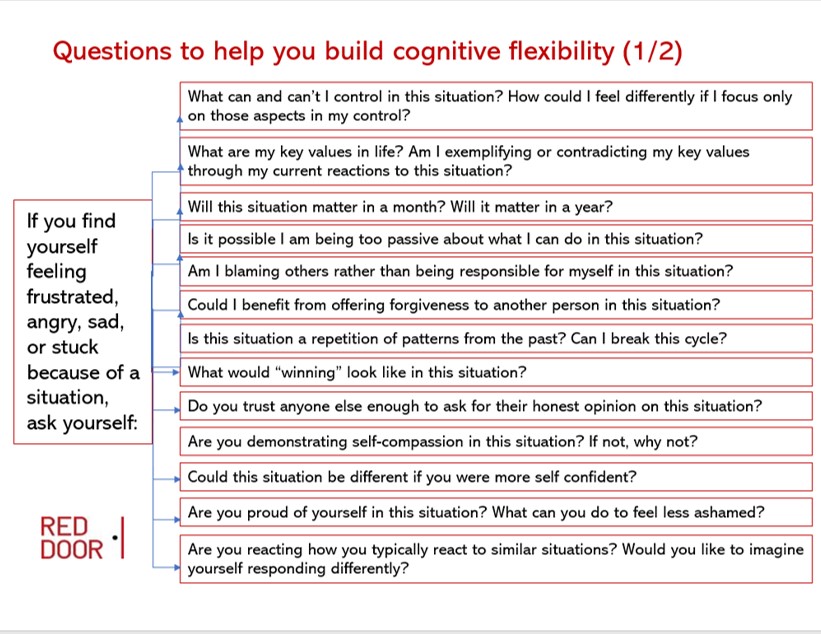
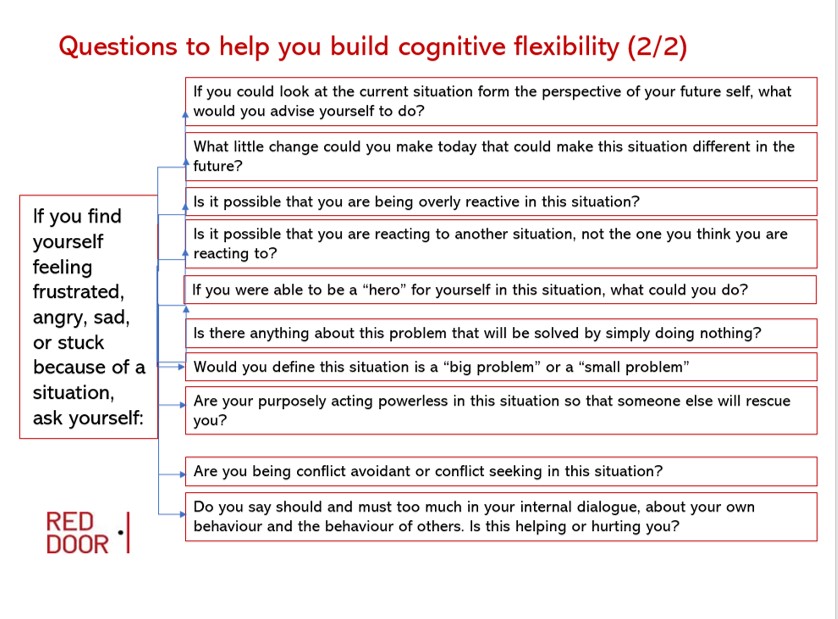
In order to overcome cognitive filters we need to capture, review and re-frame our perspectives. In therapy we use cognitive flexibility exercises in order to help clients re-frame their experience in ways that helps them become less reactive, and calmer.

Working to develop more flexible thoughts around situations can help you build a different set of responses to situations. The next time you find yourself reacting problematically to a situation consider some of the questions outlined below. These are some of the questions I use when working with clients on their cognitive flexibility.

Embracing age as a gift

Positive age beliefs serve as a barrier against stress. Being accepting or positive about growing older can affect how contented you are as you grow older. Fixating on your age, negative self talk that  you are “over it” of “old and frumpy” will make you feel bad. Think about your self-dialogue as a meal that you consume. If you only feed yourself negative commentary, how can you expect to feel good?

Connect to protect

The central tenet of Waldinger and Schulz’s 2023 book, The good life: Lessons from the world’s longest scientific study of happiness, is that good relationships, keep us healthier and happier. Good relationships, friendships and romantic relationships, protect us about the impact of negative events in our lives. Negative events are going to happen. No one completely avoids emotional hardships, what gets us through is the quality of our relationships.

Do you have the relationships you want, or infact need in your life? If not, what can you do to build new and better friendships. Our blog on friendships may help you on this matter.

You can take charge of your future. You don’t have to wait for your mood to improve to engage in change. And you can feel differently, exist differently, and live better (and longer)

About the author. Angela Watkins was named Hong Kong’s best therapist. Angela works with adults and teens to help them build better lives – including relationship recovery, building positive self esteem, overcoming depression, quietening anxiety, getting stuff done, and recovery from trauma. To contact Angela for therapy email Angelaw@reddoor.hk

If you want to read more on the topic of longevity consider reading some of these books:

Attia, P (2023). Outlive: The science and art of longevity. Harmony Books. New York

Gratton, L & Scott, A. (2016) The 100-year life: Living and working the in age of longevity. Bloombury. London.

Greger, M. & Stone, G. (2015). How not to die. Flatiron books.

Levy, B. (2022) Breaking the age code: How your beliefs about aging determine how long and well you live. Harper Collins. Sydney.

Ni, M (2006) Secrets of Longevity

Waldinger, R. & Schulz, M. (2023). The good life: Lessons from the world’s longest scientific study of happiness. Simon & Schuster. New York.

The Emotional Piggy Bank: Building an enriched relationship

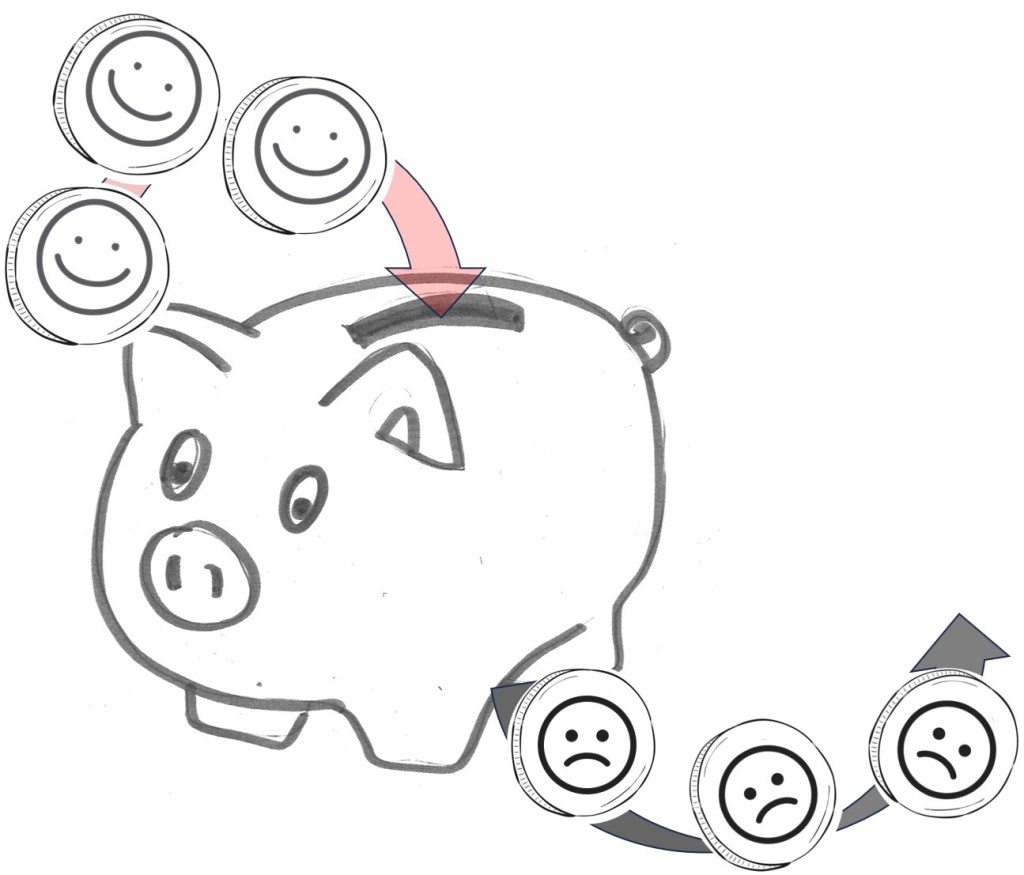
In order to make your relationship last, you need to ensure you have a full emotional piggy bank.

John Gottman, landmark couples counsellor and relationship researcher, studied thousands of couples exploring the difference between happy and unhappy couples. There are some notable differences.

Happy couples engage positively with one another and show interest in each other’s lives. Happy couples are generous in spirit towards towards each other. They try to understand each other’s world. Happy couples spend time together – connecting. When these couples experience conflict they use strategies to stay positive towards each other, see the conflict as an issue for them to resolve (e.g.you and I versus the problem) and work towards resolution.

Unhappy couples don’t do these things.

In couples counselling we often introduce the Gottman concept of the Emotional piggy bank. To help couples better realise the deposits, investments and withdrawals their actions within the marriage represent.

When our relationship’s emotional piggy bank is full, couples able more likely to be able to be generous in spirit towards each other when they encounter tricky situations.

For example. Imagine your partner, John, said he would call you at 3pm to talk about an important topic. The designated time to call comes and goes, with no message or call.

If you have a full emotional piggybank, you might react in such a manner: “I guess that big project John has been worrying about has taken off and he’s lost track of time. I know he cares about me and our issue so I’ll remind him later and we will find a new time to talk”.

Conversely, if your relationship’s emotional piggy bank is running near empty you may have no good will to help you see the situation with generosity. The aggrieved partner in that instance might think: “John did it again. He never cares about anyone by himself. He just expects me to wait by the phone like some loser. Well, not this time!”

An emotional piggy bank needs to run with a healthy balance. You and your partner need to be making deposits, and checking the impact of withdrawals.

How can you make deposits into your relationship’s emotional piggy bank?

The following activities constitute a deposit into your emotional piggy bank:

  • Giving and receiving affection from each other. Not just sex.
  • Spending quality time with together doing activities that you both enjoy
  • Learning about each other’s world.
  • Performing acts of kindness for each other – even little things like grabbing a coffee for them in the morning, running them a bath, or buying special snacks that they love for your movie night.
  • Expressing gratitude towards your partner for the kindness and support they provide to you.
  • Complimenting your partner. Make sure these are authentic and show you have been paying attention. For example, “I really admire the way you acted on your work call. It sounds like your boss is a lot to handle”. Or, “I really like that shirt on you, it goes well with your eyes”.
  • Keeping promises that you made is important to help your partner know you can be trusted
  • Apologizing when you have done something wrong.
  • Giving your partner support when they are having a tough time

You also need to be careful of withdrawals. If you make too many withdrawals or make careless withdrawals from the emotional piggy bank, there may be very little good will in times of crisis.

Some behaviours that harm your relationships emotional piggy bank including:

  • Insults and disrespectful comments
  • Criticism of your partner
  • Avoiding engaging with your partner
  • Neglecting your partner
  • Brushing of your partner’s kind gestures
  • Ignoring the emotional impact of your behaviour
  • Shouting or Scolding
  • Lying to your partner
  • Gossiping about or slandering your partner to others
  • Breaking promises you made to your partner

Please note: Aggression of any type – this is much only a withdrawal, this is a threat to the safety of people in your relationships.

What can you do to change the dynamic and build a better emotional piggy bank?

Respond rather than react

Do you find that you react to situations, rather than respond calmly. Often this is because of the manner you interpret situations? Do you later feel ashamed that you over reacted to a situation? Before you react to your partners actions stop and think what response would you later be proud of, versus reactions that you might regret. A counsellor can help you understand your reactive patterns and learn to interpret situations in a more cognitively flexible manner.

Appraise your level of investment

Many couples do not spend enough time with each other, and the emotional piggy bank is empty because they neglect each other, or the relationship becomes focused on day to day functionality, rather than fun or connection.

Are you spending enough time with your partner focused on each other, rather than the kids or an exhaustive to-do list?

A good relationship is an active rather than passive activity. Stop thinking this is the relationship you have, and start taking the action to make it the relationship you want. Firstly, acknowledge that you could be kinder towards each other and start to think of what this might look like. Secondly, think about securing some time to spend together, once a week, or at least once a month.

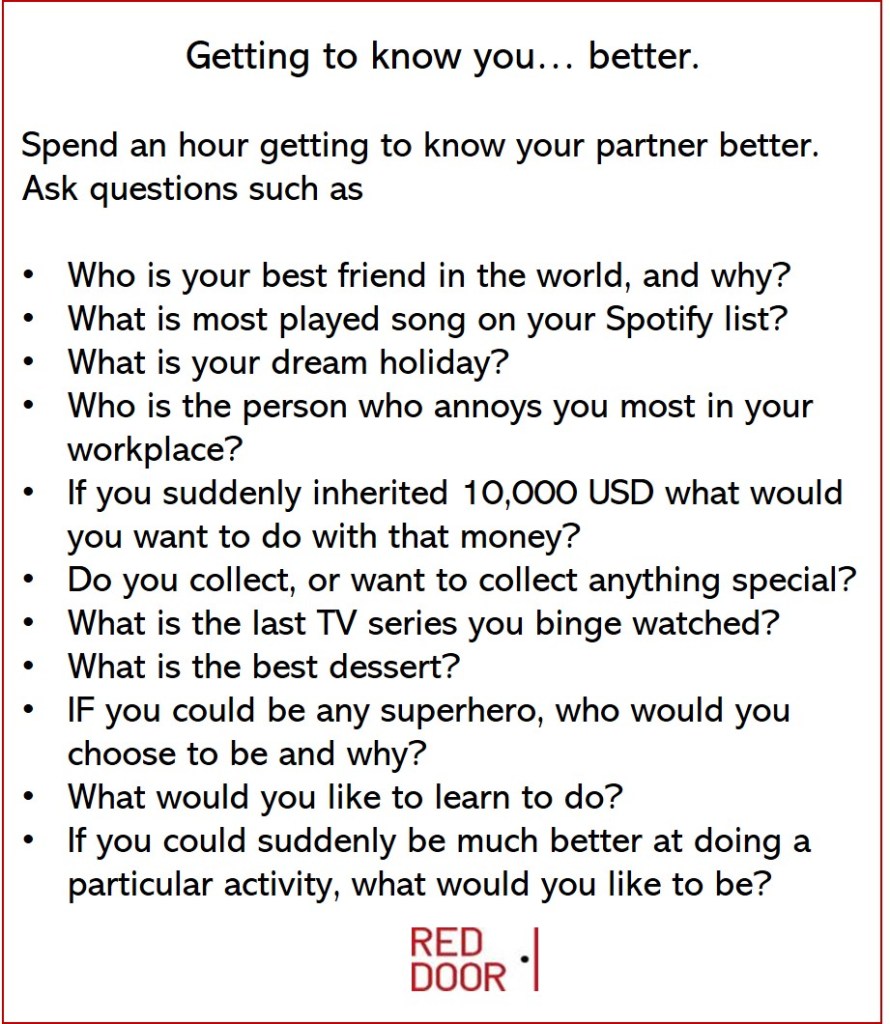
Spend time getting to know each other

Great relationships are, at their core, great friendships. Remember back to the beginning of your relationship. You probably spent a lot of time asking questions about your partner, and were thirsty for knowledge about how they interpret the world. This curiosity often diminishes with time, to the detriment of your relationship. Be curious again.

When was the last time you sat down and spent time learning about your partners world. If you don’t know what to ask, the list below is a great place to start.

Practice preferences

People have preferences. Some people like to receive gifts. Other prefer to spend time together. Do you know how your partner likes to receive love? People often give love in the manner that they, personally would like to receive it, rather than checking what their partner wants. This misunderstanding can mean that your kind actions are not

The two following quiz links might help you better understand how your partner wants to receive love, and the type of apology they like to receive. So many people get caught up waiting for the “right” apology, it might be helpful for you to know what your partner thinks are the components of a good apology.

https://5lovelanguages.com/quizzes/love-language

https://5lovelanguages.com/quizzes/apology-language

_________________

About the author. Angela Watkins is a counsellor for individuals and couples working in Hong Kong. If you’d like to improve your romantic relationship consider working with Angela or other members of the RED DOOR team. Contact angelaw@reddoor.hk

#emotionalpiggybank

#relationshipgoals

#conflictresolution

#relationships

#love

#relationshipimprovement

Feel good hormones

If you have been feeling down, find out how to best manage the hormones that help us be happy.

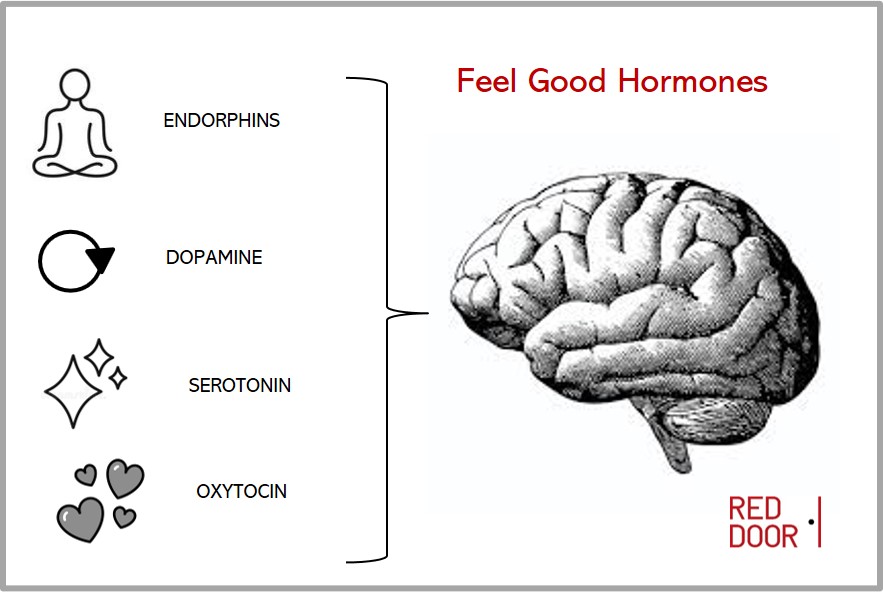
Four hormones are associated with senses of happiness, pleasure and contentment. If you have been feeling low, you might like to explore if you are stimulating the production of these hormones in ways that improve your health. There are some lifestyle changes that can influence the release of these hormones, and hence how you feel.

Hormones are chemical messengers, which, once released into your bloodstream, control many bodily functions, including how you feel. There are four hormones associated with feeling good: Dopamine, Serotonin, Endorphins and Oxytocin.

Dopamine is the hormone most associated with the feeling of pleasure and reward systems we set up in our brains. Pleasurable activities including eating, shopping, winning a game, sex can create a dopamine rush. Other substances can hack the production/ suppression of dopamine including drugs and alcohol, which can lead to addiction.

Dopamine plays a role in many bodily functions including mood, heart rate, movement, pain, blood vessel function, and sleep. One of the central tenants of Dr Anna Lembke’s book, Dopamine Nation [1], is that addiction associated with tech, gaming, drugs, and alcohol not only stop us from feeling good, because they hijack the dopamine cycle, they also mess with these other bodily functions such as mood, attention, sleep and sensations of pain.

If you are struggling to feel good, it has been suggested that you may need to go on a dopamine detox, take a break from activities that have hijacked dopamine production and utilize the activities that help manage the production and healthy release of dopamine. These activities include diet, sleep, and calming activities such as meditation and even listening to music.

Tyrosine is a an amino acid that is part of the production of dopamine. As such foods that are rich in tyrosine are recommended as part of a dopamine reset. These foods include chicken, milk, cheese, yoghurt, avocado, banana, pumpkin seeds, sesame seeds, and soy [3].

Ensuring that you achieve enough sleep is important to help keep your dopamine levels balanced. Dopamine both requires sleep, but also helps to establish healthy Circadian rhythms – the daily rhythms that regulate many biological processes [2, 3].

Calming practices such a meditation help to calm the body. Research indicates that individuals who meditate, even for one one hour, experienced increased levels of dopamine [4]. Even listening to your favourite song may increase dopamine levels. Listening to music seems to increase activity in areas of the brain which are rich in dopamine receptors. [5].

If you have been suffering from any form of addiction – to alcohol, to other substances, to food, even to tech – a dopamine detox might extremely helpful for you. To read more about this look into the book Dopamine Nation, which I highly recommend.

Serotonin is the hormone that helps people stave off depression. Serotonin helps regulate a person’s mood, sleep, digestion, memory and ability to learn. [6] Long term depression of often linked to a lack of serotonin which is why most common anti depressants, serotonin and norepinephrine re-uptake inhibitors (SNRIs), aim to increase serotonin levels in the brain.

Besides meditations you can increase your time in sunlight, or workout. Diet may also help to help increase serotonin.

Serotonin levels are stimulated by ultraviolet rays from the sun. Simply spending time outdoors, as little as 15 minutes may change your levels of serotonin [3]. Working out is good for your hormone levels. When you exercise your body releases tryptophan, the amino acid used to produce serotonin [3,6].

Diet may contribute to serotonin production. It is suggested the complex carbohydrates such as vegetables, fruits and whole grains have been suggested to help [3].

Oxytocin can help us bond with loved ones. Its main function is to facilitate childbirth, sexual arousal and it plays a role when we fall in love. This is why Oxytocin is sometimes referred to as the “love hormone”. The release of oxytocin decreases stress and anxiety. The presence of oxytocin helps us feel relaxed. when oxytocin levels are low, people can become depressed [6]

medical treatments aiming to stimulate oxytocin have not yet been demonstrated as successful. Therefore the most promising route to improve your oxytocin levels is through physical touch and exercise. Physical exercise, especially cardio is extremely positive [6]. Touch, even soft touch such as massage may be helpful to improve oxytocin levels [6].

Endorphins are the brain’s pain relief hormone. Endorphins are released when we feel stressed, or are put under strain. In addition to helping individuals with pain, they also essential for stress management and general mood [6].

There are many ways to increase the production and release of endorphins including exercise, sex, laughing, time in sunshine, and meditation.

Exercise, even moderate seems essential to release endorphins. Putting the body under strain, such as that mimicked by exercise helps the body learn to manufacture and release endorphins [3].

People often feel blissful after having sex and endorphins are part of this sensation. They also promote the release of other hormones that are associated with feelings of love [6].

Having a great time with friends and enjoying a good laugh together is joyful. Endorphins are released when we are laughing. So go ahead and organise a gathering with some fun people.

If you have been feeling out of sorts, or a bit blue, I would recommend that you explore the types of activities that stimulate the production of feel good hormones. If your blues persist, please consider therapy or consulting a doctor to help you write a plan to battle your moods. You do not have to suffer alone.

To read more

[1] Lembke, D. (2021). Dopamine Nation: Why our addiction to pleasure is causing us pain. Headline Publishing. London.

[2] Korshunov KS, Blakemore LJ, Trombley PQ. Dopamine: A Modulator of Circadian Rhythms in the Central Nervous System. Front Cell Neurosci. 2017 Apr 3;11:91

[3] Dacre, Ameri. (2023). The dopamine connection: Maximise your potential with sleep, nutrition and brain health.

[4] Kjaer, T.W;  Bertelsen, C; Piccini, P;  Brooks, D; Alving,J;  & Lou, HA. (2002). Increased dopamine tone during meditation-induced change of consciousness. Cognitive Brain Research. Volume 13(2), pages 255-259.

[5] Koelsch, S. (2020) A coordinate-based meta-analysis of music-evoked emotions. NeuroImage, Vol 223, December.

[6] Watson, S (2024) Feel-good hormones: How they affect your mind, mood, and body. Harvard Health Publishing. https://www.health.harvard.edu/mind-and-mood/feel-good-hormones-how-they-affect-your-mind-mood-and-body

Standing Up for Coming Out – Supporting Your LGBTQIA+ Teen.

One of the earliest conversations you may have had with your child involves their declaration of gender identity or sexual orientation. They might tell you they are a boy, a girl, or even express that they feel like one gender one day and another the next. As children grow, their identities and attractions may not fit neatly into the social norms they’ve been exposed to.

According to the U.S. Census, about 10% of teens identify as LGBTQIA+—an acronym that includes lesbian, gay, bisexual, transgender, queer, intersex, asexual, and others. Many more might be questioning their gender or sexuality. Unfortunately, there’s limited data for Hong Kong youth, possibly due to societal stigma and discrimination against LGBTQIA+ individuals.

During adolescence, young people naturally explore their identities. They might not identify with the gender they were assigned at birth, experience attraction to the same sex, or feel no attraction at all. As a parent, here’s what you can do to support your child and foster a positive, trusting relationship:

Be Accepting

Avoid dismissal or judgment. If your teen shares their identity or attractions, don’t dismiss it as a phase or something to be fixed. Instead, embrace their honesty. Their exploration is a vital part of understanding who they are. Express to your child that you love and support them no matter what.

One of the most loving actions a parent can provide is creating a safe space for your teen to explore and reflect. Show genuine interest, listen actively, and affirm their feelings. Remember, acceptance and validation are crucial; they help your child develop resilience and self-confidence.

Remember: There Is Nothing Wrong With Being LGBTQ+

This isn’t a problem that needs fixing. If you find yourself struggling with feelings of denial or discomfort, consider what’s best for your relationship in the long run. Challenging your internal biases or prejudices now can be vital. Research shows that rejection from parents can severely impact an adult’s mental health and ability to maintain relationships. Ultimately, your ongoing support could be the most important gift you give your child—far more powerful than any initial resistance.

The mental health statistics are sobering: LGBTQ+ youth are more vulnerable to depression, anxiety, low self-worth, and loneliness. These challenges are universal, and youth in Hong Kong are no exception. A supportive, accepting home acts as a protective anchor—avoiding blame or shame helps your teen feel safe and loved, even when they face external challenges.

Navigating Name change and Identity changes

Many transgender, non-binary, or gender-queer teens may choose a new name—often more gender-neutral—to better reflect their true selves. This act of changing one’s name can be empowering. However, it may be difficult for parents to adjust to their child’s new name. From my perspective as a counsellor, I sometimes experience parents struggling with the concept of “dead naming”. Be patient and give yourself time to adapt.

Discuss what the new name means to your teen, and understand it’s part of their journey. There have been cases in Hong Kong when parents learnt about the chosen name only after learning the child is using their new name, with support, at school. It’s helpful to communicate closely with their school and other community members, fostering an environment of acceptance and support. Open and accepting conversations really help.

Be an ally and advocate

It’s natural to worry about your child facing bullying or discrimination. Despite growing awareness, studies like the 2021 GLSEN School Climate Survey reveal that over 90% of LGBTQ+ teens experience verbal abuse at school; 81.8% feel unsafe; and many avoid school functions altogether.

As a parent, stay involved with your child’s school. Advocate for inclusive policies like LGBTQ+ support groups and comprehensive sex education that extends beyond heteronormative teachings. Working together with educators can make a real difference.

Show Your Support

Your words and actions matter. Be a visible ally—display symbols of support, speak positively about LGBTQ+ issues, and include your child’s experience in your conversations with family and friends. For example, one teen I work with shared, “My mum brought ALL the flags and even bought me a shirt that read ‘I Can’t Even Think Straight’—it made me feel loved and accepted.”

Talk to your child about how they would like you to communicate about them with broader family members. They might like you to be their spokesperson, or maybe prefer to talk for themselves. Teens sometimes do not appreciate being “outed” to family members.

Advocate for your child. Help schools establish gay-straight alliances. Push the school to provide more inclusive sex education, rather than the hetro-normative model that is pervasively taught. Rowan, who is attracted to women, retells, “Sex education at school was very weird for me”. Its not surprising as it was not about the sex that they were expecting or wanting to experience.

Moving Forward

Supporting your LGBTQ+ teen means standing firmly with them, advocating for equity, and continuously learning. Your acceptance can help your child navigate challenges, foster resilience, and build a future rooted in love and respect.

Useful references if you want to learn more

  • Besner . H. F., and Sungin, C.J. (2014) Gay and Lesbian students: Understanding their needs. Routledge. New York.
  • Georgina H. Gnan, Qazi Rahman, Greg Ussher, Dan Baker, Elizabeth West & Katharine A. Rimes (2019) General and LGBTQ-specific factors associated with mental health and suicide risk among LGBTQ students, Journal of Youth Studies, 22:10, 1393-1408, DOI: 10.1080/13676261.2019.1581361
  • Lehman, J. R.; Diaz, K; Ng, H;  Petty, E.M.; Thatikunta, M;, and Echstrand, K (editors). (2020) The equal curriculum: the student and educator guide to LGBTQ Health. Springer press. Switzerland.
  • Sadac , A. (2021) Parenting your LGBTQ+ teen: A guide to supporting, empowering and connecting with your child. Rockridge press
  • GLSEN National School Climate Survey. 2021 Visit GLSEN.org

https://www.glsen.org/research/2021-national-school-climate-survey.

About the author: Angela Watkins is a counsellor at RED DOOR Counselling practice in Hong Kong. Angela is a proud parent of two LGBTQIA+ individuals and an LGBTQ+ ally. Red Door is an identity affirming practice.

Divorce Missteps

Over the past 7 years I’ve supported a lot of individuals, particularly women, as they proceed through divorce. As a relationship counsellor I also work to help couples who wish to avoid the divorce process. I’ve learnt a thing or two about what makes the ending of a marriage better, or worse, for the parties involved. Its hard to watch people make mistakes in this journey, choosing actions that often make emotional recovery harder in the long run. If you are willing to learn the mistakes to avoid, here are some of  missteps that we encounter in helping navigating the divorce process.

Misstep 1: not being aware of your rights

Seeing a lawyer is expensive. However not knowing your rights in a divorce is a potential landmine. Without decent legal advice you run the risk of receiving careless and incorrect information about what you can negotiate in a divorce. Do not be threatened by your ex that, “We don’t need to use lawyers, we can just do this ourselves”. Often such statements precede unfair negotiations. Knowing your rights is your right, and is a must.

Misstep 2: Accepting divorce advice from your ex-partner instead of a professional

I’ve lost count of the number of times I encounter clients who accept what their ex-partner tells them what they are entitled to in a divorce. Your soon to be ex-partner does not get to define what your divorce outcome will look like.  This is particularly an issue in codependent relationships where one partner is used to listening to the advice or demands of their romantic partner without challenge. Seek legal advice. An initial consultation should suffice for you to better understand what you are entitled to fight for, and if it is in your interests to do so.

Misstep 3. Not considering or committing to couples counselling

As a couples’ counsellor we often encounter couples trying to decide if they should divorce or stay together. Counselling can help repair your relationship, in certain circumstances and it looks good to the court if you have tried to repair your relationship.

If you are BOTH willing to do the work, relationships CAN recover.

Relationships cannot recover when there is an ongoing affair or one party is continuing the divorce process at the same time as the counselling process. You can’t amputate a leg and reattach it at the same time. Coming to counselling to collect dirt on your partner does not work. Experienced couple counsellors will see through those tactics, and will often call them out. Counselling is used to see if sincere recovery can be made.

Misstep 4. Telegraphing your wants instead of negotiating.

It may sound contradictory to not communicate what you want out of your divorce. It is important that you don’t show “all your cards” until you are ready to make a deal.

The process of divorce is essentially a negotiation. In any negotiation you want to know what your adversary wants, before you let them what you want as part of your divorce settlements.

It may seem tempting to explain, “I just want a basic settlement and full custody of the kids”. But if you do this, you will have just told your ex what matters to you most. Do yourself a favor. Learn about negotiation skills, as if your life depended on it. Because your lifestyle going forward, does. I particularly like the teachings of Chris Voss on negotiation, and have clients who have used the Chris Voss negotiation techniques to break the patterns of fruitless negotiations that they had fallen into.

Misstep 5: Jumping into a new relationship too quickly.

The feelings of rejection often associated with divorce can be extremely painful. It can be tempting to avoid those feelings by jumping into a new relationship as fast as possible. This is a misstep.

Firstly, you need to heal from your previous relationship, not simply avoid the pain. I know this sucks.

Secondly, the impact of a new relationship can influence your negotiations in your divorce. If you have a partner who could be assumed to be paying some of your rent may impact your financial settlements.

Thirdly, children may be negatively impacted by your new relationship. It can be tempting, if you’ve fallen in love with another person, to rush into playing “happy families” with your children and your new partner. You chose your new partner. Your children didn’t. Sometimes children see the new partner as the reason for your marital breakdown, even if this wasn’t the case.

Resist the temptation to involve your new partner in your children’s lives, and even better, take a break from dating in the early months of your divorce.

Misstep 6: continue the conflict communications rather than seeking distance.

If you have had a relationship that has been full of conflict, and if you are used to constant conflict, you might be tempted to continue your continual arguments throughout your divorce process. I would argue, that it might be wise to explore an alternative to constant fighting.

If you had got along with your ex-partner, you probably wouldn’t be divorcing them. The declaration to divorce, can mean that you can STOP fighting. It takes only one party to stop fighting. Just stop. This might mean blocking your ex-partner, so that you don’t communicate with them, except through your lawyers, or only via slower communication channels such as email rather than immediate messaging platforms such a WhatsApp.

Involving your lawyers in all of your interpersonal conflict is a double-edged sword. You may need to use your lawyer to tell your partner to stop harassing you. But if you want the fighting to stop, you have to also agree to stop communicating with your ex-partner. Using third parties or apps to communicate such a parent coordinator person or app (such as the Family Wizard) can help break the cycle of conflict communication.

Misstep 7: Triangulation of children

It is very tempting to involve your children in your divorce. Bringing your child into divorce understanding or negotiations happens fairly often. After all, you are hurting and it would be helpful to you if they can see how much pain your ex-partner is causing you. This is a mistake. Your child is entitled to continue to enjoy their parental relationship without your experience influencing their view of their parent.

You don’t win if you turn your child against their other parent. All that happens is that your child loses. They lose the impact of that parent in their life, rather than the impact of your ex-romantic partner on you. They may begin to feel responsible for your emotional state – a reversal of the parent child relationship. Additional triangulation does not pay often pay in the long run. As children mature they will start to observe and appraise your behaviour throughout your divorce.  Later on, children do not appreciate the perception of being manipulated during divorce and this can be one of the reasons that they become estranged from their parents when they grow into adulthood.

You don’t have to hide your pain from your child. Be mindful not to involve them in understanding your pain to the extent that they feel obligated to champion of you. It isn’t fair. It isn’t healthy, for your children. They deserve to have two parents to love if this is being offered.  

Misstep 8: Allowing others to define your value.

Those going through the divorce process can feel diminished. Their marriage is over. This often feels bad, and it is common to feel feel like you have “failed”. Your ex-partner may extend those feelings of failure by telling you that the reason your marriage failed is because of your personal “failings”. They may even feel entitled to judge your competence as a parent.

Most of the women in our support group have been told that they are bad mothers. In every case I’ve encountered such accusations appear grossly misplaced. For those vulnerable individuals, being judged so harshly by their ex-partner can really be a blow. Remember these commentaries are often a  tactic to make you feel bad, and not based in reality. Especially the reality of your children.  You need to know your value, financially and personally.

It is time for you to know your value for yourself. Your value as a person is NOT determined by your ex, or anyone else besides yourself. Its time for you to work on you, so that you know who you are. Don’t let anyone else attempt to define your value. This is an area that people often seek counselling to help them overcome.

Misstep 9: Bad habits lead to compromised ability to cope, and vice versa.

Habits help build your health and over the long term determine how well you can navigate the divorce process. Regular self-medication, especially through alcohol, will erode your ability to cope. Conversely taking a positive approach to habits and your health at this time will be extremely helpful. Exercise, rest, sleep, eat healthily, all of these will help you better survive what is an incredibly stressful life event.

Misstep 10: Doing it alone.

Whilst many people feel ashamed that divorce is happening, the worse thing you can do is feel ashamed and remove yourself from support.

Even I have been delightfully surprised by the amazing value of group support during divorce.  Iron Fairies, our therapeutic support group for women going through divorce is seen as an amazing resource by all of the active members. Each of the women in the Iron Fairies is navigating their own divorce journey, and may feel trapped by their personal struggles, but at the same time, understand the challenges faced by other women, and amazingly suggest creative pathways forward for others, even when they feel ‘stuck’. Being able to help others, reminds group members that we all feel undone sometimes and that we can eventually navigate through these very uncomfortable circumstances. Having a friendly group to vent to can be extremely cathartic, especially if one of the expectations of that group is that you will continue your journey forward, at a glacial or racing pace.

Misstep 11: Wrongful resource allocation

There are a number of resources that you may involve in your divorce journey including a financial adviser, a lawyer, an accountant, a counsellor, a mediator, your family, a support group, and friends. It will be an expensive waste of time to use your lawyer as your counsellor. At a typical cost of USD 1000 per hour, you want to use your time consulting your lawyer as cleverly as possible. Save your crying time for friends, a support group, or a counsellor.

Additionally, divorce is a topic that many people have experience of, and have opinions about. Legal advice from friends can be completely wrong. They have no real obligation to ensure that the action or information they give you is in support of your rights. Please check your legal position with legal professionals.

Misstep 12: Allowing drama to impede or knock you off course.

It is quite possible that you ex will try to get you to delay or even stop the divorce process. Not because they want to reconcile, but because they want to delay or derail the divorce process for their own personal, and sometimes, financial ends. It takes quite a while for people to decide that they need to divorce their partner. Once this decision is made, please try to keep the divorce process moving forward.

You ex may try to delay you by making deals or threats such as, “Let’s meet and see if we can work this out between ourselves”, or, “If you proceed with the divorce I will do x, y, z.”. Ex- partners may try to derail the process by blowing up bombs to distract you from the momentum of divorce. For example, they may accuse you of having affairs, or acting in harassing fashion, or even being a poor parent. Don’t fall for these distractions if they are unfounded.

Once you have made this difficult decision to end your marriage, move steadily towards the exit. You can master the change that needs to happen, rather than allowing your ex-partner’s agenda to master you.

You CAN survive the divorce process. Especially if you avoid some of the pitfalls that make the journey more challenging.

Anxiety Attacks – Emergency responses

Living with anxiety feels as if you are inhabited by a monster constantly whispering about your fears, insecurities and your worthlessness, your inevitable failures and the catastrophes which you can’t avoid and are probably creating. It is estimated that 13-14% of people in Europe [1] live with anxiety. One symptom is anxiety attacks. Some people only realise that they have been suffering from anxiety when they experience such an attack.

An anxiety attack differs from a panic attack. It is usually a response to a stressor – often a thought or feeling or specific dread. People feel apprehensive and full of fear. Their hearts may race and they may feel short of breath. Often people feel out of control and may become extremely tearful. A panic attack may include some of these symptoms, but usually occurs without a clear stressor. Both can be terribly frightening. If you experience anxiety attacks it is important that you are prepared with an emergency response.

Here are my favourite techniques to respond when anxiety attacks.

Try this exercise when you feel anxious.

Breathing exercises – Listen to the pattern of your breath when you are anxious. It can give you a clue as to how best to respond to your anxiety. If you are hyperventilating – taking fast, shallow breaths, feeling faint, and fearing that you can’t catch your breath, try to breath into a paper bag. Breathing in and out using a paper bag will recycle air, returning carbon dioxide to the body, which will naturally make the breath deeper and slower. Do this for a minute. If you don’t feel better, try again for another minute.

If you are not hyperventilating, you can use the calming breath technique. Breathing exercises such as those used in yoga classes are effective in reducing anxiety. One simple exercise I use with clients uses counting inward and outward breaths to calm the mind. Simply breathe slowly in through your nose for a count of 4, then breathe out of your mouth for a count of 4. Repeat. Then breathe in through your nose for a count of 4, and out of your mouth for a count of 6. Repeat. Then breathe in through your nose for a count of 4, then breathe out of your mouth for a count of 8. Repeat. Check to see if you feel better. If you don’t, repeat the exercise again, concentrating on the sensation of your breath.

Distraction exercises. Distraction exercises help your parasympathetic nervous system override an anxious reaction. By simply refocusing your energy to elements of your environment and allowing your underlying operating system to return to homeostatic (ie regular) breathing.

Use your senses to help calm your breathing

The most commonly used therapeutic technique asks the client to engage their senses to distract their busy minds. Identifying a number of items you can see, smell, hear, touch and taste can help you reset your body. Imagine 5 things you can see, then 4 things you can hear, then 3 things you can smell, then 2 things you can touch, and 1 thing you can taste. Then monitor your breathing again. Has it become less panicked?

Since we work with a number of teens and children at RED DOOR we also use the RAINBOW technique, often with our proprietary rainbow fidget toy, to help teens achieve quick calm. One can perform this technique without the fidget toy. Simply you count objects in your near vicinity which are specific colours. You can count the number of objects, or a specified number of objects that are red, orange, yellow, green, blue and black.

Distraction and can also be created with some physical “reset” activities such as repeatedly snapping an elastic band against the wrist or performing sets of 10 jumping jacks.

Meditation/Relaxation – Mediation, when practiced regularly, can help people reach a relaxed state more easily. Practice makes progress when it comes to mediation. If you are experiencing an anxiety attack, try to find somewhere to sit quietly or lie down. Then try progressive relaxation, also known as a body scan, which can be especially helpful. Progressive relaxation soothes as you tense and relax muscles – isolating and focusing exclusively on one group of muscles at a time. Begin with your toes, and work up through your muscles to your head, where you may focus on relaxing the muscles around your chin and eyes.  Guided progressive relaxations are available on Spotify, YouTube, and on CD.

Imagery – In the throes of an anxiety attack use your active imagination to help your de-stress. First, isolate the location within your body where you feel the greatest sensation of anxiety. Use imagery to help unwind and relax that spot. Cute, warm, and amusing imagery will be of the greatest help. If you feel tension in your shoulders imagine a collective of kittens massaging the knots away. If you feel butterflies in your stomach – imagine yourself in your stomach with them, asking each to settle on your arms and flutter no more. One client recently expressed her fear of butterflies, so, using imagery, we collected the butterflies and they turned into Golden Retriever puppies, ready for a cuddle.

This mantra might help with your negative self-concept

Mantras – Anxiety attacks are created by dreadful thoughts running through your mind. One way to settle these thoughts is to repeat a mantra. While there are mantras on the internet, you may benefit from one that you write specifically for yourself. The mantra should be full of words of kindness, understanding and love. The words “should” or “must” cannot be part of any mantra.

Centre yourself with art therapy techniques

While avoidance is not a long-term technique for managing anxiety, if you are ruminating or feeling a panic attack, distracting yourself with a change of scene or activity can help. Go for a walk, particularly in nature, to reset yourself. Try colouring, which I have detailed in a previous blog [https://reddoorhongkong.wordpress.com/2017/03/06/reasons-to-colour/ ], which involves both sides of the brain, stimulates creativity, and can help to calm the mind.   Even listening to some upbeat tunes at this time, get up and dance, just break the pattern of your anxiety for a moment to reset your emotional clock.

Talk to your anxiety – The long-term cognitive approach to anxiety is to create an internal dispute. Disputing your anxiety helps you reframe situations, see hope, and utilise self-compassion. If you experience anxiety ask yourself to challenge your view of the stressful situation – have you been overgeneralising, personalising, or catastrophizing? Is there an alternative way of looking at this issue? Sarah Wilson[2] , in her compendium of suggestions to utilise in one’s challenge with anxiety suggests an ancient adage, “ First make the beast beautiful”, meaning accept that your anxiety – it is something that originally may have been created to help you, but overtime has started to inappropriately misfire. When you make the anxiety beast beautiful you may say to yourself, “Thank you brain for alerting me to potential danger, but I know I am safe right now, you can go back to your guarding post”.  Developing the process of dispute is an area of action where a therapist can be of significant help. If you cannot create this dispute for yourself, utilise the resources of a counsellor. For more information see our post on this topic https://reddoorhongkong.wordpress.com/2020/09/07/talk-to-your-anxiety/

Prolonged anxiety is extremely challenging to your health. If you have been struggling with anxiety for a while please seek the help of a counsellor or a doctor. They may recommend a combination of therapy and even medication to help lessen your anxiety. There is no shame in needing help. Take charge of your future.

Everyday is a new day for you to thrive. Start gently, start now.

 #mentalhealth #mantra #mindfulness #anxiety #reddoorcounselling #selfhelp #anxietyattack #treatmentanxiety #women

Sources

1: Prevalence –

2004: The ESEMeD/MHEDEA 2000 Investigators,2004, Prevalence of mental disorders in Europe: results from the European Study of the Epidemiology of Mental Disorders (ESEMeD) project

2011: https://www.theguardian.com/society/2011/sep/05/third-europeans-mental-disorder

2: Sarah Wilson, 2018, First we make the beast beautiful: A new journal through anxiety. Dey Street Books

__________________________________________________________________

Angela Watkins is a psychologist and counsellor at RED DOOR Counselling in Hong Kong. Her current clinical work focuses on parenting. relationships, anxiety, OCD, career change, stress management and divorce.

Your mental health matters – protecting your mental health in a world experiencing a mental health crisis.

Hong Kong’s mental health crisis has escalated dramatically since the COVID-19 pandemic, but alarmingly, troubling trends were already in motion. The World Health Organization now estimates over 1 billion people worldwide battle mental health conditions requiring support, underscoring an urgent global concern (WHO, 2025).

Locally, data from the Hong Kong Jockey Club Centre for Suicide Research and Prevention at the University of Hong Kong reveals a grim reality: suicide rates in Hong Kong have surged more than 22% since 2011, with suicide tragically the leading cause of death among those aged 15 to 24. A startling 1 in 4 youths in this age group face mental health challenges, with academic pressure topping their stressors, followed closely by work demands. Nearly 20% experienced suicidal thoughts within the past year (HKFP, 2023).

The workforce is also under immense psychological strain. An overwhelming 87% of Hong Kong employees report feeling stressed, with one in five describing this stress as unmanageable (Cigna 360 Hong Kong Well-being Survey, 2025). Work-related pressures, uncertain futures, and social isolation are key contributors, especially among young professionals and Gen Z, the most affected demographic facing elevated anxiety, depression, and burnout.

Mental health is far more than the absence of illness. The WHO defines it as a dynamic state of emotional, psychological, and social well-being that enables people to cope with everyday stresses and thrive. It exists on a continuum, shaped not only by challenges like job loss or divorce but also by positive transitions such as marriage.

Recognizing warning signs early is critical:

Physical symptoms like racing heart, fatigue, muscle pain, or sleep disturbances often signal unmanaged stress activating the body’s fight-or-flight response.

Emotionally, mood swings, irritability, persistent sadness, and feelings of hopelessness warn of deeper struggles.

Cognitive red flags include overthinking, poor concentration, and decision-making difficulties.

Socially, withdrawal, loneliness, and changes in interaction patterns indicate potential burnout.

The urgent takeaway: mental health demands deliberate, daily care. It’s essential to check in regularly with oneself—acknowledging feelings, understanding limits, and crafting protective strategies. Self-care isn’t indulgent; it’s vital. Simple habits like scheduling downtime, practicing mindfulness, engaging in positive self-talk, and nurturing sleep can fortify resilience.

Stress management is equally crucial—setting boundaries, saying no, breaking tasks into manageable chunks, and celebrating small victories help keep stress from becoming overwhelming. Lifestyle choices matter too: regular exercise, outdoor time, nutrition, hydration, and conscious digital detoxes bolster mental resilience.

Lastly, nobody should suffer in silence. Seeking support from trusted friends, family, support groups, and mental health professionals is a sign of strength, not weakness. Talking about struggles makes them more manageable—a truth captured by the saying, “What is shareable is bearable.”

Hong Kong’s mental health landscape not beyond hope. With awareness, proactive care, and compassion—for oneself and others—individuals can move from merely surviving to truly thriving in these challenging times.


The counsellors at Red Door are here to support you if you are not sure who to turn to or would value objective and unbiased guidance. Alternatively, below are a selection of resources and hotlines in Hong Kong to support you in starting a conversation. Please share this and help to raise visibility so that this information can reach more people.

Alcoholics Anonymous Hong Kong

https://www.aa-hk.org/

9073 6922

Emotional Support Hotline – The Samaritan Befrienders

2389 2223 – Mon-Fri 6.30-10pm (English)

2389 2222 – 24 hours (Cantonese)

Suicide Prevention Hotline – The Samaritans

2896 0000 – 24 hours (Multilingual support)

#worldmentalhealthday #mentalhealthawareness #mentalhealthsupport #mentalhealth #wellbeing #selfcare #stressmanagement #anxietyrelief #breakthestigma

About the author.

Contact the RED DOOR reception to set up an appointment with Tanya. reception@reddoor.hk

References

Cigna. (2023, November). 2022 Cigna 360 Global Well-Being Survey [Press release]. https://www.cigna.com.hk/iwov-resources/docs/en/about-cigna/news/2022-Cigna-360-Global-Well-Being-Survey-Reveals-9-in-10-in-Hong-Kong-are-Stressed-and-Burnt-Out-EN.pdf

Mok, L. (2023, May 12). Up to 25% of young Hongkongers have suffered from mental health disorders, HKU research reveals. Hong Kong Free Press. https://hongkongfp.com/2023/05/12/up-to-25-of-young-hongkongers-suffered-from-mental-disorders-hku-research-reveals/#:~:text=inHong%20Kong-,Up%20to%2025%25%20of%20young%20Hongkongers%20have%20suffered%20from%20mental,stress%20from%202019%20to%202022.

The Samaritan Befrienders Hong Kong. (2023). The Samaritan Befrienders Hong Kong 2022 annual report: Empowering the inner-self. https://sbhk.org.hk/wp-content/uploads/2023/07/2022-Annual-Report-2.pdf

World Health Organization. (2022). COVID-19 pandemic triggers 25% increase in prevalence of anxiety and depression worldwide. https://www.who.int/news/item/02-03-2022-covid-19-pandemic-triggers-25-increase-in-prevalence-of-anxiety-and-depression-worldwide