
Welcome to our new blog series, Love Matters, where counsellors Angela Watkins and Elizabeth Wu explore the complexities of relationships and love. Both Angela and Liz specialise in helping individuals navigate their romantic lives, with Angela also serving as a practising couples therapist.
In this inaugural column, we delve into the question on many people’s minds: Where do we find love? This topic frequently comes up in both our professional and personal interactions. To better understand the landscape of modern romance, we reached out to individuals who have successfully found love. Interestingly, we discovered that only a handful had entered new relationships in the past year, most of whom were under 25.
The majority met their partners in real-life situations—at school, through shared hobbies, or via mutual friends—while only about 9% connected through dating sites or social media. With these insights in mind, Liz and Angela will discuss their perspectives on:
- The fun and challenges of online dating
- New events designed to facilitate matchmaking
- Dating at different ages and the goals you might consider
Join us as we navigate the journey of finding love in Hong Kong!

Angela: Welcome to the first in our Love Matters series where Liz and I talk about matters of love and romance.
In our recent research, we asked for basic feedback from people regarding romances that had begun recently. Thirty people responded; most were young—under 25—with some over 45. There wasn’t much in between. In chatting with people about the results, I found few individuals aged 25 to 40 who had found love in the past year. Are we living in a love desert?

Liz: In our city we have long work hours, dense schedules and high housing costs—that constrict time and energy for dating. Recent data shows an increasing never‑married population, with a modest female surplus in Hong Kong, which can intensify the perception of competition.
Seeing the little results of love in our research may not be evidence that new love is absent, but it can also reflect sampling – who we asked, where they spend time, and how visible their relationships are.
In therapy, I pay attention to how narratives of scarcity shape our behaviour – are we grasping anxiously or avoiding the chase altogether? Neither can helps us choose well. I’d rather help you expand contexts where genuine contact can happen and strengthen your capacity to recognize and grow a good bond when it appears.

Angela: When we looked at where people found love, the majority (62%) found their partners in real-life situations—particularly through aligned activities, such as attending the same university or sharing hobbies, and also via friends. Why do you think this is?

Liz: We attach through repeated, low pressure contact—classrooms are a great example of that. Hobby groups are also great – for example, there’s been a rise in running clubs which became popular during and after COVID which has been cited as a good source to find matches. In a city that can be so hectic at times, aligned activities slow us down. They let people see each other across different moments—tired, excited, collaborative—which reveals true character better than an online profile. If you want to give love a chance here, design your week to include recurring communities, not just one‑off events.

Angela
Aligned activities allow you to take things slow and digest the relationship bit by bit. You don’t necessarily have to rush things.
What role do friends play in this?

Liz: Friend introductions are great because they can pre-vet the other person beforehand. A thoughtful introduction carries “earned data” – your friend already knows your values and blind spots and can reality check early projections. They are walking endorsements for the both of you. That said, curation is important. You shouldn’t introduce simply because two people are single, you should only introduce when there’s healthy alignment in life stage, values, and availability. While apps can feel transactional, friends can advocate for the connection, highlighting positive traits about each person to the other.

Angela: If you trust a friend, they can provide advice on your relationship standards. Do you think I’m being too particular about certain things, or is it not a good idea to have high standards?

Liz: Feedback can work when it’s invited and specific. If a friend genuinely wants perspective on standards, offer it kindly and specifically—what’s a value‑based non‑negotiable versus a preference that can be more flexible? Unsolicited advice, despite you meaning well, can sometimes do more harm than good. Dating can make people feel vulnerable, so approach with care.

Angela: I’m thinking about our recent discussion on the concept of “shreking.” To me, shreking is about accepting things that aren’t necessarily your usual standards, allowing yourself to have different experiences. It’s not just about settling for less; it’s about questioning whether your standards are holding you back from enjoying life. Do you think shreking means accepting someone below you?

Liz: I don’t like the term “shreking” because it brings in hierarchy – showing someone is above or below someone else, like love is a market with rankings. For me, the real differentiator is looking at attachment styles and whether someone is secure or insecure, rather than looking at their appearance or resume.
Sometimes choosing outside your usual type can be growth, you interrupt a previous pattern that didn’t bring you safety. If you can look beyond the superficial and ask, “Are we moving more towards security for both of us?”. If it is, then that to me that is an upgrade, not a downgrade.

Angela: Let’s talk about online dating. From our brief polling results, about nine and a half percent of our lucky, successful daters have met their partners on our online dating platform, such as Bumble, Tinder, Grindr, or even Instagram.
Its definately popular as a way to meet people. Just not as, potentially successful as meeting people in real life situations. What do you think? Do you have an opinion on online dating?

Liz: For me, apps are just a tool; it’s not really a magic wand that can get you what you want. Here in Hong Kong, many people have busy lives and hectic schedules, so it’s a good way to expand beyond your circle—beyond what your friends, hobby groups, or ex-classmates can introduce you to. It can be hard to meet someone organically in Hong Kong.
With an app, both people already know what their intentions are. But it’s a double-edged sword; there can be an element of dehumanisation. You can amplify projections—I’ve seen people swiping, thinking things like, “Oh, he looks like an F-boy,” or “She looks high maintenance.” It’s very easy to profile people, but you know how it feels when you get profiled as well.
It can all get exhausting and overwhelming, my advice is to just remember it as a tool, limit the number of people you are speaking to, and move promising off apps to in person meets before the fantasy flattens.

Angela: I recently went down a Reddit rabbit hole looking at comments about people’s experiences with online dating. It’s clear that many would prefer to be in a room together, able to look around at all the available options instead of swiping one by one on profiles on an app. People seem to want want the opportunity to move around and look for partners without making immediate decisions. Many comments mentioned that online dating feels like a lot of admin, which doesn’t sound romantic at all.
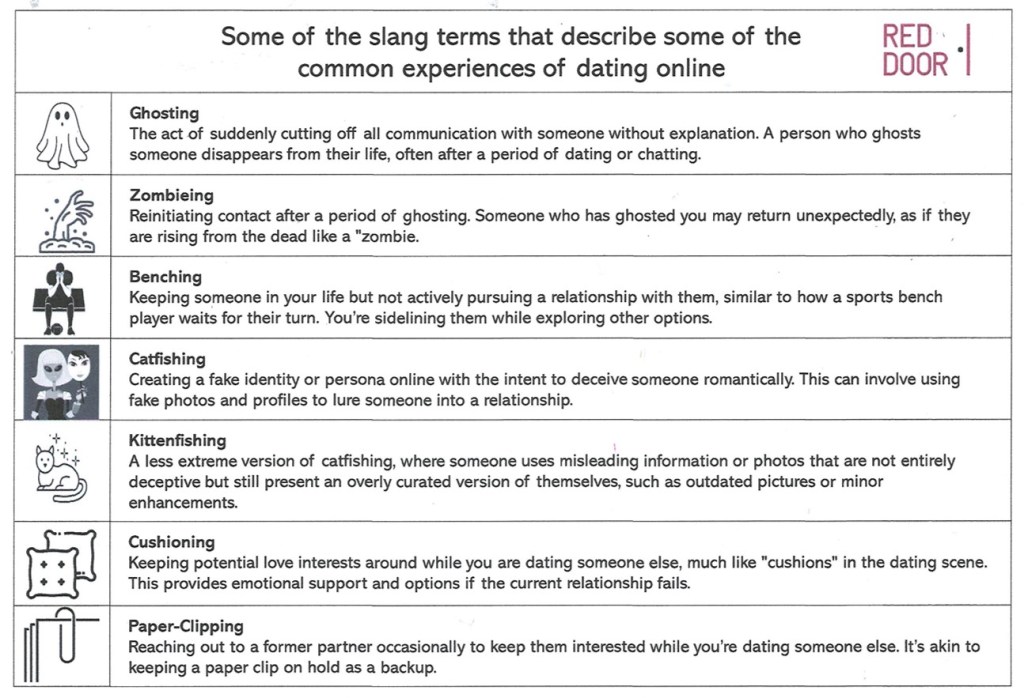
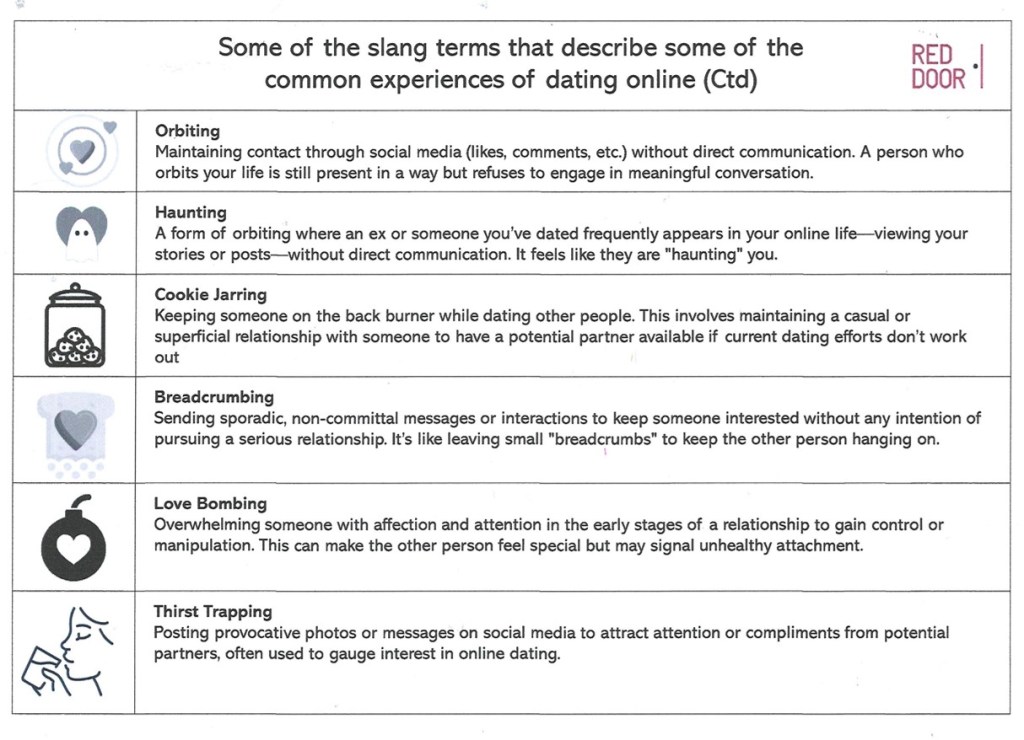
Online dating is definitely different from in-person dating, particularly in terms of the experience. A whole range of slang terms has evolved in response to online dating, which I’ll include as a call-out diagram in this document. Among this plethora of terms are expressions like ghosting, zombieing, and breadcrumbing.
Some behaviours that happen online don’t carry the same meaning as they would in real life. For instance, if someone completely stops talking to you and avoids you—i.e., ghosts you—it’s common to wonder if you’ve done or said something wrong. However, being ghosted on online platforms is extremely common, and it doesn’t mean the same thing. Understanding that online dating is a different world, with different expectations is helpful.
Many of my clients are women over 40, and for them, the online dating platforms require understanding that this medium is very different from real life. Additionally, people often fake their profiles. It’s common to engage in “kitten-fishing,” which involves telling small lies about yourself, such as your height or interests.
For this reason, many women find online dating a difficult platform to emotionally navigate – from learning who someone really is, to understanding the “new norms” around interaction frequency and styles, to trying to interpret another person’s intentions. Many of them express that they cycle on and off dating websites because they find the practices, and adjustments, too lexhausting.

Liz: Two truths can coexist at the same time: online dating being admin heavy, and many couples still meeting there.
We need to be mindful of whether this is fun or too much admin. With the rise of digital culture, we’re texting all day, sending emails on our phones, keeping up with friends on Instagram, Facebook, and other apps. It can be overwhelming to text someone while also replying to your friends’ memes on Instagram and your boss’s WhatsApp messages.
I know people who are genuinely interested in forming connections, but they find it hard to reply because they may have limited time during their breaks, and it can start to feel like an obligation. I completely understand being “left on read” due to what’s happening in real life.
To protect your nervous system, also take appropriate breaks from the apps. Give other people the benefit of the doubt, ghosting is common and rarely personal. It’s more about low confrontation exits and it does not determine your worth.
I think another legitimate concern is scams. Beyond catfishing, financial and crypto‑investment scams have been on the rise in Hong Kong. I advise that if you match with someone, try to arrange an in-person meetup or at least have a call—what I call a “vibe check call”—to ensure that this person is who they say they are. Meet up in public spaces and tell a friend about your date. Also avoid financial talk or “urgent favors” early on, slow is safe.

Angela: I agree with you completely, especially regarding the importance of moving from online to in-person interactions within a specific timeframe. It’s important not just for verifying that people aren’t scamming, but also to determine if they’re genuinely interested in meeting someone rather than just collecting potential flirtations.
Do you have an advisable timeframe for pushing for an in-person meetup?

Liz: My advisable time frame is usually within one or two weeks. The reason is that many people in Hong Kong are often travelling and there are numerous holidays. If you match with someone and can’t see them within the next 14 days due to travel delays then maintain a light, non-intense contact and set a concrete plan upon return.

Angela: Liz, I know you have your finger on the pulse of new trends arriving in this city. Are there any new ways you’ve heard of that people are using to meet new potential partners?

Liz: A recent example was an event at Soho House Hong Kong on Feb 5, where they hosted an event called “The Ultimate Wing Session” – they had friends pitching where each person had 3 minutes to prove their friend is a great catch. That is a creative event that comes to mind.
Otherwise, old‑school matchmakers exist here too, but do your due diligence – look for clear fees, refund policies, how they verify candidates, and what data they actually have in your age range and interest field.

Angela: I have unfortunately heard stories about matchmaking scams that have existed. If people want to try matchmaking services I would try to search to see if anyone you know has a had a positive experience of such a service.
So, let’s talk about different age groups. When we tackle the question, “Where is the love?”, I imagine that different ages have different goals and challenges depending if you are under 25, or in your 30s, or 40s or old.
I remind my young adult clients that it’s unlikely they will marry the person they are currently dating. With this in mind, they don’t have to rush their relationships You don’t need to be on the “relationship escalator,” driving one stage of a relationship to the next. Take your time figure out what you like, what do don’t like, learn from mistakes what you do not want to repeat, be open minded that different partners all make different contributions to a relationship. You can go out to Lan Kwai Fong, attend different events, and meet people on apps or at your university. You have lots of energy and can spend this time discovering what you like and what your type is. Essentially, have fun.

Liz: 100%! I completely agree—for early adulthood, having fun should be the focus. You’re learning attachment patterns in the field – how you pursue, how you pull away, and how you repair. There is no need to rush the relationship “escalator”. Try different contexts and types. Pay attention to how you feel in your body around different people – are you more yourself or more performative/anxious?

Angela: As people get older relationship expectations change. Additionally it can sometimes feel like there are not a lot of suitable options for you to date. I know you work with many women in their 30s, what recommendations do you have for them?

Liz: For women in their 30s, some may feel more pressure because of the biological clock around fertility. Having this clock can compress choice, and compression can breed insecure attachments. Expand time where you can. For example, if parenting is important to you, consult early on options – research on egg freezing and IVFs – so you are less dominated by your reproductive timeline.

Angela: I agree. It seems to me that many clients in their 30s, feel a lot of pressure from the expectation of the relationship escalator – distinct steps that people feel the need to rush through in a linear fashion to reach some mythical “happily ever after. First, you meet someone, get to know them, live together, get engaged, get married, and then have a baby. This linear progression is perhaps not for everyone, and it might even be healthy to step back and, instead, audit your life and ask, “What do I really need?” In terms of a biological clock, even with technology there is pressure. At some point you might need to ask yourself would you rather have a romantic relationship or have a child? W Perhaps you won’t be able to have both, and it might be necessary to consider what truly matters in your concept of a successful life.
It is important to consider whether we are being too adherent to a certain list or escalator in life. I think you can miss out on people. Sometimes, clients who are quite particular—who aren’t just women—have a shopping list of what their ideal partner should possess.

Liz: I see that too. If someone has too many criteria on their list, like requiring an Ivy league graduate who meets specific height and job expectations, it can be limiting.
I invite clients to separate non-negotiables rooted in values, for example, kindness under stress or desire for kids versus strong preferences that are nice to have e.g. specific heights, working in a specific industry.
Then ask yourself “does my list mirror my own availability”? People who meet many high‑status criteria often also seek partners with certain qualities. Consider those and build those in yourself.

Angela: For women in their 40s, do you think there are specific pieces of advice to consider? These women may have been married previously, and now be separated or divorced. They could even have children and be solo parenting.

Liz: For women 40s and beyond, beyond apps, they could explore volunteering opportunities or join various social groups. There are many communities within Hong Kong to choose from, choose one that reflect your lived values. The key variable is repetition, recurring contact that lets character show over time.

Angela: I really like the idea of expanding your network of activities because engaging in different pursuits is one of the best ways to meet people. The reality is that if you stick to the same routine, you’ll keep encountering the same people. If you want a bigger dating pool, go where the “fish” are—find activities that interest you!
When I meet with our Iron Fairies group (for women going through divorce in Hong Kong), I find that they particularly learn the nuances of online dating versus offline dating the hard way. It often seems that the pool of possible partners is quite limited. So, good questions to ask yourself include: what does companionship look like for you? What does a good life look like for you? Where do you find joy? If finding a new partner doesn’t seem possible, does that mean you’ve failed?
There are many questions that need to be asked to determine what a good, satisfying life looks like. If a partner is part of that vision, then is Hong Kong the right place to look for one? I always encourage my clients to form a supportive group and go out to clubs together—not necessarily to meet people, but to enrich their lives. After a divorce, your world can feel very small, especially since many experiences’ exclusion from their regular social circles. It’s important for them to form new groups to explore new adventures.

Liz: Those are all valid questions to help gain perspective. After experiencing divorce, the focus should be on re-expansion. Rediscovering who you are and what a satisfying life looks like for you. There are many forms of companionship beyond a romantic one too. When the romantic pool feels small, you can also enrich the ocean you swim in – clubs, studying a new course, traveling. Ironically, people often meet new partners when busy building a meaningful life that would be good with or without a partner.

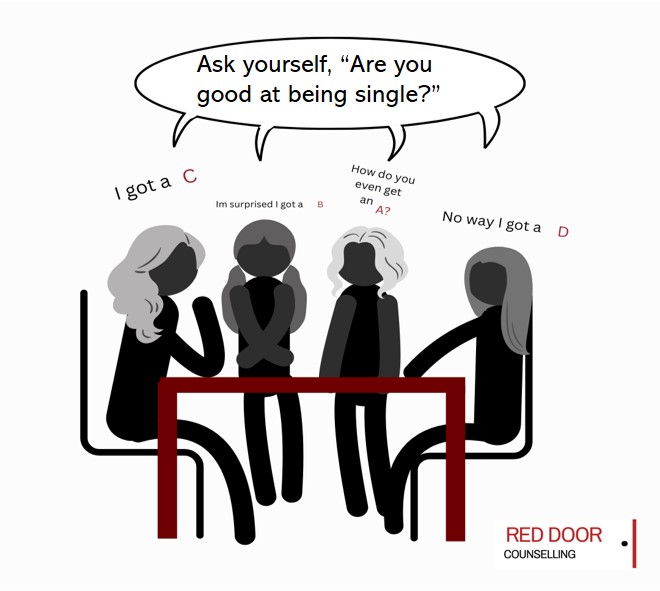
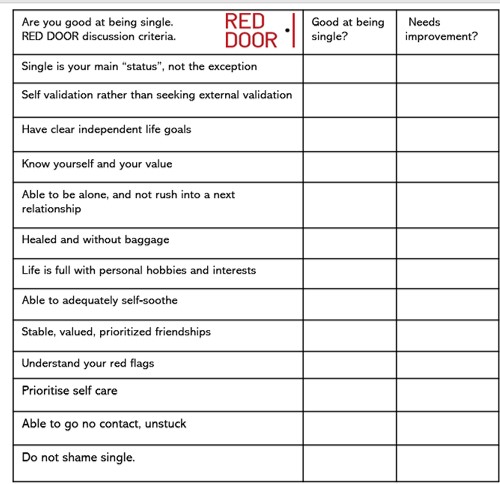
Angela: It’s vital for each of us to be good at being single. Yes, being good at being single is important. If you want a wider network, including potential partners, diversify your friends, hobbies, and explore different apps and events. The more “eggs” you have in various baskets, the more opportunities you create for new abundance. That would be my final advice. Be in a relationship because you choose to be, not because you have to be. Makes sure you a good at being single. When you are looking for love, make sure you build a network to help you meet several people in real life. If it starts online, move a meet up to the real world as soon as you feel that would be possible.
What would your main advice be Liz?

Liz: I would say to run on two tracks in parallel. On the one hand, build a life that feels rich even if love arrived later – get involved in your community, there are body based ones like run clubs and yoga, meaning based like volunteer work, and creative based like ceramics and art-jamming. Find activities that has recurrence to let attachment happen. Do the inner work, therapy can help you notice unhealthy patterns and learn repair so you can feel more secure with yourself as you go on this journey.
On the other hand, date with intention. Understand what your values are and what your non-negotiables are. If you go on the apps, try to meet your match within one to two weeks. No endless pen-pals. Involve your circle and see if there are some introductions to be made.
Also, don’t seek dating advice from AI . AI can be useful for light brainstorming, but it can’t read your history or cultural context. Generic advice can miss red flags or push you toward choices that aren’t right for you. Trust your own instincts, real life friends that know you, and if helpful, a therapist over online predictions
Most of all, hold onto hope. You don’t need to be perfect; you just need to be consistent and brave. In the search for love, you don’t need a lot of yeses, you just need one good mutual yes at the end of the day.
*******************************************************************************************
We hope you enjoyed this conversation with Liz and Angela as part of our Love Matters series on how to have more fulfilling relationships. If you would like to contact Angela or Liz for a session please email us at reception@reddoor.hk or whatsapp +852-93785428.
For other articles about relationships that might be of interest see below.

 Start your Red Door Journey