

Social skills help individuals interact effectively with one another. We communicate our needs, wants and perspectives through verbal speech as well as non-verbal cues (gestures, facial expressions, and body positioning).
There are many benefits that are associated with having strong social skills. There are also potential negative implications of having skills that are underdeveloped or impaired.
The upside:
For those lucky enough to have developed strong social skills you will find that your mental health is protected, or even boosted, because of at least three potential benefits.
Effective communication benefits.
Being in possession of good social skills often translates to being seen as having good communication capabilities. This is more in reference to being aware of certain nuances in situations rather than possessing expansive linguistic skills. Being a clear, recipient-focused communicator helps you manage situations more efficiently. For example, a person with good social skills may telephone a colleague over a misunderstanding rather than writing a lengthy email clarifying their perspective which, many of us know from experience, can often make a tense situation worse, rather than better. Not only do you avoid dodging a communication faux pas, but you are seen by managers as a solution-focused-problem-solver. Success leads to more success.
Attracting opportunities.
Everyone benefits from being liked and having strong social skills makes this more likely. The opposite is also true, poor social skills makes it harder for you to get people to like you. When people like you, doors to opportunities are opened. People remember to bring you chances to succeed when they encounter them. People vouch for you when asked. This positive impact effects subjective assessments such as school and job interviews.
Stronger coping mechanisms.
A major psychological benefit of having good social skills is that you are more likely to be able to access and utilise social support as a buffer against work and life stress. Not only will you be able to make more friends, the relationships are likely to be fairer and focused around reciprocally meeting of each other’s needs. When the chips are down, friends are more likely to offer support. Social support is an essential component of any stress management regime.
The downside:
Just as having good social skills can have benefits in terms of mental health protection, creating opportunities, and building a positive perception of you, an impairment to social skills can have just the opposite effect.
Even when we are adults, we may resist supporting a person who we believe to be a braggart, or is overly critical, or doesn’t like to share praise. It’s hard to always have the perfect social skills. Nobody is perfect, but these skills certainly help rather than hinder in our work and personal relationships in adulthood.
As children, social skills are even more essential. Those with poor social skills are more likely to find making friends difficult, to have relationships which may be unfair to one party (i.e. being friends with someone who bullies you), and isolates key adults from offering support when they see some kids struggling. Social skills are essential life skills.
For those with weaker social skills, such as autisitc individuals, intervention is essential. Those who live with autism often find reading and responding to social cues, as well as maintaining friendships, very challenging.
As a parent of such a young adult, I’m reminded that even with extensive training, even the keenest autistic individual sometimes doesn’t get it. Recently, despite her best intentions, our teen demonstrated she misses what is the socially acceptable way to respond to some situation. I recall the time we experienced a death of a pet, and my autistic teen responded in a way that seemed peculiar.
The death of a hamster.
When, Pablo our 3-year-old hamster, transitioned to that big hamster-wheel in the sky, my neuro-typical 10 year-old wept inconsolably. In comparison, our autistic teen smiled. Smiling at death is not an expected, or perhaps an acceptable, response. The teen spent a good part of her free time that day creating a “condolence” card for her sister. She effusively presented the card to her little shocked little sister saying, “I’m so sorry Pablo is gone”. And then she reached out and hugged her little sister, until the little one was suffocating and spluttered, “Enough cuddling, you need to stop!” It turned out that our teen with autism, had been smiling, because she understood how to respond in an appropriate manner – with the card, and this, paradoxically, made her smile.
So there was a situation, which started and ended with poor social skills, but in the middle, there was a moment of magic.
If you believe your child needs social skills training contact Angela at our link below to learn about out SOCIAL SATURDAYS programme at RED DOOR.
——–
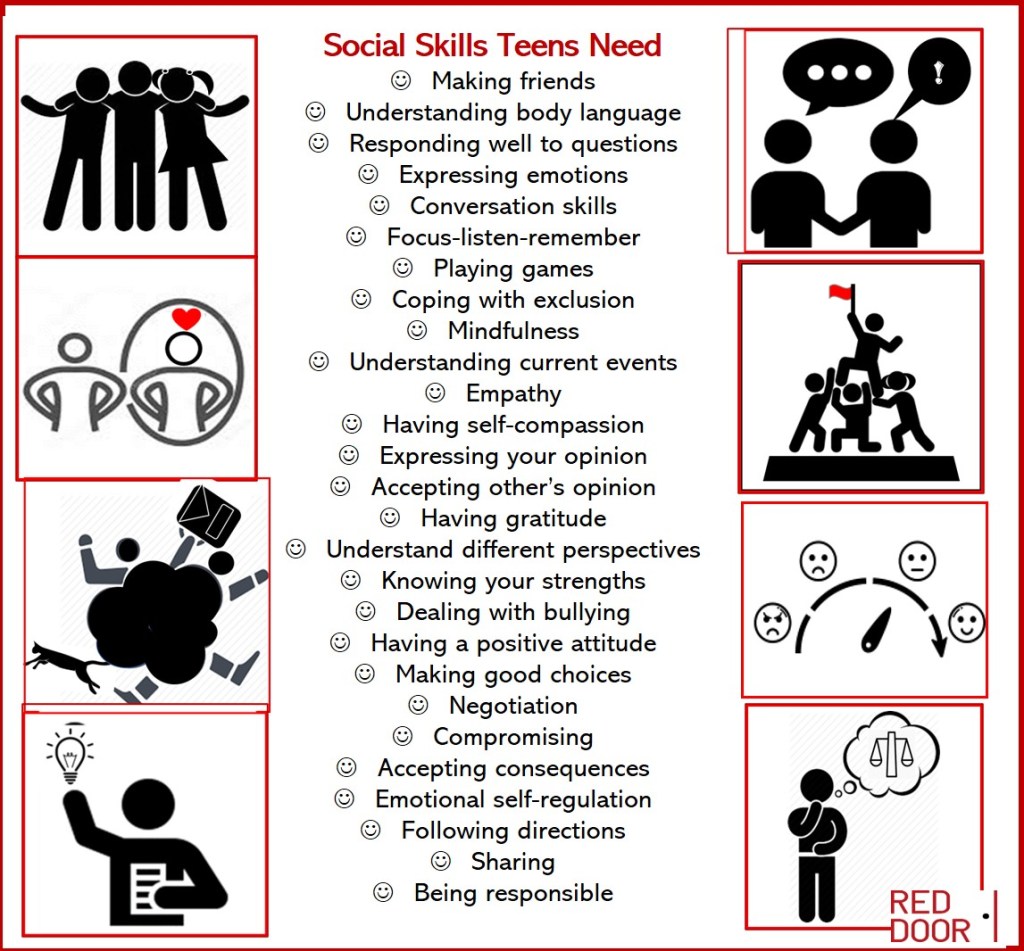
About the Author – Angela Watkins is a counsellor and psychologist working out of the RED DOOR Counselling practice in Hong Kong. Angela helps SEN families build current and future plans in support of their SEN children, helps families learn to cope with the special circumstances that occur as the parent or the sibling of a child with special needs. Together with her SEN clients she builds customised plans that help them accentuate their positive traits, and overcome specific challenges. Angela is a SEN parent herself, and understands both professionally and personally that different is NOT less, and we all benefit by identifying find our own version of awesome.
Note about this article. This article was first posted in 2017 and has been edited a number of times since. The latest version of this article was edited in February 2025.
#socialskills #autism #reddoor #predictorofsuccess #mentalhealth
 Start your Red Door Journey