Workplace conflict: You can handle it.

It is important that we shine more light on “conflict at work”. No workplace intends to be unhealthy, and helping employees understand how to navigate conflicts within the work environment, helps both the individual, and the organisation, become more robust and healthy. Of course organisation can do more to protect and prepare their employees to deal with conflict. Employees can work to better protect themselves as well.
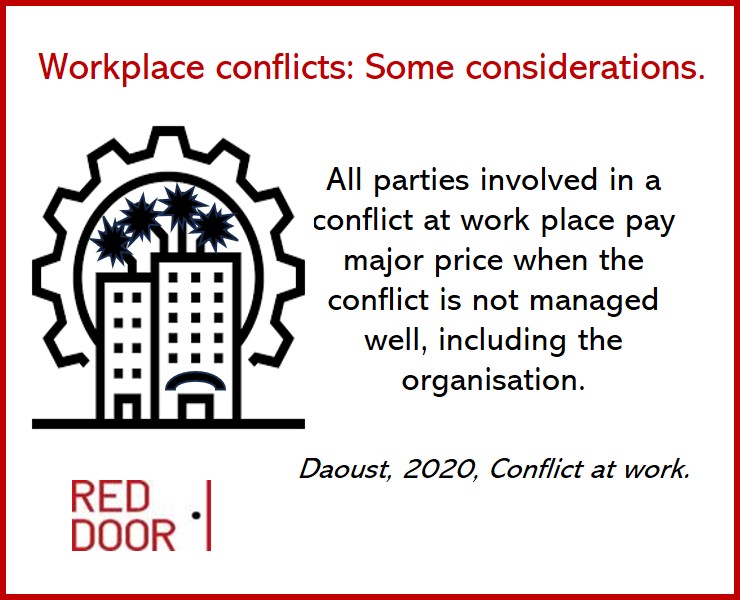
Workplace conflict can lead not only to wasted time within the work environment but also higher employee turnover, poor decision making, grievances complaints and legal processes, absenteeism and health issues, workplace violence, and organisations being labelled as toxic workplaces. It costs people personally and the organisation in terms of reputation and productivity.

Conflict in the workplace does not occur in a vacuum. Individuals bring their physiology and history of conflict into discussions at work, as well as their personal learnt approach to conflict. The environment, including line management, senior managers, task descriptions, attitudes to collaboration and differing points of view, as well as the culture of an organisation all play a role in conflict creation, and management.

In this article I am going to focus on the individual’s role in workplace conflict and what we can do in the moment to lessen conflict. Whilst I might be commenting on what you can do to improve your experience within a conflict situation, this doesn’t mean that you are solely responsible to resolve conflict in your workplace. But, by looking at conflict on a individual level I hope to enable each reader to explore their role, their reactions, and ultimately, their responsibility to respond in a way that helps them protect their mental health.

What components inform your individual conflict style?

The problem for many of us, as adults, in the workplace is that our techniques for dealing with conflict have been shaped from our experiences from childhood, not learnt during adulthood. Often, we learn how to deal with workplace conflict from experience. We have difficulty handing conflict, both in our personal and professional lives, because we are designed poorly to deal with perceived threats.

Inside the work environment we are under pressure to perform, maintain our jobs and reach KPIs, as well as, in a post COVID world, survive restructuring and reorganization as companies adapt to market forces, organisational fads, and changes in workload expectations.

Looking at the attached simplified view of workplace conflict we can explore the individual’s role in workplace conflict.
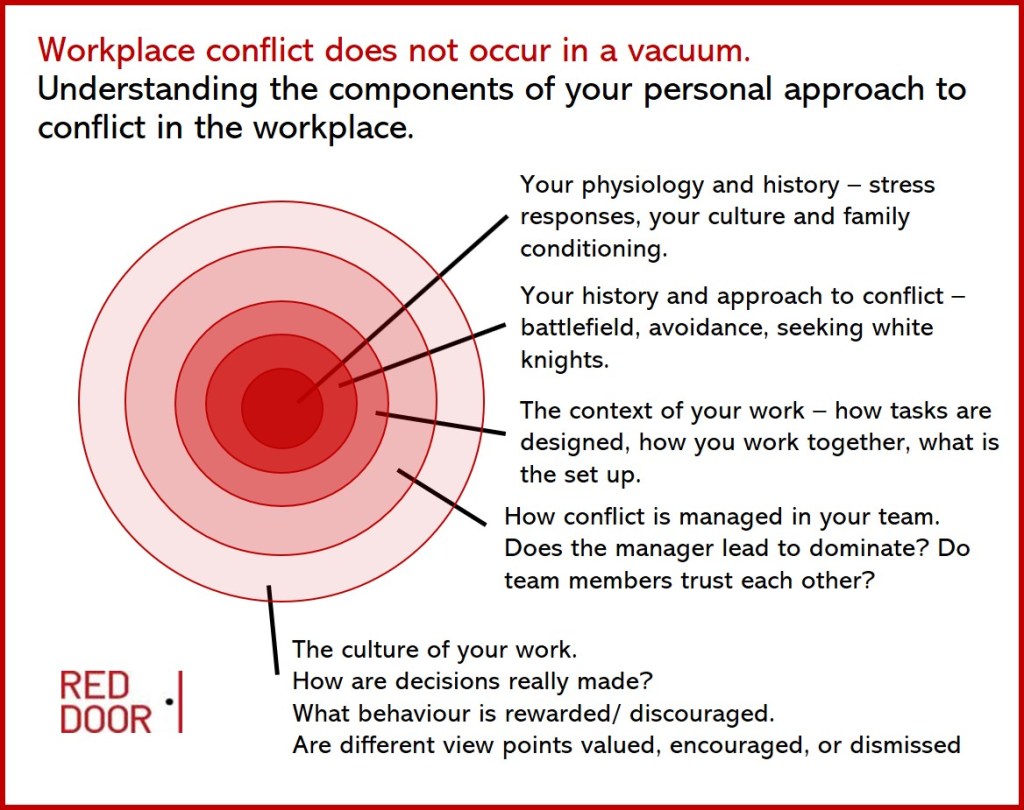
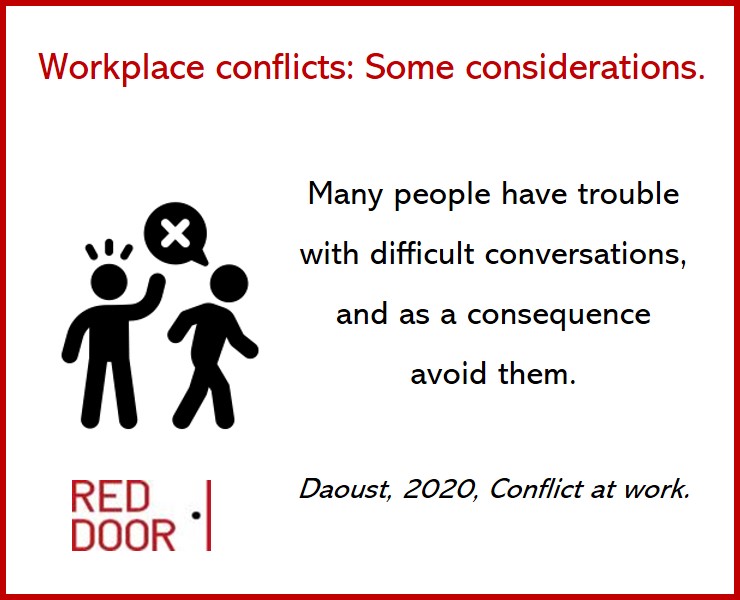
Most people have trouble with difficult conversations and may prefer to avoid them. Perceiving conflict can make us feel unsafe, and as a consequence we revert to practices that help us soothe ourselves and feel safe again. Our fight or flight responses kick in leading to basic avoidance or battleground approaches.
Avoidance approaches:  Sometimes this means avoidance of conflict, or looking for a white knight – a person to take over your fight for you, or protect you against the person you see yourself in conflict with.

Battleground approaches: Sometimes it means taking a more battlefield style of responses to conflict such as building alliances, ‘poisoning the well’ at work by bad mouthing the person you are in conflict with, taking absolution positions (demanding your way, or expecting complete admissions of wrongdoing), allocating a valiant warrior – a person to battle your perspective for you, or even exiting the organisation.  

Good conflict management requires strong interpersonal awareness, emotional regulation, and an ability to reflect accordingly, especially on the messages you are feeding yourself about what the conflict itself, and your conflict adversary, mean to you.

Your personal background, especially how you were raised can influence which conflict style you have become accustomed to using. In some with, a child may be taught to avoid conflict at all cost. Perhaps dealing with a parent who is quick to anger, may encourage some children to want to flee from conflict as a safety mechanism. Other people may be raised that if you don’t stand up for yourself and assert your point of view, you will be ignored or miss out on opportunities. Think about how your family of origin may have informed your conflict style.

Your emotional awareness and ability to regulate your emotions in conflict situations.

Being able to manage how you respond to escalating conflict in a situation is extremely important to help individuals arise at satisfactory decisions within organisations. If, during a conflict, you suddenly burst out in anger, or yourself start to insulting others in the room, it obviously will become more challenging to continue a dialogue in a calm manner. You cannot un-ring a bell of hostility, and sometimes you need a complete reset to get a meeting back onto a constructive agenda.

The following reflections and activities may help you manage a contentious meeting remaining aware of your emotional state, and helping you better regulate your emotional responses within challenging situations.

Before you meet with someone you are in conflict with, some thoughts to consider:

Creating your own “personal pre-meeting”:

Be prepared to enter any emotionally charged conversation in a positive mindset ready to make a deal. Repeat to yourself, “I choose to be open to the ideas of others, stay positive and engaged in this meeting, and know that I bring value to this organisation”

Contemplate the meaning of any concession in the situation. It’s important to consider what does it mean to you personally, if you have to concede in the meeting? Does this mean that you have lost? What does that mean in term of your sense of self, your perceived self-value? Imagine conceding territory as part of your prep, and practice self-affirmations that might make this feel okay for yourself, if you find this threatening. I am not advising your to concede, but sometimes contemplating compromise, and understanding what it means to you, might make you more comfortable accepting a concession if you have to.

Think about your long-term goals. Take some perspective on the issue at hand, before you meet to discuss it, if you have time. Ask yourself, “In a year, will this issue be important to my career?”. What about in a month?

Ways to better support yourself during meetings where conflict is present.

If you are going to be attending a meeting where conflict may become a feature, you may want to start the meeting by setting respectful communication guidelines. Such guidelines are possibly set at a company level as guiding principles. For example, you might express, “Whilst people often have differences of opinion lets agree that insults, raised voices, insulting gestures, and threats can not be part of any dialogue we need to have when we discuss x,y,z”.

Whenever possible use active listening skills within your meeting. When you are discussing a topic with someone you view in an adversarial position, really try to listen to what they are saying rather than focusing on what you can say to out-smart them, or only listen to create your counter point. When we listen with curiously, we give our full attention to the other party, and we can demonstrate that we have heard what has been said, making our dialogue partners more open to our perspectives.
Validate what you hear. Listening is not just about simply hearing and repeating what your colleague says, it is about validating what has been said. Offering validation involves demonstrating that you understand other’s experiences. You might say something like, “I can see why you felt that way in that situation”, or “I think a lot of people would see that topic the way you do? When we model understanding we keep dialogue more positive.

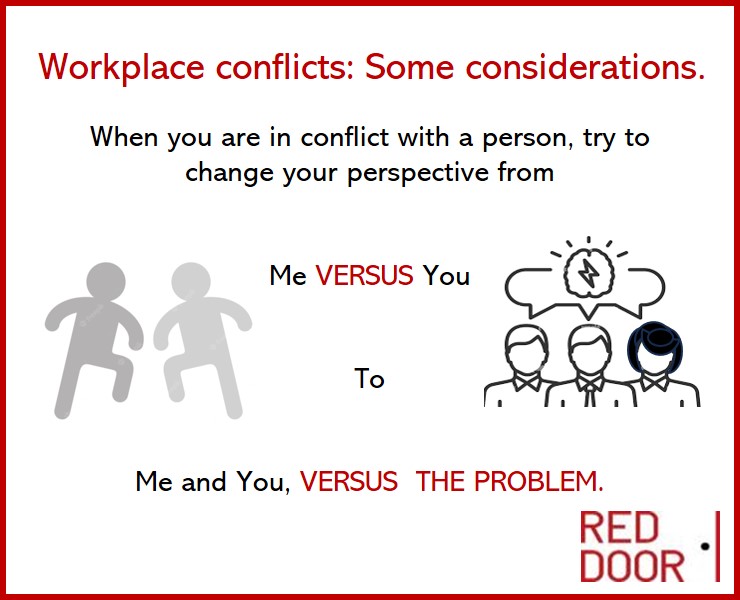
Take the perspective of the team versus the problem. Rather than looking at the situation as me versus you, can you consider that you and your teammate are a team working to solve a problem together. You need to find a shared way forward. 

Remind yourself of the goal of any interaction is to achieve some activity which is meaningful for your company – you will always benefit from taking a private and honest approach to looking at the company’s goal versus your own needs or agenda.

When you are in the meeting, mind your language choices and personal filters.

Check your adjectives. We can review our use of judgmental terms and filters which may lead us to sound dismissive, or superior to our colleagues. Value everyone’s points of view as worthy.  For example. During difficult discussion people describe their, and other’s perspectives using judgmental terms. Your proposed approach you might describe as “efficient, creative, client-focused”. Many of these terms are actually judgement rather than facts. You may find yourself describing your adversary’s proposal as “wasteful, incomplete” Many proposals can be correct, one does not need to take the absolute ‘Win’. Paradoxically sometimes value judgement terms come after the phrase, “No offence, but…”.

Block yourself from over using the term “you”. When we use the term “you” in discussions this can easily remind people of the divide between you. I see things this way, and You see them differently. You want this. You see it this way. Instead, you can ask questions. I would like to hear your perspective on this idea. This sounds more open and more inviting and less likely to be interpreted as attacking.  

Avoid using absolute terms – another form of judgmental language that can create a divide when talking is to avoid terms such as ‘never’, ‘always’, ‘nobody’, and ‘everything. When we use these terms, our objective is often to add to the value of our point of view, or to dismiss the value of another person’s point of view. However very few occurrences occur in such universal absolute terms and they can backfire making you look rigid and sanctimonious.  
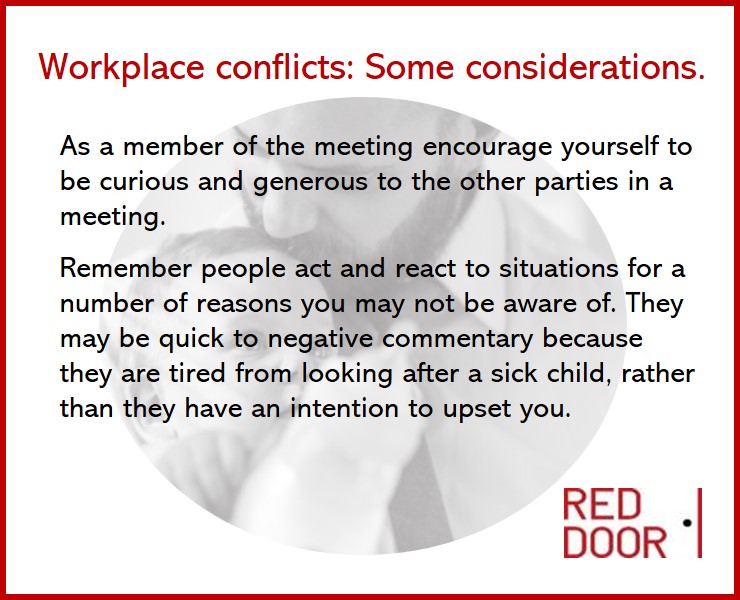
Utilise curiousity – As a member of the meeting encourage yourself to be curious and generous to the other parties in a meeting. Remember people act and react to situations for a number of reasons you may not be aware of. They may be quick to negative commentary because they are tired from looking after a sick child, rather than they have an intention to upset you.

Always act with respect – In addition to being curious about your conflict partner, check yourself if you are acting respectfully and kindly in your meeting. If you approach conflict in a battlefield mentality, you may be more interested in ‘scoring points’ rather than being kind when you talk.

Flood warning – During a meeting where conflict exists between individuals you might start to feel as if your emotions are building to problematic levels. We call this condition being “flooded”. If you are flooded by fear, anger, or anxiety, it will be advisable to take a pause so that you can calm your body.

Take a needed pause, during the meeting

During such a pause you may like to take some time to ground yourself. Grounding activities allow you to calm your body, sometimes through breathing activities or through distraction activities. Please see the tagged article at the end of this blog, addressing emergency responses when you feel flooded by anxiety. The same activities can be helpful when you feel angry.

During the pause, in addition to grounding activities you can also practice emotionally soothing language to yourself. Imagine you are talking to yourself, full of self-compassion, and as you would speak to a small child. Remind yourself that you are okay and that conflict is also not a catastrophe. Different opinions are not only okay, they also present everyone with opportunities to learn.

A pause can be 10 minutes or longer. Taking a pause to allow meeting participants to calm down, should not be utilised as a method to avoid reconvening to continue an important discussion. If a mediator is involved in the meeting, they may want to remind people about the respectful communication rules of the organisation.

Learning more about your conflict style and how you can better manage conflict situations in the future.

Perspective – take a moment to think about if the current conflict will still affect you in a year. This helps us take a higher level of resolving the topic. Will this decision matter in a year?

Look for the meaning in your own need to win or avoid the conflict. Conflicts at work are similar to conflicts between romantic partners – the stated issue is often not the real issue that underlies the conflict. It is important to explore the meaning you attach to the event or issue. For example, would “losing” a conflict diminish your need to be recognised as a subject matter expert? If you feel this way, you might like to ask yourself how is your internal and external value as a subject matter expert built and does this conflict really matter in building a stronger sense of yourself?

As yourself what is your narrative? When we look for meaning in a situation you can help create some perspective by asking yourself, “What is the story I am telling myself in this situation” This type of internal reflection allows us to better understand what our beliefs about other people’s motivation and the perceived value of winning and losing in a situation. We benefit from exploring what is a fact, and what is a personal interpretation in a situation.

Reflect about your role in your relationship with your adversary. We can sometimes demonize the person that we are in conflict with. People resist you because they think you don’t care about them, not because they don’t care of you. How have you demonized your adversary? Do you really know what motivates them, or have you made assumptions about them?

Who can help you?

All parties involved in a conflict at work pay a major role when conflict at work is not well managed – including the organisation. People in conflict are not more or less valuable than each other, but in practice some organisations may give more resources and better support those who are seen to be a key contributor to the bottom line of the company. This is sometimes a feature of conflicts we see involving compliance representatives versus sales people in financial organisations.
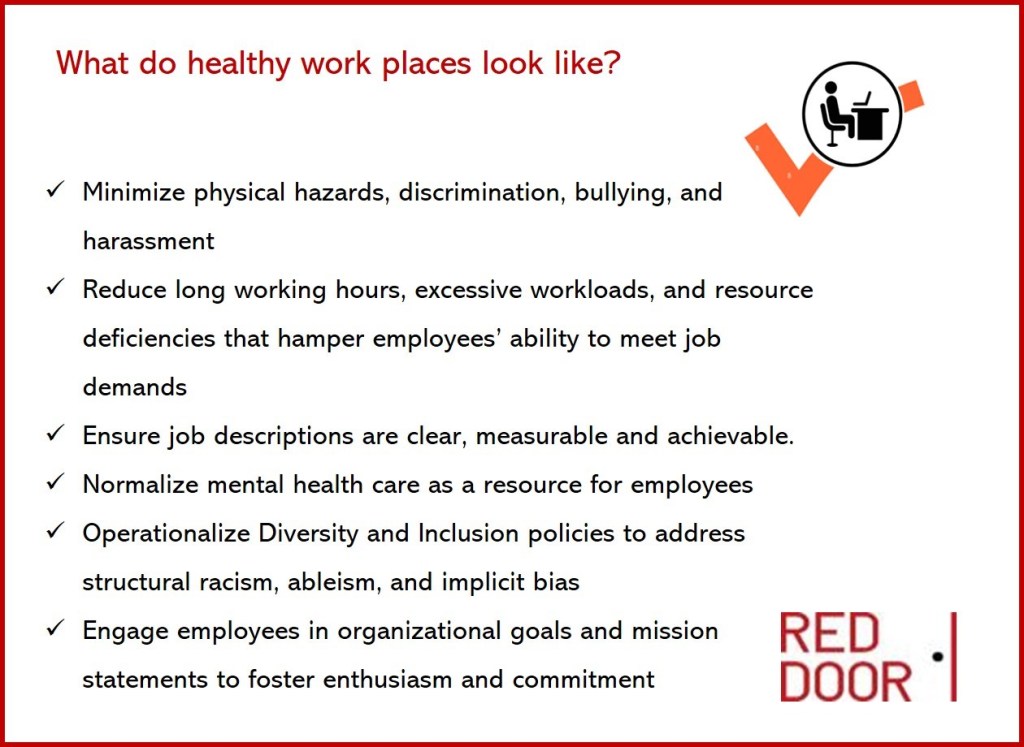
Within an organisation you may look to discuss conflict management with your line manager, or your HR partner. Sometimes people do not feel safe engaging with those roles, and we has managers of organisations need to better create circumstances to help employees manage conflict, After all, differences of opinion are a healthy component of a productive workplace.

Sometimes you need to look outside of your organisation to enable your better navigate workplace conflict. A good counsellor is a person you can consider as a confidential resource who is completely on your side.

Should you stay in your organisation, or should you leave?

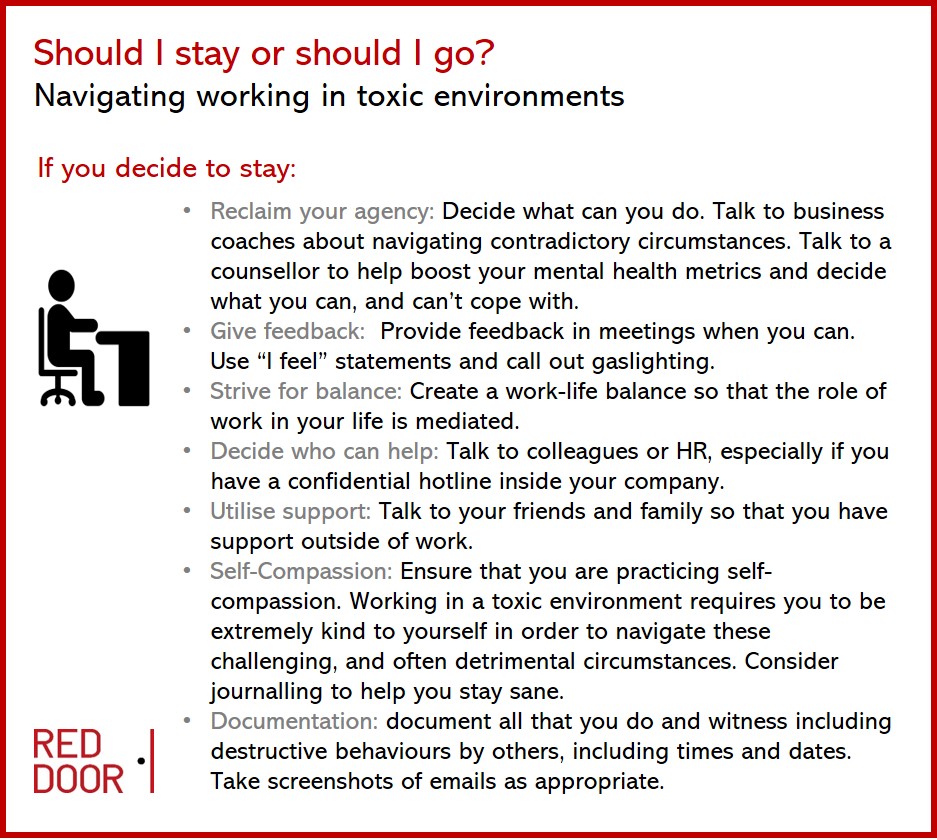
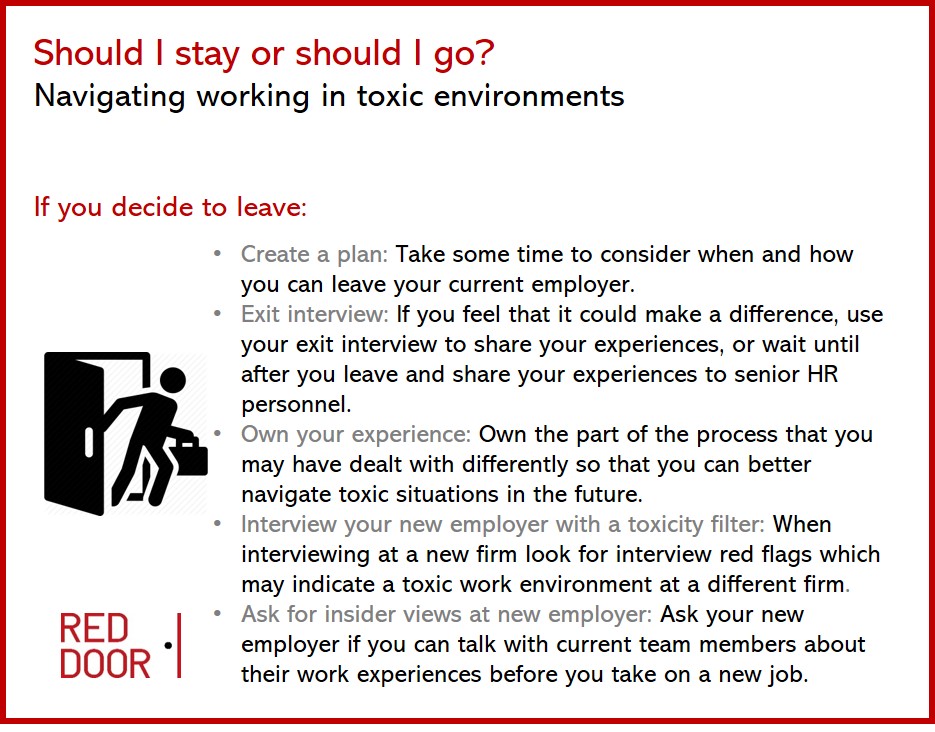
Deciding if an organisation is a good or poor fit for you is completely your decision. When individuals come to counselling to talk about their experience of conflict at work, we will help by asking a series of reflective questions that help those individuals stand aside from the problem, so that the decision may be easier to make. There is significant value in working with an objective person outside of your organisation who is qualified to help you prioritize and protect your mental health. IN addition to aiding your to frame the should I go, or should I stay” question, they can also help you brainstorm the other career ideas, and coping mechanisms.

You can discuss with people around you, or a counsellor or coach in order to fully review your perspective on the situation. Some of the question your might discuss include:

    • Who am I responsible to?

    • What am I responsible for?

    • Ask yourself – how is my conflict style working in this situation?

    • Ask yourself – Can the situation change?

    • Ask yourself – Can I change myself in the situation?

    • Think ahead – what would be the consequence of you staying silent? Or speaking up?

    • Look around – how have similar situations in the organisation been treated in the past?

Then, write it down and make a plan – shall you stay, or should you go? Below are some items you might like to consider.
Workplaces want to attract the top talent. The 2022 Women in the workplace report by the consultancy group McKinsey suggests that senior women want to work for organisations which represent healthy workplaces practices, and that demonstrate their commitment to these values beyond superficial communications. Building positive methods of conflict management is part of this.

If you are confused by conflict at work, consider discussing your situation with a counsellor. The team at Red Door are all experienced and qualified are all qualified to deal with this topic with their individual clients.

About the author: Angela Watkins is a counsellor and psychologist working out of RED DOOR counselling in Hong Kong. Angela has been voted the best therapist in Hong Kong. For appointment with Angela, and other Red Door counsellors contact us at Angelaw@reddoor.hk or SMS/ Whatsapp +852-93785428


https://reddoorhongkong.wordpress.com/2022/03/07/anxiety-attacks-emergency-responses/


Books on workplace conflict that you might find useful:
Daoust, M. O. (2020). Conflict at work: A toolkit for managing your emotions for successful results.

Genny, J., Patterson, K., McMillan, R., Switzler, A. S., and Gregory, E. (2023) Crucial conversations. 3rd Ed. 
Wesley, D. (2015). Conflict resolution in the workplace: How to handle to resolve conflict at work.

The Resiliency Rx – check-in to check-up

Resilience

The Resiliency Rx – check-in to check-up

Resilience is the capacity to rise above difficult circumstances. It is a trait that allows us to exist in this less-than-perfect world while moving forward with optimism and confidence. From a psychological research perspective, resilience is collective terms for a range of personal skills (I’ve included 28 elements below) which are developed during the childhood. Many of them can be enhanced or corrected with education, therapy and training– in other words resiliency can be taught, to both children and adults.

Resiliency is required to deal with day-to-day hassles, and is essential when you face exceptionally stressful events. Stress such as that experienced when you are going through a divorce, lose your job, suffer a bereavement, fail a significant exam, or are diagnosed with a serious illness, even fall out with your friendship group at school, require an ability to respond to these acute stressful situations.

In today’s world you need to be resilient. This doesn’t mean you need to accept other peoples’ bad behaviour, but you also need to be able to respond appropriately when other people behave badly, or circumstances turn out unfavourably for you. For example:

  • Sexism, racism, prejudice still exist in the world, and you are likely to be exposed to this at some point.
  • People can be mean, they can bully and exclude others. And this doesn’t just apply to teens.
  • You are likely to encounter at least one person in your lifetime who tries to push you around in a work or learning environment.
  • You are likely to fail at test or exam at some point in time. Will you retake that test, or are you willing to only make one attempt?
  • Family members are probably going to say something personally offensive to you at some point.
  • There might, amazingly, be a global pandemic which means your life suddenly changes completely out of your control.

If you are resilient you are better able to face the stressful slings and arrows that one encounters in a lifetime, rather than resorting to maladaptive coping strategies such as escapism (gaming, having affairs), self-medicating (abuse of alcohol, drugs), or breaking down (depression, burnout, anxiety attacks) or developing other psychological problems (paranoia, obsessive stalking).

Hence, we can think of resiliency as the super multivitamin – and the daily prescription (Rx) provides protection from environmental stressors which might, potentially, make us unwell.

There are a number of tests of resilience – for children, youth and adults. They can be self-administered. I have adapted selection of questions from various tests below to provide some examples of some of the items that are sometimes assessed. I remind you, the test within this blog is not an empirically tested diagnostic test, it serves instead as a potential check-up of your current aspects of functioning – a check-in check-up.

The RED DOOR Resiliency Rx – quick check-up

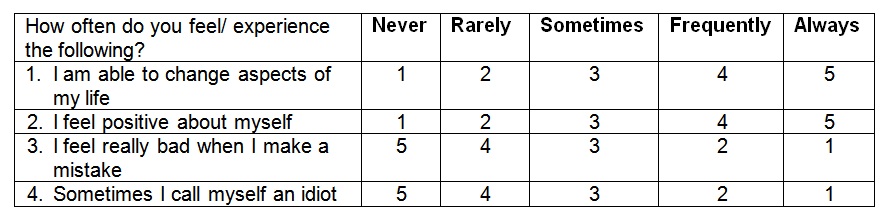
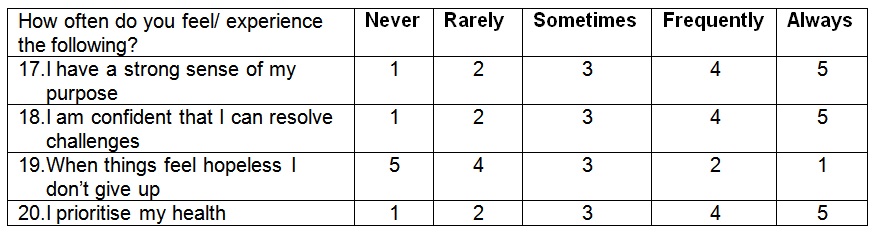
Let’s begin with some questions about how you see yourself, and then explore other categorical elements of resilience.  Select the frequency that you experience the following thoughts/ feelings or experiences:

How I see myself

how do i see myself

It stands to reason that how you see yourself will influence how well you feel you can respond to a stressful situation. Self-efficacy, our belief in our ability to influence the outcome of a situation is a key aspect. If we do not believe we have any chance to change an outcome we are forced to sit inert, whilst unfortunate events happen ‘to us’. How we see ourselves, our positive self-affect (self-liking) is also an aspect of resilience, as is our self-esteem (sense of self-worth). If we think positively about ourselves and see our worth, we can withstand adversity’s impact on our feelings towards ourselves, and our ability to be positive in the future.

A series of beliefs about ourselves, especially if they are distorted, can compromise our ability to cope. If you see yourself as a ‘loser’, or an ‘idiot’, you will expect that situations are likely to end in a negative position.

When stress occurs, those who harbour perfectionist distorted fears, such as a strong fear of making mistakes or have doubts about your actions to the extent that you are forced into in action, maybe in for a harder time when the going gets tough. It stands to reason that how you see yourself will influence how well you feel you can respond to a stressful situation.

Self-efficacy, our belief in our ability to influence the outcome of a situation is a key aspect. If we do not believe we have any chance to change an outcome we are forced to sit inert, whilst unfortunate events happen ‘to us’.

How we see ourselves, our positive self-affect (self-liking is also an aspect of resilience, as is our self-esteem (sense of self-worth). If we think positively about ourselves and see our worth, we can withstand adversity’s impact on our feelings towards ourselves, and our ability to be positive in the future.

On the four questions above I would expect a score of 10 or above to indicate that you see yourself well in terms of ability to be resilient. *

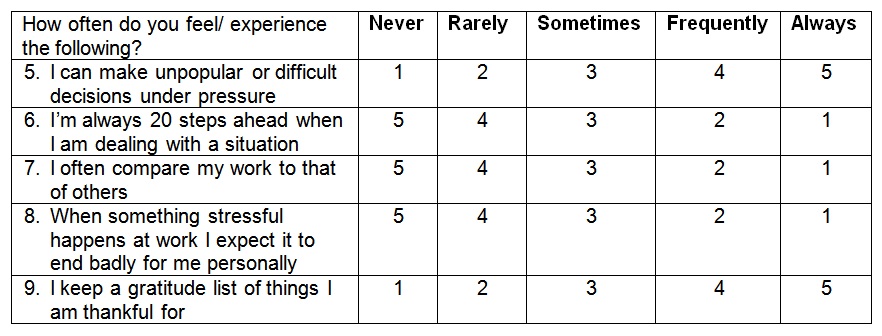
Framing and reframing situations

Framing and reframing situations

How you see the situation, and can challenge one’s original interpretations of a  situation – the ability to frame and reframe – also influences your overall resiliency.

Cognitive distortions – beliefs that you hold about the world, influence how well you can respond to it. If you tend to catastrophize about what may happen, you create a lot of additional internal anxiety for your system to deal with, beyond that which is presented by the original situation. Additionally, comparing your work or yourself to others is a guaranteed way to build doubt in yourself over the long run. Even if you are the cleverest, you probably won’t also be the most charming, or good looking, or most popular, or best educated, or best dressed. The list of comparisons you can make is endless, and the only guarantee is that you will, eventually, fall short.

Your ability to brainstorm creatively about resolving problems will lead to confidence to address challenging situations, just as having a positive attitude about challenges, learned optimism also helps. Being present, and mindful, is essential. Tackle each problem step by step and don’t fret over the parts that are a long way off from being realised. Many concerns may not materialise. If you focus on all the potential problems you may encounter in the futurebefore you make a particular decision, it’s enough to make one hide under the covers for days on end, rather than face up to making needed decisions today.

Being grateful is not just for hippies. Being grateful and keeping gratitude lists encourages two positive resiliencies boosting aspects – firstly, the ability to see that many things are good, even when not everything is good, and secondly, the recognition that there are a lot of people who would be happy to have half of what we have. Altruism, and helping others rise, will help you install the ability to bounce back into your own psyche.

On the five questions above, I would suggest that a score of 17 or higher indicates that you frame, and re-frame, situations in a positively resilient manner. *

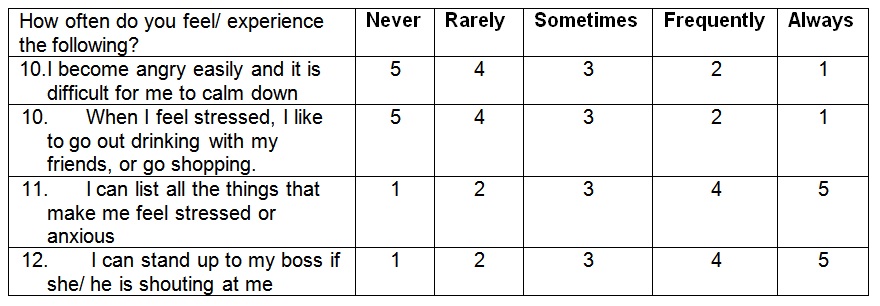
Current coping mechanisms

Current coping mechanisms

Take a moment to consider how you cope with stress now, as it is very likely that you will utilise the same coping mechanisms in moments of acute stress. Maladaptive stress responses include self-medicating through alcohol consumption or recreational drug use, escaping through game playing (on devices or with people), and avoidance (procrastinating, avoiding going out).

There are healthier coping mechanisms that you can learn. A good place to start is in identifying the stressors in your life and how your body responds under stress (for example stomach pains, headache, fatigue, shaking) so that you can identify these symptoms relationship to your anxiety experience. Learn calming techniques, breathing, relaxation, colouring, and mediation to help calm your body.  If you lack assertiveness, consider assertiveness training. Practice stress management techniques (blog coming shortly on this specific topic).

If you score less than 12 on the four questions above, it may be time to evaluate your current coping mechanisms in terms of ability to be resilient over the long term*Take a moment to consider how you cope with stress now, as it is very likely that you will utilise the same coping mechanisms in moments of acute stress.

Maladaptive stress responses include self-medicating through alcohol consumption or recreational drug use, escaping through game playing (on devices or with people), and avoidance (procrastinating, avoiding going out). There are healthier coping mechanisms that you can learn. A good place to start is in identifying the stressors in your life and how your body responds under stress (for example stomach pains, headache, fatigue, shaking) so that you can identify these symptoms relationship to your anxiety experience. Learn calming techniques, breathing, relaxation, colouring, and mediation to help calm your body.  If you lack assertiveness, consider assertiveness training. Practice stress management techniques (blog coming shortly on this specific topic).

If you score less than 12 on the four questions above, it may be time to evaluate your current coping mechanisms in terms of ability to be resilient over the long term*.

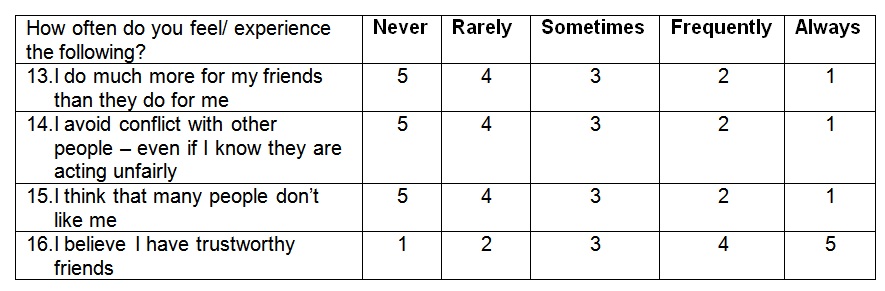
Making the most of your support network

Making the most of your support network

In order to be resilient, you need to be able and willing to ask for help and lean on people. What is particularly important, and a key element of our Teen Resiliency Rx course is understanding who are your real friends and differentiating them from those you simply spend time with. We all need someone, actually more than one, person we know has got our backs. Sometimes even trustworthy friends cannot be there for us in a crisis, because of their own life situations, so having a diverse network of support is important, especially for teenagers. Encourage your teenagers to have friends both inside and outside of school.

Resilient people also have healthy relationships with people they spend time with. They have robust boundaries – they understand what is their responsibility and what is yours and do not get those mixed-up. They do not hold negative cognitive distortions about how others see them, and have the skills to appropriately deal with conflict in relationships. All of these skills can be taught if you consider yourself enmeshed in other people’s drama, or constantly thinking people hate you.

I would consider a score of 14 or over to demonstrate that you are doing well in building supportive networks around yourself, providing a safety net, in case you need it. *

Committed to your purpose

Committed to your purpose

If you have had your path in life written for you by others, perhaps your parents or as the trailing partner of an expat, you may feel a lack of purpose. This is because you are not pursuing your own goals, rather that of others. It is important to have a sense of purpose about your life. If it needs some temporary adjustment because of your circumstances, that can be incorporated. You need to know where you are going, and why it is important for you, or you will not feel satisfied when you get there. Build a personal growth plan and an action plan so you feel directed. Manage part of your time to achieve these goals. Believe in yourself, be confident , and committed to your purpose. Enlist help if you cannot do this on your own.

Part of being committed to a purpose is to ensure that you make it to the finish line. Your health is a priority. Many of us place our health needs on a back burner because of today’s pressing needs. Your body and mind need you to be as healthy as you can be, so that if an acute stressor occurs, you have your health to rely on.

If you score 13 or more you are on your way to your purpose. If you score below this, please consider what you can do to help yourself build purposeful resilience into your daily plans*.

How did you do?

If your resiliency check-up went well, then congratulations. If your scores didn’t add up the way we recommend, then consider what might be areas for development for you. Part of being resilient is reaching for advice when you need it.

*Please remember this is not a true empirical diagnostic test. Low scores indicate you can work on areas, high scores do not guarantee that you will be resilient when hit by a crisis. If you have any concerns about your resiliency score contact our team at RED DOOR for more discussion. reception@reddoor.hk

#reddoor #resilience #personalitytest #support #mentalhealth #perfectionism #stress #selfefficacy #selfesteem #anxiety

Change your thinking – change your life.

filtersBeing contented is a matter of perspective. Those whom are content are more likely to be able to respond positively to change when it is required, accept that many negative events are beyond their control, and allow situations to proceed differently than their initial expectations. This is because they can approach life’s challenges with a rational, and cognitively flexible, perspective.

It is possible to change your thinking and be happier. If you are willing to challenge your thoughts, you can change your life.

What are thinking filters? 

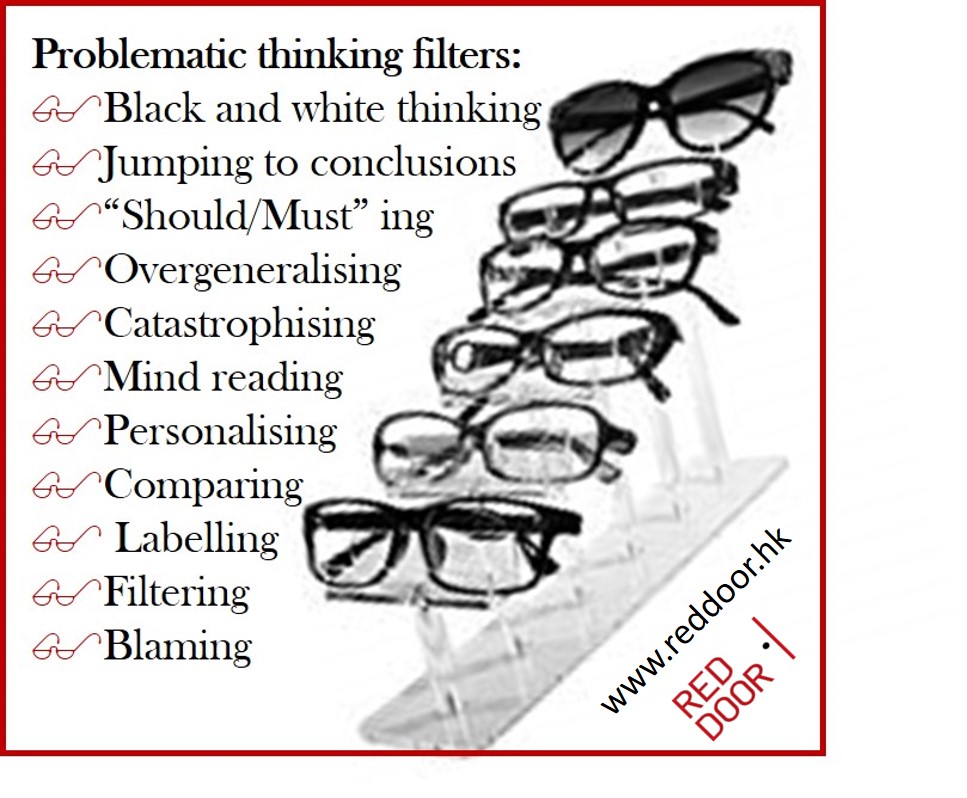
Famous psychologist, Albert Ellis, identified a plethora of irrational beliefs that we develop as part of the way we are raised, see the world, and believe about ourselves and other people. These beliefs are filters that, like a pair of glasses, interfere with the way that we see situations. Wearing faulty filters may cause people to engage in self-defeating behaviours such as experiencing self-hatred, jealousy, self-harm, accepting abusive relationships, over reacting to situations,  procrastinating, and anger.

You can stop help yourself and remove your faulty filters by creating a constructive dispute with yourself, or even have a counsellor lead this discussion for you. The dialogue will depend on the filters that you use most frequently. Experiencing faulty filters is quite common. Read on our list of common cognitive filters, how they influence how you perceive situations, and how you can change the view.


Black-and-white-thinking.

black and white thinkingThis type of thinking occurs when you look at situations in a polarised way – situations, people, activities are either good or bad, nothing in between. Most situations are neither complete disasters or beyond fantastic, often situation have both good and bad aspects. Most people have some attributes that you find challenging, but this doesn’t make these people totally bad or good.

When people wear these black-and-white-thinking filters they can respond in an inflexible way to challenges – “I didn’t get an A in that test and now my future is ruined “or “I submitted that assignment but I made an error in the first paragraph so the whole article is now rubbish”.

In particular people who have black-and-white-thinking in relation to people find themselves caught in judgement loops – these people are all bad, and therefore my poor behaviour towards them is acceptable, or they need to be brought down.

If one has black-and-white-thinking in relation to situations, a person can end up with lowered resilience. Every set back can become a tragedy, rather than a minor bump in the road.

Change the view: If you feel you may be one who experiences black-and-white-thinking actively force yourself to find the shades-of-grey in situations, or with people. Can you recall a time you thought something would be a tragedy and it ended up being ok? Perhaps you fall into the practice of judging a situation too quickly. The next time this happens, before you define a situation as a disaster, let your emotions, and the situation play out a little further. See where more evidence might lead you.

Should-ing and Must-ing.

All of use could be labeled “must-terbators” at some point in time.  It is irrational to believe that most things are absolutely necessary. Believing that acts should be performed in a particular way, at a specific time, or in an exact order, creates a tyranny of should – a condition where you live life dictated by a list of thoughts which are not really rational.

shouldWhilst everyone has lots of things that they should (or could) be doing, some beliefs are irrational in their detail and in their believed consequences. For example, if everything needs to be perfect, this creates a lot of pressure on a person to perform a task to a (sometimes) unrealistic standard. Believing that you need to be the perfect student, parent, worker, lover, or be in control of all events in your life, be slim and attractive at all times, always be interesting, always have a friction free family – are unrealistic.

Being influenced by excessive should-ing and must-ing can have a multitude of psychological consequences including:

Self-doubt: feeling like a failure because you can not maintain your own (self-imposed) impossible standards,

Procrastination: too frozen in fear to start a project without already being an expert, or knowing you will be perfect at it.

Strict expectations: that others will live up to the same standards of you, or should not settle for less than perfect. You may find, without really wanting to, that you bully others to live up to your expectations.

Change the view:  If you suffer from ‘must-terbation”, the cure is to create a thought dispute. Do you REALLY have to be a perfect parent/child/partner/etc? Is this a realistic expectation? What happens if you are not perfect? Do activities need to be conducted in a particular order? What might happen if the order can not be observed? Try to substitute the word “CAN” for the word “must”. This will help you remember that you have a choice in every situation. If you find that you respond with a high degree of anxiety to a need for order, you may have some early symptoms of obsessive-compulsive thinking, and may benefit from talking to a therapist to guide you more actively towards change.

Jumping to negative conclusions.

negative conclusionsWe all have the tendency to occasionally jump to negative conclusions. We may assume that someone deliberately performed an activity that hurt our feelings, or event assume and intent to their inaction (e.g. they don’t like me). In these situations, limited information or evidence can be used to support negative conclusions. This may be the case when we fail to get success at work, thinking that others are not supportive, when they are sometimes just too busy or not focused on our priority.
This type of faulty filter can lead to inaccuracies regarding our perception of people and situations.

Change the view: If you find yourself typically jumping to negative conclusions ask yourself the following reflective questions, “do I have solid evidence that my beliefs are true?” and, ”Is there a possible, alternative, view of this situation?”. If you jump to negative conclusions quite frequently you may even start to feel quite paranoid about other people’s motives. You may like to consider counselling in that situation. At least start a daily practice of reflection such as journaling so that you can capture and explore your emotional relationship with events at a time that may be willing to appraise your reactions.

Overgeneralising.

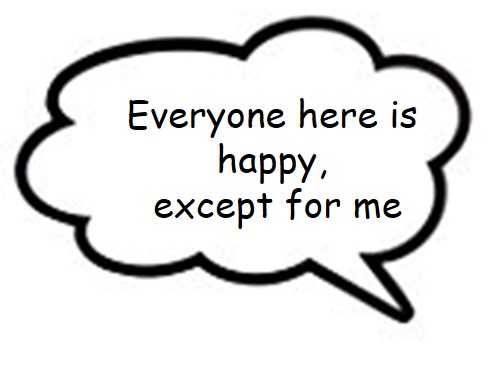
overgeneralising.jpgOvergeneralising is a special type of jumping to conclusions – both negative and positive conclusions. Overgeneralising is often reflected in our language choices – we use extreme frequency terms to describe behaviours – “they ALWAYS forget”, “Things NEVER go right for me in love relationships, EVERYBODY is happy except for me”. “Now that I am separated, ALL my married friends won’t want to see me”. Occasionally we may even do this after a single instance – one rejection letter leading to the assumption “I will never get a job”.

Change the view: When we overgeneralise, we can make decision that are self-defeating such as giving up on applications, feeling bad about ourselves, and limiting our experience of life.  This is very common in the stories you tell yourself about your romantic partner.

Try to ban words such as always, never, and everyone from your vocabulary, especially during self-talk. It is highly unlikely that an absolute term will be an accurate description of a situation.

Mind-Reading.

mindreadingMind-reading is a special type of jumping to negative conclusions. Not only do we make an assumption about people in the absence of complete evidence, but at some level we feel certain we know what they are thinking. Whilst on some occasions we may guess this right, we may also get this wrong. I often talk with clients who assume people talk about them negatively or think a particular way about them. In my experience we greatly overestimate how much people talk about us, and how judgmental of us they may be. Most people are usually worrying about their lives and what they need to do, rather than the role we play.

As a consequence, mind-reading can lead to self-limiting or self-defeating behaviours. We may not sign up for an activity because we know what people may think. For example, we may not go to join a dating event because you think others will think you are desperate. Or go to a family dinner because your cousin may negatively judge you.

Change the view: People who practice mind-reading will benefit from an automatic Anti-mindreading reminder that people do not think about you as much or as negatively as you think. Additionally, worrying about what people think may be indicative of your own challenges with self-esteem. When you love yourself enough, what other people think will not matter so much.

Catastrophising.

catastrophisingCatastrophising refers to the faulty filter we apply when exploring the future of situations in regard to negative outcomes. Whilst it is typical to occasionally feel a negative outcome, when we go for medical checks and such, excessive worry is of no help. If you tend to catastrophise regularly you cause yourself immense distress. Imagining that all situations will end in disaster is exhausting. Worrying that people will die or leave you will not make those situations any easier when they do happen, it just makes you experience the situation, virtually, again and again.
Change the view:  People who catastrophise need to challenge their thinking with more ‘realistic’ thoughts, and remind themselves how many times in the past situations have turned out OK. Often the worry caused by catastrophising may move people to seek out reassurance from others, and this in itself can become a problem. Try to do nothing for a while first. Whilst the anxiety you feel is unpleasant you can work to distract yourself from that experience with anxiety relieving activities.

https://reddoorhongkong.wordpress.com/2018/08/02/when-anxiety-attacks-6-immediate-solutions/

Personalising.

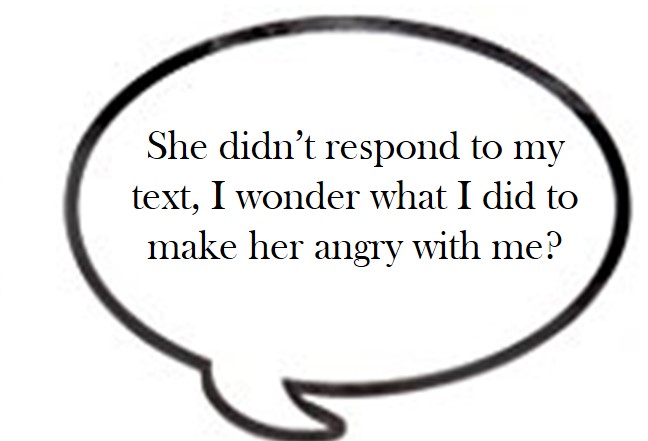
personalisingWhen we personalise we feel responsible for events or situations that are not our fault, or we assume that it is our fault. It can lead to us feeling offended when it isn’t necessary. If a friend ignores your text may not mean that you’ve offended them, instead it may mean they are busy. They may not be trying to offend us, or even be having an emotional reaction to something we have done.
Personalising can be a component of co-dependency in relationships. I once had a grumpy boss, and many of us who reported to him walked around on eggshells, torturing ourselves over what we had done wrong to upset him. Rather than wasting valuable energy on this worry, it might have been more constructive to let him have his time being grumpy (after all his emotions are his responsibility) and get on with the work that needed to be done.

If you have performed an act, either selfishly or unwittingly, where another person was hurt. You can take responsibility for your role in a situation, and apologise or try to make amends, but leave it to that situation. Whilst we can take responsibility of for our own behaviour and thoughts, we do not need to take responsibility for the choices of others.

Change the view: If you personalise you may want to review your thought process to see how a situation could be viewed differently. If you are taking responsibility for someone in addition to yourself you may want to ask yourself if you have become co-dependent –. When we are co-dependent, we see ourselves through the views of our significant others – if they say we are okay, then we are okay. IF they are angry or not operating properly in life, we need to change our behaviour in order to save them. Counselling is a great way to break out of co-dependent patterns.

Filtering.

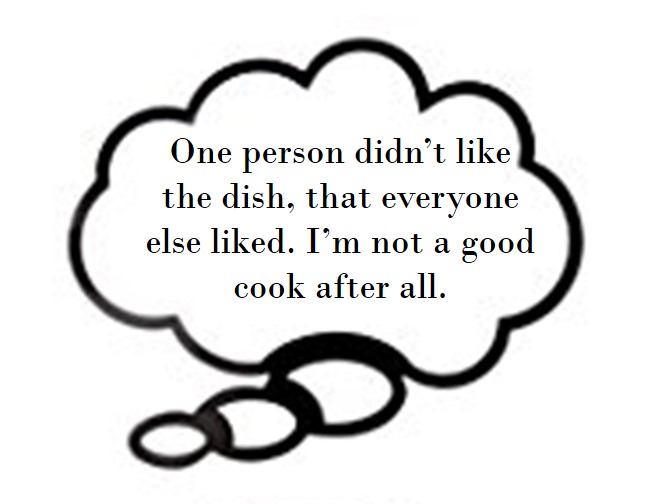
We all filter sometimes. Imagine you are in a group and each is providing feedback on your work. Nine of the 10 people say you did a wonderful job. One person says they thought your contribution wasn’t good enough. Which do you remember – the 9 positive remarks, or the one negative. That is filtering.

filtering.jpgFiltering becomes a threat to our self -esteem if you use this faulty thinking style frequently. In the era of the internet where people can feel more willing to troll other people and say horrible things on line, selecting what you choose to believe and reinforce as regards you sense of self, is extremely important. This is especially true for teens who use internet vehicles to test reactions to their world views – and perhaps do not yet have the resilience to rebuff negative feedback.

Change the view: it takes time to build a solid sense of self, and it is a worth while activity. Catching the filtering you do in your life is one way to eliminate negative self-perceptions.  If 9 people say you are great, say thank you 9 times. To the person who gave negative feedback, say thank you as well (provided the feedback was given in an honest and with improvement in mind), but move on. One negative review does not define you, but it can help shape you. You will make mistakes in life. That is actually part of the journey. If one person says you are ugly, stupid, lame, vulgar, it is the opinion of ONE person, and quite possibly says more about them than it says about you. Be realistic, you will not receive 100% consensus on any topic, even how fabulous you are. There is only one vote that counts, and its yours.

Comparing.

comparingIt is common to consider our own attractiveness, status, success, and personal worth relative to others. Comparing oneself constantly can become quite negative, especially when we assume elements about the other person and ourselves. For example, thinking a person who gets a better pay rise than you is an overall better person than you is not only unrealistic, it is unproductive. Please see our article on the strong relationship between comparing and feeling miserable.
https://reddoorhongkong.wordpress.com/2017/10/23/comparison-a-one-way-ticket-to-misery/

Change the view:  Catch yourself comparing and making assumptions about others. If your friend has a success, this says nothing about you. Repeat to yourself, “ I am enough, I do not need to compare”.

Blaming.

blamingOccasionally people let us down, even hurt us with their actions. Sometimes these actions are intentional. Many times, they are not.  It is good to be able to accept disappointment and imperfections in others. If you find that you become stuck and blame others for your position in life, or in a situation you give away some of the power to fix that situation. Accepting someone’s behaviour is not an endorsement of that behaviour, it is simply acknowledging that bad realities exist, and that life can be unfair.
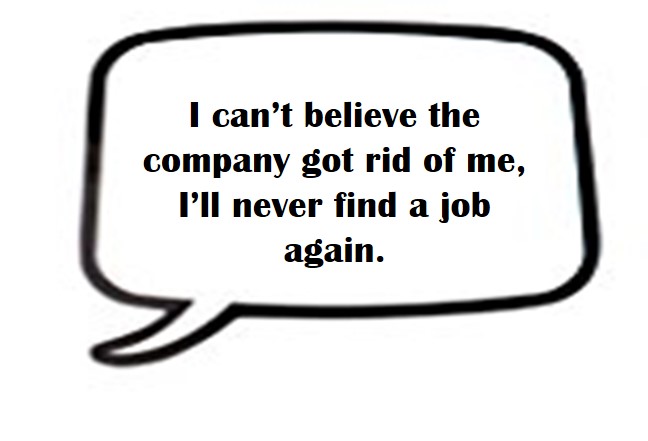
People can get become stuck in the hurt they feel – for example if they are forced out of a job, or their romantic relationship ends. It is up to us to help ourselves move on from painful events, even if they were initiated by the action of others.

Change the view: keep moving forward in life. There will be set backs. Overcoming them is a part of life and building resilience. If you are having trouble getting past a pain caused at work our article on career crisis might help {blog career crisis), whilst if you are stuck from the pain of a hurt in a personal relationship our blog on recovery may be of assistance.

https://reddoorhongkong.wordpress.com/2018/12/31/let-it-go-let-it-grow/

Labelling.

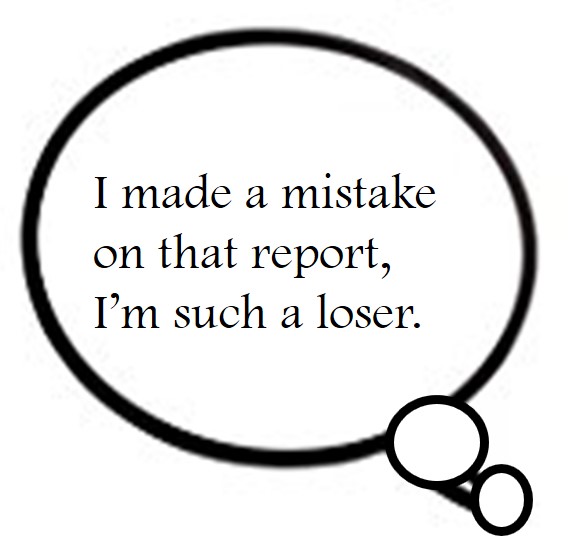
We all make mistakes or act foolishly sometimes. When we label ourselves, rather than our behaviour we diminish ourselves. For example, if you made a mistake on a report you could say, “I made a mistake”, or you could label “I’m so stupid”. The latter response does nothing for your self-esteem. Acknowledge mistakes and bad choices as part of life, that can be forgiven.

labellingIt is also illogical to label others, on the basis of one inference or observation. One fight with a colleague does not make her a “bitch”. When we label others, we not only diminish them, we provide rationalisation for further retaliation, “its okay to do xyz, because she is a bitch”. This is clearly not rational, and can often become prejudicial.
Change the view: Catch yourself when you use labels for yourself and others. Label acts and behaviours as problematic, not the person. We all need forgiveness sometime.

Where to next?

Did you notice if you have been wearing filters? Its time to take off those shades, and change your view. Changing your thinking patterns will change your life. Are you ready to feel differently. Challenge these thinking filters and see how your life could be better.

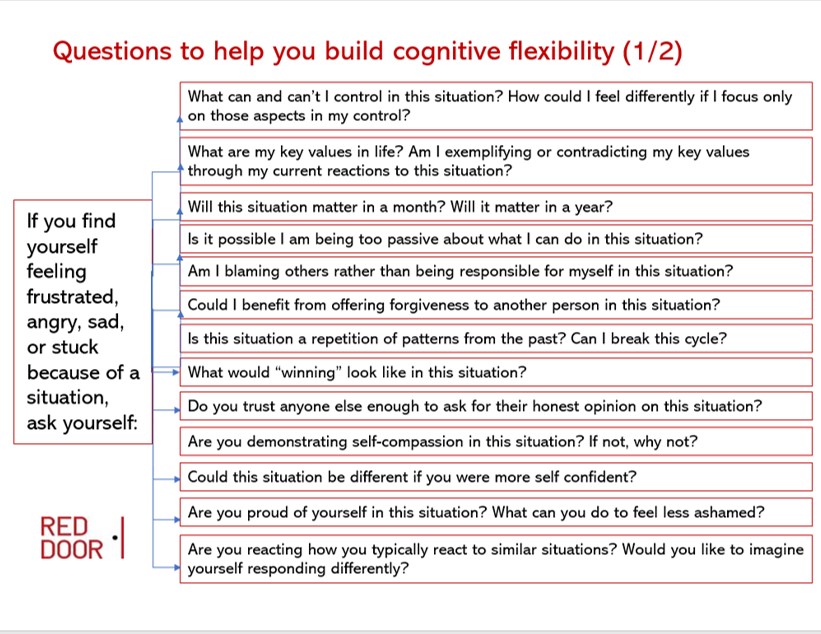
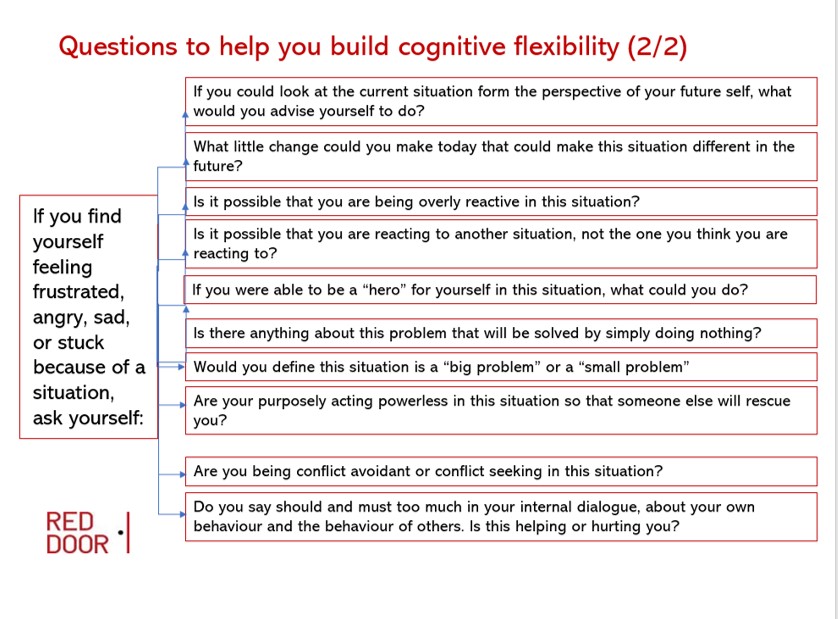
One way is to start to actively practice cognitive flexibiliy exercises. These can be done alone,but are even more effective when discussed with a counsellor. Counsellors are trained to help clients identify thought traps and repetitive patterns, and as such may also be able to help you ask the very different questions you need to ask to change your reactivity to a situation. Some great examples of cognitive flexibility questions are detailed below. 


Using cognitive flexibility exercises, such a using these questions when you are reacting to a situation, can be part of a pathway to change.

About the Author: Angela Watkins is a CBT and narrative therapy counsellor working in Hong Kong with teens and adults. Angela helps her clients work through pain, shame, grief, and being stuck. You can feel differently.

Note: an earlier version of this article first appeared in 2019. This article has been updated and edited since that time. The latest version of this article was edited in April 2025. 

#catastrophising   #commonthinkingerrors  #faultythinking #blackandwhitethinking  #comparison  #blaming  #filtering  #personalising    #mindreading #reddoorcounselling

Don’t cry for me Margarita: Is it time for you to re-evaluate your relationship to alcohol?

Have you ever questioned your relationship with alcohol? Its a common question at this time of year.  Have you ever made rules for yourself in regard to your drinking behaviours. For example do you find you promising yourself ” I’ll only drink wine, nothing stronger” or “I’ll only have 3 drinks max before I go home – no more”? Has anyone close to you asked you about your drinking volume or behaviours? Do you ever wonder if your drinking is getting out of your control? Many of us do. You are not alone. From time to time, it is healthy to reflect on the aspects of your life which are working, and are not. Take a moment to think about if your drinking is making your life better, or is possibly a contributing factor in making your life experience, worse.


When people look at their relationship with alcohol they often consider taking a break. Taking a break is a great idea. I recommend a month rather than a week. If this sounds an overwhelming request, read on.

Perhaps you don’t feel confident to break up, or perhaps you think you really need alcohol in order to be you (ie a co-dependent style relationship). Its actually very common for people to be concerned about their drinking. Catherine Gray, in the book, The unexpected joy of being sober, suggests that that one third of regular drinkers are worried that they drink too much, but only half of those who worry actually do something about their drinking behaviour.

It isn’t your fault if you are confused or even ashamed about your relationship with alcohol. You have been tricked, entangled, and trapped, in that relationship. Advertising and society treat alcohol as a social lubricant when it is more of a social charlatan, suggesting it is the route to a good time, rather than communicating the reality of alcohol as silent poison which destroys more relationships than it creates. The harmful use of alcohol is a global problem as alcohol is a major risk factor in health and social issues such as violence, accidents, child neglect, absenteeism and mental health issues.

If you want to take a break there are a number of options for you to consider – from books, to online resources, to face to face support. There are a number of resources that can help you give up for a week, a month, a year, or longer.

Books

There are a number of books that support breaks from alcohol, of any period. In my opinion the books sharing the experience of the author seem more compelling, and less judgmental than some of the more academic books. I have included both styles of books in the following list. Many of these books are recommended by online support groups. These books can easily be found from online book retailers.

This Naked Mind – Annie Grace 

It is easy to understand why this book is a best-seller. This book explores links links between the unconscious and conscious mind to help create motivation for change. The techniques used help readers explore their relationship to alcohol, so that giving up reminds you that you are embracing regained freedom rather than focusing on what you fear you might be missing out on. I would recommend this as a first book to read if you are considering any kind of break.

The Unexpected Joy of Being Sober – Catherine Gray

Another popular best-seller, the unexpected joy is a well written memoir with extremely practical advice and insights. Gray provides information to help you staying sober for 30 days, and abstinence beyond . There is a great Facebook page attached to this label online.

Glorious Rock Bottom – Bryony Gordon.

Bryony Gordon recounts her lived experience of quitting and recovery from alcohol and cocaine addition. Simply put she describes her journey as, “I stopped drinking because I wanted to start living”. A raw and heartfelt account of her movement into and out of the shame of her addiction. Whilst the truth hurts, it also heals.

Alcohol Lied to Me – Craig Beck 

Craig Beck was a highly functional, “2 bottles of wine a night” drinker. From the outset, he looked like he had his drinking under control, but that wasn’t his reality. Craig Beck has written a treasure trove of quit drinking books and has programmes attached to his model. The process starts with exploring misconceptions that we hold about alcohol.

Nothing Good Can Come from This – Kirsti Coulter 

This memoir of one woman’s journey to sober, provides a sometimes funny, and worrying, commentary on women and their problematic love relationship to alcohol.

Girl Walks Out of a Bar – Lisa Smith

Another recover from alcohol focused memoir, this book explores cases of individuals who have been successful career wise, but struggled in their relationships with alcohol. Lisa Smith provides a real, emotive take on her experience of recovery. One of the most common excuses people use to keep drinkings, is that they are still able to, successfully, hold down a job.

Push off from here – Laura McKowen

This personal account of alcohol recovery is a deep dive into the 9 messages that McKowen need to hear, learn and accept as part of her journey to sobriety. For each of the 9 messages McKowen recounts how she came to assimilate each of the key learnings. This is a helpful book to help you understand that its not your fault, but what you choose to do is your responsibility.

Almost Alcoholic – Robert Doyle & Joseph Nowinski 

A fairly academic book written by clinical psychologists. This book outlines the problematic drinking behaviour which does not reach the level of diagnostic classification, outlining the cost of their drinking and providing practical cessation and limitation guidelines.

Sober Evolution: Evolve into sobriety and recover your alcoholic marriage – Matt Salis

Part lived experience, part advice, Matt Salis details his journey to sobriety and through marriage repair. A loving relationship and alcoholism can not co-exist. This is the reason that there is a 50% divorce rate for alcoholic marriages. Salis does not hold back. His message, for people who have out of control relationships with alcohol you have three choices: quit now; quit later; or drink yourself to death. Salis doesn’t sugar coat the reality of how difficult and shameful it feels to not drink when you associate with your regular drinking friends. Additionally marriage recovery is not automatic – there is still work to do. Salis, though, thinks it is well worth it.

Drinking: A love story – Caroline Knapp.

“I drank when I was happy and I drank when I was anxious and I drank when I was bored and I drank when I was depressed, which was often”.

Caroline Knapp exemplified the phrase “high functioning alcoholic”, until she didn’t. Like many others, her ability to work well delayed her decision to quit. This is another great lived experience book that may motivate you to explore your relationship to alcohol. Knapp, had been able to follow her own rules around drinking, and therefore avoid the consideration that she might have a problem. Through starting to explore her relationship with alcohol she realised that booze had become a great love affair, and like other affairs, it was not actually helping her be the version of herself she wanted to be..

Online support groups

Online groups and platforms provide support and discussion possibilities. Some are free whilst others are paid for. The most popular groups can be found on Facebook and online. The benefit of these groups is that you can maintain some degree of anonymity but still get some support.

One Year No Beer – http://www.oneyearnobeer.com. 
One Year No Beer is a cessation programme that provides paid for support alcohol-free challenge options for one month, 3 month and 1 year programmes. Boasting over 55,000 members and plenty of tales from successful challenge completers, you can sample OYNB content on their Facebook page first to see if this is a good match for you. Many of the OYNB members take on positive health challenges aligned to their break from drinking, with added potential health benefits.

The alcohol experiment – http://www.alcoholexperiment.com

Attached to the Naked Mind platform, this 30 day free program (beyond that there is some cost) provides groups, mentors and advice how to move away from alcohol. Currently there are 35,000 users, and many success stories.

Online and in Person support groups

If you have a more serious issue with alcohol a face-to-face option may be your best choice. You can also discuss these options with your general practitioner. Some defining questions follow this section to help you frame if it is time for you to consider change.

Alcoholics Anonymous http://www.aa-hk.org

With more than 35 meetings a week in Hong Kong, this is the most famous alcohol recovery programme on the planet. This 12 step program includes all the great milestones of change management including support groups, mentoring, personal exploration and no judgement. Some people have reservations about elements of AA, but there is no denying the good that AA tries to do to support people recovering from problems with alcohol.

SMART RECOVERY https://www.smartrecoveryinternational.org/meetings

SMART recovery is an alternative to AA, and doesn’t involve the attachment to higher power which some people find hard about the AA process.

You can connect with Smart Recovery on Facebook and On Instagram.

SMART RECOVERY  is a global community of 3000 support groups in which participants meet weekly to help each other overcome the life challenges caused by any addiction (to drugs, alcohol and behaviours such as gambling). Using SMART (Self-Management and Recovery Training), they find the power within themselves to change and lead fulfilling and balanced lives guided by a science-based and a 4 point programme focused towards building the motivation to change, be able to manage cravings of addiction, managing the thoughts and behaviours attached to addiction and lead a balanced life.

Face-to-face therapy: Counselling – various 

You may start your exploration of your relationship with alcohol in a relationship directly with a counsellor familiar with addiction recovery. Sometimes individual counselling is a nice complement to support groups. Therapeutic alliance, ie how much you feel you fit with your counsellor, is a major factor in the success of your therapy, so shop around to find the right fit for you. RED DOOR offers addiction counselling for alcohol and substance misuse. If you’d like some more questions about the RED DOOR offering feel free to contact reception@reddoor.hk.

How do you know if you have a drinking problem, not just a drinking habit?

The following is NOT a diagnostic test, but includes some of the types of questions that would be used for a formal diagnosis of substance abuse issues. Please answer Yes or No to the following 10 questions.

  1. In the past year have there been times when you have consumed more alcohol, or drank for a longer period, than you had originally intended?
  2.  In the past year, has your drinking interfered with your relationship with friends, family or work colleagues.
  3. In the past year, have you missed work, or key appointments on a few occasions because of alcohol consumption the night before? 
  4. In the past year, have you wanted to cut down your drinking amount or frequency and found yourself unable to do so?
  5. In the past year, have you blacked-out as a consequence from drinking alcohol?
  6. In the past year, have you lost personal items such as your keys, or wallet, whilst you were inebriated?
  7. In the past year, have you missed work, or key appointments on a few occasions because of alcohol consumption the night before?
  8. In the past year, have you noticed that your tolerance to alcohol has increased, and you now need to consume more alcohol in order to feel it’s effects?
  9.  In the past year, have you found yourself in situations where you may have compromised your personal safety, or the safety of others, as a consequence of consuming alcohol
  10. In the past year, have you started to experience some of the symptoms frequently labelled as  alcohol withdrawal, when you are not drinking including shaking, experiencing a racing heart, sweating more than usual, nausea, or trouble sleeping.

Scoring: How many questions did you answer with a “YES” response? If you answered 3 or more with a YES, then I recommend you consider to break-up with the booze, if only for a short period (3 months), and possibly longer. You can break free of the shame of that you can feel when alcohol dominates your life, and decisions, and you want to feel and act differently. You CAN put that shame behind you and live a better life.

About the Author.

Angela Watkins is a counsellor and psychologist working out of RED DOOR Counselling in Hong Kong. Angela has an interest in helping families and individuals with anxiety and depression. Sometimes drug and alcohol consumption is a component of those emotional challenges. You can feel better. Come in and talk to someone about it.

#reddoor #alcohol #alcoholdependence #alcoholrecovery #alcholicsanonymous #thecabin #oneyearnobeer #alcoholexperiment #thenakedmind #theunexpectedjoyofbeingsober #alcoholliedtome #girlwalksoutofabar #smartrecovery #pushingofffromhere #soberevolution #gloriousrockbottom #almostalcoholic #nothinggoodcancomefromthis.

Note about this article. An earlier version of this article first ran in June 2020. This article was updated, including adding more reading recommendations and republished in October 2024.

Get into a group: English language support or therapy groups available in Hong Kong

The Benefits of Group Counselling and Support in Hong Kong

While I love counselling individuals, I acknowledge that group therapy can be a powerful alternative to achieve therapeutic results. Group counselling offers unique benefits—working through challenges collectively can reduce feelings of isolation and shame, provide access to shared resources, and often be more affordable than individual therapy.

Who Leads Group Therapy?
Groups can be led by qualified mental health professionals, such as counsellors or psychologists, or facilitated by individuals with lived experience. When choosing a group, consider the facilitator’s qualifications and experience. Some with lived experience are highly capable of guiding others, especially when they have received appropriate training.

Cost and Accessibility
Group sessions vary in cost—some are free, while others charge a fee. Typically, group therapy is significantly less expensive than individual sessions, making mental health support more accessible.

Effective Group Dynamics
Successful groups are run by competent leaders who establish clear rules regarding privacy and respect, share the group’s goals, and manage members who may disrupt progress—such as those experiencing emotional dysregulation, refusing to participate, or bringing unrelated issues to the group.

Below is a list of current English-language groups in Hong Kong covering various topics. Please note I haven’t personally experienced all of these groups, so this information isn’t an endorsement but a resource guide.


Counselling & Support Groups in Hong Kong

Iron Fairies
A therapeutic support group for
women navigating divorce, run by RED DOOR Counselling. Led by an experienced psychologist and counsellor, it has been active since 2017. The group meets fortnightly at RED DOOR’s Central office, with additional support via a mobile app.
Fee: HKD 300
Contact: WhatsApp 93785428 | Email: angelaw@reddoor.hk

The Care Bridge

The Care Bridge is an online group run by counsellors and counsellors in training from RED DOOR Counselling. The group supports adults as they care for relatives at a distance. It can be stressful and worrying looking after people who you are far apart from. The group meets via zoom. Attendance at the group is free.

Contact: WhatsApp 93785428 | Email: angelaw@reddoor.hk

Talk Hong Kong
Offers support groups for survivors of sexual abuse and assault, for both men and women. Facilitated by peer leaders with lived experience, these monthly groups aim to build coping skills, understand personal trauma, and establish healthy boundaries.
More info: https://www.talkhongkong.org/

St. John’s Counselling (Young Adults)
A peer-support group for young adults facing mental health challenges, facilitated by counsellors. Suitable for those seeking an alternative to face-to-face individual counselling, with weekly meetings held at St. John’s office.
Contact: 2525 7207 | Email: kimberly.ho@sjcc.hk

Special Needs Network Hong Kong
A longstanding support group for parents of children with disabilities, providing education, support, and community connection. Open for over 20 years, it meets monthly—ideal for parents of children with special educational needs.
Website: https://www.snnhk.org/

Alcoholics Anonymous (AA)
A global organization focused on overcoming alcohol addiction through the 12-step program. Meetings are held weekly both in person and online. AA’s approach may not suit everyone, but it remains one of the most effective programs available.
More info: https://www.aa-hk.org/

SMART Recovery
An alternative to AA that does not involve spirituality. It employs a science-based, four-point program empowering individuals to manage cravings, change thoughts and behaviors, and lead balanced lives. Meetings are weekly, available both face-to-face and online.
Instagram/Facebook: @smartrecoveryhk | Website: https://smartrecovery.org/

OCD and Anxiety Support
Monthly group therapy for individuals experiencing severe anxiety, led by qualified counsellors. A donation is requested, with discounted counselling options available. For OCD.
More info: https://www.ocdanxietyhk.org/

The New Normal
A charity offering monthly mental health support groups on topics like grief, cancer, and unemployment. Led mainly by trained volunteers, these sessions are usually free.
Website: https://www.thenewnormalcharityhk.org/


Final Thoughts

Trying a support group can be highly beneficial—you may find it complements individual therapy or serves as an effective standalone approach. If a group isn’t suitable or available, individual counselling remains a valuable option.

About the Author
Angela Watkins is a private practice counsellor and psychologist based at RED DOOR Counselling Hong Kong. She supports adults through divorce, anxiety, depression, substance misuse, abuse, and career transitions. Angela also leads the Iron Fairies group for women navigating divorce.

Note: If you operate an English-language mental health support group and would like your information

#grouptherapy

#divorcerecovery

#parentingspecialneeds

#alcoholicsanoymous

#smartrecovery

Understanding school refusal

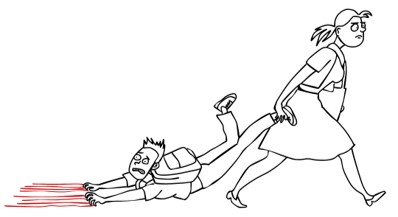
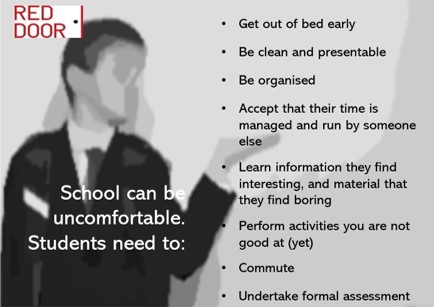
Probably every parent has encountered a morning when their child refuses to go to school. We try to convince our child to get their acts together, and get ready for school. Sometimes it works, sometimes it doesn’t. This is usually very stressful for parents. Now, imagine this happens every day.

What is school refusal?

School refusal is made up of a persistent pattern when a child is reluctant to attend school and remains at home and the parents know about this absenteeism. In most cases the child has had an episode which accompanies their refusal – including expressed fearfulness, throwing temper tantrums, or presenting with somatic illnesses, which possibly disappear when they are allowed to stay at home.  Most parents have usually attempted to secure the child’s attendance at school and are not, initially at least, supportive of school absence (Heyne et al, 2013).

From an academic research perspective, school refusal requires a pattern of absence, adding up to above or near 10% of school days (Havik & Ingul, 2021).  It is different from time missed from school due to truancy. Truancy involves absence without the parents awareness or consent (Heyne et al, 2013).

Before the COVID pandemic, school refusal occurred at a rate of 1 in 25 kids. It is suspected that since the since pandemic there has been increased absences in schools and growth of the number of children missing more than 10% of school days (Havik & Ingul, 2021).

School refusal poses a serious threat to a young person’s development because it affects their learning and achievement, places the youth at higher risk of dropping out of school completely, it places the youth at risk of becoming socially withdrawn, and can place the young person at greater risk of later mental health issues and/or developing other anti-social style behaviours (Henye et al, 2013; Havik & Ingul, 2021). So its not just a missed learning issue.

And as any parent will tell you, it is not just the child that is affected. School refusal can be a source of family stress and conflict (Henye et al, 2013).

Why does school refusal occur?

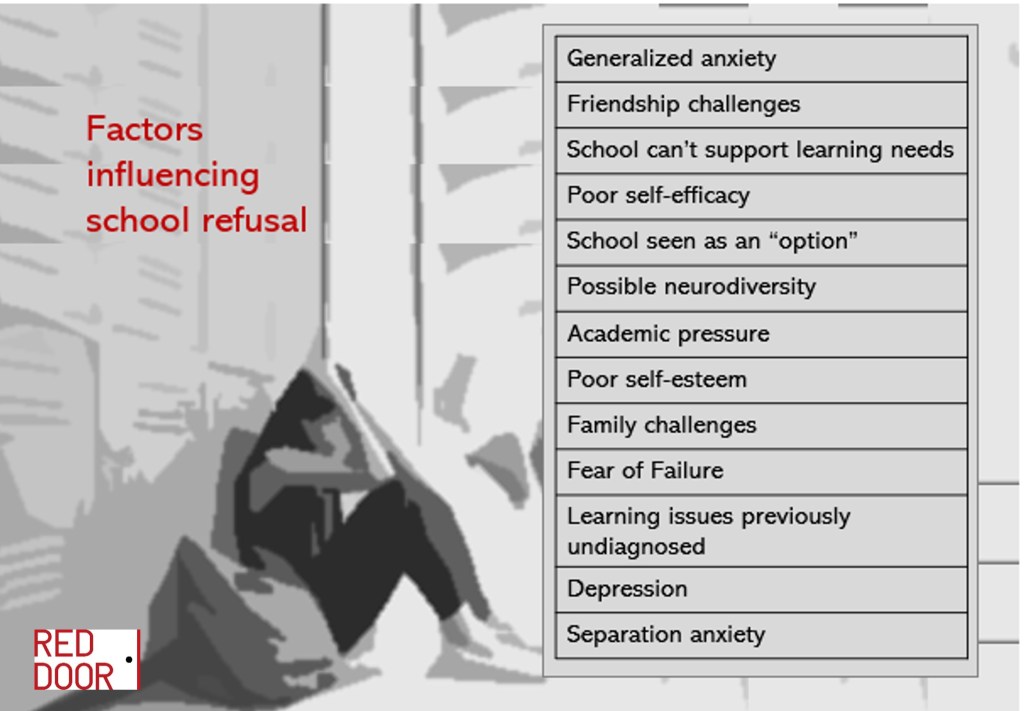
Looking at the academic research about school refusal we can identify the features about the refusing child, their family home, the school and the greater environment that may drive this behaviour.

About school refusers

School refusal occurs when stress within the individual exceeds support, when the risks to self are greater than resilience, and the factors that promote non attendance outweigh the factors that encourage attendance (Havik & Ingul, 2021).

Individuals refusing to go to school may have heightened fear of failure, low self-efficacy, and physical illness (Maynard et al, 2018).

Children’s anxiety is often a factor in their absence from school (Totsika et al, 2024). Anxiety disorders are present in about 50% of clinic referred youth exhibiting school refusal (Maynard et al, 2018). School refusal might be about avoiding school because it provokes such negative feelings such anxiety, depression, and distress (Havik & Ingul, 2021). For younger children the presence of separation anxiety may be a key component in their refusal to attend school (Roué et al, 2021). The correlation of mental health factors such a anxiety and depression may be a precursor or a maintainer of the refusal behaviours. Because of the mental health aspects, and the complication of understanding what is motivating a situations, versus what is maintaining a situation, professional help from a psychologist or experienced counsellor is paramount to support children displaying school refusal.

There is also the possibility that some of these emotional experiences are actually indications of underlying learning issues finally being brought into the light of day. Many children with learning issues find it possible to fake some form of learning progress, until the content that they are learning becomes too complicated for their compensation style behaviours or skills to fake learning any more.

Children who are neurodiverse – including those with dyslexia, dyscalculia, dysgraphia, ADHD, ADD, and autism – have a particular vulnerability to school refusal. It is suspected that in addition to internal anxiety and fears over failure, that school refusal may be due to a mismatch between the child’s needs and the schools ability to accommodate with appropriate learning adaptions (Totsika et al, 2024). Additionally, neurodiverse children may be more at risk of social exclusion at school, a school factor which drives school refusal (Totsika et al, 2024).

Age is an individual factor determining the severity of school refusal. Adolescents may see return to school to be solely determined by them rather than collaboratively with parents (Heyne et al, 2013) Teenagers are also more likely to be more physically capable of resisting parental efforts to return them to school. Therefor older children tend to present with more complicated cases of school refusal to treat, and cases with younger children are often easier to treat successfully (Heyne et al, 2013).

It is important to also consider what is happening after school has been avoided. School refusal might be about avoiding school in order to pursue another tangible reinforcements outside of school. For example children may be refusing to go to school in order to stay in bed, talk to friends outside of school (in different time zones), and to engage in gaming (Havik & Ingul, 2021).

What might be happening at home

School refusal might be about avoiding school to gain attention from others, particularly parents. Havik and Ingul (2021) suggest this might be the root of use of somatic illness as a method to refuse attendance at school. Other researchers highlight that family factors such as divorce of parents, individual parents mental health challenges, general family dysfunction and parents feeling overprotective of their children may be components of a child’s desire to refuse school attendance (Maynard et al, 2018).

This highlight the needs of professionals, and the school, to understand the home environment when attempting to build a school attendance plan to overcome lost learning as a consequence of school refusal (Roué et al, 2021).

School factors

The school itself may be a part of the school refusal puzzle. School factors include bullying, the structure of the school, and the level of schooling (Maynard et al, 2018).

The older the child, and the age of children in the school, the more complicated school refusal treatment can become:

“Socially and academically, the secondary school environment is more demanding than the primary school environment. This together with increasing importance of academic performance, peer influences, and identity formation during adolescence, can make it more difficult for school-refusing adolescent to overcome school refusal, relative to a school-refusing child”.( Henye et al, 2013)

School refusal might be about avoiding school to avoiding evaluation situations (Havik & Ingul, 2021) . Very academically aggressive curriculum may be more pressure than some children can bear. Additionally, schools may not be designed to meet the holistic needs, or learning needs of all of their members (Havik and Ingul, 2021).

The social world at school is also a challenge. Schools have a lot of difficulties managing bullying and exclusion and compromised relationships between children/ teens can be a factor in school refusal (Havik &Ingul, 2021; Henvik et al, 2015). Many teenagers in Hong Kong experience exclusion, and want to miss school as a reaction to their social difficulties at school.

In the wider environment

Societal pressure towards academic pressure may be a component in school refusal (Maynard et al, 2018). Pressure to perform well at school is common in Hong Kong, and is a factor in school engagement, and many other mental health challenges (Chyu & Chen, 2022).

During the COVID pandemic many individuals worked from, or studied from home. As with work, it it seems like the relationship with school became optional. This is not just affecting children, teachers also seem to feel this way (Havik & Ingul, 2021).

How do counsellors treat school refusal?

School refusal requires treatment, not just a plan, because of all the intricate forces that create the behaviour and perpetuate it, including ongoing mental health challenges. (Maynard et al, 2018). One element I want to highlight to parents is that school refusal treatment usually requires an evolving plan needs to involve the child, the parents and the school, and may take several weeks to implement successfully.

Counselling is recommended for school refusers. Family therapy is promising to help resolve school refusal (Roué et al, 2021).  Cognitive behaviour therapy (CBT) styled treatments are usually recommended (Heyne et al, 2013).

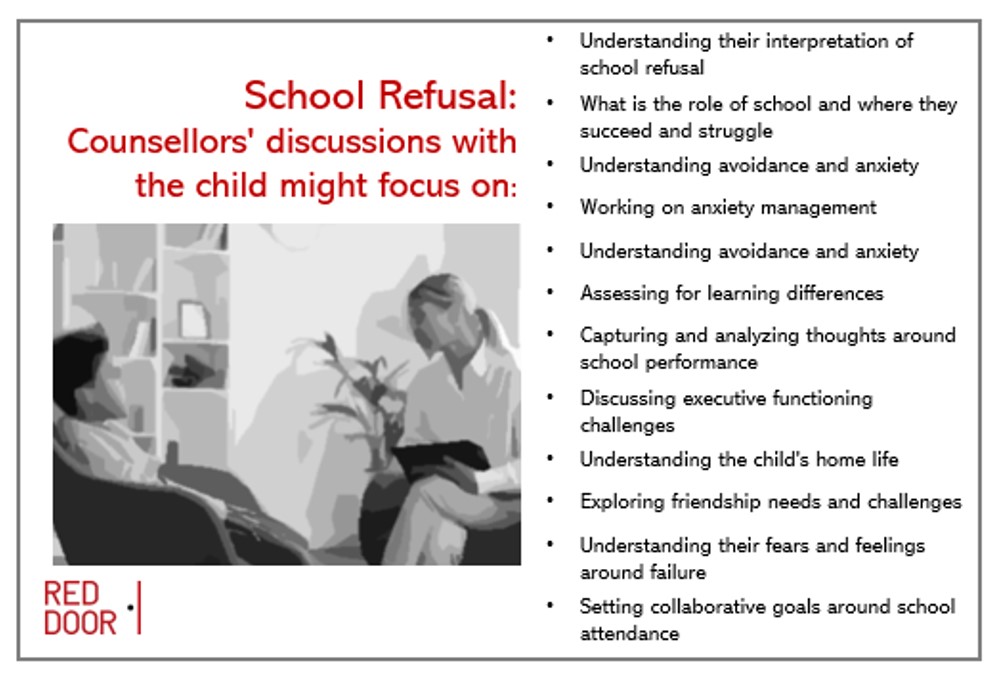
A plan around sessions and discussion by a counsellor with a child or teen who has been refusing to attend school might include the following:

Similar discussions need to take place with parents.

School refusal has a major impact on families, and may stretch a parents’ vulnerability. Additionally, the degree of commitment of school personnel toward children with school refusal largely depends on their parents’ attitudes (Roué et al, 2021). Programmes need to have sessions including parents or family therapy sessions so that all concerns, barriers, learning and scheduling accommodations to discuss with the school, and the goals can be agreed. Family or parenting sessions could cover understanding the reasons and impact of school refusal, developmental expectations of the child, understanding what reinforces school refusal in the home setting (Maintenance), helping build new communication tools within the family, Helping parents build new responses to school refusal signals and behaviours and improving overall family dynamics (Heyne et al, 2013; Roué et al, 2021).

Counsellors may also work with the school, and family, to help explore the school’s ability to coordinate and organise around the requirements of the child at school including flexible scheduling, looking at means to overcome lost learning, help build in structures to support for anxiety, and build strategies around social difficulties the child may have been experiencing (Heyne et al, 2013). Unfortunately schools are organisations with limitations and sometimes accommodations can not be made, but many do as much as they can. In the end, sometimes a change of school may be required.

Special consideration for parents of school refusers in Hong Kong

In Hong Kong the typical school calendar is 190 days, so if thresholds to consider school refusal a problem is are usually around 10% of school days on offer, 19 days of missed school would be considered indicative of a school refusal problem.

Every day you encounter a school refusal issue, you might like to put the school refusal behaviour in context to this overall threshold. It isn’t just one day. Ask yourself, “If my child had to repeat a whole year if they miss 10% of the days, would you allow your child to stay at home?”

Remind yourself, and your child, what makes school worth attending and considering. Listen to your child, and see if you can summarize their arguments back to them. Remember, they might not want to tell you the whole story that they are struggling with learning of friends. Try to get to the bottom of what is going on, and consider professional help, such as a counsellor, to achieve this.

Please appreciate, some aspects of the school experience are uncomfortable. Think about what you want your child to become use to, rather than avoid, in the list of elements about school that can be difficult for them. Ask yourself you are able and willing to help your child navigate what they find uncomfortable.

Are you willing to make your child’s requests to stay home uncomfortable in different ways? Ask yourself are you willing to remove any excuses for them to stay home? For example, unless they are sick, the child can’t stay in bed all day. Would you be willing to remove their access to devices so that gaming to talking to friends online is not an option? Can you sit with your child whilst they do their schoolwork at home?

Schools in Hong Kong, do try, but probably need to do more, about bulling and exclusion. There is an attitude, especially among teenagers that they should be able to navigate these delicate social troubles on their own, without adult intervention, and we may need to assess if this is wise.

For neurodiverse kids school life may include exclusion and and bullying. This is not okay, but is quite common unfortunately. What supports exist at the school help your child navigate social situations? Some of these resources may be outside of school. For example, Red Door hosts a social social skills programmes on Saturday mornings, and many of our students consider that group of individuals their safe group of friends, rather than relying on school for close friendships.

Schools may find supporting your learning differences too difficult. Explore what they can and can’t do. Perhaps school may not be perfect, but it may be good enough for some of the time. Also consider what external supports could help to lighten the expectation on the school? This would also require schools to be more flexible on their attendance parameters. You may want to think changing school, but not before you have secured another spot for your child. Learning support spots at schools in Hong Kong are highly sought after, and limited.

One last note, treating school refusal can take time. Parents naturally want quick results, but this doesn’t happen immediately. I highly encourage you to seek the imput of an experienced counsellor or psychologist to help. I hope this article helps you better understand some of the nuances of refusing to go to school

About the author. Angela Watkins is a psychologist and counsellor working our of RED DOOR Counseling in Hong Kong. Angela works with children and families on a range of issues, including school refusal. To contact Angela email angelaw@reddoor.hk

References to this article.

Chyu, E.P.Y; and Chen, J-K; (2022) Associations Between Academic Stress, Mental Distress, Academic Self-Disclosure to Parents and School Engagement in Hong Kong. Front. Psychiatry, 14 July 2022

Havik, T; Bru, E; and Ertevåg, SK (2015) School factors associated with school refusal and truancy – related reasons for school non-attendance. Soc Psychol. Edu. Vol 18:221-240

Havik, T; & Ingul, J. M. (2021) How to understand school refusal. Frontiers in Education.

Heyne, D; Sauter, F.M.; Ollendick, T.H. Van Widenfelt, B. M.; and Westenberg, P. M. (2013) Developmentally sensitive cognitive behavioural therapy for adolescent school refusal: Rationale and case illustration. Clinical Child Family Psychology Review.

Maynard, B. R.; Heyne, D; Brende, K. E; Bylanda, J. J; Thompson, A. M; Pigott, T. D. (2018) Treatment for school refusal among children and adolescents: A systematic review and meta-analysis. Research on Social Work Practice. Vol 28(1).

Roué, A; Harf, A; Benioit, L; Sibenoni, J, and Moro, MR. (2021). Multifamily Therapy for Adolescents With School Refusal: Perspectives of the Adolescents and Their Parents. Frontiers in Psychology. June 2021.

Totsika, V; Kouroupa, A; Timmerman, A; Allard, A; Gray, K.M; Hastings, R.P; Heyne, D; Melvin, G.A; and Tonge, B. (2024) School attendance problems among children with neurodevelopmental conditions one year following the start of the Covid19 Pandemic. Journal of Autism and Developmental Disorders; Vol 54, 2998 -3007.