Be the best parent you can be after divorce – the importance of collaborative co-parenting

collaboriave coparenting image...The question is never if divorce will have an impact on your children, but rather if this impact will be minimal or significant.

Children can adjust to divorce with help.  An important element that determines if there will be long term negative consequences on your child will be your ability to which you can  collaboratively co-parent with your ex-partner. Afterall your marriage may have ended, but your love for your child continues.

Collaborative co-parenting is a practice where parents agree to parent in a discussed, organised and agreed manner, in order to minimise the negative impact of divorce on their child. This is possible even if they hold differing views on how to raise a child.

For families of divorce, children often become innocent victims of the tension and resentment between the parents. Collaborative co-parenting can change that situation by providing parents with constructive tools to use in building positive child custody and visitation plans.

The collaborative co-parenting approach means finding a way to work with your co-parent with dignity and respect. What was once a personal relationship changes and becomes more like a business relationship wherein both parties, necessarily,  set aside personal feelings for the benefit of the children. Collaborative co-parents learn to develop strategies for conflict management and to establish a stable routine for the children via a collaborative child custody and visitation parenting plan.

The backbone of collaborative co-parenting arrangements can be discussed with specialist counsellor or divorce mediators. When I work with divorced couples, I remind them that the collaborative co-parenting process focuses and assesses each parent around the best parent that they can be, rather than on hurting or scoring points against your ex-partner.

It is important to note that a collaborative co-parenting agreement is not legally enforceable but should be signed with honest intent as if it is a legal contract. Copies of the agreement can be held by each parent, and shared with relevant family members, including older children if this is done in a supportive manner.

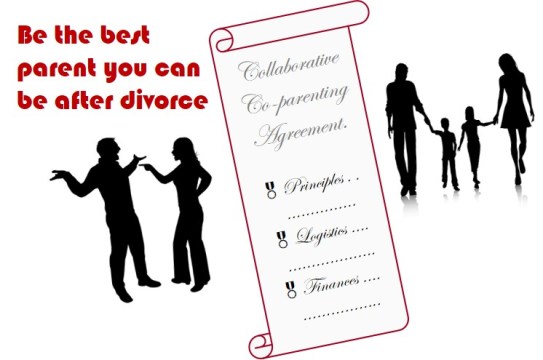
collaborative coparenting agreeentA Collaborative Co-parenting process includes three main topics of discussion.

The first, and most importantly, is to agree on certain principles that parents are willing to adhere to. These principles provide a framework of you promising to be the parent your child needs you to be.

The second discussion focuses on setting up the logistics – such as how living arrangements are split, holidays agreed, ECAs discussed and decided.

The third section is often the most contentious, is about how finances will be allocated in order to support the child.

The arrangements are summarised into a collaborative co-parenting agreement to be signed by both parents.

The logistics and the finances need to be discussed within a framework that protects each parent, whilst stretching them to turn up as the best parents they can be. If you are struggling getting to an agreement, get help.

What I can easily share are some of the principles that I ask parents to consider when setting the framework of decisions. Ask yourself where you stand on the following topics – would you agree? If not, why not?

I agree to:

  • Hold my children’s needs above my own territorial needs or desire for independence.
  • I will take the adjustment required by divorce to rise to the occasion and be the best parent I can be to my children.
  • My child’s emotional well-being and self-esteem are paramount and I will act in a manner that best supports my children.
  • I will not over promise time, money, or effort in support of my child, and then under deliver on these promises.
  • I will not use my child as confident, messenger, bill collector or a spy with my co-parent
  • I will not withhold my child from their other parent. I understand that my child is entitled to have a positive relationship with both of their parents.
  • I will abide by the rules of fair and practical time sharing and will make a serious effort to honour this agreement.
  • I will communicate necessary changes in the schedule of child care with my co parent in advance. Any changes in the schedule will always be discussed with the other parent prior to informing the children.
  • We agree to respect the other’s parenting style and discuss any concerns at agreed upon communication meetings.
  • I promise not to only do fun things with our child, leaving hygiene, homework and day to day care explicitly to the other parent
  • We agree to make arrangements which can be understood by our child and are sustainable.
  • We agree to clearly communicate to our children our respect for their other parent.
  • We will keep our child physically safe when they are in my care.
  • We agree to reinforce to our children that time with their other parent is important.
  • I will be mindful of my child’s need for a stable diet and sleep and not return them to their other parent over tired, unclean or poorly nourished.
  • We agree to work on our problems as individuals privately and not in front of the children. We agree to allocate an agreed designated communication time, and involve professionals in this discussion if we can not reach and agreement on our own.
  • We will agree to communicate to our children that no new romantic partners will be introduced to them in meetings that have not been agreed by the other co parent.
  • We agree to speak or write derogatory remarks about the other parent to the child.
  • When we are with our child, we will be focused on spending quality time with that child, and not primarily engaged in another activity (drinking with friends, attending meetings) as agreed.
  • We agree that the child can display photos of both parents in their bedroom.
  • We agree to collaboratively set behavioural guidelines of expectations of our children in front of step parents, relatives, etc.
  • We agree that we will not consume alcohol at all/ become intoxicated in front of the children. Drug consumption at any time, prior to or during child care time is not tolerated within this agreement.
  • We agree to only leave our children with agreed third party caregivers and with the other parent’s agreement.
  • We agree to both collaborate in our child’s school meetings.
  • I agree to honour our arrangements about financial support of children and will not withhold this support from the co-parent.

These principles are designed around best parenting practices. Are you ready to be the best parent you can be, as you divorce?

Remember one day your child will be an adult, and will probably tell their romantic partner about your divorce from their perspective. Imagine the script you want them to detail. For example,

“I know my Mum was hurt by the divorce, but I was always so impressed that she always attended my personal events – school shows, birthday parties – with my father, so that I felt that I was the priority.

” I wasn’t happy when my parents told me that their relationship was over, but my Dad always helped me buy presents for my Mum for her birthday and Mother’s day, he didn’t just stop caring for her as my parent, when their romantic relationship was over”.

How will you behave? What story will your child say about you in a few years time? Even more reason to be the best parent you can be.

About the author  of this blog. Angela Watkins is a counsellor working with couples – individually and together –  helping them build safe, supportive parenting practices and respectful relationships as they work through challenges including marital split.

#parenting

#divorceandparenting

#collaborativecoparenting

#childrenanddivorce

Note: an earlier version of this article was previously published in July 2020. This article has been significantly updated since that time. The latest version of this article is from September 2024.

Good at being single.

I often think about single hood. It seems that society fluctuates between positioning singledom as a piteous position, to selling it as an almost toxic positive psychological mountaintop, which feels as fake as the piteous position feels wrong.

Antonyms for single include “unpartnered” and “unpaired”, and even “on the shelf”. In a world full of movies, love songs, and novels which telegraph that our goal in life should be to find “the one” to be with as the ultimate accomplishment, it is no surprise that we are often not very good at the alternative.

Because of these modern myths, some people choose to stay in relationships for the wrong reasons, and one of those reasons is fear of being single, like it is something bad. They choose this path in response to the negative rep being single seems to hold. I’ve even heard teenagers gossip with each other saying, “Its no surprise she hasn’t got a boyfriend” in a manner than connotes the superiority of relationshiped over single. It’s almost as if being single implies that there is something “wrong” with you. Surely, time spent by yourself, uncoupled and working towards your goals and individual identity is as, if not more, important than being in a relationshiop? Therefore I want to challenge the harmful stereotypes of being single. Don’t just be single, be GOOD at being single.

Being single and independent could be the most valuable time of your life. Not just when you are a young adult, but also later in your life, when you find yourself “uncoupled”. People can find themselves suddenly single in midlife. It may not have been your intention to be single again, and that can feel unfair. We can hold onto that sense of unfairness, but it doesn’t help us. Being single is the time we learn who we are, and can be a great time for personal growth.

If you are single, I want you to be good at being single.

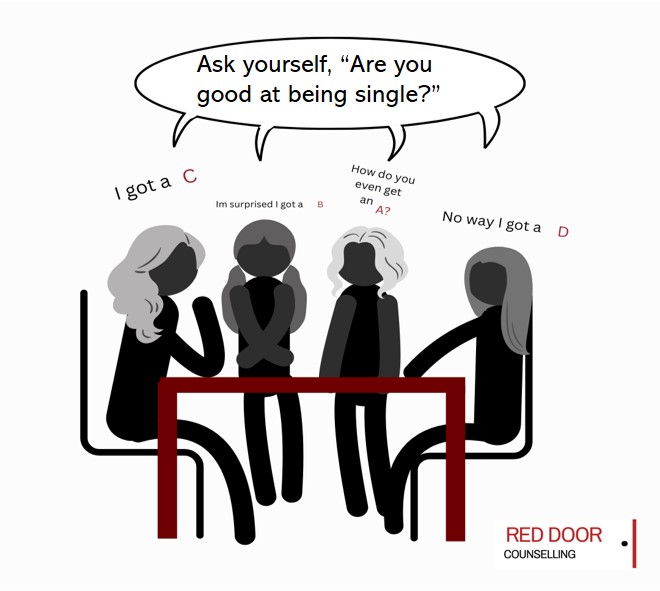
Are you good at being single?

I want to challenge you to give yourself a grade for how good you are at being single. Let’s use the old fashioned grading system, moving from A plus to D minus. For the sake of this exercise lets say a C is the basic pass. C minus is actually a close fail. What grade do you give yourself?

Take this discussion up with friends. Discuss the grades you give yourselves. Do you agree with the grades your friends give themselves? Do they agree with the grade you gave yourself?

Think about the criteria that you used to calculate your grade.

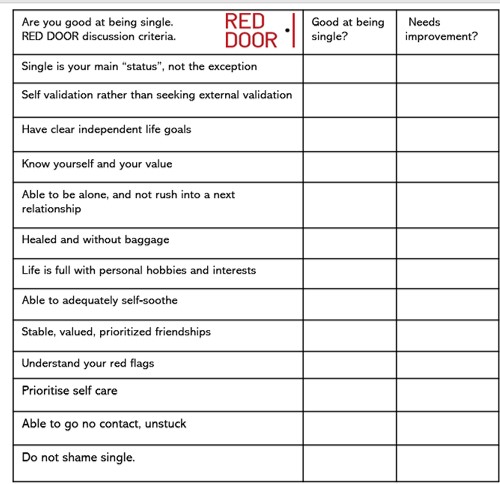
I’ve been toying with what makes people good at being single for a while. I work with teens, young adults and divorced women in my practice, and I have up with the following criteria that I think you could consider.

Criteria you might use to assess if you are “Good at being Single”?

Understand Single as a destination, not a pit stop

Ask yourself, are you single more than you are in relationships, or mostly in relationships. Being single is not only a status update between relationships, it can be a time of significant self investment. Single is not just a status you survive until you are in your next relationship, it is a destination on its own, with dedicated goals. If you have hardly ever been single for more than a short period of time, you are probably not good at being single.

Understand your sources of validation

When you are good at being single you will work to provide validating messages for yourself, rather than seek validation from external sources, particularly a romantic partner. Self-compassion and self-validation are essential to be an independent, complete and competent adults.

Its time to learn to accept yourself – imperfection is actually great. Consider if you fixate on being perfect. People who are perfectionists often compare themselves to others – which often leads to feelings of inferiority and reinforce external sources of validation over internal sources of validation.

If you have trouble with this criteria, talking to a counsellor may be of help to acquire this skill.

Have direction in your life

Being good at being single means that you have a personal career plan and hold yourself responsible to achieving those goals on your own.

The contrast, not being good at this aspect of being single, means that you are possibly rotating around another persons plan for your plan for the future. A man is not the plan. Even if you are likely to be a trailing spouse, you need to have a life and plan of your own.

If you don’t have your own goals in life this is a topic you can take up with a counsellor or career coach. Setting your own goals is liberating.

Know your self – Know your value

If you are good at being single you will have spent, and be spending, significant time knowing who you are, what you stand for, and what are your values. Being single is a time when you are focused on growth and understanding yourself.

If you are not so good at being single you may not know who you are, what you stand for, when you aren’t in a couple. This could mean that you are co-dependent.

Able to be alone

Being alone is not the same as being lonely. I have a woman, lets call her Mary, in our divorce support group who summed this up beautifully:

“I was scared to leave my marriage because I feared being alone. What I didn’t realise was that I was desperately lonely in my relationship. Everyone assumed I was okay because I was with my partner. To be honest, when I left my marriage I was alone, but significantly less lonely.”

Can you be without a romantic relationship for a significant period of time? Some people seem to jump from one relationship to another. There is a mass of commentary on what is a suitable time between relationships. Here are some general guidelines that might help.

  • You actually END one relationship before you have started your next relationship.
  • If your relationship lasted 3-6 months you could take at least 3 months before you consider another relationship. Remember being single should be the main status, not a temporary status.
  • If your relationship lasted 6 months to 18 months, consider a break of at least 5 months.
  • If your relationship is 2 to 5 years take at least 6 months to spend on yourself.
  • Between 6-10 years – take a year.
  • Over 10 years take at a month for every year.

Manage the baggage, own your healing

A primary goal of being single is planned self development. One aspect of this is understanding yourself in relationships. Do you know what hurt are left from your relationship? Have you actively engaged in healing those pains and learning whatever lessons need to be and lessons that need to learnt. Have you taken responsibility for your role in the successes and failures in that relationship?

Those who are not good at being single avoid this hard recovery work. You could simply blame your ex-partner for all the problems in the relationship. You may avoid healing yourself and auditing the relationship appropriately, and therefore repeat patterns in relationships or carry your baggage forward into future relationships. Healing is hard work, but its good work.

Full life versus life, “on hold

People who are good at being single have a full rich life including having hobbies, goals, and activities that are not completely dependent on other people’s participation or acceptance.

Individuals who are not good at being single, may only take up new hobbies when they are between relationships or have hobbies that are performed only with their partner. These might even be the hobbies of their partner, that they have taken on, instead of choosing hobbies for themselves.

Able to self-soothe

Being able to soothe yourself rather than depend on your partner as your “rock” is a healthy behaviour. Self-soothing techniques used by good at single individuals may include writing letters (that you do not send), journalling, talking to friends, self talk, or engaging in therapy.

If you are not good at being single you might continue to use your romantic partner as your soothing source, even when that relationships is over.

Friendships are a stable priority

Single does not mean unsupported. Successful single people have solid friendships that remain a priority regardless if you travel, if you are dating, or if you take on a significant personal or work project. You don’t need to see your friends every day, but they know they can rely on you to turn up every week or month, as you say you will.

People who are not good at being single use their friends as entertainment or a buffer between relationships. When this person finds a new love interest, their friends are about to be ghosted.

Red Flag assessment

Those individuals who are good at being single understand that they may have ignored red flags in their relationships in the past, so seek advice, from friends and, even therapists, about the flags that you may routinely miss or ignore.

For example, selecting to pursue unavailable partners IS a red flag that you choose to ignore. Rewriting the narrative around episodes of being treated badly by partners may have been a red flag that you have chosen to ignore. This ignoring of warning signs is almost like you have been gaslighting yourself to stay in situations that may not be in your best interests. For example, I’ve heard the clients say “I know that he slept with another girl, but it wasn’t his fault. That girl made it happen“. Whilst relationships can recover from infidelity, blaming third parties is not a healthy repair and doesn’t immunise your relationship from future trysts.

How can you see the red flags you previously ignored?

Mostly your good friends know what you have ignored or rewritten in relationships in the past, and may have even tried to tell you that this could change. But you also dismissed them because, quite simply you didn’t want to listen.

When you are good at being single, you will seek your friends thoughts on past and potential partners, and, even more importantly, listen to, rather than rebuff, their observations. Of course they can be wrong. But maybe, so can you.

Or you can ignore the red flags, and continue to go to the circus.

Prioritise regular self care

Successful at single people look after their health consistently. How you look and feel is a priority to you and you will engage in regular self-care activities.

People who are not good at being single hit the gym only to find a new partner, or create their “revenge body” now that they are single. When they are in relationships they may even prioritise care for their partner over fulfilling their own self-care needs. You need to show love and commitment to your care regardless of your relationship status.

Leave the past in the past – becoming unstuck.

In order to move on, and to be whole in your single hood, you must first let you of your past relationships. Ideally you have gone “no contact” with your ex. This is the only way to really put your past behind you. Some situations are particularly challenging to let go of your past relationships. Some situations, such a divorce with a co-parenting partner, make no contact difficult or impossible. However, you need to try to minimise contact even in those situations. The great break up book, “Getting past your break-up” by Susan Elliot helps identify some of the ways individuals choose to stay entangled with their ex.

Methods you might have used to minimise contact. Ask yourself honestly if you are maintaining a relationship with an ex. Audit how often you contact them or respond to their messages. Be honest. Is all that contact needed?

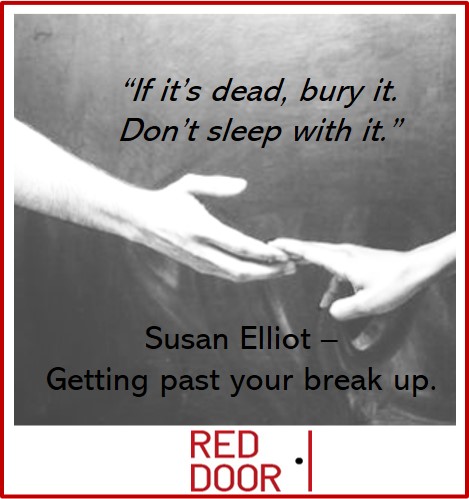
Susan Elliot (2009) details 7 common excuses that individuals use to keep in contact with their ex- partner. I’ve added some personal thoughts on what you might like to do if your are using these excuses:

  1. Wanting to be friends: When a relationship ends each individual needs to do the work to lose their couple identity. Just because your ex wants to be friends doesn’t mean that you should. If you even contemplate a friendship, go no contact for a few months and then review this from a perspective of a healed person, rather than a hurt one.
  2. Seeking closure: Obviously when relationships end we need to grieve. Sometimes people believe that they need answers to questions in order to move on. This is unrealistic. You don’t really need the answers. Additionally, you may never really get an answer, you may just get excuses or lies. You don’t need closure. The only way through grief, is to grieve.
  3. One more thing to say or do: You may just need to ask x, or explain y, before you let go. No, you don’t. Often a person’s behaviour has communicated all that needed to be said, but you’d rather hear a script that keeps you engaged or attached to that ex-partner. If your ex-partner routinely let you down then their behaviour said it all – they can’t or won’t be a regular source of support for you. If they suddenly started seeing someone else, you don’t need to know what was wrong with your relationship. You were not their priority, or they didn’t want to be monogamous. You don’t need to know, “what you did wrong”. Their behaviour indicates their choices. They do not need to explain themselves, their behaviour has already done this. That IS who they are. It is quite likely that you need to work on developing self-compassion and learn to self-validate so that you can self-soothe better in this situation. This does not require attachment to your ex-partner.
  4. Reconciliation is a possibility: Staying attached to someone in the hope that your relationship could be rekindled is choosing to engage in a form of self-torture. Sometimes ex-partners say that reconciliation is possible as a means to maintain your engagement with them. They may still want the benefit of the support that you have provided to them in the past, but do not want to have reciprocal responsibility. A break should be a break. If someone wants to get you back, let them experience the full loss of the relationship for a few months. During this time do the work to help yourself recover including grieving the relationship and being good at being single.
  5. Returning stuff: Return stuff is your ex wants stuff desperately. If they don’t, then throw the stuff away. If you really want something back, as, but also understand that you might not get it back. Stuff is stuff. It is not love.
  6. Lusting: Continuing a physical relationship when you end an emotional relationship is confusing, and probably harmful to your mental health. Susan Elliot writes, “If it’s dead, bury it. Don’t sleep with it.”
  7. We run in the same circles: Maybe you are at the same school, are co-parenting children together, have attached careers, or have shared friends. This can make complete no-contact difficult. You can still work to minimise contact. Negotiate to split up resources – don’t go to the same club on the same day, don’t have chats that are not focused on the children or a shared project, and don’t triangulate friends into the dissection of your relationship. Keep your lives as separate as possible.

Shaming single

We must all work towards the mythology and stereotypes around shaming singlehood. Being in a relationship is NOT superior to being single. Catch yourself, and others, implying that being single is wrong, or that something is wrong with women who are single.

Having worked in the area of counselling individuals going through divorce for over 8 years, I am well aware of how much others like to gossip when marriages break up. Stop yourself, and others doing this. It only maintains the wrongful belief that divorce is a shameful condition.

A special word for those who are, “Suddenly Single”

When people have been married for a long time, being single again is a major adjustment. From my experience people often have poor sense of self, compromised self-concept. Be compassionate with yourself – it will take you a while to “find yourself” again. Do the work. Grieve the relationship. Find some great sources of support. Counselling can help. If you are in Hong Kong, join the Iron Fairies support group for women going through divorce. You are not alone.

Where to from here?

How did you do once you looked through our criteria of what it takes to be Good at being single?
What can you do now to make yourself a complete person without a relationship. You can still enjoy being in a relationship, but be so because you choose to, not because you are afraid of being single. Any belief that single is less, or wrong, stops now.

About the author:

Angela Watkins is a counsellor and psychologist working with adults and teens in Hong Kong. Angela is a couples counsellor and counsellor for individuals. Angela runs the Iron Fairies – a therapeutic support group for women going through divorce in Hong Kong. For a session with Angela or to find our more about relationship work, contact Angela at AngelaW@reddoor.hk

#single #singlehood #breakup #divorce #split #independence #love #selfcompassion #brokenheart

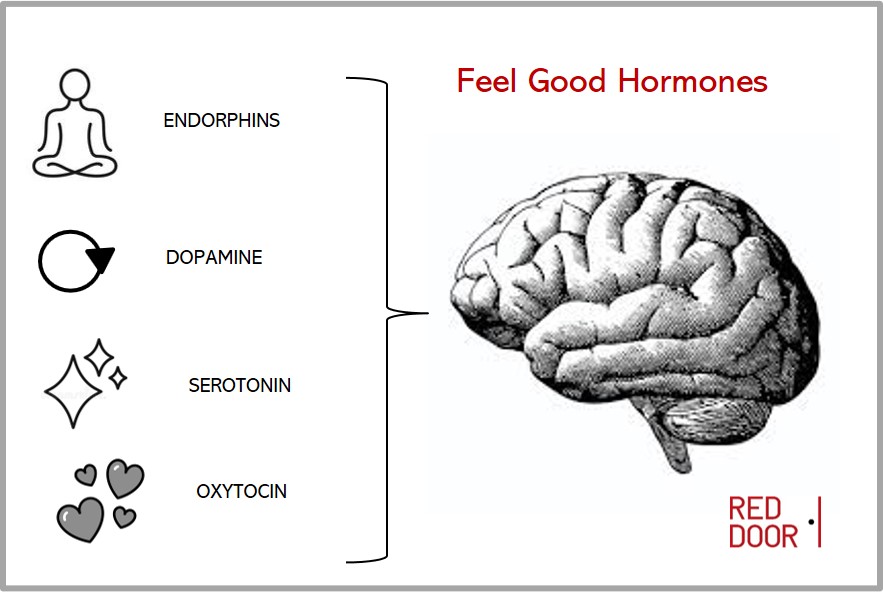
Feel good hormones

If you have been feeling down, find out how to best manage the hormones that help us be happy.

Four hormones are associated with senses of happiness, pleasure and contentment. If you have been feeling low, you might like to explore if you are stimulating the production of these hormones in ways that improve your health. There are some lifestyle changes that can influence the release of these hormones, and hence how you feel.

Hormones are chemical messengers, which, once released into your bloodstream, control many bodily functions, including how you feel. There are four hormones associated with feeling good: Dopamine, Serotonin, Endorphins and Oxytocin.

Dopamine is the hormone most associated with the feeling of pleasure and reward systems we set up in our brains. Pleasurable activities including eating, shopping, winning a game, sex can create a dopamine rush. Other substances can hack the production/ suppression of dopamine including drugs and alcohol, which can lead to addiction.

Dopamine plays a role in many bodily functions including mood, heart rate, movement, pain, blood vessel function, and sleep. One of the central tenants of Dr Anna Lembke’s book, Dopamine Nation [1], is that addiction associated with tech, gaming, drugs, and alcohol not only stop us from feeling good, because they hijack the dopamine cycle, they also mess with these other bodily functions such as mood, attention, sleep and sensations of pain.

If you are struggling to feel good, it has been suggested that you may need to go on a dopamine detox, take a break from activities that have hijacked dopamine production and utilize the activities that help manage the production and healthy release of dopamine. These activities include diet, sleep, and calming activities such as meditation and even listening to music.

Tyrosine is a an amino acid that is part of the production of dopamine. As such foods that are rich in tyrosine are recommended as part of a dopamine reset. These foods include chicken, milk, cheese, yoghurt, avocado, banana, pumpkin seeds, sesame seeds, and soy [3].

Ensuring that you achieve enough sleep is important to help keep your dopamine levels balanced. Dopamine both requires sleep, but also helps to establish healthy Circadian rhythms – the daily rhythms that regulate many biological processes [2, 3].

Calming practices such a meditation help to calm the body. Research indicates that individuals who meditate, even for one one hour, experienced increased levels of dopamine [4]. Even listening to your favourite song may increase dopamine levels. Listening to music seems to increase activity in areas of the brain which are rich in dopamine receptors. [5].

If you have been suffering from any form of addiction – to alcohol, to other substances, to food, even to tech – a dopamine detox might extremely helpful for you. To read more about this look into the book Dopamine Nation, which I highly recommend.

Serotonin is the hormone that helps people stave off depression. Serotonin helps regulate a person’s mood, sleep, digestion, memory and ability to learn. [6] Long term depression of often linked to a lack of serotonin which is why most common anti depressants, serotonin and norepinephrine re-uptake inhibitors (SNRIs), aim to increase serotonin levels in the brain.

Besides meditations you can increase your time in sunlight, or workout. Diet may also help to help increase serotonin.

Serotonin levels are stimulated by ultraviolet rays from the sun. Simply spending time outdoors, as little as 15 minutes may change your levels of serotonin [3]. Working out is good for your hormone levels. When you exercise your body releases tryptophan, the amino acid used to produce serotonin [3,6].

Diet may contribute to serotonin production. It is suggested the complex carbohydrates such as vegetables, fruits and whole grains have been suggested to help [3].

Oxytocin can help us bond with loved ones. Its main function is to facilitate childbirth, sexual arousal and it plays a role when we fall in love. This is why Oxytocin is sometimes referred to as the “love hormone”. The release of oxytocin decreases stress and anxiety. The presence of oxytocin helps us feel relaxed. when oxytocin levels are low, people can become depressed [6]

medical treatments aiming to stimulate oxytocin have not yet been demonstrated as successful. Therefore the most promising route to improve your oxytocin levels is through physical touch and exercise. Physical exercise, especially cardio is extremely positive [6]. Touch, even soft touch such as massage may be helpful to improve oxytocin levels [6].

Endorphins are the brain’s pain relief hormone. Endorphins are released when we feel stressed, or are put under strain. In addition to helping individuals with pain, they also essential for stress management and general mood [6].

There are many ways to increase the production and release of endorphins including exercise, sex, laughing, time in sunshine, and meditation.

Exercise, even moderate seems essential to release endorphins. Putting the body under strain, such as that mimicked by exercise helps the body learn to manufacture and release endorphins [3].

People often feel blissful after having sex and endorphins are part of this sensation. They also promote the release of other hormones that are associated with feelings of love [6].

Having a great time with friends and enjoying a good laugh together is joyful. Endorphins are released when we are laughing. So go ahead and organise a gathering with some fun people.

If you have been feeling out of sorts, or a bit blue, I would recommend that you explore the types of activities that stimulate the production of feel good hormones. If your blues persist, please consider therapy or consulting a doctor to help you write a plan to battle your moods. You do not have to suffer alone.

To read more

[1] Lembke, D. (2021). Dopamine Nation: Why our addiction to pleasure is causing us pain. Headline Publishing. London.

[2] Korshunov KS, Blakemore LJ, Trombley PQ. Dopamine: A Modulator of Circadian Rhythms in the Central Nervous System. Front Cell Neurosci. 2017 Apr 3;11:91

[3] Dacre, Ameri. (2023). The dopamine connection: Maximise your potential with sleep, nutrition and brain health.

[4] Kjaer, T.W;  Bertelsen, C; Piccini, P;  Brooks, D; Alving,J;  & Lou, HA. (2002). Increased dopamine tone during meditation-induced change of consciousness. Cognitive Brain Research. Volume 13(2), pages 255-259.

[5] Koelsch, S. (2020) A coordinate-based meta-analysis of music-evoked emotions. NeuroImage, Vol 223, December.

[6] Watson, S (2024) Feel-good hormones: How they affect your mind, mood, and body. Harvard Health Publishing. https://www.health.harvard.edu/mind-and-mood/feel-good-hormones-how-they-affect-your-mind-mood-and-body

I’ll never fall in love again….

never fall in love again

..or will you?

Can you fall in love again after the pain of divorce?

If your partner left you, you may be currently focused if the ache associated with feeling discarded will ever go away. A new romance is the not the cure to that ache, but it can make for a useful distraction. Even deciding to date again can be a challenge.


Could you start dating again?

When: There is a time that you might contemplate dating again. I divide the stages of divorce into phases, and certainly the earlier phases are not the time to start dating.

Contemplating: this is when you are wondering about your relationship, if you should split, if you should stay. This phase may last several years. It is not easy to decide if you should end your marriage.  At the end of this article we will attach our article on preping for divorce. Have a look at that article if you have time. 

The next phase – Declared involves the early stages of your divorce process. You might have verbalized the desire to divorce but have not actioned the divorce paperwork yet. In this stage you might even resolve your relationship issues, potentially with counselling. Dating during this stage might actually end your marriage, so perhaps wait until you have started the next step.


divorce stages


Filed. This means that you have started the divorce process and your partner has been formally informed. You may find dating at this time makes the process rather muddy, but at least you have said that, for you, the marriage is going to be over.


Who: Do yourself one favour whilst you are divorcing and conduct a self-audit on your strengths and weaknesses before you jump into dating? Make sure that you are healed. Have you been successful at being single. I would argue that you should be. Know yourself as well as you can.

If you have explored what role you played in the ending of your marriage. This is not about accepting or attributing blame for the end of the marriage, this is a mature reflection on your role in the end of this marriage. If you accepted too much criticism, if you gave and gave of yourself – only to be unappreciated, take a cold hard look in the self-accountability mirror. Have you started to change those elements in yourself that will prevent you falling into the same trap for a second time?  Take some time to actively date yourself, so that you can honestly say that you love yourself and want a partner rather than need one because of a weak self-esteem.

It is natural to look to date someone very different from your previous partner, it’s a natural response. Just take your time to explore if that is a good fit for you.

How: There are a number of apps on offer to meet up. If you use apps, remember to take to the process with an open mind, and a sense of humour. Rather than looking for love specifically explore if a person might be a potential friend or contact. It doesn’t hurt you to meet a bunch of new people.

Meet for coffee rather than a drink or dinner. Coffee can be a short introduction and can lead to a potential second meeting.  If your meet up is painful, you can orchestrate an urgent text from the office so has to escape easily and leave. From the women in our divorce groups, they commit to meeting many new people, and sometimes romance blossoms. Many times, they, at least, make great new friends.

Woops: There are some woops behaviours you might like to pay attention to.

  • If you see warning signs – listen to your antennae. Step back, take a breath.
  • Do not introduce the person you are dating to your kids, until you have been dating for a few months at the very least. Remember you may have picked to spend time with this person, but your children have not actively made that choice. 

If you feel tempted to dive back into the pool of possibility, go ahead. Remain open minded, have a sense of humour, and just have fun.


Note- a previous version of this article ran in July 2020. This article was last updated in September 2024. 

Our reading list – RED DOOR reading recommends

At RED DOOR our team often recommend books for clients to read, to help them be motivated, heal, understand their situations, and stimulate change.

Attached are some of the books we recommend regularly. We put out blogs featuring book recommendations fairly regularly, so continue to follow our pages to keep your reading list fresh.

Take a look at just a few that we recommend regularly. One of these books could be an instrumental part of your journey to feeling differently.

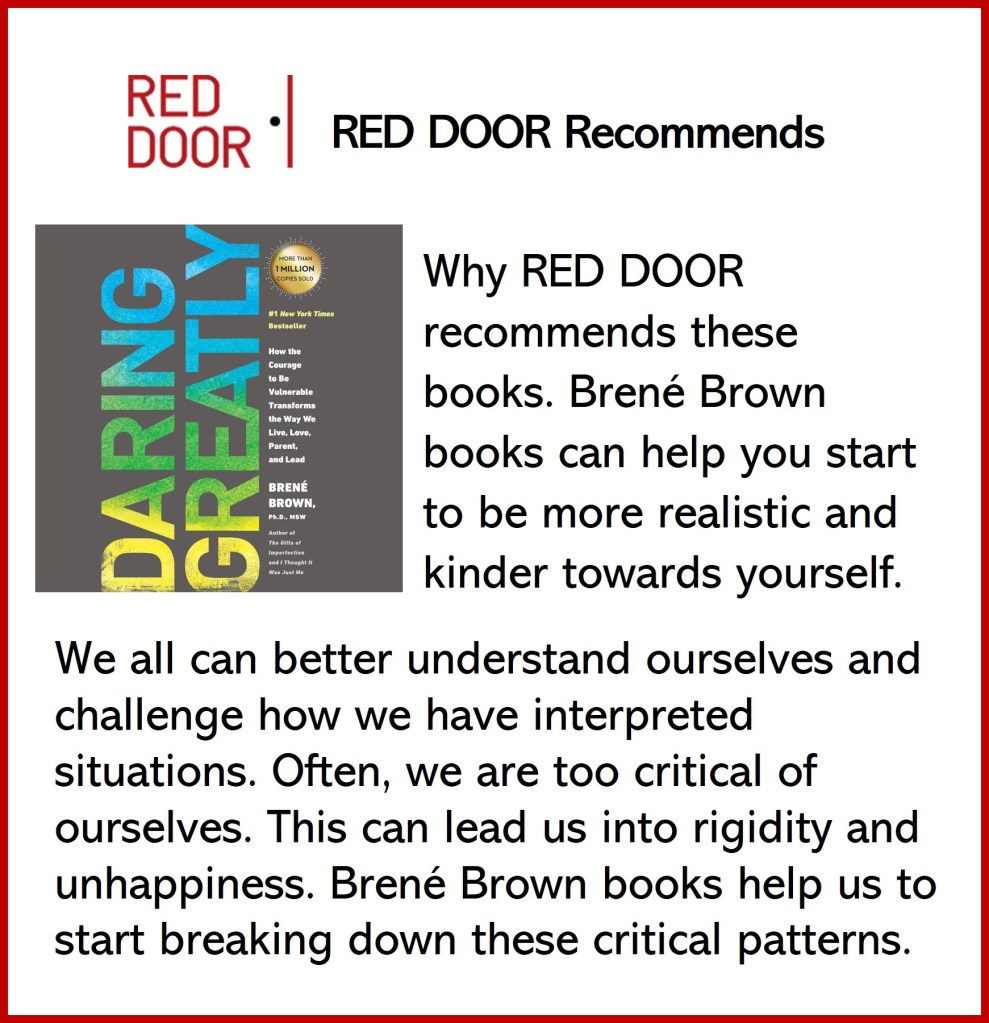
Dare Greatly

Brené Brown

Brené Brown deserves her fandom status as a self-help guru.

Read any of the Brené Brown books including Dare Greatly, Rising Strong, or the Gifts of Imperfection to help you embrace your own vulnerability, be brave, accept yourself as you are, and review “the story you are telling yourself”.

Why RED DOOR recommends these books. Brené Brown books can help you start to be more realistic and kinder towards yourself. We all can better understand ourselves and challenge how we have interpreted situations. Often, we are too critical of ourselves. This can lead us into rigidity and unhappiness. Brené Brown books help us to start breaking down these critical patterns.

——

Atomic Habits

James Clear

Clear’s central hypothesis is that small change compound into big impact. Start small habits and keeping them going is the key to substantive change.

Helping outline what makes a good habit, how to beak bad habits so that you can change outcomes, the cost of your behaviours, and even how you see yourself.

Why RED DOOR recommends this book. When people need to tackle change, and are struggling with motivation, I find this book a helpful resource for them help them frame their goals and understand how and when impact can occur.

 —-

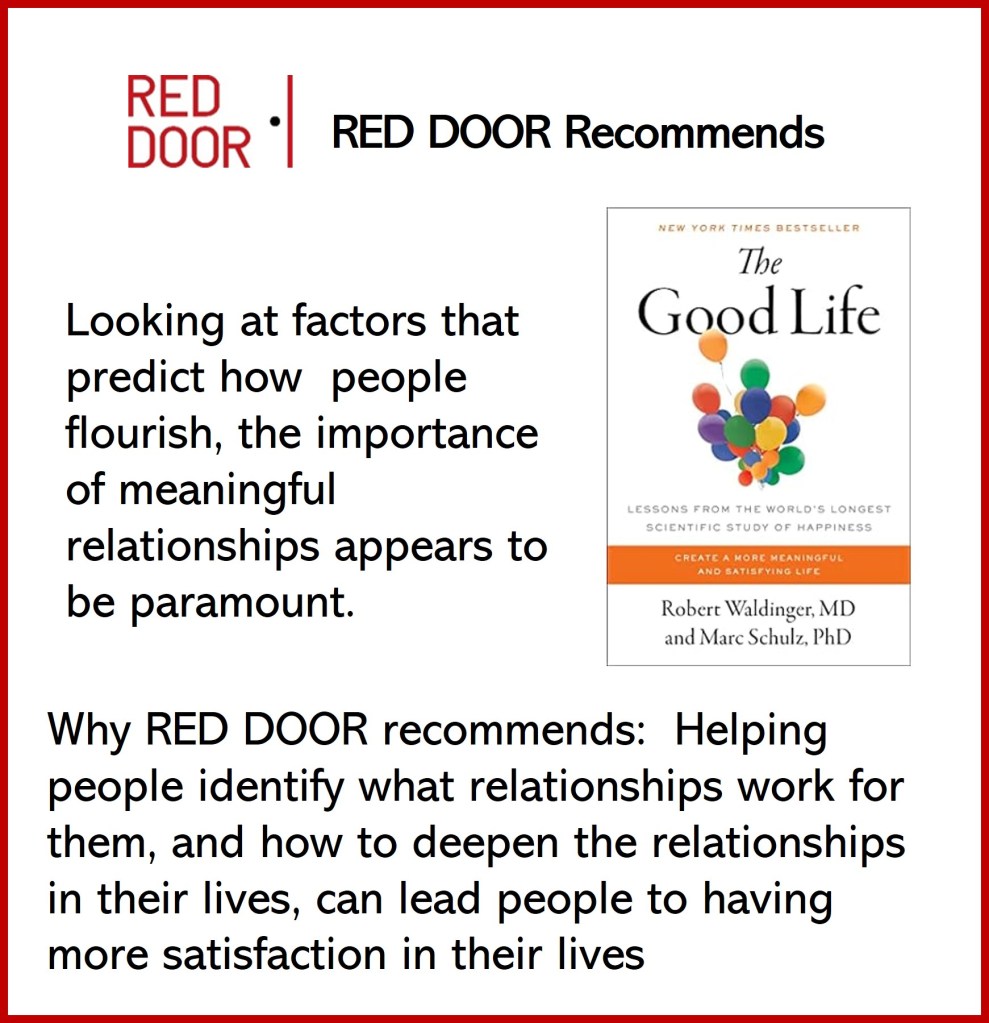
The Good Life: Lessons from the world’s longest scientific study of happiness.

Robert Waldinger & Marc Schulz

This book is built out of a bedrock of research from the Harvard Study of Adult Development as well as a plethora of other longitudinal studies.

The researchers’ study of happiness is not based on what people say will make them happy. Rather they explore what people are doing when they rate their lives as thriving.

One of the greatest influences helping people flourish is the quality of their relationships. This book explores case studies and data exploring what makes relationships positive for them, how these relationships work in a protective manner, how generosity and curiosity shape meaningful connections. If you want to live a good, healthy, satisfying life, this book could help.

Why we recommend it. Helping people identify what relationships work for them, and how to deepen the relationships in their lives, can lead people to having more satisfaction in their lives.

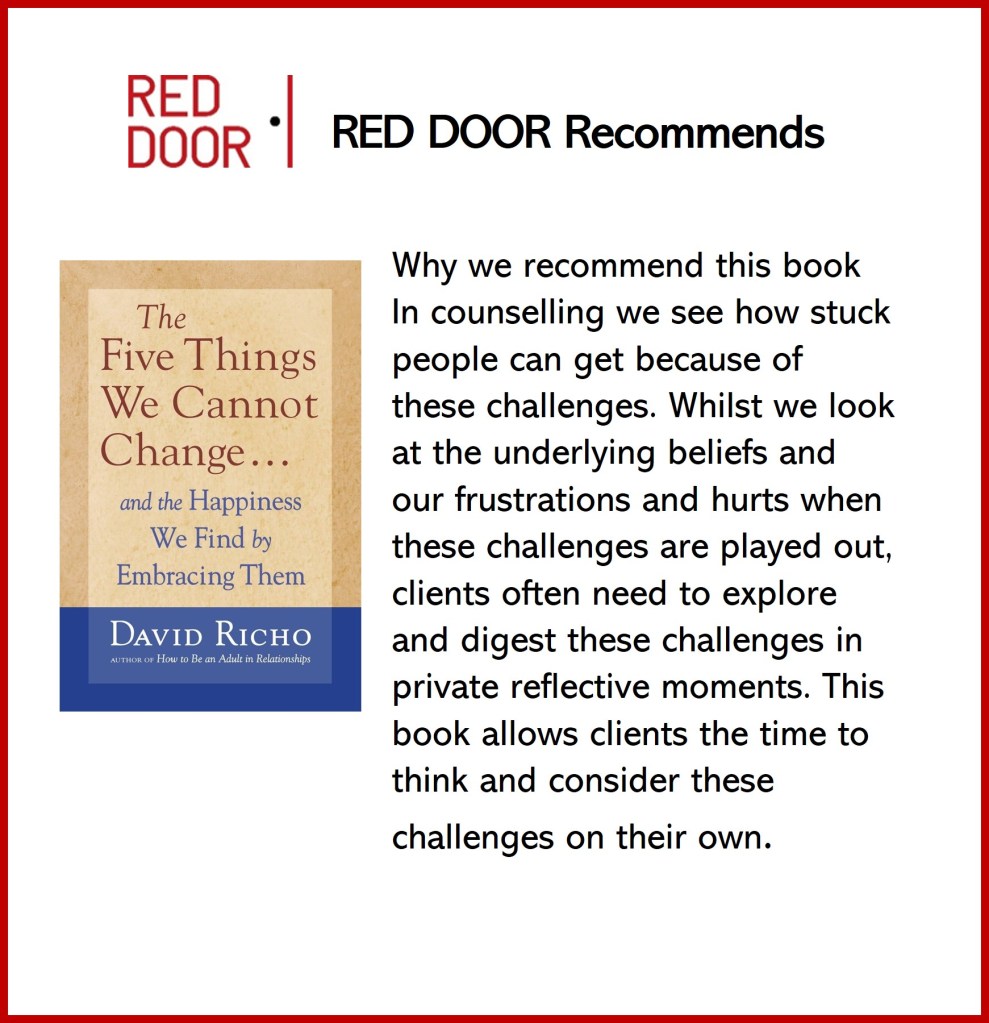
The five things we cannot change

David Richo

Richo talks about the five big challenges that people struggle to understand: including that life is not always fair, everything changes or ends, your plans don’t always work out as you’d like, pain is part of life, and people are not always as loyal and loving as you expect.

Why we recommend this book: In counselling we see how stuck people can get because of these challenges. Whilst we look at the underlying beliefs and our frustrations and hurts when these challenges are played out, clients often need to explore and digest these challenges in private reflective moments. This book allows clients the time to think and consider these challenges on their own.

Can’t hurt me

David Goggins

Over 5 million copies of this book have been sold, attesting to the motivational power of David Goggins. Whist Brené Brown writes to help you better accept yourself, Goggins provides a contrary view of the world, be uncomfortable, strive to be better and do at least one thing a day that is out of your comfort zone. Both Brown and Goggins motivate. Whilst Brown helps you feel calm, Goggins strives to wake you up.

The book recounts much of his personal journey overcoming poverty, self esteem issues, and health challenges. Goggins is a like a Sargent at arms, if you need to go to war with your motivation – this is your man.

Why we recommend this book: When clients need energizing motivation, and particularly have been procrastinating over challenges in their lives, David Goggins trumpets the wake-up call to action.