
Girls are different: Expanding our understanding of Autism.

In the United States, one out of every 54 children, is suspected of being autistic (1). This rate has increased each time that the CDC performs studies to explore the rate. One of the reasons is our increased understanding of autism and how we define autism. Our ability to detect and label early signs of autism is improving and this allows for early intervention strategies to be employed during key developmental growth time-windows.

Rates of autism vary around the world, and this may be a factor of access to resources, parental feelings about diagnostic labels, and growth in the prevalence of autism in general. Males outnumber females at a ratio of 4.5:1. (6)  In the past 10 years there has been a renewed exploration of girls and autism – to see why autism is less prevalence among females. We are discovering that our diagnostic criteria and approach to girls may mean that many girls have been missed. This has significant impact. Girls do not get access to early intervention which would benefit them. Additionally, they may be labelled as having other disorders that are an element of their autistic traits, rather than a diagnosis on their own. (6)  

Why is autism in girls missed?

When researchers explore clinicians and school records of autistic girls, it seems that they were missed because they ‘fly under the radar” (8). One reason is that girls need to be bimodal- diagnosed – early and late (9) because of preferential diagnosis towards boys. Practitioners have been using indications of social isolation as a method to identify ASD (Autism Spectrum Disorder) and girls simply do not play alone as much as boys (9).

This inability to see autism, and label it as such, seems to happen at all the stages that typically identify a child as being autistic.  These stages include when a)  their parent thinks something is different and of concern with their own child, b) if teachers or another significant adult in the child’s life has concerns or has suspicions that this child is different from other kids, c) if the family doctor believes that this child’s agrees with the suspicions of those adults, and that then, d) a  psychologist observes and conducts appraisals that might be decisive that this girl child is different from other children and that autism may be the cause of those differences (8) .

In describing how it is that girls look different and get missed (7) , Carpenter and his colleagues write, “Many autistic girls have a desire to fit in with their peers. It appears that, to a greater extent than most autistic boys, many girls use protective and compensatory factors to give the appearance of social conformity and integration with their peer group. They may use observational learning to interpret and imitate facial expressions, create scripts for social interaction and apply rules by rote to social-emotional situations and friendships”. (7)

Girls with autism can use compensatory behaviours such as staying in close proximity to pears, weaving in and out of activities, which appear to mask their social challenges (9). Girls can even learn to “linguistically camouflage” using “Um” and “Uh” appropriately to create pauses in conversations (10). We call these compensatory behaviours camouflaging. It includes the skills of Blending and Masking (11).

It appears that girls are flying under the diagnostic radar in terms of being labelled autistic. It’s important to understand that when autistic girls act in a manner that looks normal, it doesn’t mean that they are typical. It is exhausting to mask. But girls do it because they seem to want friendships (11, 12). And there are consequences to this.

Firstly, girls are being diagnosed in a manner that Professor Francesca Happé , from Kings College in London, describes as diagnostic over-shadowing. In this process by which these girls are brought to the attention of psychologists struggling with other problems, or an educational or mental health nature. Happé comments, “Autistic girls seem more likely to conceal and internalise difficulties. Over time this imposes a detrimental psychological burden, making autistic girls vulnerable to emotional difficulties and mental health disorders such as anxiety, self-harm, depressive, personality and eating diseases. There are a growing indications that autism may be an underlying case of a significant number of undiagnosed girls experiencing those difficulties”(7).

From my personal perspective I meet teen girls that come for help, presenting with learning profiles such as dyspraxia, and anxiety together with communication challenges, or with ADHD, depression and signs of OCD, that are quite possibly autistic. Autism is the core component of their experience and these other challenges, are manifestations of living with autism and masking. Identifying that autism is part of the profile is a mental health, and learning therapy, game-changer.

We need to support autistic girls. Whilst they may look like they can manage friendships, and their cleverness to blend may distract from an autism diagnosis, research indicates that they also have trouble within those friendships. When compared to typical girls, autistic girls encounter more social and communication challenges and can find friendships much more difficult and stressful to manage than their neurotypical peers (12,13).

These problems include troubles with bullying, difficulties with conflict in friendships, understanding flexibility in friendships, understanding who they are versus playing personas, and understanding social rules (12,13). Indeed, it seems that whilst these girls are doing really well, we need to help them do better.

For too long girls’ abilities to fit in may have dismissed their need for support for their autism. Just because you can hide it, doesn’t mean it doesn’t exist. These autistic girls are the potential poster children of accomplishment, and we need to support them as such, not wait until they are overwhelmed and need help because they present to psychologists with another mental problem.

******************************

About the author: Angela Watkins is a counsellor and psychologist working our of the RED DOOR Counselling practice in Hong Kong. In addition to her work with teens dealing with issues such as depression, learning styles, anxiety and perception of self, Angela is SEN educator working with teens with a variety of Special Educational Needs. Angela is the proud mum of Alex – an autistic teen girl. Angela has been identified as the Best Therapist in Hong Kong by Liv Magazine (October 2022)

References and Resources

  1. Australian Bureau of Statistics survey of Disability, Aging and Careers (2015)
  2. US CDC figures
  3. US census data 2019
  4. National Autistic Society UK
  5. Epidemiology and Research Committee, Child Assessment Service, Department of Health, Hong Kong. https://www.dhcas.gov.hk/file/caser/CASER3.pdf
  6. Naguy, A; and Alamiri, B (2018). Girls and Autism – Any sex-based peculiarities? The Journal of Nervous and Mental Disease. Vol 206(7) page 579.
  7. Carpenter, B; Happé, F, and Egerton, J. (2019) Girls and Autism: Educational, Family and Personal Perspectives. Routledge. Quotation from Chapter 1: Where are all the autistic girls?
  8. Happé, F. (2019). What does research tell us about girls on the autism spectrum. Chapter 2 of Carpenter, B; Happé, F, and  Egerton, J. (2019) Girls and Autism: Educational, Family and Personal Perspectives. Routledge.
  9. Dean, M; Harwood, R; and Karsari, C. (2016). The art of camouflage: Gender differences in the social behaviours of girls and boys with autism spectrum disorder. Autism. Vol 21(6), 678-689.
  10. Parish-Morris, J; Liberman, MY; Cieri, C; Herrington, JD; Yerys, BE; Bateman, L; Donaher, J; Ferguson, E; Pandey, J; Schultz, RT. (2017) Linguistic camouflage in girls with autism spectrum disorder. Molecular Autism. Vol 8(48).
  11. Ryan, C; Coughlan, M; Maher, J; Vicario, P; and Garvey (2020). Perceptions of friendships among girls with autism spectrum disorders. The European Journal of Special Needs Education. April.
  12. Cook, A; Ogden, J; and Winstone, N. (2018). Friendship motivations, challenges and the role of masking for girls with autism in contrasting school settings. European Journal of Special Needs Education. Volume 33(3), page 302-315.
  13. Sedgewick, F; Hill, V; and Pellicano, E (2018). It’s different for girls: Gender differences in the friendships and conflicts of autistic and neurotypical adolescents. Autism. Vol 23(5).
Activating the Second Wave – Intervention for teens experiencing learning challenges.

If you are a parent of a child with special educational needs (SEN), I hope that I do not need to convince you about the importance of early intervention to support your child.

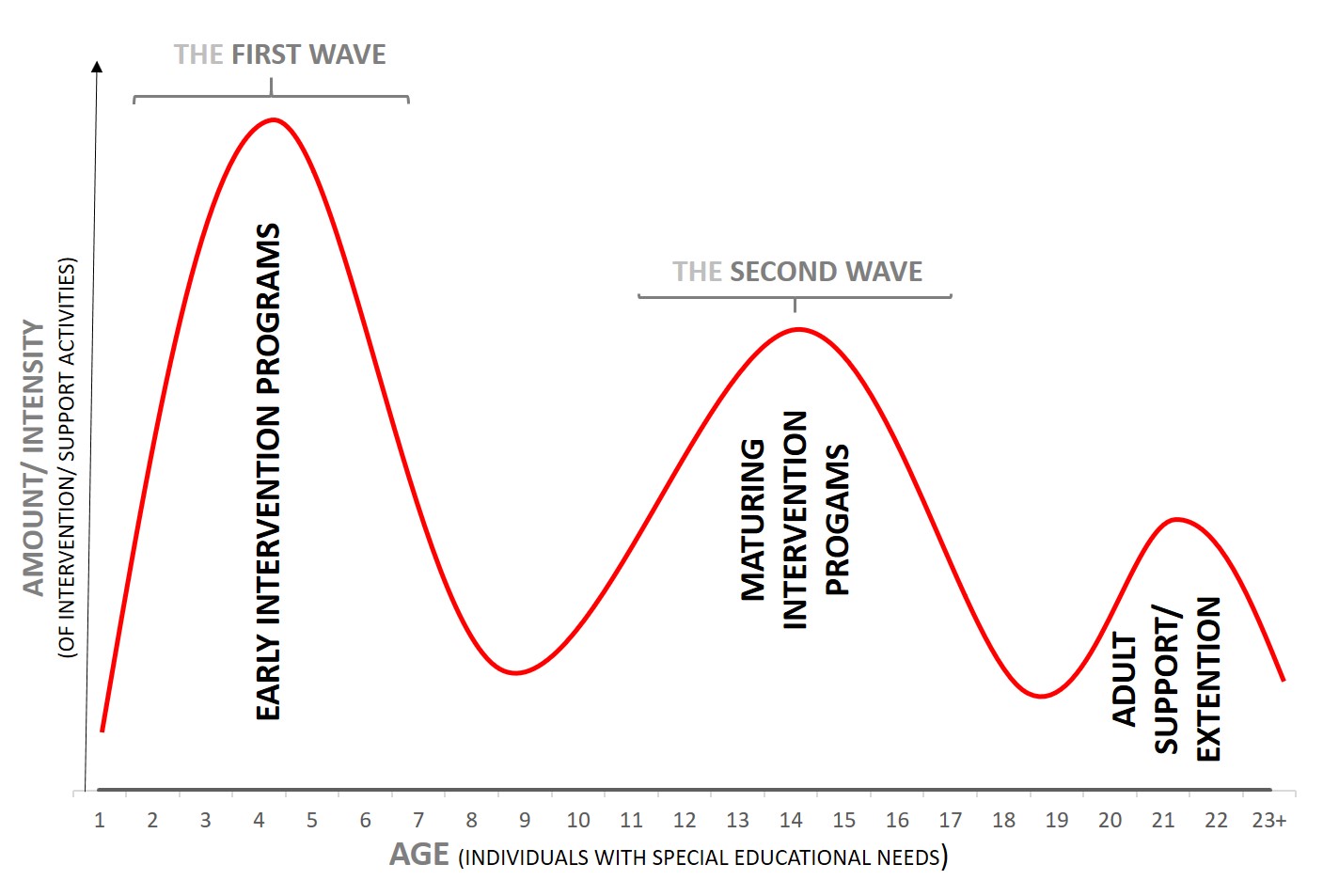
Between the ages of 2-4 years old you most likely noticed that your child does not respond or develop in sync with their same aged peers. Intervention activities aimed to aid physical, cognitive, communicative, self-help, and behavioural development may have been recommended by your pediatrician. Early intervention activities start at diagnosis and usually lessen when they child begins regular school, with some training continuing throughout childhood.

You may think that was it for your intervention efforts. You have a few more developmental stages to consider for intervention.

I am here to encourage you to think of the period between 12-17 years old as the,  “Second Wave” of intervention. At this time your child, typical or atypical, will go through a lot of change, and similarly to early childhood there is significant developments during these years. As parents and professionals working with teens with different educational needs, the second wave provides a new chance to explore the opportunity for change and positive development. It is important that we honour the struggle that all teens face, and support them accordingly. The Second Wave of intervention needs to meet these children at the stage of development that they have now achieved, not as a simple add-on to, or repeat of,  the original early intervention plans.

Changes during the teen years.

The teen years are a significant developmental period of internal change for an individual. Together with the growth of body and hormones there is significant development in the learning capacity of teens. This is extremely well detailed in Frances Jensen and Amy Ellis Nut’s fantastic book, “The Teenage brain”

From a neurological perspective, the teen brain is seen as only 80 percent mature. The finer connections in the brain are yet to firmly established, and the brain is a time when it is more open to learning and being excited. The neurons in the brain are well connected at the back of the brain, the centre of sex and excitability, but not well developed for the frontal lobes, the centre for rational thought, self-awareness, generating insight, assessment of risk and danger, abstract thought and planning. Jensen likens the teen brain to a sports car that is all revved up, with nowhere to go.

During this time teens are also expanding their knowledge base. It is a period of great flexibility, with windows for great development of learning. However, the open brain is more open to dopamine, the neurotransmitter that makes us feel good and drives us into a, “gotta have it” type of state. If you have your teen responding to situations in a FOMO style of anxiety, you know what I’m writing about.

Put this all together and you have a teenager – highly excited, easy to learn, find it difficult to explain themselves, difficult to stop an activity, irrational under pressure, and not able to see another person’s perspective  very well. And this is for, so called, typical, teens!

Additionally, the adolescent developmental period is one when behavioural and psychiatric issues develop. The general theory is that the onset of such issues may be created with the changes in body chemistry. Therefore, we see issues such as anxiety, depression, self-identify and body image develop during the teen years. Dysregulation of emotion can become common. The atypical teen is as, if not more, susceptible to these mental challenges. Additionally, for some atypical teens conditions, such a epilepsy can suddenly begin in the teen years.

And then there is puberty itself and all that new hormones introduce into and onto the teen: genitals, periods, a desire for physical stimulation (aka masturbation), voice changes, breasts, hair – everywhere – and the new hygiene requirements attached to much of this. You may still think of your teen as a child, but they certainly don’t look like one anymore.

On top of significant internal changes, the atypical teen faces significant changes in their external life. They may be at high school and surrounded by many typical teens, and viewing many behaviours – romantic, personal, oppositional, defiant, illegal – you may have wanted them to avoid, but this is not possible

All of this requires a new intervention plan – one based on their age and the launching pad that the teen years represent. For many children with special educational challenges, they grow into their challenge rather that grow out of it. Rather than trying to change them to fit the world, we have to help them be who they are going to be, but still be able to have a place in the world.

Elements to be considered in the SECOND WAVE of intervention.

The second wave of intervention is different from Early Intervention (ie the first wave) in many ways. Firstly, this wave coincides with the teen years and all the opportunity for growth, and challenge, that those years represent. Secondly, the focus moves away from a deficit model of the child to a strengths model can really help your child.  This is described in detail in another blog from our team , (htps://reddoorhongkong.wordpress.com/2019/04/02/lost-in-the-language-of-intervention/).

Part of this change in focus is to work less areas that your child can not keep up with their same age peers, unless those skills are considered essential life skills, and spend a greater proportion of time turning their splinter skills into academic success, and hopefully career options.

seond wave graphic

Lastly, I recommend that your efforts for your  teen focused training towards new essential behaviours and to revisit some behaviour management issues from the past. These include new and updated behavioural expectations, social and emotional support, relationship advice, academic support, learning about learning, independence and understanding of the self. This really helps your child develop essential skills that may help them build connections and friendships for the future.

Areas of training: There will be some behaviours that were cute when your teen was a child may be perceived extremely negatively now that they look like an adult. For example a young boy’s fascination with girls with blonde hair may seem cute, or even charming, when they are a toddler. When they are 6ft tall, very few people will find amorous fascination acceptable, or cute. We need to help these teens navigate the teen and adult rules of engagement around expected behaviour, conversation topics, expressing themselves, etiquette, personal reputation and dressing appropriately, personal space, and personal hygiene, as well as sexual urges. Many of these topics benefit from some peer-to-peer work, discussion and explicit instruction.

Counselling/Emotional sensitivity: It is extremely important that atypical teens are given the opportunity to learn about and express their emotions. After all their experience in the world is very different from ours, or that of other teens. They are more likely to be ostracized, bullied, or overwhelmed. Yet at the same time like many teens they appraise values such as “independence” and “having friends” as important. So we need to help counsel and guide teens to navigate the world of belonging, the importance of a growth mindset, self-acceptance, mindfulness, self-advocacy, resilience, emotional understanding and regulation.

Relationship navigation:  Friendship is a major need of all teens, although the intensity of relationships may differ. Our kids need to learn the basics of making, and being a good friend to another teen. They also need to be able to distinguish a good influence on them, from a poor. Some atypical teens are being bullied by the very people they consider “friends”. During teen years romantic interest will also be piqued. One needs to learn the expectations and restrictions around interpersonal romantic relationships. This is particularly true for those teens who are poor at reading social cues so may come on a little strong, and risk complete rejection. 

Explicitly learning what doesn’t come naturally: Many teens with special educational needs have difficulty is executive function (learning how to learn, how to think) and theory of mind (understanding how other people see the world differently from you) are sometimes easier to train in the teen years, rather than to children, because of the expectations of all teens are explicit around these topics. Teens passionately learn to express their opinions confidently, and listen to those of others. Performing on tests, and comparison of marks, can be a mixed blessing. Knowing that you didn’t do as well as a classmate on a test can open the door to discussion on your learning practices. Whilst we may have explicitly taught  our kids that, “it’s okay to ask for help”, we may need to update this to include the comment, “but try to do it on your own first”.

Cognitive development: remains important: Some atypical teens may have subjects that they are extremely good at (splinter skills), as well as areas that they perform less well in. As teens age, specialisation allows them to drop some topics that hold no interest or remain too difficult and focus on those skills that may help them form success stories, future studies, or even a career. Some topics – specifically basic math, and English, remain essential skills that require continuous learning within age appropriate contexts. It insults the teen to perform reading comprehension around topics or stories aimed at young children. I encourage children with SEN to take on learning communication training – persuasive text, expression, vocabulary banks, as a lifelong education plan.

Independence: Independence is the reward of the teenage years. All of the teens I have worked with over the years see Independence as a positive trait, even if they are not, yet, capable of many aspects of independence. As the parent of a child with special educational needs I have occasionally found offering independence very challenging – what if she gets lost, what if something bad happens. My own daughter has navigated getting home from school when she lost all her money, dealing with flirtations by weird men, and having to ready herself for an exam which we had recorded on another date. In every challenge she was stressed, but responded. In the exam, she actually passed! Independence can, and must be trained.

I am Me: The last special area that is to be considered within the Second Wave is appreciation of the self. This is not just part of the emotional growth that needs to be undertaken during the teen years, this is understanding your unique position in the world., what you contribute, what you want to contribute and how you are different from others. When our children with disabilities are young children we may focus on trying to fit in. In the teenage years this can change. Their strengths become a pathway to the future. Their quirks may become how they are to be defined. To quote a phrase from the fantastic book about being different, Wonder, “Why try to blend in, when you were born to stand out”?

I hope you found this detail of the Second Wave helpful. If you have any questions about the Second Wave, and your child, feel free to contact us via angelaw@reddoor.hk to see how our team of psychologists can help frame support for your child.

#specialeducationalneeds #earlyintervention #teens #autism #relationshiptraining #socialskills #reddoor #theoryofmind #executivefunction #splinterskills #secondwave  

Useful books

Frances Jensen and Amy Ellis Nut – The Teenage Brain

John Donvan and Caren Zucker – In a different key

Tony Attwood and Temple Gradin (and others) – Aspergers and Girls

Delia Samuel – Against the odds

Barry Prizant – Uniquely Human: a different way of seeing autism

Tony Attwood – The complete guide to Asperger’s Syndrome.

Blythe Grossberg – Autism and your teen

Liam Dawson – Teens therapy: The mental emotional and physical challenges with teenagers.

Travel into better mental health

One of the unfortunate side effects of the COVID pandemic is that our homes became our workplaces, and for many hours of work became without boundaries. Use your time away to disconnect from your job, and also some of your social media habit. Write that out of office message and mean it. If you like to check emails determine that you will only do it once a day, not constantly. Allow your workplace to miss you for a change. Taking some time away from devices especially your phone is extremely good for you. It helps create more space for you to be creative again. Look at the time you spend on your time by checking your screen time and your first 3 apps that you use, can you get those numbers down over your holiday. Set yourself a limit and see how you do. Consider reading more on this issue. My personal recommendations include the books, “How to break up with your phone” by Catherine Price, and “Digital madness” by Nicholas Kardaras.

Any digital detox could also include gaming consoles for teens as well as time on social media apps – particularly Instagram and snapchat.

Take time to connect – in the right way.

Often holiday time is family time. When you slow yourselves down from your busy day to day activities, you can build more special memories together. Make sure that you are not racing from one Instagram-able event to another. Really connect with your partner and your children. Ask them about their favourite books, films etc. Take time to get to know your family again.

Rest.

Please make sure that take a break if you need it. Rest. Your body will thank you for you.

Reset

Consider what has been working well in your life and what you could do during your time away to help you improve your health. Some light exercise, more fruits and vegetables might be great choices. Watch your alcohol consumption whilst you are away. The occasional celebration is great, but takes it toll on your body and your mind.

Reflect.

If you can consider journalling over the break. I often tell client that journalling is a free form of therapy. For more information on journaling see some of our articles on this topic.

Build memories.

Try something new, see something new. We are really a collection of our experiences, not the things that we have.

I hope you get to get away this summer. And if you do, invest in your mental health.

The benefits of using a thought log.

Sometimes in therapy we ask clients to capture their thoughts so that they can better examine how they are interpreting events in their lives..

Our thoughts influence our feelings, which in turn, effect our behaviours (responses). If your thinking is not rational then the feelings and behaviour may be out of whack.

Our thinking can be influenced by forces such as cognitive filters (see article link below) and cognitive bias, we need to be constantly reviewing our thoughts so we respond constructively to situations rather than react in negative ways.

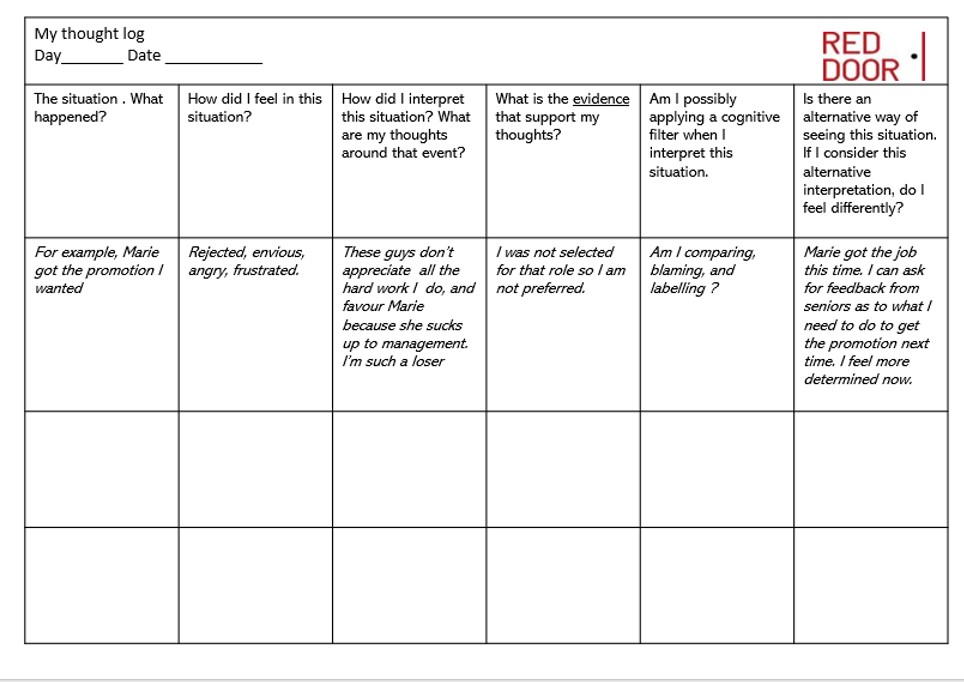
To help you challenge some of your thoughts process one useful way is to write down your thoughts in a thought log. A thought log helps you organise your thoughts and the events that stimulated these thoughts and the consequences of those thoughts. By capturing and examining your thoughts you can see how they influence your behaviour

Many times, your thoughts and behaviours are unhelpful to you. Events, are not as you think they are. Reflecting on your thoughts, and reactions allows you to consider different ways to interpret situations and potentially change your behaviour.

Forms like this are often used in CBT therapy. Sometimes they ask you to capture them, sometimes they also have segments to dispute them. A typical thought log will help you capture notes about the situation, your thoughts, the evidence in support of your thoughts as well as alternatives.

If you have been reacting to situation in a manner that you consider unhelpful or potentially unhealthy, a thought log might be a great first step to helping you capture what is happening between your thoughts, and your behaviour.

Read more about Cognitive filters and how they influence your thoughts at the following link: