
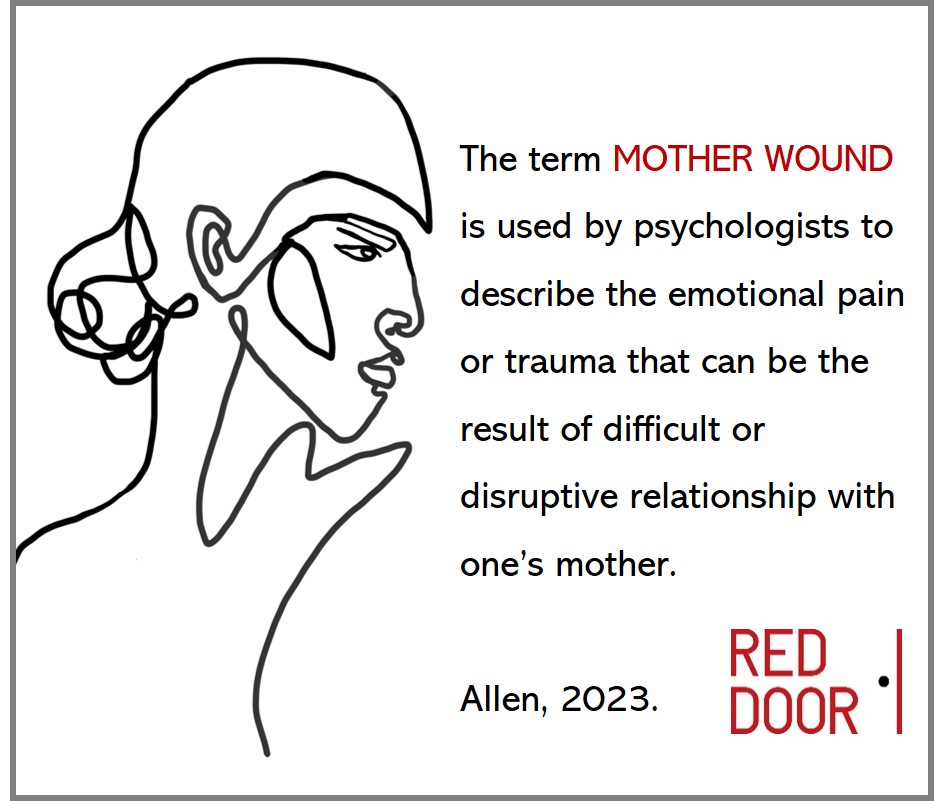
The term mother wound is used by psychologists to describe the emotional pain or trauma that can be result of a difficult or disruptive relationship with one’s mother. You do not need to have had “bad” parents, or a history of trauma, to acknowledge that a part of you feels wounded from how interactions with your mother have left you feeling incomplete or unloved.
Many people identify that they have experienced a lack of emotional validation from their mothers. Individuals have a plethora of reasons to be unable to provide emotional care for their children. Whilst this creates pain in the children of these mothers, this article is not about blaming that parent.
It is unfortunate that you did not have the type of parent that you needed, and deserved. You can stay stuck in that pain, or consider looking at how to heal that hurt.
Healing the mother wound is about actively providing the care for yourself to heal what remains. In the same way that if someone accidentally cut you with a knife, it does you better to pay attention to treating the wound than shouting at the weapon that caused the injury.
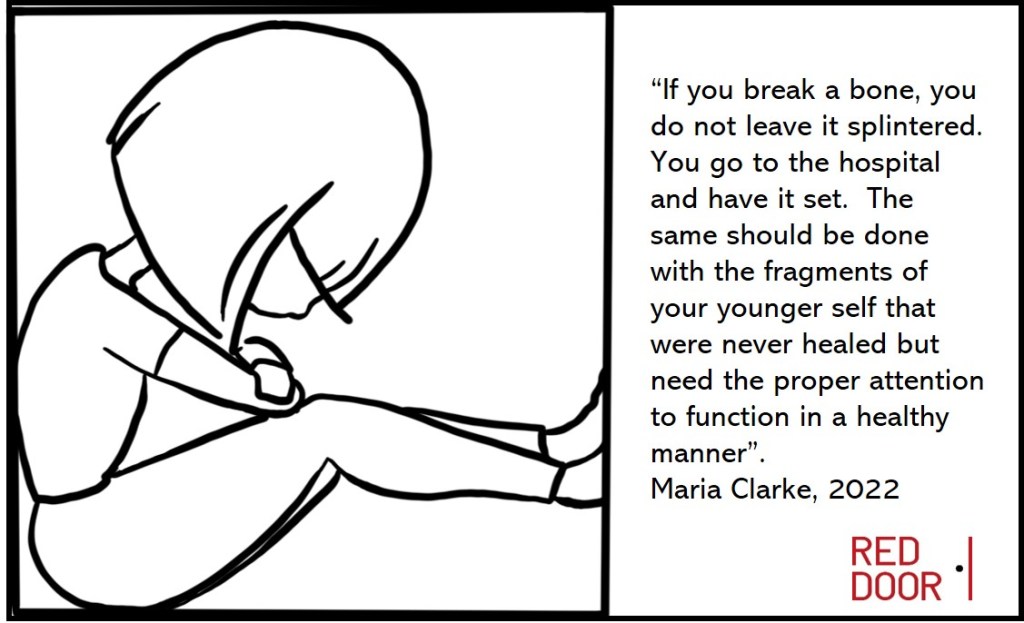
You may feel angry because of the perceived failings of your parents. I encourage you to talk through that anger with a professional. You do not have to forgive or forget. That said, this venting, whilst cathartic, does not completely heal the wound. Blaming your current status on other people might feel good, but you will still need to actively work on a repair for yourself. This probably feels unfair. An alternative way to look at it would be to say that you are seizing the reigns of your future and will do the work to deliver your future, rather than waiting for someone else to do the work for you (not possible) or stay stuck in the past (in which case repair rarely occurs).
Understanding your mother wound
Take a moment to reflect on your relationship with your mother. Think about how that relationship affects you today. Did you feel loved and secure? Were you let wondering if you were good enough? Did you need to act in a role that didn’t allow you to be a child? Did your needs take second place to the needs of other family members? Were you labelled as lazy, crazy, a troublemaker? Write these observations down so that you can reflect on this commentary later. Recognising the ways that your past experiences affect your present can help you begin to heal.
Some of the symptoms and signs that you may be experiencing as a consequence of having a mother wound can include the following:
- Perfectionism
- Low self-esteem
- People pleasing (being a Yes-person)
- Poor personal boundaries
- Self-sabotaging behaviours
- Problems with being assertive
- Difficulty caring for your needs
- Idol worshiping other people
- Being conflict avoidant
- Difficulty regulating your emotions, feeling over emotional
- Constant feelings of shame and guilt
- Trouble in interpersonal relationships including fear of abandonment, difficulty trusting people and/or co-dependency
- A sense of emptiness.
- Lack of confidence to parent your own children
- Difficulty accepting responsibility for your role in situations
- Vulnerability to addiction or self-medication
- Regular negative self-talk
What can you do to heal your mother wound?
The following activities will help to heal your mother wound. Whilst you can do these alone, these tasks are often more effective when performed in collaboration with a counsellor. Counsellors are trained to help frame questions in a constructive, reflective manner that helps clients to focus on the feelings and their responsibilities rather than noise and excuses, additionally they can help you to feel safer, and more calm, during these painful explorations.
Reflections and recognise An important first step is to understand how your past is affecting your present. We listed a series of symptoms in the section above. It is important for you to consider particular instances where you have demonstrated these behaviours so that we can consider what thoughts, reactions, or triggers are occurring in those situations.
Let me give you an example. A client recently told me a story about a recent frustrating her interaction with her boss. In the recount, Janice (not her real name), was annoyed that her boss had not yet repaired the air conditioner in the classroom where Janice teaches thirty 5-year-olds. Janice identified that she was angrier about the air conditioner than she felt was logical. Knowing Janice well, as well as her history with a mother who often dismissed the impact of events in Janice’s early life, I asked if her current reaction could be related to feeling ignored by her mother when she had made bids for emotional validation as a child. Suddenly Janice’s overreaction made sense. Janice was reacting not only to her boss’s current inaction, but to a repeated, old wounded belief, that she was not important enough to be listened to, a mother wound.
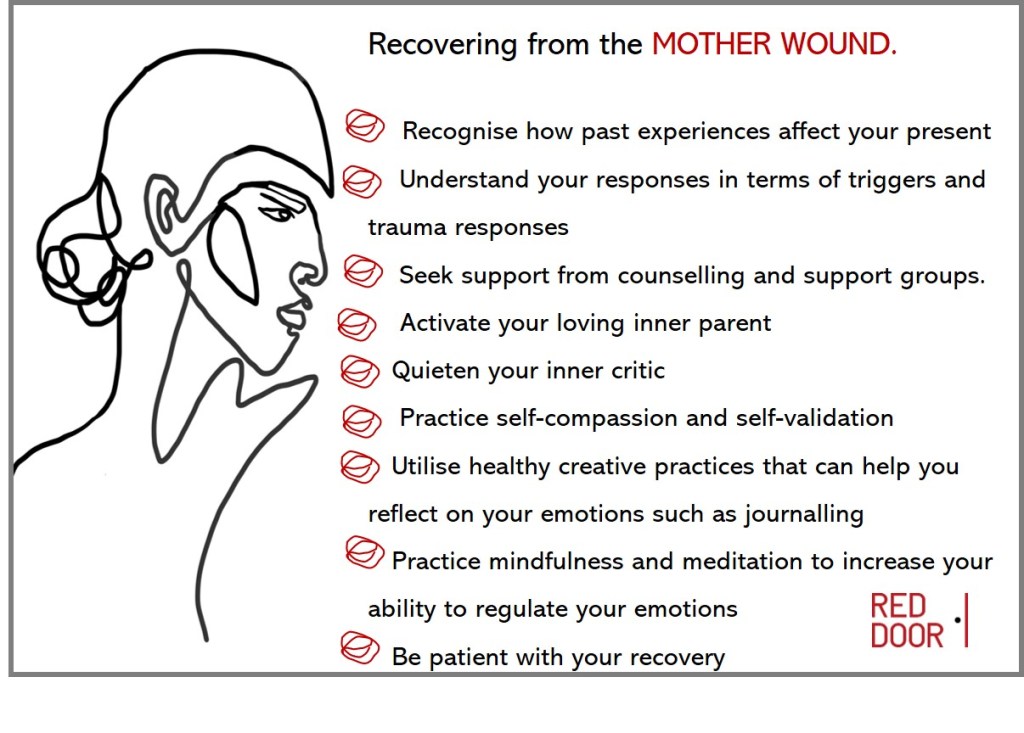
If you have overreacted to a situation, do not stay locked in the shame you might feel about it. Be curious. Could the present actually be reminding you of the past? We call this type of reaction a trauma response. It is usually attached to a traumatic event, but isn’t always. If certain circumstances remind you that you feel ignored, dismissed, labelled unfairly, or mocked, it may be as part of your history, and pain from your childhood.
Throughout the recovery from a mother wound, and especially at this time, journalling your thoughts is particularly helpful. Start writing some helpful prompts that can start your ability to reflect on these situations. Here are some prompts which might help.
Pick one symptom that you suspect may be attached to experiences from your childhood. When did you start to notice this behaviour in yourself? What could have happened in the past that planted the seeds for this behavioural choice? If you could, magically be rid of this problem, how would your life be different?
Pick one symptom that you suspect may be attached to experiences from your childhood. What are the benefits to you of feeling this way, or performing this behaviour? What does it mean for you as an adult to be experiencing this behaviour/ feeling? Are you ready to consider changing this behaviour/feeling? Do you know how?
A key component of recovery from the persistent challenges from a mother wound involve the essential element of re-parenting. Re-parenting involves creating a character or component inside yourself whose role is to be the parent that you need. That role is sometimes refered to as your Inner Parent.
Counselling provides a objective, yet non judgmental way to look at yourself and how you interact with the world. All of us can benefit from the process of self-exploration which is an essential component of the counselling processing.
When deciding what your inner parent might need to perform in support of you, it will be helpful for you to consider what you want/wanted your parent to do in their role as parent.
For example your inner parent could:
- Encouraging us
- Calming us
- Taking care of our basic needs
- Organising our health checks
- Supporting us when we feel unfairly treated
- Help to build your self-esteem
- Looking after your safety
- Validating your feelings
- Nurturing you
- Helping you identify and regulate your emotions
- Help us face up to our responsibilities
- Prioritise us over other people
When you write a list of these activities you can use it to start to set an agenda of what your Inner Parent needs to provide for you. The questions that remain is how can you achieve these goals. Talking this through with a counsellor, or close friends will be a great place to start.
Do yourself a favour – write the agenda of your inner parent today, and start re-parenting yourself tomorrow.
In order to set up a compassionate inner parent for success, you will need to quiet your Inner Critic. Each of us has an inner critic, who often picks away at our sense of self, building a kingdom of shame. In session we will often confront a client’s inner critic so that they can, often for the first time, realise that they are feeding themselves a series of unhelpful and poisonous thoughts. I often encourage clients to name their inner critic, usually with a name that I dislike. Mine is called Kevin, simply so I can say to myself, “Shut up Kevin,” whenever I find myself in a labyrinth of self-criticism. This quietens the critic AND makes me smile.
To help recover from the emptiness we may feel from the way we were raised we need to practice self-compassion and self-validation. Being kind to yourself is an active process. Many of us give a full stage and podium to our inner critic, but little air time to soothing words of self-affirmation. Remember the words that you say to yourself can build you up or strip you down. If you are suffering from negative self-concept you need to feed yourself positive words. You need to change the record that plays in your head. Remember nothing changes, if nothing changes.
Look up self-compassion workbooks in Amazon to start building and enterprise of exercises to help you. Or talk to your counsellor who can help create a customised programme around your needs and messaging.
The practice of mindfulness and mediation to create a greater generalised sense of calm so that you can better observe your reactions to situations and be curious and more reflective over your behavioural responses. Working with a mindfulness trained coach can help you better notice and react to situations that trigger you.
Utilizing healthy creative practices can help you reflect on emotions and create a vision of your future with the help of your Inner parent. Creative expression of ideas, feelings and conerns decrease stress and anxiety, increase feelings of calm and help develop self-awareness. Engaging in creative endeavors is good for your mental health. For example, you can use colouring, painting, needlecraft, clay work and writing to express yourself.
For those of you who know me, you will know I am a fan of reflective journalling. Journalling allows your internal dialogue to be played out on the page. If you use journal prompts you can better capture your thoughts to be expressed on a particular issue or worry. Its harder to start journalling from a blank page.
Some journal prompts that might help you could include:
When was the last time I was truly kind to myself. How did I feel when I was looked after by myself?
Am I able to allow myself to “parent”? If not, what thoughts and concerns are holding me back?
What kindness or support could I provide for myself that would make a big difference in my life?
If I had to compare the amount of time that a listen to my inner critic rather than my inner parent, what would the balance look like? What could I do to make the ratio of air-time better for my mental health?
Lastly, be patient with yourself and your healing journey. You may want to rush to be whole again. It might be better to change one small thing at a time, so that you can reflect and re frame your world around the small changes that could be made. Allow yourself time to grow , after all that’s what a good parent would do.
About the Author – Angela Watkins is a psychologist and counsellor helping teens and adults recover from hurt and shame. Angela helps clients make the changes that take back their control of their lives. To book an appointment contact angelaw@reddoor.hk
Helpful books about the mother wound and reparenting:
Larry ALLEN (2023) Unearthing the mother wound: Healing and growth for a happier life
Maria CLARKE (2022) Healing your wounded inner child
Natasha LEVINGER (2023) Healing your inner child: Re-parenting yourself for a more secure and loving life.
Other articles you might find helpful:
Changing your thinking:
about writing a journal
breaking free from narcissism
when parents and children become estranged
 Start your Red Door Journey