
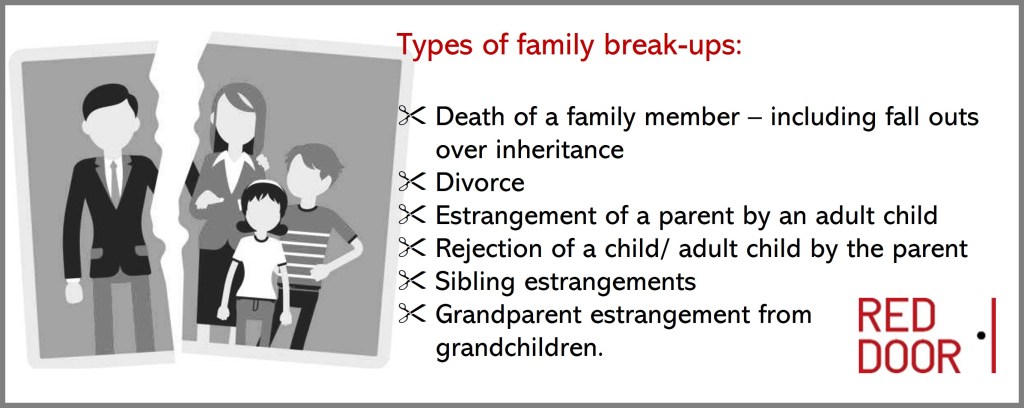
There are a number of ways that families can break-up. Death of a family member, divorce, rejection of a child by a parent, break ups due to strained adult sibling relationships, and, the topic of this article, parental estrangement by an adult child.
A few years ago I received a text from a parent living in Europe. Mary*. Mary’s son, John*, lives in Hong Kong and Mary was looking for a way to reconnect with him. She detailed that John had asked for them to cease contact, for reasons that, “she knows what she had done”. She supplied John’s email address and requested that I broach contact with John to check if he would be willing to engage in family therapy to reconcile their relationship. (*these are not the real names of these individuals)
I reached out to John to see if he would like to start a discussion about what had happened from his perspective, with a view to considering if relationship recovery could be possible. He was clear in his intent to remain estranged. Reconciliation requires two willing parties.
My attention turned to Mary and providing some of the support that she would require to understand her situation and be able to move forward. One piece of “comfort” I could provide is that parental estrangement from their adult children is a growing trend among families. She is not alone.
The trend for adult children to choose estrangement from their parents might be increasing as individuals value their individuality over group membership (ie staying in touch with family) in modern societies. Adult children, more often do not live in the same town or city as their parents. Isay (2007) suggests that members of society are driven by external safety requirements. In times of war families try to stay together. In times of peace, deliberate estrangement seems to become more likely.
Regardless of the societal factors behind the trend of estrangement, adults today seem to feel more enabled to consider separation from their family of origin.
Estrangement is painful and confusing. You will likely be consumed in a haze of emotions including shock and disbelief, shame, anger, rejection and you will be stressed. It is normal to worry and catastrophise over how bad it can be and how long this can last. Unfortunately, estrangement usually lasts a matter of years, rather than a matter of weeks and months.
“When they are adults, our children, posses the ultimate weapon: distancing. In order to keep from feeling hurt or put down, they just recede from us and get on with their lives”. Isay, 2007, Walking on Eggshells.
Why do adult children choose to distance themselves?
I don’t think that adult children are obligated to maintain a relationship with a parent, especially if there has been a history of abuse in the family. Sometimes parents do very little to cause an estrangement. Sometimes they have done a lot.

“However painful the separation, many adult children report that ending the relationship with the parent was the only way they could find to take control over their own lives” Coleman, Rules of Engagement, 2020.
In researching the main causes that adult children choose to distance themselves from their parents the following causes are the most recorded reasons.
Family therapist Joshua Coleman surveyed 1600 estranged parents and suggests that 75% of the cases that he reviewed were estranged as a result of a divorce between biological parents.
While the revelation of a parent’s affair is a lot for a child of any age to work through, it is especially damaging if the other parent uses the affair to punish their ex by poisoning the children’s opinion of that parent.
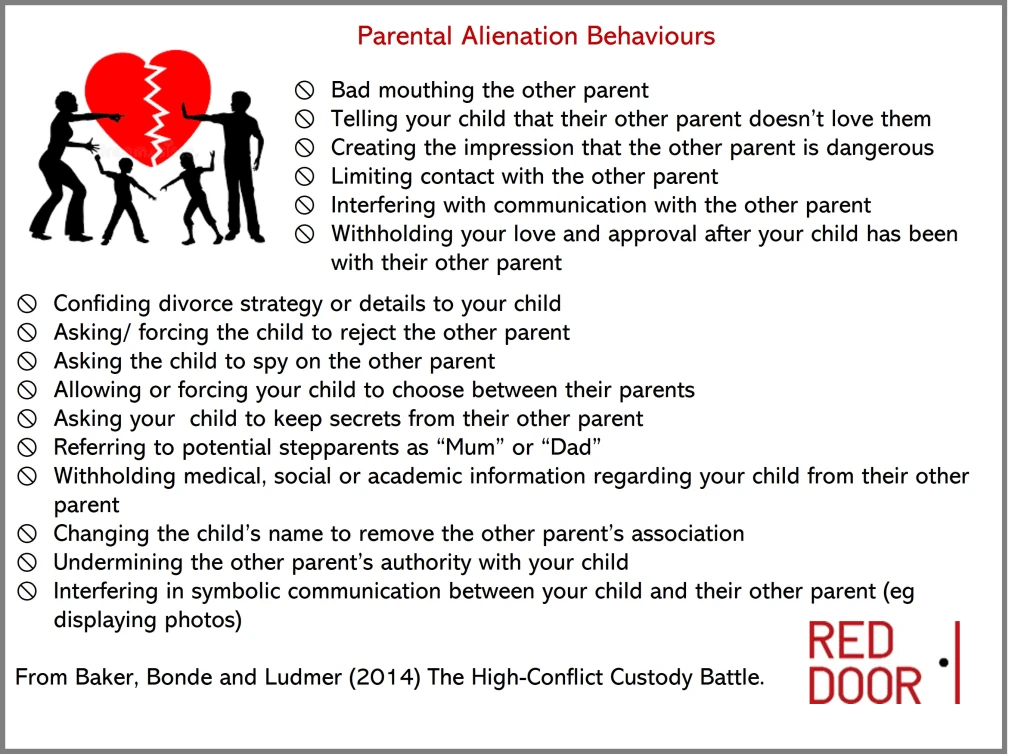
Parental alienation Syndrome (PAS) is a major factor driving some children’s decision (including adult children) to distance themselves from a parent. When one party in a divorce engages in parental alienation behaviours (such as listed below) it can create the circumstances where a child (adult or a minor) may choose to distance themselves from their biological parent.
A word of warning to the those parents utilizing alienation activities – when children identify that they have been exposed to such practices, which can happen when they become adults, this can become a reason that they choose to become estranged from their parent that they believe weaponized and manipulated them during the divorce.
Any discussion of reasons why adult children reject their parents has to include the impact of third party influencers. Your child’s romantic partner, or their family may be partly involved in their decision to distance themselves.
If your child is struggling with mental health issues, they may choose to become estranged as part of that condition, or because of their shame attached to their condition. Addicts, particularly if they are not ready to consider recovery, do not like their families to witness their struggle.
If your adult child has felt suffocated or controlled during their childhood they may feel like they have no means to become self determining that involves your parenting style.
Studies have showing that differential treatment – where parents behave more positively toward one of their children (favoritism) can affect the overall well-being of children even after they have grown. Whilst this is only one of the potential causes of ongoing sibling conflict, it may be one of the reasons that sibling conflict can split up the family of origin.
If parents expect their children to mirror their own values and beliefs this can cause particular challenges. Gay adults find it extremely difficult to maintain relationships with parents who are rejecting of their identity. In such circumstances parents will need to consider the price of the reconciliation. They can have a relationship with their gay adult child, or no relationship with their preferred/imagined straight offspring. Differences in viewpoints can break down connection.
Can you reconcile?
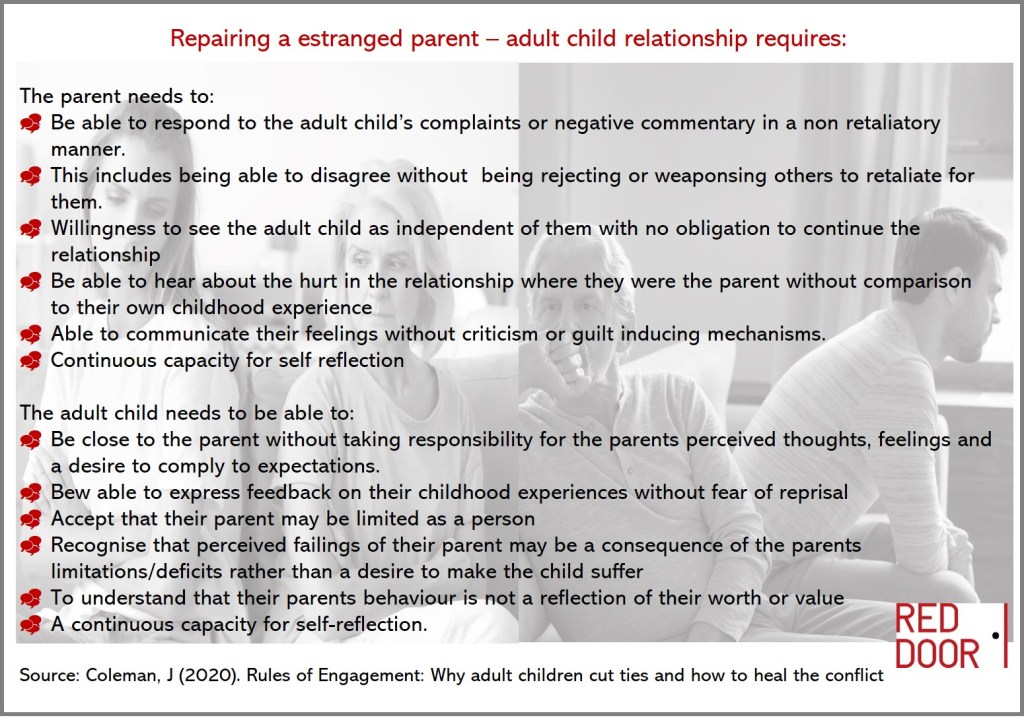
When a parent reaches out to facilitate a reconciliation I make no assumption about their guilt or innocence in regard to claims by their adult child. What I want to emphasize is that if you want things to be different, it will require change on the part of the parent. It is important that the estranged parent ties to empathize and understand their perspective of their adult child. This doesn’t mean that you are saying that the adult child is right, you need to consider to stop telling them that their perspective is wrong, or invalid.
It is easy, but not productive to resist the need to empathize or change. You might feel you have done nothing wrong. You might believe that being willing to listen to your child’s version of events will reinforce their immaturity, reinforce the position of other, third, parties, or be used against you. You may even fear that becoming tolerate to your child’s narrative might make you feel bad about yourself. Being vulnerable is sometimes more possible if a family therapist drives the reconciliation process.
In the below graphic we detail some of the elements each party needs to be prepared to commit to in order for reconciliation to be possible:
As I detailed in the case of Mary and John at the beginning of this blog, it takes two collaborative parties to make reconciliation possible. Often a family therapist provides the space and perspective required for each party to be able to express themselves in a constructive manner where their feelings can be managed. Even then success is not guarenteed.
You may therefore need to consider how you will survive the estrangement, whilst you hope that reconcilation may become possible.
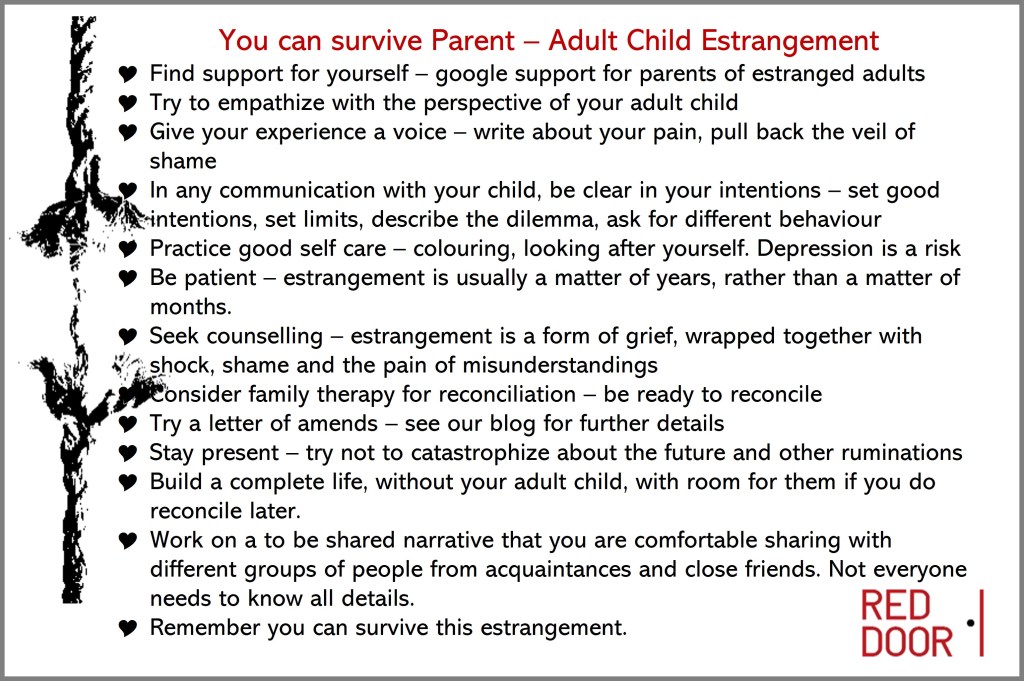
How to survive Parent- Adult Child Estrangement.
It is extremely distressing to be cut off from any group, and particularly if your own child decides to distance themselves from you. From my work, and research on this topic I have the following practices that you can consider.
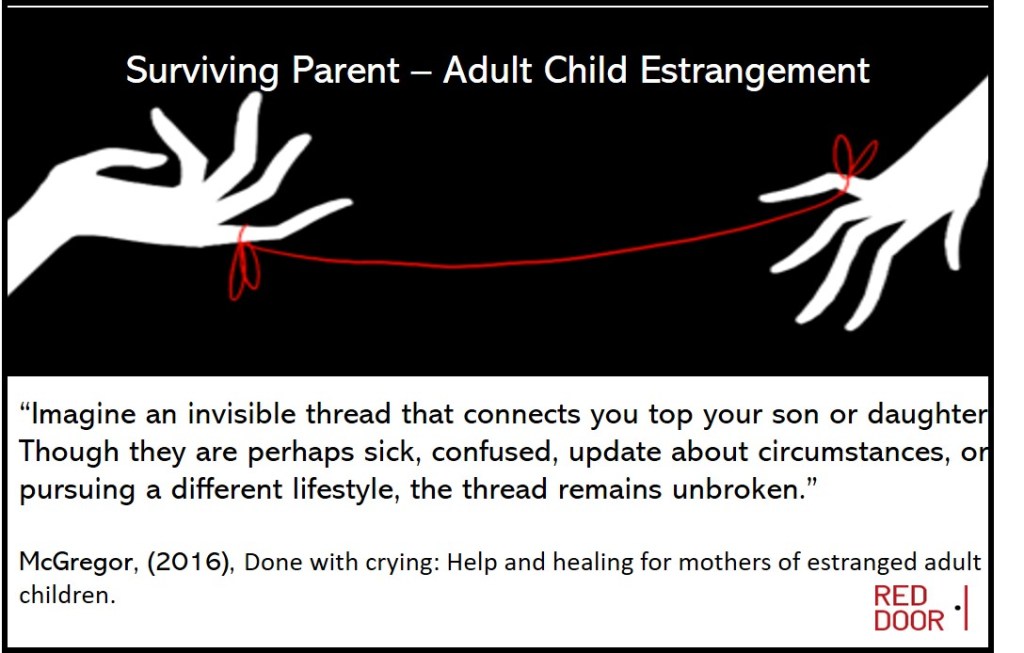
If you are going though any challenge to your mental health, including estrangement from your child, find a support group if possible. Your experience is unique to you, but not uncommon in society. Find a physical or online support group. Google search for parents of estranged adults to see if you can find a forum online or in person.
Empathizing with your adult child is an essential ingredient of reconciliation. Take some time to reflect on their experience. For example – what pain could you acknowledge may have been hard for them. Is it possible that you have dismissed this pain or invalidated your child’s experience? Even if your adult child continues to distance themselves, these reflections may make it more possible for you to forgive them for their choice.
Give your experience a voice. Estrangement is painful. Write about your pain. Try to capture your thoughts so that you can reflect upon them. Write about the shame that you might be experiencing. Challenge if you need to really feel ashamed. Social media paints pictures of families wrapped up together in a loving embrace. Many of those images are fabrications, not reality.
Be careful in any communication with your child. Be careful not to create further reason for estrangement. It may be tempting to lecture your child . It is reasonable to expect you treat you with the kindness and sensitivity that you expect from any other adult, but understand they want to be heard and respected as well. Communicate at a frequency that you are comfortable with. For example you might choose to communicate around significant dates – birthdays and Christmas etc. Consider a letter of amends.
Joshua Coleman recommends that his clients (parents) write a letter of amends to their adult child. This letter shows you care. Such a letter will demonstrate that that you are willing to model reflecting, taking responsibility and offering an apology. This letter can help clarify what you accept and take responsibility for in the parent-child relationship whilst emphasizing that no harm was intended within that relationship. This letter provides proof that you acknowledge that your child is now an adult, and able to make the decision to continue to distance but you would like them to consider an alternative. In writing the letter you can demonstrate that you can take responsibility for yourself, whilst also offering yourself some self-compassion.
Counselling – both regarding the reconciliation, and for yourself will help you frame your emotional state, explore your responsibilities, and consider a path forward. Counselling can help you address the shame and the weight of the stereotype of the pitiful rejected parent.
You will need to spend time, with your counsellor, or on your own capturing your thoughts and ruminations. It is hard to understand what to do, and how to process some of these thoughts on your own.
Whilst you wait for reconciliation, do you not put your life on hold. Make friends, spend time with people.
You decide what you share with other people about the condition of your relationship with your adult child. You can be honest, but economical, about the estrangement with new acquaintances. For example you do not need to explain the whole situation to everyone. If you are asked if you have children, you can simply say, “I have a child but we are estranged at this time”. You do not owe anyone the backstory.
Remember you can survive.
About the author of this article: Angela Watkins is a counsellor at RED DOOR Counselling helping adults, teens and families navigate various mental health challenges including divorce, special educational needs, family relations, romantic relationship challenges, substance dependence, depression, self-harm, and recovery from abuse.
Parent – Adult Child Estrangement books
Coleman, J (2020) Rules of Engagement: Why adult children cut ties and how to heal the conflict [RECOMMENDED]
Isay, J (2007) Walking on eggshells: Navigating the delicate relationship between adult children and parents.
McGregor, S (2016) Done with crying: Help and healing for mothers of estranged adult children [RECOMMENDED]
 Start your Red Door Journey