Career Insight: Re-entering the job market after a career break

Career breaks have become increasingly common, with 62% of the global workforce having taken time out from employment at some stage, according to LinkedIn data. A gap that so many have previously taken pains to conceal is now out in the open and recognized by LinkedIn. Since 2022, the employment-focused social media platform has included “career break” as a profile category, which has helped to normalize the experience. Thankfully, the perception of taking a break is shifting, no doubt assisted by the great leveller that was the coronavirus pandemic.

Despite reduced stigma, countless doubts and fears can consume individuals contemplating a return to the workforce. Irrespective of whether a break is voluntary, such as extended maternity leave, or otherwise, as in the case of redundancy or trailing spouses, the struggles can be much the same.

We discuss some of the common feelings and challenges that can paralyze and prevent you from moving forward while also considering action that you can take, not to mention the positives that can also be gained from this period.

What you might be experiencing:

Sense of overwhelm and lack of direction

The prospect of job hunting can feel daunting and overwhelming when you don’t know where to begin. There are also different levels of anxiety, which may be correlated to how long you have been out of the market. For example, 6 months or a year may feel relatively tolerable to some, whereas 5 or 10 years would comparatively induce a lot more fear. You may be struggling to make sense of your purpose. Sometimes, it is easier to start with or have more certainty over what you don’t want to do as opposed to knowing what you want to do. For instance, you may have done some reimagining during your break and now wish to reposition yourself but do not know where to start or how to go about making the necessary changes. Jumping into the unknown can be terrifying, and following through takes both strength and courage. Connecting with a counsellor may help you find some of the answers to those deeper questions as you navigate this life transition so that you can move forward with confidence and a clear direction.

Lack of confidence and loss of identity

You may have lost sight of your former professional self after being away from the workforce for so long. This may trigger feelings of self-doubt and affect your confidence, given one’s identity can be so bound up in work. You might be thinking, who’s going to hire me or what do I have to offer? Although you may now feel irrelevant, life experience is invaluable. Part of the fear can be attributed to the stigma attached to a break, though that perception is now weakening. Don’t overlook any experience you may have gained, such as through volunteering, or any contributions you may have made to your community during your break, despite these being unpaid. These experiences enhance your profile and differentiate you. Maximize your potential by recognizing the gains and giving yourself credit.

Imposter syndrome and self-limiting beliefs

Career gaps can breed insecurity and cause you to question your skills and viability as a candidate, and uncertainty surrounding the job search can further amplify any fears. Focusing on your weaknesses can lead to procrastination, and fear of rejection can prevent you from even applying for jobs. You may have already applied to a few jobs and had some knock backs. However, looking for a job is a full-time job, it isn’t meant to be easy, nor does it happen overnight. It is easy for negative thoughts to spiral if you do not actively check and challenge them. To silence that inner critic, it is important to gather evidence, reflect on your career, review your accomplishments, note any highlights or promotions you’ve received, and note any transferable skills for those contemplating a pivot. Don’t downplay your achievements; try asking friends or family what they see in you to gain another perspective.

Steps you can take to better understand yourself, recognize your potential, and find meaningful work:

Pause and seek help

Take a moment to recognize and acknowledge your emotions. Confide in your loved ones. There is no need to go it alone; whether you are needing to offload or obtain advice, things will feel less intense and overwhelming once you start to voice and breakdown your struggles and concerns. It isn’t easy jumping straight back in after a break, so it’s perfectly normal to experience some discomfort. Enlisting the help of a counsellor could be beneficial to process any emotions, bounce thoughts, and find tools to better cope with the uncertainty of the job search process.

Reframe your thinking and reflect on your strengths and values

There can be benefits to taking a break in that it allows you to reset and gain perspective and clarity. Take the time to evaluate whether you are on the right path; consider what worked for you in your former chapter and what didn’t. What are your priorities, and have these evolved over time? Do you now wish to explore new opportunities? Think about what motivates you versus what drains you; what is important to you? It can be helpful to define your core values, as if your career is misaligned, you are likely to feel disengaged and unfulfilled.

Similarly, recognizing your strengths should direct you towards a job that is more rewarding and enjoyable. Reflect on what differentiates you from others and what skills come easily to you. You may be interested in taking a psychometric test such as the Gallup Clifton Strengths Assessment to uncover more of your unique attributes and learn how to optimize your potential. If you are seeking to pivot into a new career or are in a new market (country), what transferable skills do you have? Do you need to reskill or upskill? How can you make your profile more compelling to potential employers? We’re often so critical of ourselves and have our personal blind spots, so speaking to a friend, a career coach, or a recruiter could prove enlightening.

Put yourself out there and tap into your community

Create a plan, and rather than focusing purely on the outcome, think about what small steps you can take to move you closer to your goals. Talk to people and network; go to industry events; gather information; and gain insight into market trends and gaps. Let people know that you are thinking about returning to work and reconnect with former colleagues or acquaintances in your chosen field. You never know what leads, introductions, or ideas you might get, and this engagement and process of discovery is likely to revitalize you. Connect with headhunters, a career coach, your alma mater, update your CV, and optimize your personal branding – ensure your LinkedIn profile is marketing your expertise to allow for direct approaches.

Lastly, manage your expectations and be realistic about what you can achieve and your timeframes. If you harness your network, you are likely to find a job much quicker than you can on your own. And remember when you get rejected, try, try again.

About the Author:

This  blog is written by Tanya Knott. Tanya focuses on the following areas in her practice: Life transitions. Career coaching. Grief. Anger management. Stress management. Anxiety. Depression. Sleep issues. Individual relationship issues. Mindfulness.

Tanya is a counsellor and psychotherapist at RED DOOR. Her practice is informed by 15+ years of HR and recruitment experience and evidence-based techniques such as CBT and Mindfulness. She is passionate about helping those who feel lost or overwhelmed when faced with uncertainty or challenging life transitions. Through guiding her clients to develop greater self-awareness, she helps them identify tools and coping strategies to better navigate any challenges that life may bring.

Contact the RED DOOR reception to set up an appointment with Tanya. reception@reddoor.hk

#careerbreak #careerchange #jobsearch #anxiety #counselling #careercoaching #perseverance #strengths #gallup #cliftonstrengths #reddoorcounselling

Warning signs: when to consider couples’ counselling.

warning signs

Can couples counselling save your marriage?


Whilst most counsellors would like to say an unequivocal “YES” to this question, reconnection is very dependent on the couple, the history of their relationship, the degree of contempt in the relationship, the commitment of both parties to try to work at the relationship, and of course, the involvement of other parties.


When couples come to me for counselling the first diagnostic that I look for is the “sign of life”. We’re these people happy together once? If they were happy once, and both believe this, this is a promising sign of life and hope for the relationship. There will still be a lot of work, but you cannot make something that was never good into something great, but you can, again, like someone who you once loved.


The reality of couples counselling is that some couples  come to counselling after a serious disruptive act – such as having an affair, long standing contempt, and the echo of other significant life events (death of a parent, loss of work).  Whilst walking back from those challenges can be accomplished, it may be better to consider counselling when there are warning signs, rather than war wounds.


You are having the same argument again and again, for more than 6 months. Sometimes these arguments are a cover for other, even more complicated issues. Counsellors can help couples learn to communicate more effectively, and also dissect underling issues.


You live separate lives from one another. If you feel like you are more like flatmates than life mates. The process of counselling may help you build positive shared goals and set rules of engagement to help you reconnect Sometimes marriage partners feel determined, because of past hurst (inside or before the marriage) to express their independence from their partner. Counselling may help you face and resolve the opportunity to reconnect and enhance your shared feeling of like, and love.


You want different things out of life from your partner. Once upon at time you may have been best friends, and shared everything. As we grown, partners can become disconnected, especially as children enter the equation. A love relationship requires investment. People can change, and you may believe different things, but could an remain connected. A counsellor could help you navigate your shared values and help build better connectivity.


Intimacy is lacking. Intimacy is not just sex. All affection – hand holding, touching, kissing, and sex, matters. Couples counselling can help partners describe and discuss the reasons behind their challenges to intimacy.


You or your partner is tempted to have an affair. Relationships can be significantly damaged by disruption to expectations of exclusively. Even harmless Facebook flirting with ex-partners. Couples counselling can help individuals connect and consider their needs of their ego, and their current relationship.


Trust has been broken. Trust is the foundation of a healthy relationship. When we do not trust our partner, we may try to build defences around ourselves and these compromise our future of the relationship in our relationship. Trust is an essential, yet fragile, component of relationships. Counselling can help couples explore reasons to trust (or not) and their own personal values and viewpoints that compromise their barriers to trust in the future.

Counselling can help couples reconnect. When choosing a couple counselling options you will find different modes and options. At RED DOOR we are the only provider in HK to provide the Conjoint therapy of Couples Counselling.

The advantage of Conjoint therapy in Couples Counselling. The model we use at RED DOOR. At RED DOOR we use the conjoint couples therapy approach. In Conjoint therapy two therapists work with the couple during couples’ sessions and then one counsellor will meet with you for any one-on-one sessions. This is an advanced method of couples therapy. Since there are two therapists in the room there is less chance of either of the partners feeling blamed, or favoured. If you have felt that any previous couple therapist sided with you, or your partner, you will appreciate the objectivity and inclusion that this model supplies. There are a number of therapeutic options available in the conjoint model including pairing vs individual counsellors , role play and modelling of problems and techniques, as well as  break-out sessions within couples sessions (which is helpful if one client becomes flooded, or some negotiations are required) . This model also keeps the therapist moving sessions forward constructively. Often if sessions become heated much of a therapist’s attention is moved towards “traffic control”. Traffic control whilst necessary, is not the goal of therapy. Therapy is to help blockages in communication and find the right tools and skills to help remedy the problems. Having a second therapist on hand helps keep the therapeutic goal on track. In conjoint-couples therapy you each have someone who understands each of your perspectives in the room. The team of counsellors work with you, and together to formulate a plan to understand and overcome the challenges in your relationship. At RED DOOR, we use a Gottman informed approach, but will also include emotionally focused therapy, CBT and narrative therapy tools. Because two therapists are involved there are cost implications. At RED DOOR we try to manage this by asking each of the therapist to reduce their standard fee for the sessions.

If you don’t feel ready, or your partner will not go to counselling, you might consider reading relationship building books

I personally like Gottman & Silver, “The seven principles for making marriage work” and M. Kirshenbaum’s “I love you, but I don’t trust you”. For some quick ideas to reconnect, please see our blog on making your relationship better:  https://reddoorhongkong.wordpress.com/2019/02/14/make-your-relationship-better/

Best of luck keeping your relationship on track. Please remember the words of American relationship psychologist Barbara De Angelis , “Marriage is not a noun; it’s a verb. It isn’t something you get. It is something you do”.

#reddoor #couples #relationships #trust #mentalhealthessentials
How to (really) get over a break up

If you’re reading this you are likely in the throes of grief and struggling to move on from an ex. Perhaps they’re always on your mind. Perhaps your days are clouded by their absence. Maybe you can’t stop yourself from scrolling through their social media, or messaging them. Possibly you still dissolve into tears. Being rejected and the ensuing heartbreak can sometimes feel absolutely unbearable.

But it’s ok.

You’ll take it step by step, day by day. And you’ll come out the other side. Here’s how:

Why is this so fricking hard?!

There are multiple reasons why this feels like the end of everything.

You’re grieving the future.  AND the life you planned together. You’re grieving the loss of a best friend and companion. The loss of your routine. The loss of security.  You’re having trouble accepting the finality of it all. You’re even grieving the version of the person you thought you’d grow into with them.

You’re experiencing physiological shock. The emotional shock from a breakup causes acute stress, fear and anxiety (thanks to the stress hormones norepinephrine and cortisol being released). This causes symptoms such as having trouble sleeping, digestive  issues, headaches and more. In fact it’s been shown that when we’re going through a heartbreak it activates the same regions of the brain  that are responsible for processing physical pain.

You’re going through withdrawal.  Without the oxytocin hits from our exes, our brains can experience a      withdrawal effect similar to people who are going through drug  withdrawal. No wonder we feel it emotionally and physiologically.

You think you’re an unloveable   –  a  failure. It’s easy to think that being rejected means you meant nothing. That your    ex’s decision means your entire relationship was worthless to them. This is a powerfully destructive story we tell ourselves, and we end up convinced we are unloveable and hold no value. The happy truth is that of course we are loveable and valuable, and people can and will love us. We  can be absolutely worthwhile and still have our partner leave us. That’s life, it sucks and that’s ok.

You’re holding onto false hope.  If only that one (or two or three) problem would resolve! If only one little thing about them or you could change! If only they could see the potential you see! We’re convinced we can persuade them to try one more time. We torture ourselves with hope and the illusion of possibility.

You have nothing else.  Breakups are particularly tough on those who feel they have lost everything, instead of just losing a lover. Those who lack purpose, strong social connections, hobbies, a community and (or) financial security tend to struggle the most.

Counselling can help.

If you find your feelings of sadness, hopelessness and apathy are overwhelming you then counselling will be beneficial. For example,  if these feelings start disrupting your daily life (cancelling plans, withdrawing from friends, calling in sick to work) or if you cannot see a way past this (feelings of hopelessness and/or helplessness).

If you also realise your emotional, intellectual, physical and social needs were mostly dependent on your partner, counselling would help you lead a more fulfilling life by building your self-esteem and mapping out how to build a social support network.

The good news

You  won’t grieve on just one occasion. You’ll grieve every time you notice the loss. But processing that pain will bring you closer to healing. Every morning you will wake up with a little less heaviness in your heart.

The good news is you don’t need your ex to recover from this. You don’t need them to give you closure. Infact you may have to accept that they might not give you closure (and you can’t make them). Your healing has nothing to do with your ex. It has everything to do with you, your perspective, your actions, and of course the passage of time.

How to get yourself out of the hole

Firstly…

Accept the breakup and feel  everything!  Cry, scream, sulk and laugh your way through this. It’s proven that talking through a breakup can help expedite the grieving process as long as self-reflection is involved, instead of just pure wallowing. Not accepting a breakup is also not only unhelpful for you, but also disrespectful towards your ex who has every right to do what they choose. As do you.

Next, do the internal work. There is an increasing amount of evidence that states self reflection, and a process known as self re-organisation can help with getting over a breakup. Difficult breakups are usually because we go from feeling the loss of our ex, to believing that their rejection means we and the relationship we shared are now worthless to them. It’s time to let that ruinous story go with some inner work.

Take accountability.  Why did the relationship end? How did you contribute to the issues in this      relationship? What destructive or negative patterns kept repeating throughout? Take control of your thoughts and use them to identify where you went wrong. Maybe you need to look at your attachment style and love      language. Maybe you need to reflect on why some of your destructive patterns keep popping up.

Analyse your relationship  truthfully.   Following on from point #2, ask yourself if your needs were actually met  with your ex. Did you feel free to share your needs, thoughts and      feelings? Did you have shared values? Did you feel lonely? Unheard?   Misunderstood? Did you tread on eggshells? Did you unfairly put all of  your needs on them?

Figure out your ideal relationship.  Map out what a healthy and loving relationship looks like to you. How do you resolve conflict? What do you do together on the weekends? What are  your relationship needs? What are your deal breakers?

Look at your post-break up behaviour.      It is unhealthy to obsess over your ex. This could look like constantly      calling or messaging them, continuing to ask to meet and cannot stop contacting them and habitually viewing their social media. If this sounds  familiar then this is your cue to look at your life and decide to make some  changes. You need to respect your ex’s right to make this decision. You cannot make someone love you or want to stay with you. Secondly this obsessive behaviour is often indicative of a life that is empty. Your ex cannot save you from your life. You need to honestly ask yourself if you are lacking purpose, meaningful friendships and community. Obsession is a way to distract yourself from the agony of accepting the end, but it is destructive and can cause shameful thoughts further down the road.

Create distance from them, and make space for yourself.

Stay busy.  Date yourself! Take yourself out. Try new things. Fill your calendar with      fun things to do with your friends or by yourself. Don’t have a self-care routine? Make one and do it. Make space in your life for the things you enjoy such as returning to old hobbies or starting new ones, or prioritising heading to the gym for the endorphin hit and community atmosphere.

Distance yourself.      Delete or archive emails, photos, messages and phone numbers. Use an  external hard drive if you need to. Put all of this somewhere you cannot  easily access. In this same vein, block their socials and return or throw  out physical reminders. If you can’t stand the thought of this then temporarily move physical reminders into a storage box and put it away. If  you have to contact them, use a mediator.

Ask for help.  Your friends aren’t mind readers. Ask them for help if you need it. Be the one to text first, call or suggest a meetup. Make space for your support system to actually be there. Spread the net wide so as to not overwhelm one person.

Go on an adventure.      An adventure not only provides an exciting break in your routine, but it      removes you from the world where your ex is missing. It can do absolute wonders. Have you ever dreamed of getting to Everest base camp? Doing a  wine tour in France? Going on safari in Kenya? Doing a local camping trip      you never made time for? Spoiling yourself at the spa for a full weekend?   Now’s the time to do it.

Remember

You and your ex could only do the best you could at the time, with the tools you have, at the stage of life you were in. A rejection is not a sentence or a judgment on you, it is more so a reflection on where your ex is at.

Ultimately you do not want to be with someone who doesn’t want to be with you. You deserve far more than that. You deserve someone who chooses you as their life partner and teammate. And who needs no persuasion to do so. When you believe these words you will know you’ve healed.

Step by step. Day by day. You’ll be ok.

This week’s blog is written by Kirsteen Thain. Kirsteen focuses on the following areas in her practice: Self esteem. Body acceptance.  Anxiety.  Relationship issues. Couples counselling.

Kirsteen is a counsellor and psychotherapist at RED DOOR.  Years in the corporate and fitness world informs Kirsteen’s psychotherapeutic style.  Kirsteen’s approach addresses current and situational issues, as well as maladaptive thoughts and behaviours that stem from childhood or previous trauma. Contact the Red Door reception to set up an appointment with Kirsteen. – reception@reddoor.hk

When families break-up: Parent- Adult Child Estrangement.

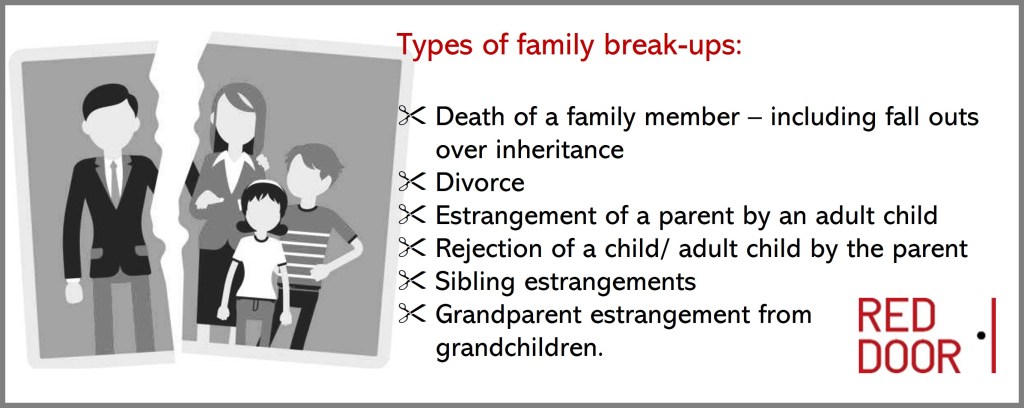
There are a number of ways that families can break-up. Death of a family member, divorce, rejection of a child by a parent, break ups due to strained adult sibling relationships, and, the topic of this article, parental estrangement by an adult child.

A few years ago I received a text from a parent living in Europe. Mary*. Mary’s son, John*, lives in Hong Kong and Mary was looking for a way to reconnect with him. She detailed that John had asked for them to cease contact, for reasons that, “she knows what she had done”. She supplied John’s email address and requested that I broach contact with John to check if he would be willing to engage in family therapy to reconcile their relationship. (*these are not the real names of these individuals)

I reached out to John to see if he would like to start a discussion about what had happened from his perspective, with a view to considering if relationship recovery could be possible. He was clear in his intent to remain estranged. Reconciliation requires two willing parties.

My attention turned to Mary and providing some of the support that she would require to understand her situation and be able to move forward. One piece of “comfort” I could provide is that parental estrangement from their adult children is a growing trend among families. She is not alone.

The trend for adult children to choose estrangement from their parents might be increasing as individuals value their individuality over group membership (ie staying in touch with family) in modern societies. Adult children, more often do not live in the same town or city as their parents. Isay (2007) suggests that members of society are driven by external safety requirements. In times of war families try to stay together. In times of peace, deliberate estrangement seems to become more likely.

Regardless of the societal factors behind the trend of estrangement, adults today seem to feel more enabled to consider separation from their family of origin.

Estrangement is painful and confusing. You will likely be consumed in a haze of emotions including shock and disbelief, shame, anger, rejection and you will be stressed. It is normal to worry and catastrophise over how bad it can be and how long this can last. Unfortunately, estrangement usually lasts a matter of years, rather than a matter of weeks and months.

“When they are adults, our children, posses the ultimate weapon: distancing. In order to keep from feeling hurt or put down, they just recede from us and get on with their lives”. Isay, 2007, Walking on Eggshells.

Why do adult children choose to distance themselves?

I don’t think that adult children are obligated to maintain a relationship with a parent, especially if there has been a history of abuse in the family. Sometimes parents do very little to cause an estrangement. Sometimes they have done a lot.

“However painful the separation, many adult children report that ending the relationship with the parent was the only way they could find to take control over their own lives” Coleman, Rules of Engagement, 2020.

In researching the main causes that adult children choose to distance themselves from their parents the following causes are the most recorded reasons.

Family therapist Joshua Coleman surveyed 1600 estranged parents and suggests that 75% of the cases that he reviewed were estranged as a result of a divorce between biological parents.

While the revelation of a parent’s affair is a lot for a child of any age to work through, it is especially damaging if the other parent uses the affair to punish their ex by poisoning the children’s opinion of that parent.

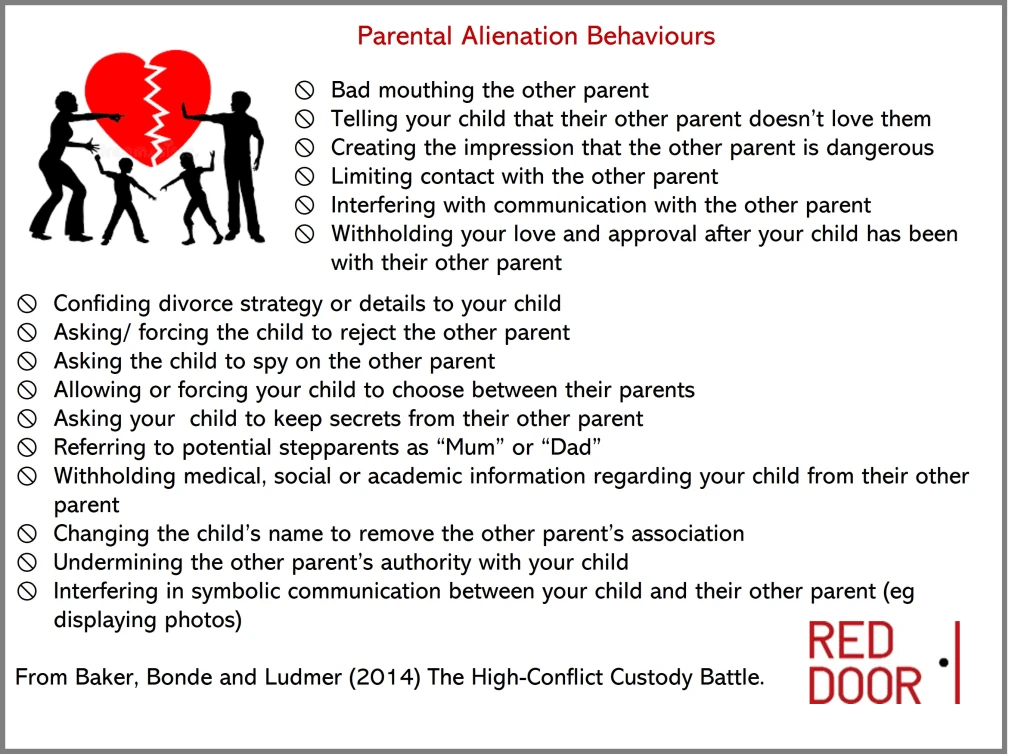
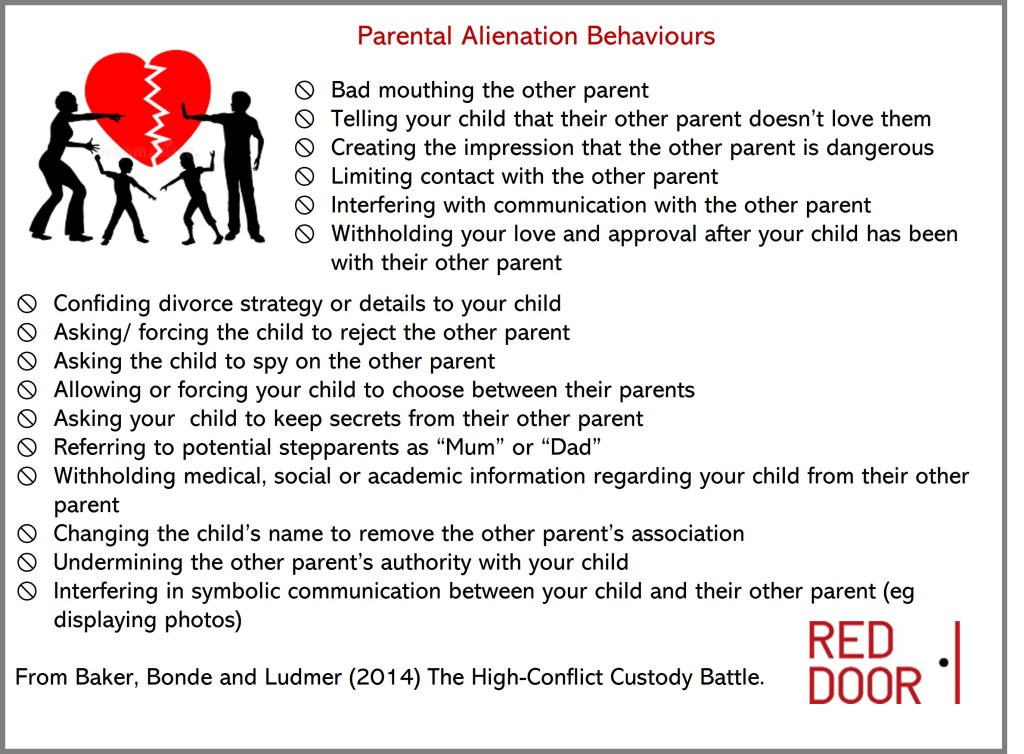
Parental alienation Syndrome (PAS) is a major factor driving some children’s decision (including adult children) to distance themselves from a parent. When one party in a divorce engages in parental alienation behaviours (such as listed below) it can create the circumstances where a child (adult or a minor) may choose to distance themselves from their biological parent.

A word of warning to the those parents utilizing alienation activities – when children identify that they have been exposed to such practices, which can happen when they become adults, this can become a reason that they choose to become estranged from their parent that they believe weaponized and manipulated them during the divorce.

Any discussion of reasons why adult children reject their parents has to include the impact of third party influencers. Your child’s romantic partner, or their family may be partly involved in their decision to distance themselves.

If your child is struggling with mental health issues, they may choose to become estranged as part of that condition, or because of their shame attached to their condition. Addicts, particularly if they are not ready to consider recovery, do not like their families to witness their struggle.

If your adult child has felt suffocated or controlled during their childhood they may feel like they have no means to become self determining that involves your parenting style.

Studies have showing that differential treatment – where parents behave more positively toward one of their children (favoritism) can affect the overall well-being of children even after they have grown. Whilst this is only one of the potential causes of ongoing sibling conflict, it may be one of the reasons that sibling conflict can split up the family of origin.

If parents expect their children to mirror their own values and beliefs this can cause particular challenges. Gay adults find it extremely difficult to maintain relationships with parents who are rejecting of their identity. In such circumstances parents will need to consider the price of the reconciliation. They can have a relationship with their gay adult child, or no relationship with their preferred/imagined straight offspring. Differences in viewpoints can break down connection.

Can you reconcile?

When a parent reaches out to facilitate a reconciliation I make no assumption about their guilt or innocence in regard to claims by their adult child. What I want to emphasize is that if you want things to be different, it will require change on the part of the parent. It is important that the estranged parent ties to empathize and understand their perspective of their adult child. This doesn’t mean that you are saying that the adult child is right, you need to consider to stop telling them that their perspective is wrong, or invalid.

It is easy, but not productive to resist the need to empathize or change. You might feel you have done nothing wrong. You might believe that being willing to listen to your child’s version of events will reinforce their immaturity, reinforce the position of other, third, parties, or be used against you. You may even fear that becoming tolerate to your child’s narrative might make you feel bad about yourself. Being vulnerable is sometimes more possible if a family therapist drives the reconciliation process.

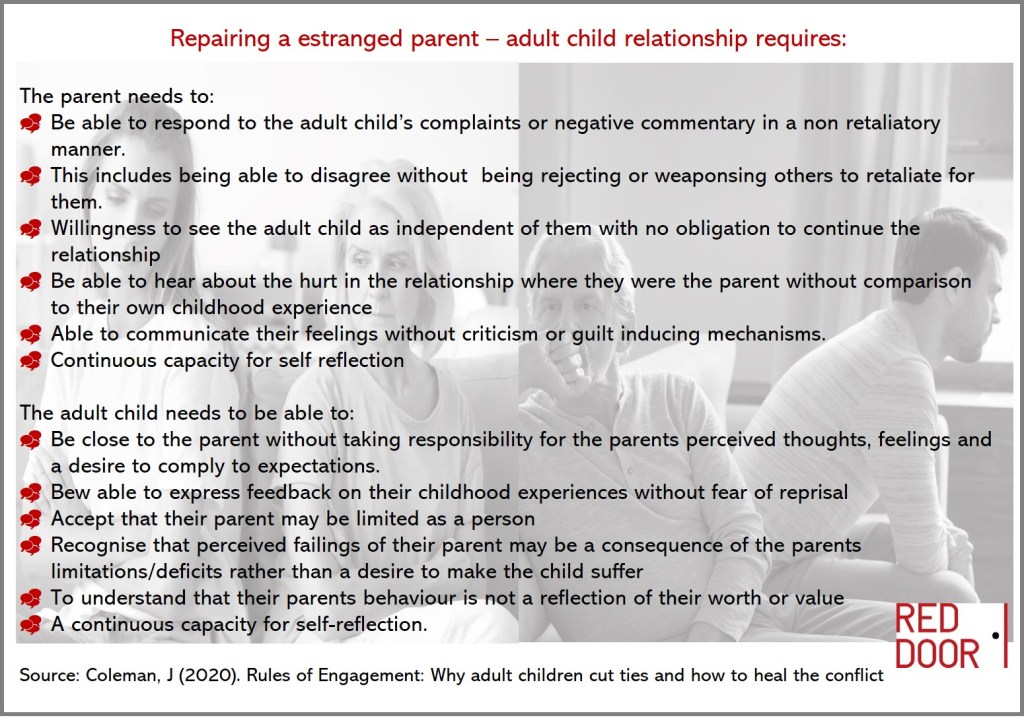
In the below graphic we detail some of the elements each party needs to be prepared to commit to in order for reconciliation to be possible:

As I detailed in the case of Mary and John at the beginning of this blog, it takes two collaborative parties to make reconciliation possible. Often a family therapist provides the space and perspective required for each party to be able to express themselves in a constructive manner where their feelings can be managed. Even then success is not guarenteed.

You may therefore need to consider how you will survive the estrangement, whilst you hope that reconcilation may become possible.

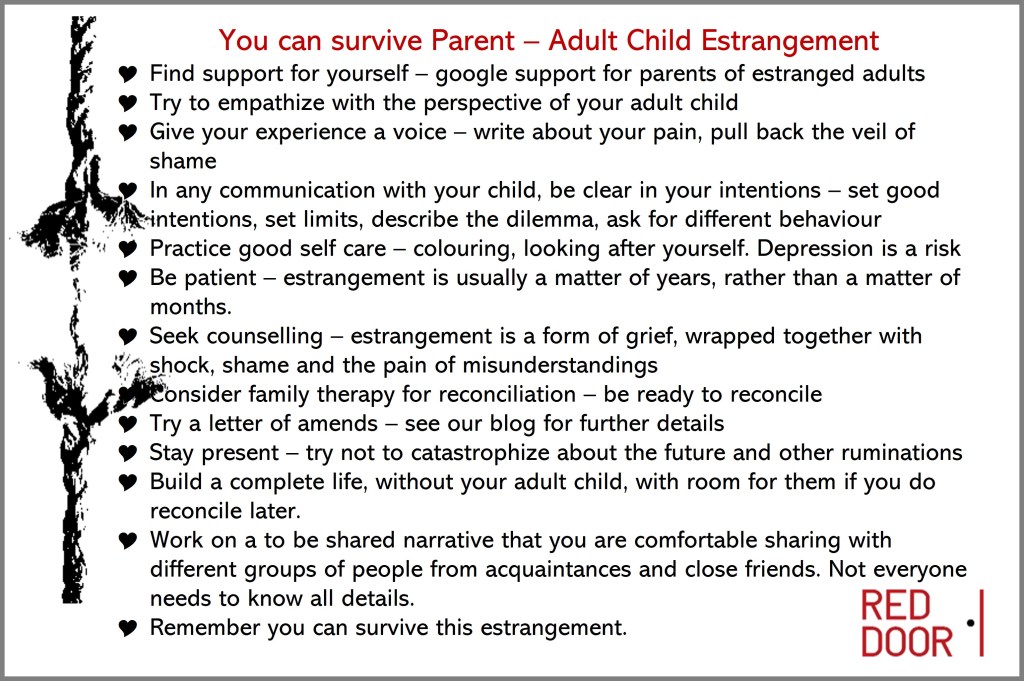
How to survive Parent- Adult Child Estrangement.

It is extremely distressing to be cut off from any group, and particularly if your own child decides to distance themselves from you. From my work, and research on this topic I have the following practices that you can consider.

If you are going though any challenge to your mental health, including estrangement from your child, find a support group if possible. Your experience is unique to you, but not uncommon in society. Find a physical or online support group. Google search for parents of estranged adults to see if you can find a forum online or in person.

Empathizing with your adult child is an essential ingredient of reconciliation. Take some time to reflect on their experience. For example – what pain could you acknowledge may have been hard for them. Is it possible that you have dismissed this pain or invalidated your child’s experience? Even if your adult child continues to distance themselves, these reflections may make it more possible for you to forgive them for their choice.

Give your experience a voice. Estrangement is painful. Write about your pain. Try to capture your thoughts so that you can reflect upon them. Write about the shame that you might be experiencing. Challenge if you need to really feel ashamed. Social media paints pictures of families wrapped up together in a loving embrace. Many of those images are fabrications, not reality.

Be careful in any communication with your child. Be careful not to create further reason for estrangement. It may be tempting to lecture your child . It is reasonable to expect you treat you with the kindness and sensitivity that you expect from any other adult, but understand they want to be heard and respected as well. Communicate at a frequency that you are comfortable with. For example you might choose to communicate around significant dates – birthdays and Christmas etc. Consider a letter of amends.

Joshua Coleman recommends that his clients (parents) write a letter of amends to their adult child. This letter shows you care. Such a letter will demonstrate that that you are willing to model reflecting, taking responsibility and offering an apology. This letter can help clarify what you accept and take responsibility for in the parent-child relationship whilst emphasizing that no harm was intended within that relationship. This letter provides proof that you acknowledge that your child is now an adult, and able to make the decision to continue to distance but you would like them to consider an alternative. In writing the letter you can demonstrate that you can take responsibility for yourself, whilst also offering yourself some self-compassion.

Counselling – both regarding the reconciliation, and for yourself will help you frame your emotional state, explore your responsibilities, and consider a path forward. Counselling can help you address the shame and the weight of the stereotype of the pitiful rejected parent.

You will need to spend time, with your counsellor, or on your own capturing your thoughts and ruminations. It is hard to understand what to do, and how to process some of these thoughts on your own.

Whilst you wait for reconciliation, do you not put your life on hold. Make friends, spend time with people.

You decide what you share with other people about the condition of your relationship with your adult child. You can be honest, but economical, about the estrangement with new acquaintances. For example you do not need to explain the whole situation to everyone. If you are asked if you have children, you can simply say, “I have a child but we are estranged at this time”. You do not owe anyone the backstory.

Remember you can survive.

About the author of this article: Angela Watkins is a counsellor at RED DOOR Counselling helping adults, teens and families navigate various mental health challenges including divorce, special educational needs, family relations, romantic relationship challenges, substance dependence, depression, self-harm, and recovery from abuse.

Parent – Adult Child Estrangement books

Coleman, J (2020) Rules of Engagement: Why adult children cut ties and how to heal the conflict [RECOMMENDED]

Isay, J (2007) Walking on eggshells: Navigating the delicate relationship between adult children and parents.

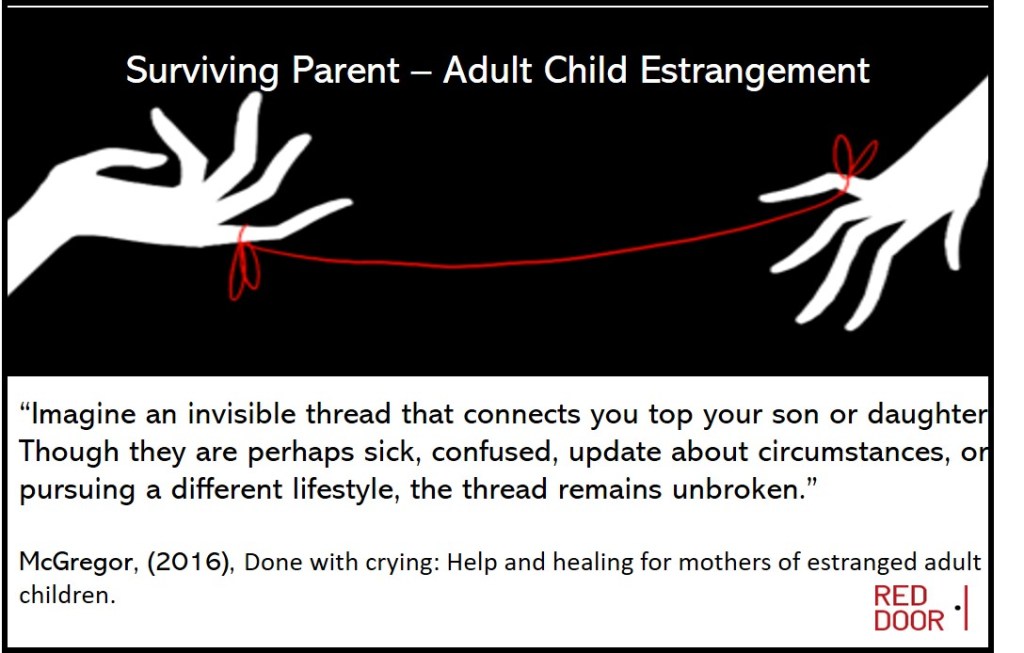
McGregor, S (2016) Done with crying: Help and healing for mothers of estranged adult children [RECOMMENDED]

Break-Up books: Recommendations from the trenches.

divorce books

Here is some advice from the trenches – Six of the best books are recommended, from the participants of our surviving divorce therapeutic support group, and myself, as their counsellor.

No book can help you completely recover from heartbreak. Each of these books may contribute a step in your learning journey: surviving divorce and becoming a new you, especially when used in collaboration with therapy.


1.                 He’s history, you’re not. Erica Manfred

An honest guide to getting through the breakdown of a marriage without it costing you an arm and leg – financially and emotionally. This great book is written from first-hand experience. Recommended for women over 40 years old. hand experience good for women over 40 –especially those left by their partner.

2.                 Crazy time. Abigail Trafford

The break-up of a marriage heralds a year of break down inducing confusion. This book uses real life cases to describe the problems inherent in the marriage and challenges you’ll need to overcome. Recommended for anyone going through divorce.


3.                 You can heal your heart. Louise Hay and David Kessler.

Grief and loss experts blend affirmations and mindful observations to enable the reader to explore their soul and situation in order to grow and find solace. Recommended if you feel like you’ve lost hope


4.                 Leave cheater gain a life. Tracy Schorn

Tracy Schorn, aka the chump lady, provides a wealth of advice amidst heavy doses of humour, to help avoid rookie mistakes, disarm your fears and bounce back. Recommended if you have just recently been dumped.


5.                 Runaway husbands. Vicki Stark

This book explores wife abandonment syndrome, sharing the findings of surveys of 400 women worldwide. If you’ve been abandoned, find the way to turn your loss into an opportunity for empowerment with the information and strategies included in this guide. Recommended for those who have lost long term relationships.


6.                 The good divorce. Constance Ahrons.

Whilst any divorce is unlikely to be described as “good”, there are some smart decisions you can make, some myths you should abandon, and activities to plan to help your family heal. This book uses the results of longitudinal research and the wealth of knowledge gained as a therapist to help guide the reader through the divorce process. Recommended for parents exploring divorce.

If you are going through a painful break-up, one piece of advice I can share comes from the words of Winston Churchill, “When you are going through hell, keep going”.

If you would like to regularly read our RED DOOR blogs – on a range of topics from mental health and wellbeing, resilience, relationships, parenting, anxiety, sadness, addiction, and so much more – please like our FB page:  https://www.facebook.com/REDDOORHongKong/


Angela Watkins is a psychologist and counsellor at RED DOOR Counselling in Hong Kong. Her current clinical work focuses on adults in the areas of, depression, the experience of divorce, anxiety, perfectionism, career change, loss of direction, burnout, relationship and family challenges, OCD, and parenting special needs children.

Minimizing the impact of Divorce/Parental Split on your Children

DIVORCE PIX

Every year there are a significant number of divorces between couples. For example, there are over 20,000 petitions for divorce a year in Hong Kong, over 90,000 in the UK, and over 780,000 in the USA. For those cases involving children produced within the marriage or a long term relationship, parents are usually concerned about the impact a divorce or splitting up may have on their child. As a counsellor helping individuals responding to divorce, I would like to highlight the following guidelines regarding how to best inform children and how to minimize the impact of your divorce on the mental well-being of your child.

How to tell your children about your decision to divorce.

  • Tell the child together as a couple rather than separately, if possible. Children often fear that divorce may mean that they will lose a parent. Telling the child together reinforces your intention that both parents remain dedicated to the child.
  • Consider telling your child at home rather than outside of the home. Inside their own home children can respond in an authentic and real manner.
  • If possible, tell the child in a neutral area of your home such as the lounge or kitchen. Do not tell the child in their bedroom. That room needs to remain an impartial safe zone where they are entitled to retreat.
  • Tell your child at a time when the household is quite calm, not just before bed, or after a long day out or when they must yet complete their homework.
  • Try to be as calm as you can – explain that the marriage is over, but the family is not. You both remain parents to your child.
  • Remind you child that you love them.
  • Make sure you reinforce that the divorce is not their fault. Do not assume they will know this automatically.
  • Children will undoubtedly have many questions. Answer these as fully as you can. It may be better for you and your partner to discuss, and agree, interim living arrangements, before telling your children.
  • If you cannot answer every question when it is asked, communicate that you will intend to answer that question as soon as you can. Some ambiguity is to be expected. At the time that you are informing children of a potential split, your obligation is to help them see that the future will still be positive, and that they are a priority. 
  • Do not allow emotionally hurtful descriptions to be presented by one partner. For example “Daddy is leaving us”, can heighten the pain of abandonment. If your partner paints the scenario in this way, simply correct without judgement. For example, “Mummy is a bit confused. We are splitting up and I am going to live somewhere else, but I’m still your Dad and I am not leaving you”
  • Offer access to counsellors or support networks to allow your child to express their feelings to other people. Whilst they may have many questions for you, they may not initially feel comfortable asking YOU those questions at the beginning.

Building positive practices whilst the divorce is in progress.

divorce advice parenting

It is not a matter of if your divorce will impact your child, the question is how much it will impact your child. Here are my recommendations as to what you can DO, and DO NOT DO, to best support your child.

  • Do understand divorce from the perspective of your child. From their perspective this is a big change so that there may be feelings of grief and fear, and anger, involved. These feelings come in waves rather than all at once. You may have offered counselling at the time when you announced a split. Offer counselling or support options repeatedly over the next year or two.
  • Don’t fight in front of your kids. The divorce should be the END of their experience of parents fighting in front of them.
  • Collaboratively co-parent – working and agreeing together how to respect, negotiate, organise and stay well boundaried when you split, it a superior model of parenting during a divorce. You may need to utilise a mediator or counsellor to help exercise your arrangements.
  • Build an honesty-based, collaborative relationship that resolves conflict, including managing emotions, showing mutual respect, and entering healthy negotiations
  • Be the best version of a parent that you can be for your child. Your divorce need to both rise to meet the needs of your child. You might consider reading a few books about parenting during divorce or attend a parenting effectiveness course.
  • Remember that a clear structure is important to children. They need to know when they are going to see each parent, and what their weekly schedule might look like. If one of the parents refuses to be transparent about the time that they will turn up for your child, allocate them sometimes and move on. Tell the child of the times that have been offered. If one parent does not turn up, it will hurt the child. Be mindful of this.
  • Avoid alienating your child from their other parent. Parental alienation has a serious impact on your child’s relationship with their other parent, so be extremely careful.  There may be deep hurt between the two adults in the relationship, but your child should not be cut off from their parent because of your reaction to this pain. Limiting their access to a parent that they want to see may backfire on you in the long run as children sometimes grow to resent this parent during teen and later years. Do not set yourself up.
  • Believe in your child. You may fear losing your child’s love. Perhaps your ex-spouse has gone into “super-parenting” practice. Your kids might love this. After all who wouldn’t? Let them get all the love they can get. Kids know who looks after them in a crisis.
  • If one parent wants to play Santa-Dad or Santa-Mum let it happen. Most of this behaviour can not be sustained so utilise these moments. If one parent is being very generous, remind your child to ask for that new computer for school, or to ask them to volunteer to run the school bake stall this year. It will not last, so enjoy it whilst it lasts. 
  • Hold the line on positive healthy practices when the child is with you. Agree on a limit for the ipad, bedtime, and guidelines around junk food. That said…..
  • Don’t sweat the small stuff. The occasional muffin is not going to kill a child. Have some perspective on when rules could be bent. If rules become habitually bent, then they are no longer rules.
  • Keep your ex in check. If your child is constantly late picking up or returning the child keep a record and take this up with them, either one to one, or with a mediator. This data may help you negotiate subsequent changes to childcare arrangements.
  • Don’t be fooled by labels. Too many times I have encountered parents who are labelled ‘bad parents’ by their ex, when they are clearly not bad parents. Remember judges have seen these cases countless times, they will ask for proof. Your ex’s opinion of you as a parent is not a fact, or proof. Additionally if your ex tells you that experts say “x,y,z” look this up. I have read some painfully misinformed claims – often cited to frighten, or even bully one partner. Read what experts have to say for yourself. 
  • Do not use your child as a messenger between yourself and your ex. They are not part of your interpersonal conflicts, or your avoidance of conflict. 
  • Do not ask your child to spy on their parent for you. This is extremely destructive.
  • Avoid badmouthing the other parent to your child. Do now harm your child by trying to paint your hurt image of your spouse over their image of their parent. Children often feel that they have to choose sides. Do not encourage this. Over time, applying this pressure, often backfires on the person trying to force the child to choose.
  • Research triangulation so that you can avoid it. Triangulation involves including your child in your feelings of hurt, or as a pawn in the negotiations with your ex-partner. When you are hurt you may want to feel like your child is on your side, but using them as a weapon against their parent will cause them emotional pain. I hear this most when parents make comments such as, “Your mother/father has abandoned us” instead of “My marriage is over and this may effect you”.
  • Do not guilt or blame your child for the divorce as a means to manage their behavior. “If you could have just gone to bed on time, I would have been less stressed and Dad probably wouldn’t have left us.”
  • Be extremely respectful of introducing your child to new partners. You and your ex can write your agreed expectations about introducing your children to new partners into a mediation agreement or separation agreement. Remember any rule you set for your ex-partner also applies to you. Additionally, you may think your new partner is amazing. Remember your child didn’t pick them, so they are not obligated to like them. 

Remember, be kind to yourself, and your kids when you are going through divorce. The process of divorce will undoubtedly reshape you, so make this as positive as possible.

About the author: Angela Watkins is a counsellor helping couples navigate relationship re connection or split. Angela is a child psychologist as well and determined to help parents lessen the impact of divorce on their child(ren).

#divorce

#divorceandchildren

#collaborativecoparenting

#reddoor

You will survive: Staying strong during divorce.

divorce2019

At the beginning of the divorce process it may feel like you’ve signed up to have open heart surgery, under minimal anesthetic, with seemingly no guarantee of a complete recovery. Such is the pain and uncertainty encompassed in the process of divorce. You will need to be brave, resilient, and patient. 

Even if you initiated the divorce process, the journey includes traumatic trips, emotional chasm, and the determination to scale mountains. Despite this, many not only survive this crazy time, they go on to live better, happier, and healthier lives.

It’s important to maximise those activities and processes that help you come out of the process with your heart and hopes intact, and the prospect of a brighter future. As a therapist I work with  women, and men, individually and within therapy groups, to help them face the challenges of divorce and to co-parent cooperatively. Here is some of the advice I can impart from watching people transverse the bridge from married to divorced, from hurt to healed, and from chaos to calm. While much of the advice I offer here would also be helpful to men, it is written mainly with women in mind.

Recognizing  that this is “crazy time”.

Individuals experiencing divorce are sometimes perplexed and surprized by the extent of disassociation they experience during the process – feeling detached from reality and floating between shock and vulnerability. I’ve had a number of clients who come to therapy and tell me how they would, ideally, like their divorce to proceed. Wouldn’t it be nice if we could have the divorce we want – no conflict, no sadness, no fighting over kids or finances, everyone acting in a mature manner, with respect for each other? Unfortunately, it doesn’t typically happen this way. 

One minute you may feel completely numb, the next filled with rage, worry, fear, then hurt and pain so great you feel your heart may actually break. At the same time, the person that you would normally have shared these intense feelings of vulnerability, was maybe your best friend, has become a stranger to you, perhaps even an enemy. You lose your sense of self, wonder who you are and what you are worth. 

This time, feels insane, and typically lasts anywhere from two to five years. Don’t go into the shadows alone. Find yourself some good support and constantly remind yourself that it does not last. 

You need support to survive, and even more to thrive.

This is not a time to hide away from the world. It is normally to feel embarrassed. Unfortunately, stories of divorce provide juicy gossip for bystanders and you may live in fear of informing friends (and foes) of your new circumstances. Divorce shaming is a real thing, and you will need to face it with courage. 

Whilst this does happen, at the same time divorce also reveals champions to support you, if you let them. Friends, especially those who have experience of the divorce process, are essential support. You will need at least one “been there, done that” girlfriend that you can call when you feel completely lost. 

Consider a support group. As a counsellor I run therapeutic support groups for women. I am constantly delighted as to how uplifting, supportive, and reaffirming these groups can be to individuals in time of divorce. If you can join a support group then do, if you can find a therapeutic group (i.e. run with some form of therapeutic agenda), even better. These groups allow for reflection and sadness, but also focus on the key skills that will build your brighter future. 

Other members of your household also require support, especially your children. Children are harmed by divorce in a plethora of ways, particularly if there is a lot of parental conflict. My simply recommendation for this blog – give your child the opportunity to go to counselling, not just once. Like you, they will have good days and bad days, offer counselling again and again. If you can, work with a professional to build a personalised gold standard of co-parenting that will support your children. The question is never, “will this divorce effect our child”, but rather “how much will this divorce affect my child, and what can we do to minimise this?”

Have patience with yourself, you may grieve for a while. 

Many women want recovery to be fast, and why wouldn’t you?  The emotional journey does not end once final papers are signed, although this might bring some temporary relief. Many women report feeling deflated and sad when the divorce is all done. 

You may feel tempted to run away from the feelings of discomfort until this is “over”.  However, be wary of the pressure your feelings may create. Rushing sensitive negotiations just so they can end faster than you feel you can cope living in emotional discomfort, can be a mistake – take the time you need to get the terms you want. 

Grieving can continue, even when the deal is done and you are shipping your kids from your home, to that of your ex, for their turn. Its difficult to repeatedly review the cost of a “broken family”, when the children are sometimes yours, and feel like they are sometimes, not. This is normal, it is sad, be kind to yourself, and your kids. It will get easier.

Time (out) your period of denial 

It can be extremely difficult to even acknowledge that your marriage has had a breakdown, let alone understand that it is over. Many individuals fall into a cycles of denial and can stay stuck in that stage for a long time (years). Whilst I advocate for you to be have patience and kindness with yourself, you do need to understand and acknowledge what is happening so that you can best protect yourself in the long run.

I encounter individuals who are hesitant to find out about their legal rights, and will instead of seeking professional advice, will listen to the advice of their ex-partners. You need to learn to advocate for yourself in this situation, and that sometimes requires you to acknowledge that your ex-partner is no longer your best friend or most trusted confidante.

Joining a group can be especially helpful to move you beyond denial. Seeing that other people struggle, but still face up to the difficulties ahead and champion for themselves and their children, will be a great source of inspiration.

What becomes of the broken-hearted?

While many people use another relationship to give them the strength to finally leave a marriage, statistically the odds of that relationship being successful after three years are not favourable. Divorce does come with the opportunity to be “newly single”, and for some is extremely tempting to test the single waters again. Be mindful not to miss some of the valuable self-development opportunities that divorce provides

Others feel they may never trust another again. We lament, “what becomes of the broken hearted?” Divorce provides a valuable opportunity to us to explore, how did I get here? Learning to know and trust yourself again, is an important recovery step to help you thrive.

Build your better tomorrow.

It might take two, three or, even ten years, but you will feel much better in time. I have been counselling women going through divorce for several years, and it is almost always true.

Divorce is unsettling for many because they don’t know how they will survive outside of their marriage. Finding a financial and personal future is important. Even if you have ample alimony to last the rest of your days (and I hope you do), you will still need to think about what you’ve learned about yourself, who you want to be and what do you want in the future. Women who start new careers during the divorce process often come out of divorce better than those who chose not to work again.

Build an new you. List the things you would like to try, that you felt you were not able to explore inside your marriage – perhaps travel to a new country, take up a hobby or class. Start on a journey to a new you.

Learn to like yourself: Make a list of the attributes that you like about yourself. Have your friends contribute. Pull out that list whenever you have moments of self-doubt.

If you lose your way, try something else: If you have trouble seeing beyond today, a counsellor or coach can help to determine and build your strengths and help you to see and realize a different tomorrow.

I hope you find these guidelines helpful. Divorce is hard, and it often gets harder before it gets easier. Be kind to yourself, and remember as the great Gloria Gaynor declared in song, “I will survive”.

#divorce #maritalbreakdown #mentalhealth #women  #relationships

_______________

Angela Watkins is a psychologist and counsellor at RED DOOR Counselling in Hong Kong. She works with families and individuals going through mental health challenges including divorce. Angela has been leading the Iron Fairies, a therapeutic support group for women going through divorce since 2017.

What is RED DOOR? A red door holds several life-enhancing connotations.
A red door is the traditional sign of welcome and sanctuary for weary (life) travellers.  If you encounter  a red door in your dreams it  heralds the arrival of new opportunities. In traditional Chinese mythology the red door denotes power, energy and abundance of luck and happiness.  In the area of mental health facilities, colour coded doors can denote greater or more restrictive access to the real world, the red door is typically the exit, symbolising completed healing and renewed mental strength