
In the English language, we use the term Groundhog Day to describe a situation in which events that have happened before happen again, in what seems to be, exactly the same way. Repeating, without end. For some people, every day in their romantic relationship can feel like Groundhog Day.
Most couples fight. Especially when they are tired or stressed. Couples may find that they have the same arguments repeatedly. These cycles can be broken by exploring the types of problems involved, the conflict cycles of the partnership, aspects within the communication styles of the couple, and activities that build positive regard within the couple. It’s not easy to stop the pattern, but it is possible.
This article explores the types of problems couples have the how they can overcome their cycle of conflict. Other articles on other aspects that can help your help are embedded at the end.
The Problem itself. Different problems are more difficult to fight about.
You need to spend some time stepping back from your relationship so that you can ascertain what kind of problems you are fighting about and if these problems really can be solved, or rather require more interpersonal respect and understanding, and even appreciation, of your differences in opinion.
When thinking about the types of arguments that you have in your relationship it is helpful to consider if the problem is solvable or perpetual.
“Solvable problems’ are those problems that usually attached to specific situations, for example household chores, timings around events, selecting a restaurant. ‘Solvable problems’ are different from “perpetual problems’ because a solution can be found and maintained and there is not a deeper meaning behind each of the partners’ positions on the problem
All couples have ‘perpetual problems’. These problems are due to more fundamental differences in beliefs or personalities between the members of a relationship. These may be the same issues as some couples may experience as solvable problems, but they are not solvable in your couple relationship. Rather you are likely to return to them again and again. If you feel like you are “spinning your wheels” on a particular problem, it may not just be perpetual, it may also be gridlocked.
The issue many couples struggle with is that perpetual problems are unsolvable. Instead of looking for a solution you may need to explore what is driving you to hold your own position so strongly. Often perpetual issues are about really about differences in beliefs and/or personalities within the relationship, not the topic being discussed.
Cyclical patterns in conflict communications
If you are having the same argument repeatedly, always ending in the same outcome, regardless of the number of times you have tried to tackle the issues, you are quite possibly utilizing a negative cycle of conflict communication.
You can identify your type of cycle by filling in the gaps when you ask yourselves, “When we talk about challenging topics, the more I _______, the more you _____”. When performing this evaluation, don’t project your feelings onto your partner. Don’t mindread what your partner is thinking, or why they do what they do. This is rarely, if not never, helpful.
The following three types of conflict cycles are often experienced by couples.
Who is the “bad guy”?

In this model of conflict each of the partners tries to highlight the faults of their partner, in a “You’re the problem, You are at fault” style of communication. This practice usually insights strong reaction in both relationship members, and as accusations fly back and forth, the degree of antagonism escalates.
Each partner is desperate to be “right” and the relationship suffers. If this describes your conflict style, please recognize that if you win not only does your partner loose, the relationship loses. To completely break this cycle of contempt and criticism each partner needs to feel safe to express their vulnerability as part of the fix for the relationship.
Pursue and Withdraw communications
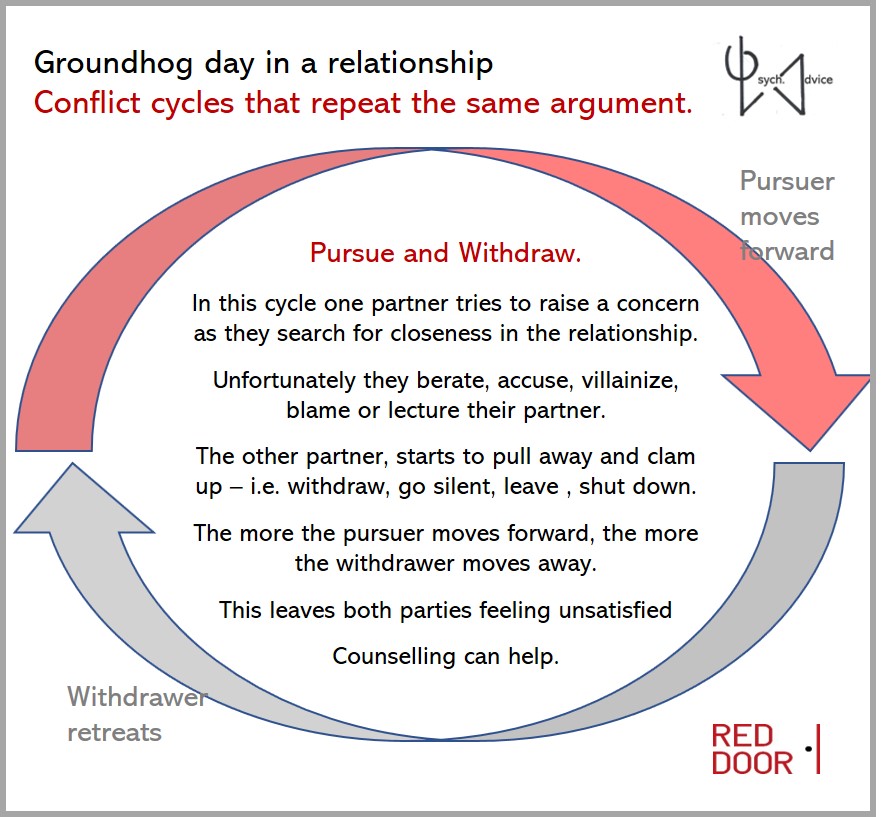
One of the most common patterns of communication in relationships, both heterosexual and same sex, is the pursue and withdraw cycle.
In this cycle one partner tries to raise a concern as they search for closeness in the relationship. Their intention is often to broach a perceived distance in the relationship. Unfortunately they berate, accuse, villainize, blame or lecture their partner rather than create a safe, soft space to discuss the issue.
In response, the other partner, starts to pull away and clam up – i.e. withdraw. They may be anxious and are keen to fix the situation but instead of talking they go silent, leave or shut down.
The more the pursuer moves forward, the more the withdrawer moves away. This leaves both parties feeling unsatisfied. This cycle benefits from outside help, particularly in the form of couples counselling. In a safe environment both parties are encouraged to understand and acknowledge their roles and be willing to share vulnerability to discuss their feelings and desires.
Avoid-Avoid style communications
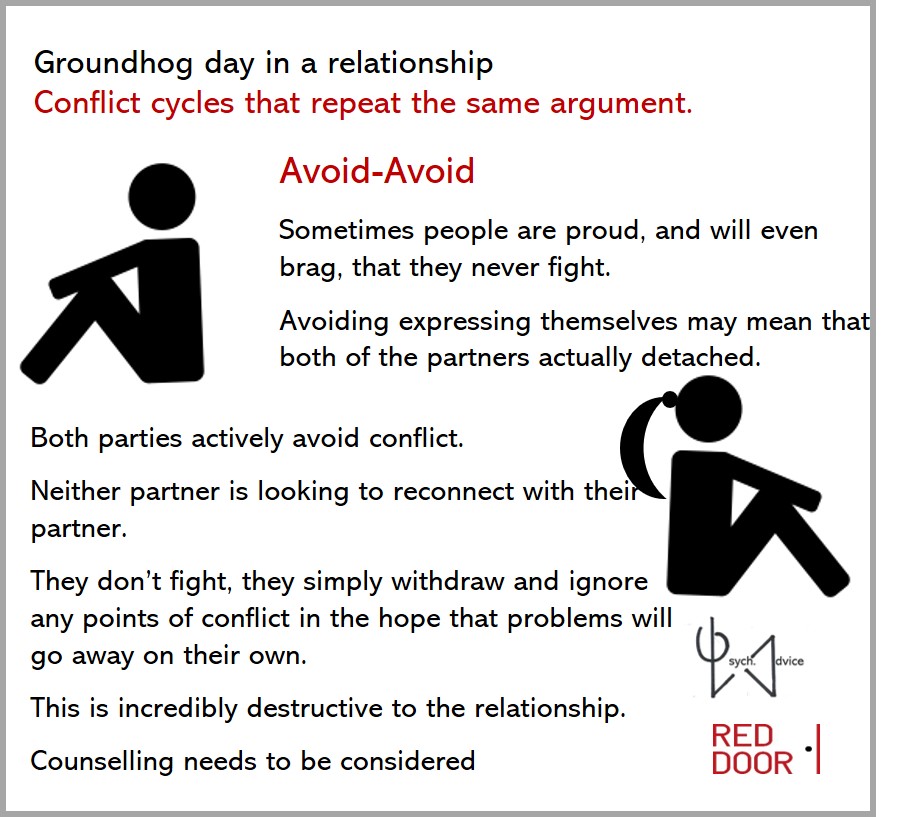
This is the rarest couple we see in counselling, but the one who most needs couples counselling.
In this model both parties in a relationship avoid conflict. Neither partner is looking to reconnect with their partner. They don’t fight, they simply withdraw and ignore any points of conflict in the hope that it will go away on its own. Unfortunately, this is destructive to the relationship.
Sometimes people are proud, and will even brag, that they never fight. By avoiding expressing themselves mean that both of the partners are checked out and at risk of becoming detached.
Counselling needs to be considered in a safe non-judgmental environment so that potential conflicts can be properly brought to light, feelings and desires explored and validated.
If you are in this model of conflict communications, I would recommend that you use the conjoint couple’s model where there are two counsellors to two clients. This model more actively supports each individual in the relationship. You can read more in the paragraph below.
Do you want to break these cycles in your relationship. First of all observe the pattern. Below we have two other articles on how to communicate and build more positive regard, plus an article detailing great books to improve your relationship on your own. At some point in time, you might like to consider couples counselling. I have included some information on our conjoint couples therapy approach that is available at RED DOOR. We have 4 couple counsellors at RED DOOR waiting to help you break the cycle after other recommended readings below
About the author: Angela Watkins is an experienced couples counsellor and counsellor of individuals in Hong Kong. To contact Angela for information or counselling email angelaw@Reddoor.hk
Recommended readings – you might find helpful
The advantage of Conjoint therapy in Couples Counselling.
One of the models we use at RED DOOR.
At RED DOOR we use the conjoint couples therapy approach. In Conjoint therapy two therapists work with the couple during couples’ sessions and then one counsellor will meet with you for any one-on-one sessions.
This is an advanced method of couples therapy.
Since there are two therapists in the room there is less chance of either of the partners feeling blamed, or favoured. If you have felt that any previous couple therapist sided with you, or your partner, you will appreciate the objectivity and inclusion that this model supplies.
There are a number of therapeutic options available in the conjoint model including pairing vs individual counsellors , role play and modelling of problems and techniques, as well as break-out sessions within couples sessions (which is helpful if one client becomes flooded, or some negotiations are required) .
This model also keeps the therapist moving sessions forward constructively. Often if sessions become heated much of a therapist’s attention is moved towards “traffic control”. Traffic control whilst necessary, is not the goal of therapy. Therapy is to help blockages in communication and find the right tools and skills to help remedy the problems. Having a second therapist on hand helps keep the therapeutic goal on track.
In conjoint-couples therapy you each have someone who understands each of your perspectives in the room. The team of counsellors work with you, and together to formulate a plan to understand and overcome the challenges in your relationship. At RED DOOR, we use a Gottman informed approach, but will also include emotionally focused therapy, CBT and narrative therapy tools.
Because two therapists are involved there are cost implications. At RED DOOR we try to manage this by asking each of the therapist to reduce their standard fee for the sessions. ON some occasions, when we have a suitable counsellor-in-training, we can offer a significant discount.
 Start your Red Door Journey