

Gaslighting is the psychological manipulation of one person over another over an extended period of time. The “gaslighter” tries create circumstances that can make the “gaslightee” question the validity of their personal thoughts, perceptions of reality, or memories. Gaslightees are left confused, losing confidence, and start to lose their sense of agency in the relationship. Over time the gaslightee becomes more and more uncertain of themselves and develops greater dependency on the perpetrator.
Gaslighting happens when someone manipulates you into thinking your perspective or account of an experience is different than the way you said it happened, for the purpose of undermining your position in the relationship. There are a number of techniques that gaslighters use to create these circumstances.
Gaslighting is a form of emotional abuse and mental manipulation that may leave one questioning their perception of reality. If you have been gaslight repeatedly you may will feel you are wrong in almost all arguments. Gaslighting doesn’t just happen in romantic relationships — it can happen with your family, your friends, your colleagues and, even, your boss. There is also research on institutional gaslighting, particularly when people report misconduct.
Gaslighting doesn’t just happen in romantic relationships — it can happen with your family, your friends, your colleagues and, even, your boss. There is also research on institutional gaslighting, particularly when people report misconduct.
Who becomes a gaslighter?
Sometimes gaslighters are aware of what they are doing. Many are not aware. They are threatened by lack of control, protecting their ego, or just wanting to maintain the upper hand in a relationship. Because of their anxiety and fears, they may not have explored the reason for their behaviour. Regardless if they are motivated by malevolence or angst, it is not a healthy behaviour.
You will often see the term gaslighting used in association with another term – narcissism.
Narcissism is a personality trait that people occasionally display. It involves expressing a grandiose sense of self-importance, obsession with power and success, a sense of entitlement, and a constant need for praise and attention. Narcissists lack empathy and are often quick tempered. As such they frequently use manipulative techniques, such as gaslighting, to take advantage of others. Whilst not all people who gaslight are narcissists, narcissists almost always use gaslighting as one of their tools to control people in their lives.
Gaslighters sometimes meet the criterial for narcissistic personality disorder or other personality disorders where control of others is a key component (Such as antisocial personality disorder and histrionic personality disorder)
What Gaslighters have in common is that they demand loyalty (and punish disloyalty), are emotionally sensitive, wear people down over time, misrepresent themselves often (lie), and refuse personal responsibility. If you have started a relationship with a Narcissist there will be a few red flags you may watch out for including possessiveness by your new partner, love bombing, talking only about themselves, rushing into a more “committed relationship”, a history of cheating, and lack of respect for your personal boundaries.
Who is vulnerable of becoming a gaslightee?
Individuals who are people pleasers, are overly empathetic, are conflict avoidant, seeking approval of others instead of relying on their own self-confidence, and generally have self-doubt are more likely to be the victims of gaslighting. If these traits describe you, you may need to work on yourself through self-help programmes, counselling groups or individual counselling in order to build better boundaries and protect your mental health. Much of the time, the victims of gaslighting are women.
How does gaslighting wear one down?
- Gaslighting exploits any existing self-doubt about your capabilities as well as past trauma and experiences. You may start to feel that you are too compromised od “damaged” in order to be able to see reality clearly.
- Gaslighting exhausts a victim’s internal resources so they you develop a sense of learned helplessness and regularly question your thoughts and actions. .
- Gaslighting depletes individuals of a stable sense of self-worth. You lose sight of your sense of agency in the world.
- Gaslighting manufactures insecurities and fears that never existed, some of these fears and worries are not real, rather they were planted by the gaslighter.
- Gaslighting causes the survivor to, pointlessly, investigate whether he or she has done something wrong, looking for evidence to support their view, or refute that of the gaslighter. The gaslighter will negate or ignore any results and often become angry at the action of being investigation at all.
- Gaslighting sets up survivors to fail no matter what they do.
- Gaslighting creates a fear of retaliation for victims speaking out, because each time a gaslightee tries to assert themselves, there is criticism and punishment.
The long-term impact on your mental health of being gaslight.
People who are exposed to long term gaslighting are likely to experience problematic degrees of anxiety and depression, stress (even trauma).
They may have become completely isolated from the people who would normally help them reality check their circumstances.
They will have a week sense of identity, have become trained to become easily overwhelmed, and be full of self-doubt.
They often start to gaslight themselves -internalised gaslighting – preventing them from being able to assess situations appropriately.
These are many of the same long term mental health symptoms of emotional abuse.
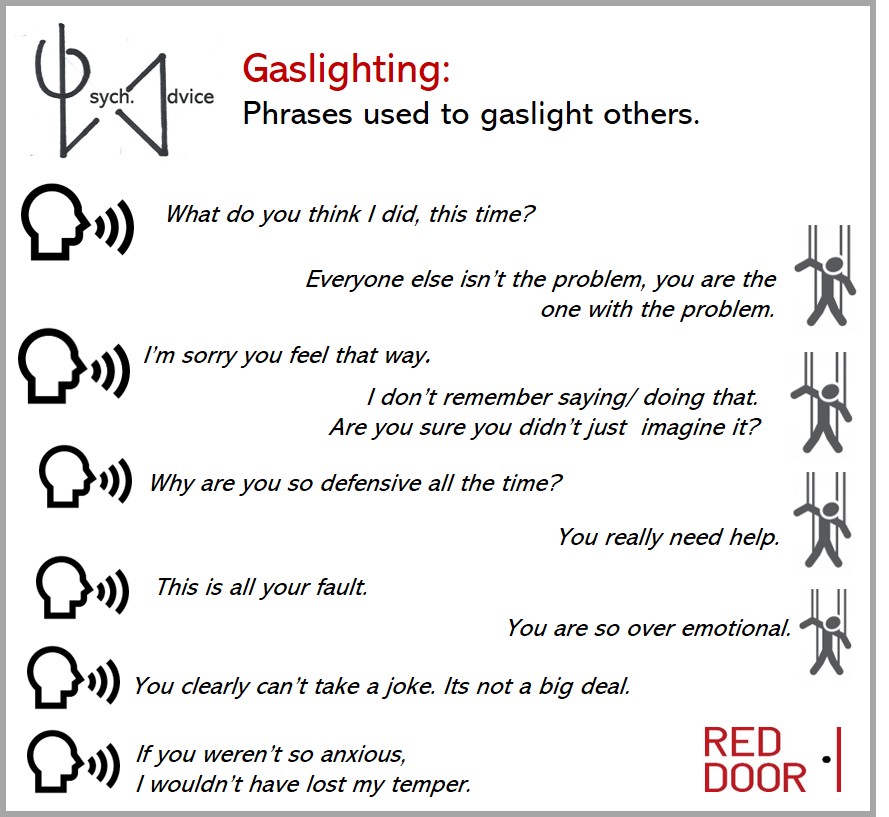
Gaslighters use a plethora of tools to challenge the reality of people they wish to control.
Projection – instead of accepting responsibility for their bad behaviour, a gaslighter might accuse the gaslightee of the exact behaviour they have been accused of. For example, “Stop thinking that I would hook up with that girl, you are just saying this to cover up the fact that you’ve been cheating on me”
Side stepping or “what-about-ism” – the gaslighter will actively dodge the evidence that highlights their poor behaviour, and may even throw you off the discussion by introducing an erroneous wrongful act as a counter-point. For example, “How dare you suggest that I lied about where I was, its not like you care about me. You didn’t even make me a cup of coffee this morning!”.
Conditional or incomplete apology – an apology that is either not an apology or is an apology used only to make a further request. The most common example is, “I’m sorry you feel that way”. This actually implies that you are the problem, rather than their behaviour.
Triangulation – Gaslighters like to enrol other parties to reinforce their messaging to you. This happens in particular if you have tried to separate from them. For example, they may encourage a third party to talk to you to explain how hurt they are by your action. Those third-party players are sometimes referred to as “flying monkeys”
Displacing or diverting – a gaslighter may blame their bad behaviour on you. For example, “I wouldn’t have stayed out so late if you were nicer to come home to”
Trivialise – a gaslighter may belittle your experience to minimise the impact of their actions. For example, “I think you are overreacting, its just not a big deal”.
Denial – a gaslighter will pretend that events didn’t occur or say they forget them.
Withholding – a gaslighter may completely refuse to engage in a discussion. For example, “You are trying to confuse me, I am not getting into this with you”.
Disorienting – a gaslighter challenging the whole discussion because of inconsistencies in one aspect of your account. For example, ”Make your mind up, did we fight about this on Tuesday or Wednesday, or did you just imagine the whole thing?”.
Countering – challenge your memory or account of events in totality. For example, “Your memory is so stuffed up, I don’t think you see this anywhere near correctly”.
Splitting – a gaslighter can weaponize other person’s real, or imagined, account of you to wear you down. For example, “I didn’t want to believe Mary when she said you were oversensitive, but it seems she was right”.
Comparing – in an argument a gaslighter may compare you to other people, often those you admire, to imply that your challenger of them makes you look bad. For example, “Why can’t you be more like Jean, she lets Mike go out anytime he wants without making such a drama”.
Stereotyping and Shaming – a gaslighter may blame the gaslightee for a situation as part of generalisations about their race, colour, religion. For example, “Are you on your period, you sound like a woman suffering from PMS”
It may not feel like you have a chance to stay sane when bombarded by these communication manipulations. The pathway back to positive mental health is to counteract the gaslighting.
Counteracting gaslighting.
Distance and Boundaries: If you want to recover from gaslighting you have to consider separating yourself from the gaslighter. Confronting a gaslighter is extremely unlikely to change their behaviour. They are more likely to double down on their practices. Even if you have begged them to change, and they agree, take a break. You need space to consider the impact of being gaslight and to consider if you really need to be involved a person using such practices. You can’t recover from an abuse that is ongoing.
Counselling: I recommend counselling to recover from the impact of gaslighting and to tackle those traits and thought patterns which make you vulnerable to being gaslight again in the future. A counsellor will help you explore the stresses you have experienced, helping you talk it out, rather than the alternative, which is to act it out. Specifically, counselling can help:
• A counsellor can help you explore your account of events to help you analyse if you were being manipulated. • Counselling can help you explore your self- concept and self-worth to help you regain a sense of yourself again.
• A counsellor can hold space for you whilst you grieve the potential end of a relationship, and the image that you had of yourself from that relationship
• Counselling can help you choose healthy coping mechanisms whilst you recover from gaslighting.
• A counsellor can help you identify red flags to avoid gaslighting success in the future. Counselling can lead you though mindful and self-compassion work to help you recover.

• A counsellor will help you explore any traumas explored before your relationship or as a consequence of your relationship.
Journalling:
Write your story out to help bring it into context. Journalling your experience can be an excellent way to track your progress and narrate your reality. This may particularly help you counteract your internalised gaslighting.
Social support: Connect with people who help you stay tethered to reality and help you gain a stronger sense of yourself. If you are divorcing a gaslighter, consider joining a support group such as the Iron Fairies run by RED DOOR in Hong Kong. Watch out for flying monkeys and placators. These are well meaning family and friends who may approach you to give your partner another chance. Remember they do not really understand what they relationship was like for you, and have no right to assume they know what is better for you than you do.
If you can’t avoid the gaslighter: if you have to interact with them act bored or ambivalent rather than allowing them to spin you into a web of drama. You can simply “Agree to disagree”. Don’t get trapped trying to convince your gaslighter of your world view – this is a fruitless activity.
Third party filters: if you are leaving a marriage with a gaslighter you may need to interact with your partner for several more years. Whenever possible use third parties to help you stay boundaries from your ex- partner. Your lawyer, your family of origin, parenting coordinators, can help you set rules, filter information, and take the sting out of communications. Recording details – A record of events and interactions will help you stay anchored to reality, and remind you about the relationship with the gaslighter should you start to fall for their charms again. Do not be tempted to help “clear up” the record unless you have to. A gaslighter will usually reject any account other than their own.
Conduct self-compassion work: There are a variety of self-help books on self-compassion and mindfulness that you can consume on your own, or in collaboration with the work you do in counselling. Remember counteracting gaslighting requires distance from the gaslighter and the gaslighting experience. If you don’t know if you are being gaslight a counsellor may be able to help you identify what is your problem, from what is being defined as your problem by others.
Useful books if you’d like to learn more about gaslighting.
Barlow, D (2021) Recovering from gaslighting and narcissistic abuse, co-dependency and complex PTSD.
Marlow-Macoy, A. (2023) The gaslighting recovery workbook.
Moutlon Sarkis, S (2018) Gaslighting: recognising manipulative and emotionally abusive people – and break free.
 Start your Red Door Journey