
When we look at options of services to extend the skill development of teens and adults after they finish school in HK is thankfully being expanded, but still has a long way to go. This is even more complicated as we rise and fall with the waves of COVID 19 outbreaks and responding restrictions.
Good people are doing good work, but the data on employment opportunities remains depression. Currently post school programmes are provided by Watchdog, and the Nesbitt Centre all of which do a great job, but there are still areas of need not covered.
In general, this period of time is hard to be young adult (disabled or otherwise)!
Exploring data from International Labour Organization (2017 data in the link below), global employment trends for growth 2017 suggests the global unemployment rate was 13.1%. The youth population (disabled or otherwise) represents more than 70 million people globally are experiencing unemployment – they are neither in employment or in further education. Young adults are 3 times were 3 times more likely to be unemployed than older adults. And this was BEFORE the global COVID epidemic.
Young people need to be prepared to be educated but still be unemployed. This applies to all young adults, and affects the disabled in a disproportionate format. The future of the world of work is the topic of many fantastic books at the moment and will have a major impact on those already in work, and the next generation of college and school graduates.
It’s even worse if you have a disability.
Exploring US data from the Bureau of Labour Statistics (link below) the disabled experience less employment than those who have no disability and are young.
There are often barriers for those with disability to gain access to suitable employment, including prejudice and misconceptions among employers, difficulty accommodating people’s physical or work schedule needs, the type of disability including the health implications, the ability to act a in socially expected manner, academic or task related competencies, and of course having the right skills. Part of the solution to this problem is adequate education of employers (thank you to the SENsational consultancy in Hong Kong www.senconsultancyltd.com)
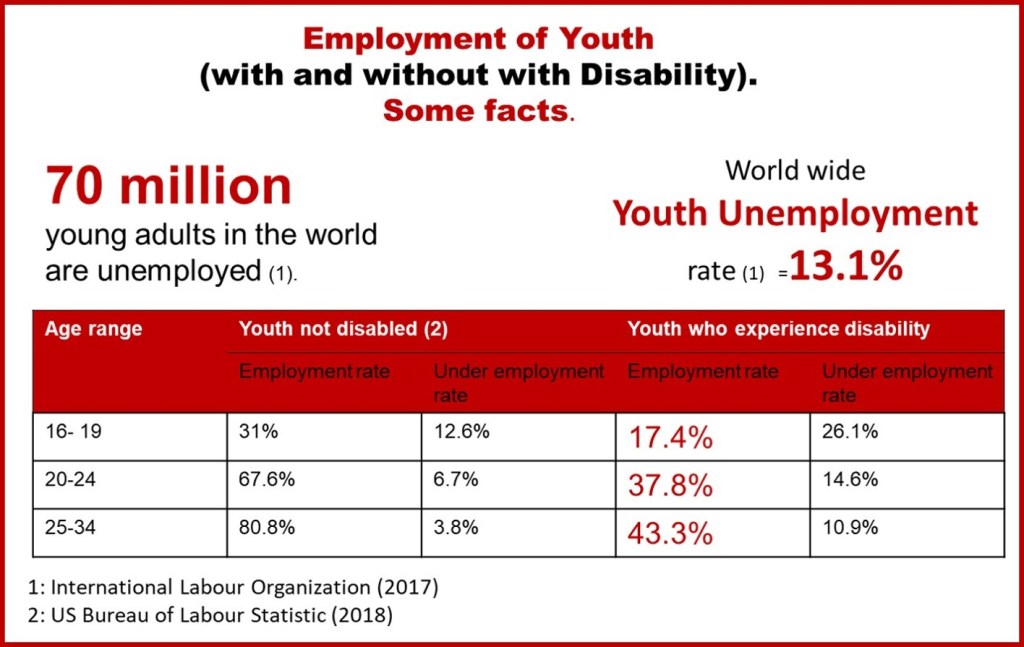
• For those 16-19 years old and disabled only 17% are employed, and 26% are underemployed
• For those 20-24 years old and disabled only 37% of that population are employed, and 14.6% are underemployed.
• For those 20-25 years old and disabled only 43% of that population are employed, and 10.9 % are underemployed.
To better prepare the next generation of special educational adults, we as parents and educators need to provide ample services to those young adults as they launch from high school into the next stage of their careers. The majority of areas in which disabled individuals in Hong Kong find employment (hospitality, some retail, office work) are covered by certain centres in Hong Kong, but as these centres have become under greater financial pressure, their futures can also be fragile
Careers need to construct a future around specific strengths of their SEN teens and young adults.
The gap exists for children who have different areas of strength and varying levels of motivation – perhaps they are great artists, mathematicians, photographers, early childhood teaching assistants, even have extremely good knowledge of music or ability to sing. For them, and many others they not only require a more customised style of vocational training not previously available in HK. What is also important, they may have finished school without their education being complete. They may need a basic entry level of English or Math in order to start their career in a suitable arena, and this needs to be made possible within a setting that also teaches the requisite social skills and independence skills. Private tutoring provides the content but not the context. Quite simply, these kids, need the continue a concept of school until they are more fully cooked.
A new hope for the future – worth considering.
One area of employment growth which I believe has enormous potential is the area of self-employment or entrepreneurship. Self-employment for people with special educational needs may help build career success within the future world of work. Portfolio work – working on various projects, and different arenas – in a freelancing capacity might be suit them more. What parents and their young adults need is a customised plan to help create these opportunities. Particular psychologists, including myself, can help parents and young people create these customized plans.
Careers developed around the strengths of individuals – artists, mathematicians, photographers, artists, which may involve further training, further therapy, and personalised business development plans.
In collaboration with their families and their community, young adults with disability can start to build a strong plan to identify their strengths, and vocations which celebrate those strengths. I am not saying its going to be easy. I’m simply pointing out that its necessary and possible.
A word about continuing education.
Children with special educational needs often leave school before their education is finished. They have often not solidified basic knowledge of key math and English skills. I heavily encourage parents to continue to work with tutors or other programme providers to continue to develop key English receptive and communication skills, as well as understanding the world of money, basic maths, distance and time. I will be exploring these key skills to help your child achieve in a future blog.
About the author
Angela Watkins is a counsellor and psychologist working with teens – typical and neurodiverse – to help them overcome various challenges including vocational planning, learning difficulties and emotional challenges such as anxiety, suicidal ideation, self-harm, abuse and violence, and troubles with schooling.
 Start your Red Door Journey