
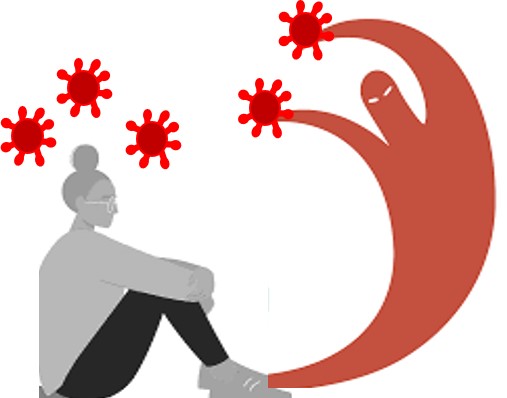
As restrictions start to be reintroduced in Hong Kong do your find yourself feeling disproportionately anxious to these regulations? It may be possible that you are reacting due to Post Traumatic Stress responses created by the COVID-19 pandemic.
The COVID-19 epidemic began to spread around the world in the early months of 2020. To date (June 2022), the pandemic has wreaked havoc on population growth, people’s health, the economy and our ability to function. It is suggested that people are suffering psychological challenges including anxiety, depression, and PTSD (Post Traumatic Stress Disorder).
Population Impact. COVID:19 has had a significant impact on the global population with over 6 million people having been lost to the disease, and the epidemic increasing building to a growth in the death rate in the world. [1]. In Hong Kong, we are encountering the highest death rate in the past decade [2]. Over 540million people worldwide are recorded as having contracted COVID, whilst the current figure of cases in Hong Kong is 1.2 million.
Ongoing Physiological Impact: Whilst most people recover from COVID, especially if they have been vaccinated, some people do not recover well. The prevalence and impact of Long-COVID are still being researched and many questions remain unanswered, with inconsistency in numbers in a lot of the research. Current conservative estimates [3] indicate that about 13% of those who contract COVID-19 are still experiencing symptoms after 28 days. Some people – about 2.6% – still experience symptoms 90 days after initially contracting COVID19. This would represent about 1.5 million people worldwide at this time. The most prevalent long-term symptoms include fatigue, headache, attention difficulties, hair loss and shortness of breath.
Psychological Impact from COVID-19: COVID-19 impacts the lives of those who contract it, and the greater population. People fear the consequences of catching COVID and also the impact of particular government regulations and health practices
Anyone who lived in Hong Kong during the period February 2022 and April 2022 may have experienced anxiety during the fifth wave [4].
In Hong Kong we are coming out of our fifth wave, our worst experience of COVID-19 so far. The fifth wave appears to be dissipating, from a height of over 78,000 new cases a day in early March 2022, to an average of 740 cases a day by mid-June 2022, and a death rate of close to 300 deaths a day in March 2022, to zero deaths so far in June 2022. In the wake of the fifth wake, we note an explosion in cases in Hong Kong. At the end of January 2022, less than 1% of the Hong Kong population had contracted COVID, by the time the fifth wave started receding, the rate was 16% [10].
Whilst HK did not experience an official “lockdown”, there was still a significant impact on ‘regular life. Schools had to, repeatedly, move online, working remotely became standard, businesses were closed (and reopened, and re-closed), and various isolation facilities for cases, and close contacts, have been utilised. Flights into and out of Hong Kong have been cancelled, travel has become unpredictable, and quarantine rules continue to be revised (and not yet, removed), and the health system, and those working within it, collapsed. The Hong Kong government’s interdependent approach with mainland China, to supporting the concept of Zero-Covid maintains a sense uncertainty. And the fifth wave will not be the last.
A recent piece of academic research produced by the Hong Kong Polytechnic University [4] revealed a prevalence of over 12% of PTSD (Post Traumatic Stress Disorder) symptomology among Hong Kong adults recorded after the fourth wave of COVID-19 in Hong Kong.
It is suggested that there are particular people who appear to have psychological vulnerability [6] particularly those of lower social socioeconomic status, younger people, and women. The Hong Kong research [4] also suggest that those with lower socio-economic status in Hong Kong, may also have a heighten vulnerability to experiencing PTSD symptomology.
What is PTSD?
PTSD is a psychiatric disorder featuring distress and disruption to daily functioning in response to a traumatic event. Not all people exposed to a trauma develop PTSD. Any particular individual may be exposed to more than one traumatic event in their lifetime, with over 30% being exposed to multiple traumatic events [5].
The characteristic elements of PTSD include a distressing rotation of intrusion and avoidance compulsions together with hyper vigilance. The intrusion elements include experiencing nightmares, visual flashbacks of the trauma, and having intrusive thoughts about yourself, the events and the outcome of those events. Avoidance is demonstrated through deliberate efforts to avoid thinking about or talking about the events, as well as places and people the remind you about the event. Hyper vigilance is demonstrated through being easily startled, and feeling wary and unsafe, and therefore agitated, when the trauma is over [7]
The likelihood that PTSD will develop after a trauma is, in some part, influenced by the type of trauma. More personal and violent traumatic events being more likely to produce a PTSD response [5].
The question now is if the type of stress experienced by actions around the COVID-19 pandemic cause PTSD. This type of trauma has not been studied extensively, given the rareness of this event. So, the HKPoly U [4] finding of a 12% prevalence (from wave 4) is revealing. That study explores the presence of this stress response in the general public, not just those who have contracted COVID-19.
Disasters are a trauma that can produce PTSD. Although there is no consistent definition of disasters in the literature, researchers generally agree that disasters share three key characteristics of large-scale traumatic events. Firstly, disasters threaten harm or death to a large group of people, regardless of the actual extent of lives lost. Secondly, they affect regular process, causing disruption of services and social networks and communal loss of resources such as economic impact. Thirdly, they involve secondary consequences, namely identifiable mental and physical health outcomes, such as anxiety and depression. [8] It appears that the COVID-19 pandemic could fit the criteria of being a global disaster trauma.
In therapy, people often dismiss their stress responses in response to the COVID-19 pandemic because, “everybody is experiencing this”, thereby invalidating their individual experience because there seems to be a societal expectation to “just get through this”. As with other disasters, it would be a mistake to dismiss that people do not develop PTSD simply because everybody has been exposed to the traumatic event.
When people become influenced by PTSD their nervous system becomes agitated by trauma and people then try to ‘regulate’ this traumatic response. Unfortunately, self-treatment can include an attraction to some destructive practices to soothe those agitations including performing self-injury, drastically controlling food consumption, using alcohol or drugs to create numbness, or distraction through hyperactivity. [9]
Despite the debilitating nature of PTSD, many people do not seek treatment, or only seek appropriate treatment after extended period of suffering from these symptoms, or experiencing multiple traumas [8]. Sometimes PTSD is even used a reason to avoid therapy as people fear facing and exploring their symptoms. How do you know if you have PTSD?
Diagnosis of PTSD.

You can assess if you are suffering from PTSD yourself. You can use the same measure used by team at Hong Kong Polytechnic University [4]. They used a slightly adapted Cantonese version of the Impact of Events Scale – Revised [7]. This questionnaire can be self-administered. A copy of this survey is pictured to the right. You can look up copies online..
This measure corresponds to many of the items from the Diagnostic and Statistical manual (DSM) that psychologists utilize in their decisions about diagnoses.
There are two ways you can use this measure once you have completed it. The questionnaire asks you to rate your experience from 0-4 relating to how frequently you experience a particular symptom. As you are completing the survey consider if you feel this symptom specifically in relation to the COVID pandemic. Once completed, add up your total score. A normal, non-PTSD score, would be less than 12. A score of over 33 merits further attention and may indicate that you are experiencing PTSD symptoms to an extent that requires support.
You can also explore your performance as to which sub scale presents the most problems for you. The three sub scales of the questionnaire are are Intrusion, Avoidance, and Hyper vigilance. The sub scale items are highlighted the bottom right hand courner of the Weiss survey pictured above. Average your score for those sub scales so you can compare them. The sub scale that has your highest score (somewhere between 0 and 4) is the most problematic, and any average score over 2 is warrants further attention.
The treatment for PTSD.
The treatment you can consider for your PTSD depends on the type of trauma you have experienced (see Note). The following information applies to PTSD resulting from your experience of the COVID pandemic. PTSD deserves to be treated properly, through therapy [4,7].
What would you cover in therapy?
In therapy wish to reduce the negative impact related symptoms have on your individual functioning. Ideally our goal would be for a client to no longer experience or be troubled by event recollections, avoidance of event reminders, hyper arousal and disinterest in relationship or activities. in the interim, involve an evolution to becoming comfortable with being uncomfortable rather than seeking numbing through self-medication and other behaviours.
The sub scales that you explored in the survey will tell us what we could focus on first – for example, building self soothing thought processes to reduce hyper vigilance, using CBT (Cognitive Behavioral Therapy) activities to help overcome avoidance demands, and ACT (Acceptance and Commitment therapy) or CBT to overcome intrusive thought processes.
Treatment using these types of tools have great track records in the treatment of PTSD [8,9]. These tools need to be customised to each clients triggers, circumstances, soothing mechanisms, feelings of shame and advocacy, so that, eventually, a new style of calm can be achieved. Therapy can help. Recovery is possible.
NOTE IF YOU have PTSD attached to another trauma – particularly sexual violence – please only visit a therapist who has a solid track record (years) of treating such trauma.
About the author – Angela Watkins is a counsellor and psychologist working out of RED DOOR in Hong Kong. She is experienced in treating anxiety – such as that resulting from the COVID pandemic, loss and abuse. For more information contact Angela at AngelaW@reddoor.hk
References
1 Centre of disease and control and prevention – National Center for Health Statistics: Excess deaths associated with Covid19
2 Macrotrends – HK death rate 1950-2022.
3 Halvalkele, B. D.; and Parham, J (2022). Long Covid: A review of long-term consequences of Covid-19. Journal of Mississippi State Medical Association. Volume 63(6).
4. Cao, Y., Siu J. Y-M.; Shek, D. T. L; and Shum, D. H. K. (2022). Covid-19 one year on: identification of at-risk groups for psychological trauma and poor health-protective behaviour using a telephone survey. BMC Psychiatry. 22:252.
5.Benjet, C et al. (2016). The epidemiology of traumatic event exposure worldwide: results from the World Mental Health Survey Consortium. Psychological Medicine (2016), 46, 327–343.
6. Kessler, R. C et al. (2017). Trauma and PTSD in the WHO World Mental Health Surveys. European Journal of Psycho traumatology , Volume 8.
7. Weiss, D. S. (2007). The impact of event scale revised. In JP Wilson and TM Keane (Eds). Assessing psychological trauma and PTSD: A practitioner’s handbook. 2nd Edition. Guildford Press.
8 Goldmann, E.; and Galea, S. (2014) Mental health consequences of disasters. Annual review of Public Health. Vol 35.
9. Fisher, J. (2021).Transforming the living legacy of trauma: A workbook for survivors and therapists. PESI Publishing.
10. Using Worldometer figures as at 16 June 2022.
 Start your Red Door Journey