

Becoming a parent changes your romantic relationship. The landmark relationship advisors, the Gottman Institute, assessed satisfaction among new parents. Their research reveals that two-thirds (67%) of the couples that they interviewed expressed dissatisfaction in their romantic relationship within the first two years of having a baby. The pattern of lower martial satisfaction when comparing parents with non-parents is supported by other academic research as well.
There are many paths to parenthood. New parents often feel stressed and exhausted. It can feel as if the distance created by small differences that existed between you and your partner when you first got together, have become a chasm once you are parents.
What drives this unhappiness? And, what can you do to protect, or improve your relationship after bringing home baby?
Perception of individual roles
Part of these differences are due to how you see your new role as parents and how this redefines to your perceived role as a person, worker, friend, partner, and a representative of your community. Suddenly you aren’t just a man, who is romantically involved with this other person, and a worker, and a member of the sporting community. You are now a “Father” – with all that word conveys to others, and expectations that it holds for you.
How we see our roles, and that of our partner, are the result of our research, and created through an osmotic process of being the child of the parents in our family of origin. The father figure featured in your family of origin taught you what you admire, and don’t admire , about the role of being a “Dad”, The same applies for Mum.
What do new parents fight about?
The Gottman Institute suggest that for each new child, an additional 33 hours of household work is required to look after their needs on a weekly basis. Suddenly time becomes a precious commodity, and you may be exhausted all of it. Given the pressure of child care, and the changes to roles and personal lives that parenting can require, what do new parents mostly fight about?
In our ounselling practice, we see similar trends to those seen by the Gottman Institute. The main issues that we encounter with new parents include are stresses over family finances, the division of labour in the household, the (unwelcome) influence of family and friends, changes (or not) to social and recreational activities, and mood and affect challenges resulting from the physical changes of child rearing.
When couples enter the counselling environment, they are ready for the counsellor to highlight up how wrong their partners’ perceptions, behaviours, and viewpoints are. In essence, they often want the counsellor to be the judge and tell them who is “right”. But the counselling process is not about who is right and who is wrong. Rather the focus is about establishing those practices that make love last.
So, what makes love last?
The answer to this question is so simple, and so complicated, at the same time. In studying successful relationships, famous relationship researcher John Gottman, suggests that the friendship with the romantic relationship which is the greatest predictor of relationship satisfaction. Quite simply, people who like each other are happier together. It’s deceptively simple.
Unfortunately, our romantic partner often receives the worst of us, not the best of us. Sometimes the way we act towards our partner is, quite frankly, unlikeable. Over time those small jabs, and missed connections, create a canyon that feels hard to transverse.
With re-establishing your friendship as a goal, there are a few actions that you can take to help build back that positive affect in your relationship. Whilst all couples have conflict, partners who prioritise friendship are more likely to create homes where conflict is not feared, destructive to the relationship, or negatively impactful on their children.
How do you get back the friendship when all you do is fight? Sometimes a safe zone, such as a counselling environment can help. There are some activities you can try for yourselves:
1.Affirm each other.
Firstly, when you can, try a brief affirmation exercise. This exercise is suggested to help couples appreciate what attributes their partner appreciates and recognises about them. When you have a young child, sharing appreciative or affirming comments, becomes a rare activity. Take a moment to reverse this trend.
Sit together. Pick three positive attributes about your partner. If you have trouble identifying those attributes, I’ve included some suggested by the Gottman Institute for your ease. You don’t have to pick items from the list. You can identify your own.
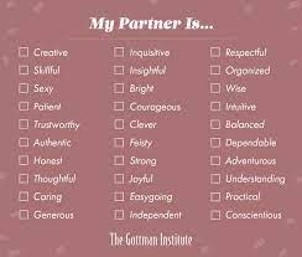
Take turns sharing an attribute and the story behind your perception of that attribute. For example, “I was so impressed by how resourceful you are. When we were lost in Italy, it didn’t take you long to sort out new bookings and get our holiday plans back on track.”
After you have each shared three attributes stories, take a moment to think about how it feels to listen to these recollections and compliments from your partner. Do not dismiss your good work with the temptation to share what “bothers” you at this time. Enjoy the positive atmosphere created.
2. Create strong Love Maps.
Another great Gottman Institute idea is to rebuild your Love Maps of each other. A Love Map is the personal knowledge you have of your partner. Sometimes we assume that we know everything about our partner. Often, we don’t, or our perceptions are out of date.
Do you know who is their best friend? Do you know who is the relative they like least, and why? Do you know what their favourite song to listen to is at this time? Who do they talk to most at work? What would they do if they could retire today? What countries are on their bucket list of places to visit? What activity helps them calm down? What things make them smile? What is their favourite meal of all time? What would a dream weekend involve? Who do they wish that they had a better relationship with in their family of origin?
Take some time to really get to know your partner again. You can undertake building love maps as a date-night activity, or you can break it into a series of daily connection moments. Build a path back to understanding, and appreciating, each other’s worlds.
3. Fight fair.
The most constructive thing you can learn to do to support your relationship is to learn to have constructive rather than destructive conflict. It is normal to disagree, and have some form of conflict in a relationship. The style of how you express yourselves during the conflict can, determine if their relationships can last, or remain satisfying. Relationships where conflict discussions include contempt, criticism, excessive defensiveness, and avoidance, are unsatisfying. When these destructive elements exist, are likely to remain so. They will not go away without activity to change.
Think about at the last time you and your partner had a disagreement. Did you say hurtful comments that you regret? Did they? Did it feel like things just “exploded”. Did you feel out of control? Did you feel neglected or invalidated? Did you storm off and then refuse to reengage in any future discussion?
Learning to fight well involves developing a series of skills around communication – being a good listener, a responsible speaker, choosing your timing well, using gentle introductions to conflict topics, being respectful of your partner’s world, owing your emotional reactions, avoid blaming and contemptuous language. Think about if you are ready to start adjusting your behaviour. Even one person changing their behaviour can have an impact on style of conflict within a couple. Quite simply, if you do what you’ve always done, you will get what you’ve traditionally got. So, make a change, so that change is possible
In the reference section of this article there are some great books, by the Gottman Institute that suggest activities to help you improve your communication conflict style regarding the specific behaviours that destroy relationships. Couples’ counsellors are trained to help couples adjust those behaviours. They can help you understand your conflict style, and help practice new habits to help change the disagreements, and dissatisfaction in your relationship. You can seek out couples counselling for conflict, or to make a stronger connections. It is a wise investment in the future of your relationship.
Notes:
- Red Door Counselling offers couples counselling through the conjoint-counsellor model. This model involves 2 counsellors with 2 clients. This model is superior in avoiding perceived favouritism and situational objectivity.
- Red Door offers couple connection courses from time to time – for groups – to help teach those skills that make love last. Our next couples’ connection course will run in August 2022.
Useful References
Gottman books you might enjoy:
Gottman, J and Gottman, JS (2007)
And baby makes three: The six-item plan for preserving marital intimacy and rekindling romance.
Gottman, J and Gottman, JS (2008)
Ten lessons to transform your marriage.
Other good references.
Twenge, J.M.; Campbell, W.K.; and Foster, C.A. (2004). Parenthood and marital satisfaction: A meta-analytical review. Journal of Marriage and Family. Vol 65(3), page 574-583.
Nagaraja, A.; Rajama, N. M.; and Reddy V. V. (2017). Effects of parents’ marital satisfaction, marital life period and type of family on their Children Mental Health Status. Journal of Psychology, p 65-70.
 Start your Red Door Journey