Love yourself first.

In the words of Drag Goddess, Ru Paul Charles, “If you can’t love yourself, how the hell are you gonna love someone else?” As a counsellor, I’ve met so many people who dedicated to demonstrating their love of others, but do not seem to demonstrate love of themselves.

When we celebrate love, prioritize to give yourself love first.

What is self-love?

Practicing self-love means ensuring that you invest enough time and energy in yourself to make sure you have enough love in your life, are kind to yourself, and are grateful for all that you have achieved in life. Sounds easy, right? Now you know this, you can wake up from the trance of unworthiness. Yet it seems so much other to love others ahead of loving ourselves.

What prevents us practicing Self-Love?

Ain’t got time for that.

You are in control of your time, so if you think that you don’t have the time for self-love, I would ask you to challenge how you have chosen to spend your time. How is it allocated? Could you give up scrolling the internet in order to create time for self-love? Could you give up your late-night TV watching?

It is important that you create time for your goals, including the goal to love yourself first. Reallocate your time, delegate tasks to others, challenge what you believe are your priorities so that you create time to prioritise yourself. I remember when my first daughter was born. She was my beautiful dolly. Each day I would take great care in the outfits she would wear out. One day my husband needed to look after her instead of me. He sent me a photo of them at the playground. Was my daughter really out, in public, in her pyjamas? The horror! In reality she was having fun, and he was being a great dad. The outtake was a gift, relax about her wardrobe. It was a priority which, really, wasn’t important.

Putting others, probably everyone else, first.

Running yourself ragged in order to look after everyone else is a recipe for disaster. Burning yourself out, just so you can have a rest, is a little extreme. An audit of your time may raise if you are performing activities only because of other’s expectations rather than for your own benefit. Are you a people pleaser? I want you to challenge this default. You do not need to be class mum! You do not need to pick up other people’s kids. Say no, move on, let go. Remember that in order to take care of others, you need to first take care of yourself.

Why do we do this? This dedication to others is a trap. People want proof of life that they exist. When people call on you, you may feel recognised, required, even, important. In reality your sense of self-worth can only be filled from within. On their deathbed, the dying do not regret completing that last load of dishes, they regret not pursuing their dreams or spending time with people they love. Not doing the to do list set by others.

Self-love is different from being entitled. When a person feels entitled, they believe that something should be theirs, even without effort or merit. This is not the same as recognising and acknowledging your self-worth and setting expectations accordingly.

Oh, the shame!

You may be embarrassed that self-love could be your goal. People tend not to praise other’s self-care achievements. “Look at Claire taking a break – go girl”. “Wow John, good for you that you got yourself a massage to relieve the stress in your shoulders.” Life is too short for you to be concerned with what anyone else thinks.

We are ashamed when we take care of ourselves – this is a trap. Let go of the belief that if you want to take care of yourself that there is something wrong with you. It is important that you preserve and protect the greatest asset that you possess – you.

When I love myself enough.

I find one way to tackle the topic of self-love with clients is to ask them to articulate some of the things they would do differently when they love themselves enough. Some of the common elements of self-love include:

Accept that you have goals.

It is important that you accept the types of person that you may need to be in order to achieve your goals. Many women, in the past, have been criticised for being ambitious. Don’t be embarrassed if you have a goal. When we love ourselves enough, we prioritise our development. We follow our dreams and work to free ourselves of the shackles of shame that others may try to impose.

Prioritising your goals.
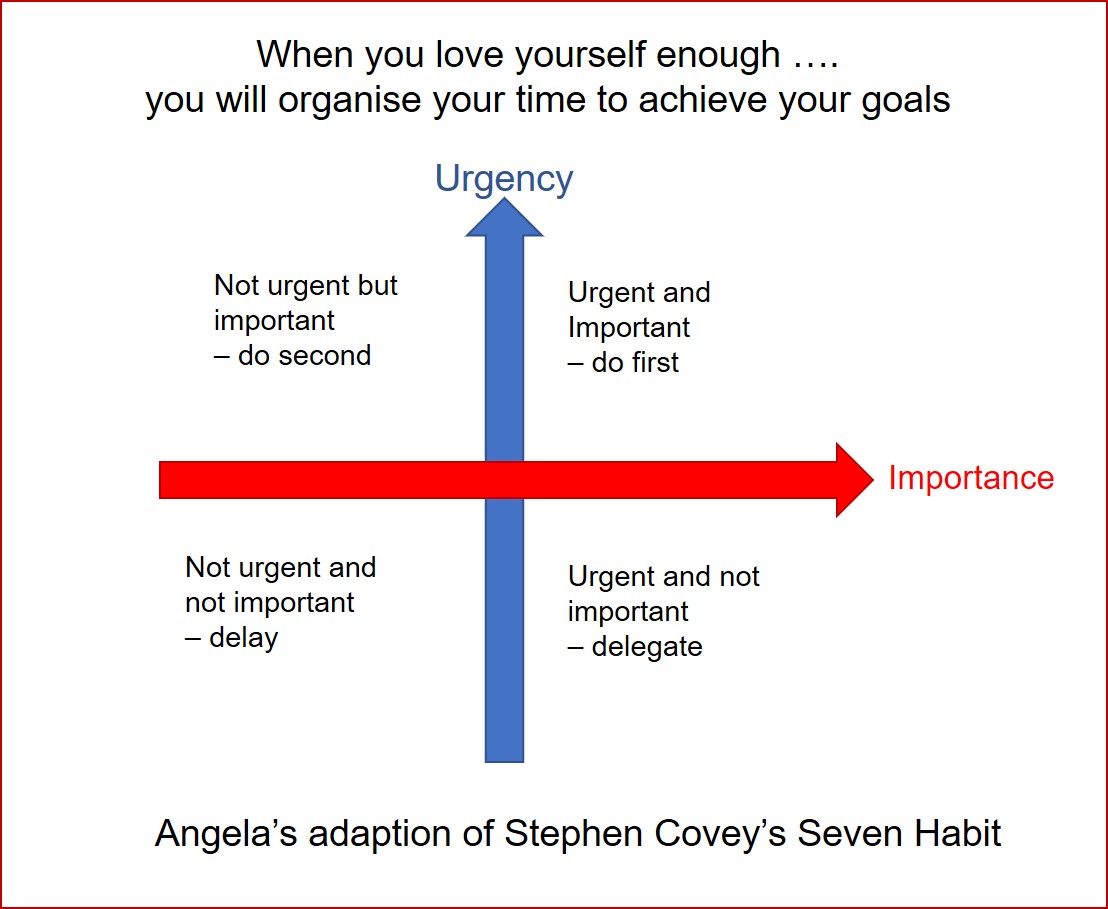
when I love myself time management

Part of a self-love routine is to set your priorities around your life goals rather than concepts of ‘urgency”. Stephen Covey in this instrumental book, the Seven Habits, outlines a method to help prioritize tasks/activities into quadrants. I have adapted this slightly in the figure on the left. We all understand the concept of urgency. The concept of importance is somewhat trickier to clarify, and you may benefit from talking to a coach our counsellor about this. For a task to be important it needs to help achieve a value for which you want to be recognised. For example, if you want to become a senior leader in your future, you will prioritise those tasks where you have been given the opportunity to shine as a leader over those where you are simply a contributing voice.

Establish a self-care routine.

A well-rounded self-care routine is essential to your well being. This is an essential element of having a positive growth mindset. You deserve care, it is an investment in you. This would probably include eating well, exercising, getting enough sleep, and watching drug and alcohol consumption. How do you do, even on that short self-care checklist?

Develop an accepting self, not just self-acceptance.

Self -acceptance is saying to yourself, “I like me”. Developing an accepting-self allows us to also allow ourselves to fall down occasionally, and believe this is also okay and acceptable. This attitude of unconditional kindness towards yourself, whatever you may be experiencing helps us grow. You are a work in progress, and that is wonderful.

Add the voices of self-compassion and an inner-cheerleader, to any dialogue with your inner critic.

Our inner -critic is only just a judgemental voice who breaks us down. Sometimes it plays a role similar to a responsible parent, telling us to get out of bed and go to work, get that report completed, pay your taxes! Listening only to your inner-critic can lead to feelings of inadequacy and desire to avoid activities – denying your to do list whilst you glut watch Netflix.

When you add the voice of self-compassion and your inner-cheerleader to the dialogue the script changes significantly. You give yourself the chance to recognise and acknowledge feelings you may have around a challenge. You may produce a report you don’t really feel confident producing. Acknowledge the at many people might feel nervous in that situation. Your inner cheerleader can then add their voice. “You can do this, just give it a go”. This is when your inner critic may help – with practical advice “

Thrive rather than, merely, survive

Many of us have grown up in household with complex emotional environments. Perhaps your parents were too harsh, or not present, or you found it hard to be accepted. Almost all of us have sacrificed parts of ourselves in response to our childhood and adolescence. Perhaps it is time for you to thrive rather than just survive, overcome our box of darkness issues. IF this describes your situation you may find the articles at the end of this blog helpful.

When we love ourselves first and foremost.

When we love ourselves first and foremost, we let go of the feeling that something is wrong with us, that we are not good enough. You exist. You matter. You are loved.

About the author: Angela Watkins is a counsellor and psychologists who works with couples and individuals to help them have better relationships as well as improved mental health.

#reddoor #love  #selfhelp #selfcare #selfesteem #wellbeing #selfcompassion #goalsetting  #relationshipadvice  #relationshipadvice #relationshipgoals  #relationshipadvice

Further reading you might enjoy

Let it go, let it grow

Past hurts and old injustices can keep people stuck in old patterns of behaviour and thought traps. Bad memories can be like emotional quicksand, and can consume your thoughts taking command of your day-dreams, and leave you feeling obsessed over perceived or real losses, betrayals, and inequities.

The American poet, Mary Oliver wrote of her experience of death in the poem “The Uses of Sorrow”: “Someone I loved once gave me a box full of darkness. It took me years to understand that this too, was a gift.”

I must use this quote at least once a week in therapy with clients, especially those who are navigating the painful paths initiated by the actions of a loved one, a spouse who walks out, a broken friendship, the death of someone special. In our moments of shock and grief, it is indeed like we have been given a box of darkness to unpack and cope with. So painful and debilitating, action seems pointless and enormously necessary at the same time.

https://reddoorhongkong.wordpress.com/2019/03/18/the-box-of-darkness-dealing-with-painful-gifts/

.

Your relationship can be better: Implement these four changes now.

valentines day

Do you want to make your romantic relationship better? It is possible. From my experience of working with couples, helping them to reconnect, here are a few considerations that I believe can make your relationship stronger.

Commit to communication.

In all relationships, communication is key. I have clients, considering separation, who can count the words expressed between her and her partner over the course of an evening on less than her 10 fingers. Communicating with each other keeps us connected and is essential when you are in conflict with each other. Rather than focusing on snappy comebacks when you argue, take a moment to reflect back to your partner what you hear them saying, before adding your opinion. Using “I feel” rather than “You did” type of comments helps keep some of the dialogue constructive. By owning your experience you can better deal with conflict. When conflict arises remember to slow communication down, ensure that each partner is heard before you consider your response. Also avoid wanting to score points at the cost of your relationship.

The Gottman institute – a leading relationship research and training facility in the US reminds couples of their 5:1 rule. You should be expressing 5 positive sentiments to your partner for ever single negative or critical comment. Think about the balance in your interactions, and make this small change.

Good communication is like oxygen to a relationship. Give your relationship the breath of life that it needs.

Stay engaged and interested.

Remember how you were in the early days of your love, you knew everything about each other’s days. As time goes on, couples can become disconnected and their relationship focused on the fulfillment of a to do list. Take time to spend time understanding your partner’s experience of the day. What was the best thing that happened to them today? Did anything happen today that made them angry? Show up and show your interest.Building a stronger understanding of your shared experience allows you to build more positive times together.

Be your best self.

Give them the best of you, rather than saving it for others. Often, we are kinder to strangers or people we hardly know than people who are closest to us. Ask yourself, “Who gets the “best” of me?” and then ask, “Who gets the worst?”. Are you taking your workplace stress out on your partner? In addition to sharing your kindest and most sincere communication with your life partner, honour the promises you make to them first, before others.

Learn your language of love.

The best way to convey your love for your partner is to express your love in the language of love that they prefer. The 5 languages of love include words of affirmation, gifts, physical touch, time sharing and acts of service (you can conduct an assessment of your style on the website of author Gary Chapman (www.5lovelanguages.com) . We want to receive love in the matter that we most appreciate. Understanding each other’s preferences is the ultimate form of respect.

Happy Valentine’s Day – I hope your romance grows stronger after trying these techniques.

About the author: Angela Watkins is a qualified counsellor at RED DOOR Counselling. She conducts couples’ therapy as well as runs con- joint co-parenting programmes.

Attached is another article you might find helpful if you are experiencing the same argument repeatedly in your relationship You can break free of those negative conflict cycles.

Groundhog day in relationships – having the same argument again and again, and again…..

#valentinesday

#couplecounselling

#marriage

#love

#relationshipgoals

#couple

#relationships

#lovequotes

#dating

#relationshipadvice

Take a collaborative approach to internet safety with your teen

We can’t, as parents of teenagers, simply prohibit them being on the internet, and it’s almost impossible to out-maneuver an internet savvy teen, so I suggest that, instead,  you work collaboratively with them to keep them safe and protect their self-esteem.

Much of the advice that you will find on the internet aims to help parents better control their child’s interactions on the internet. Today’s teens are actually well informed about internet risks, but you can help them do better to keep their reputation safe, watch your wallet, and keep them out of trouble.

Teens are distinctively different than children.  What I propose for teens is not what I propose for children. Once your child enters the teen years independence online, and offline, becomes a continual negotiation.

In the era when school had become a completely online experience, it became counterproductive to try to set boundaries that apply “outside school hours” when they actually can achieve unlimited internet access all day.

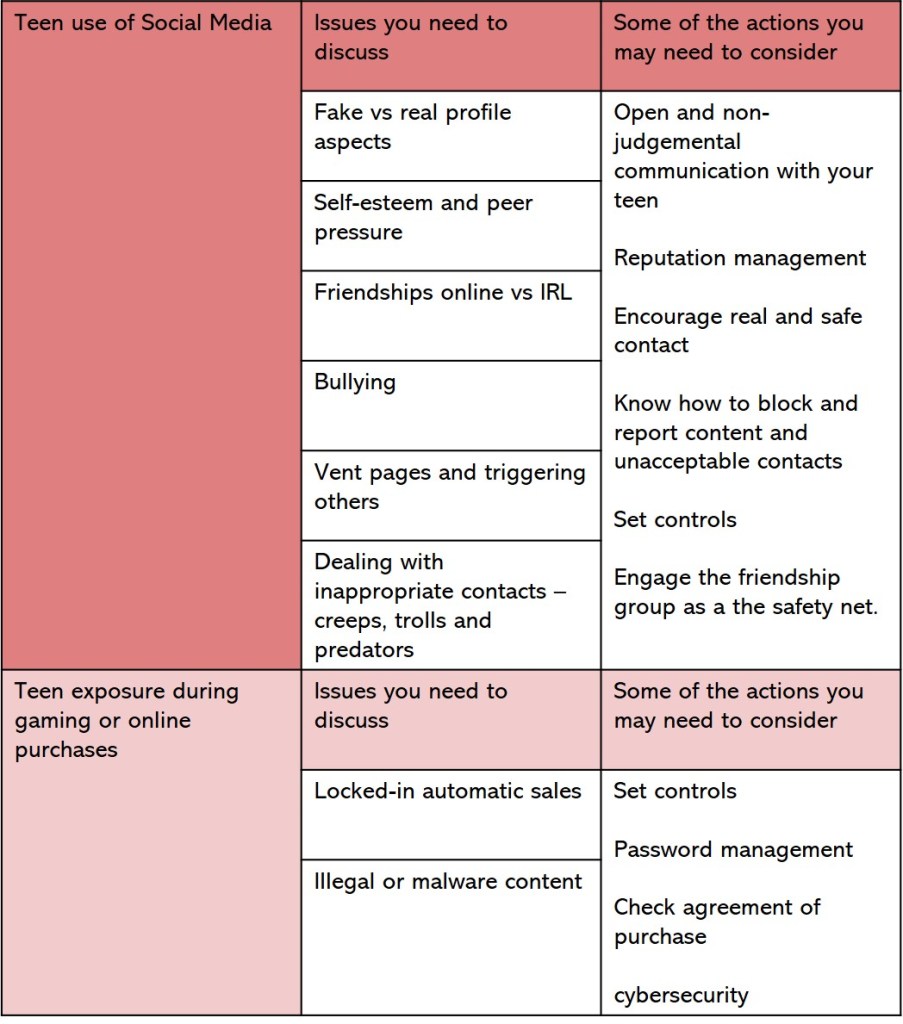
Teens social media lives raise a plethora of issues that teens can learn to navigate in collaboration with their parents. In order to collaborate with your teen, please suspend your desire to dictate the decisions and agenda. Allow discussion and negotiation to occur, and most importantly, listen to what the ideas that your teen has in mind.  Open, non-judgmental communication is going to be your greatest asset. The teen years for parents are about conceding any desire to control your child to protect them.

Talk with your teen about what they think is ok to post on social media about their lives. You may need to negotiate with them. And you may lose this discussion. Be really compared to compromise, in order to be able to remain in access.

 My own teen posts photos that I consider “too sexy”. I had to think about what I was really doing trying to control her online image. Do I think she is being too sexy in her behaviour? Was my perception of how she looked attached to my social values about what teens should look like? I don’t necessarily agree with her posts, but I know what she is like in real life. We often laugh about where the “other half” of her outfit is in a photo. But I’m allowed to look at those photos and I can see what people say to her about her shots, and most of it is a celebration of how cool she is, rather than the creepy boogeyman that I anticipated.

That said we have to also acknowledge that social media also influences how teens, particularly young women, see themselves in comparison to others. The internet can hold a strong influence over teen’s self-esteem. This use to be a situation exacerbated by magazines. Teens now have exposure to thousands of touched up, fake lives and stories every day. Talking to teens about how “real” their profile is, and how real the lives of other people’s lives are online has become an essential part of our current lifestyle. Ask quite openly, do you feel better or worse about yourself after looking through other people’s Instagram pages? I often ask teens to assess what “perfect” is on the internet. The internet communicates completely contradictory values and advice. It is important that teens come to recognise that a concept of perfect is an illusionary, often messed up, construct.

Social media is a key component of teens’ social lives. Looking for new contacts on Snapchat and Instagram has allowed our teens to develop friends outside of their school year group, at different schools, in different parts of the city. Additionally some teens who feel as if they are members of marginalised groups, often find great support online. Usually, we would encourage this type of diversification of friendship. Having friends outside of your schoolmates is recommended, especially for girls who seem to practice and experience exclusion on a regular basis.

But don’t simply befriend everyone and anyone. Discuss some parameters with your teen. What kind of age range is sensible for them to talk with? For my own teen a general 18 month to 2-year age gap guideline applies. For younger teenagers, this range might be too broad, perhaps in the same year group might be a more appropriate guideline. Kids want the power to choose, so letting them negotiate some of ranges around age, area, and such, might be helpful. It might feel tempting to ban members of the opposite sex, or potential romantic partners, but I suspect this may lead to secrecy and dishonesty rather than compliance.

What I do encourage is that teens have the chance, in groups, to meet the people that they talk to online, in real life. When counselling teens, I often get the sense of how close many of those online relationships feel to teenagers. Often teens feel like they can talk more openly and deeply with people on the internet that they have never met in real life. But try to convert those friendships to situations in real life. Online friends can be extremely volatile, can easily change from being positive to being at odds with your teen’s point of view, not to mention be deceitful in content.  Talk with your teen about what they like about their online vs offline friends. So then, they can start to become aware of the advantages of in life friendships, and online friendships so that both can be explored.

I recommend that you encourage your teen to is making decisions about their profile by themselves, not in response to other people’s ideas, including your own. Peer pressure to post controversial content is more common than you might imagine.  Talking to your teen about what good friends expect and ask of them, and what they are comfortable communicating as a representation of who they are, will help.

Which brings us to bullying. Bullying on the internet is prolific. Your child’s school will have a policy on this behaviour, and may even involve the police depending on the act. Your child will, undoubtedly, be able to recount a story of internet bullying that they heard about at their school. Ask them about it. Rather than simply laying out the “rightness” or “wrongness” of a situation, ask them what made a bully act in a particular manner, what was their agenda, why would they want others to feel a particular way? By asking these more provoking questions rather than judging the act as good and bad, they may be able to see the human vulnerabilities that lead to people acting carelessly online. Understanding the situation will better help them avoid that situation.   

Ask your child if they sometimes get contacted by people who make them feel uncomfortable, and ask what they have done about this. Kids these days are aware of those creeps, but they may not know what to do. Ask them to talk to their friends about setting boundaries. Teens can actually get good advice, and horror stories to learn from, from other teens. My teen simply blocks anyone who gives her a weird vibe. When we discussed it further, that weird vibe was people she didn’t know contacting her out of the blue, just wanting to get to know her. Most of her contacts are friends of friends, and she will ask those friends for more background information to ascertain if that new contact is someone she might want to talk to, or not. Talk to your child about what makes them consider blocking, and reinforce their careful decisions.

We need to also talk about vent pages. Vent pages are used by teens as a way to “vent” their anxiety and pain. Teens who vent online may often learn to regret this choice. Not only do those vents become part of their online reputation, they can actually become stressful to others. Sometimes teems may forget that these pages are triggering for other people. Saying you want to “disappear” or harm yourself will upset others. This can, and has for more than one of my teen clients, ended in serious trouble. So, whilst I am a big believer in helping teens express themselves, I am also about finding appropriate avenues to do this. Encourage an old fashioned diary instead, but then- do not snoop through it.

The teen years are such an interesting time, and independence is the goal of this period. Negotiating internet safety with your teen rather than enforcing the rules, can be one way to navigate this important period of change. There is always a chance that your teen will find themselves being hurt, or in hot water, because of their internet behaviour. This is the same offline. Open, non judgemental communication helps to set the path for better protection, and future forum for collaboration. Good luck

About the author: Angela Watkins is a counsellor and psychologist working with teens to improve their mental health. She also works with families and adult clients. You can contact Angela at angelaw@reddoor.hk.

We have three teen focused counsellors at RED DOOR – Angela, Tanya and Kirsteen.

#teens

#teenager

#socialmedia

#internetsafety

#parenting

#bullying

2 years in – COVID19 continues to produce considerable anxiety.

Since early 2020 we have been experiencing continual threat from the COVID 19 virus and the numerous variants that have developed. COVID has impacted our lives significantly – how and when we can socialise, go to work or school, travel, see family, celebrate special occasions, even say goodbye to loved ones. All aspects of our regular life seem to have been altered. And we do not know when this will end. This leaves us in a repeating cycle of anxiety and flight/fight type of responses.

Anxiety can be a crippling emotional challenge. As a psychologist and counsellor I work with clients dealing with their anxiety and I want to share some information about this condition and its management.

A strategy of waiting for normalcy to return is impractical. Pandemics take years to work out so please consider adjusting to a new normal of living with COVID-19 for now.

It’s not only exhausting to spend so much time in a state of high alert, but it can also be physically damaging. The physical consequences of acute stress can include high blood pressure, migraine headaches, and exacerbation of various inflammatory illnesses. After more than 2 years of stress, people may need to explore more than some deep breathing exercises to calm their nervous systems down.

If you feel flooded with COVID-Anxiety:

  • Limit your time scrolling news about new cases and the current situation. Measure your experience of anxiety when you are looking at news sources. Sometimes no news is a good approach.
  • Acknowledge your anxiety – give it a voice, but not a megaphone. Talk to your anxiety as you would a worried child. Accept that it exists, how it might perceive the situation, and offer alternative ways of looking at the issue. Be kind to yourself.
  • Seriously consider talking to a therapist at this time. Sometimes the process of just expressing your anxiety to a properly qualified listener will help. We often can not change a situation, but bottling up our anxiety and feeling trapped within it will only make one feel more stuck.
  • Perspective is important. Try to focus on what is positive in your life when you feel weighed down by the difficulty of dealing with this situation. Many of us have not seen family, for years.  Sometimes this might feel very difficult. You may actually benefit from being thankful that things are not worse. If you get stuck a negative through cycle, start your next thought with the line, “at least ….. “.
  • Be careful when you share information. Search for facts, not rumours. At the same time, share facts not opinions – seriously wear a mask, get your vaccine, do your bit.
  • Don’t judge those who leave, or those who stay in your area as the number of cases grows or fluctuates. People make the choices that they think are best for their family.
  • Practice being grateful. Gratitude allows you to stay positive.
  • Challenge your thinking. We often employ cognitive filters when we interpret information and this can increase our anxiety. For example, if you tend to catastrophise situations it will possibly lead to exacerbated anxiety. Take a look at the following article which might help. (https://reddoorhongkong.wordpress.com/2019/03/28/change-the-view-challenging-your-thinking-filters/)

Working actively on your anxiety can help to reduce it. Sometimes talking to a professional might help. If you’d like to tackle your anxiety with Angela, or one of our other therapists, in Hong Kong, contact us at angelaw@reddoor.hk or SMS to 852-93785428.

anxiety #depression #mentalhealth #mentalhealthawareness #mentalhealthmatters #stress #ptsd #therapy #health #wellness #anxietyrelief #covid #anxietyawareness