
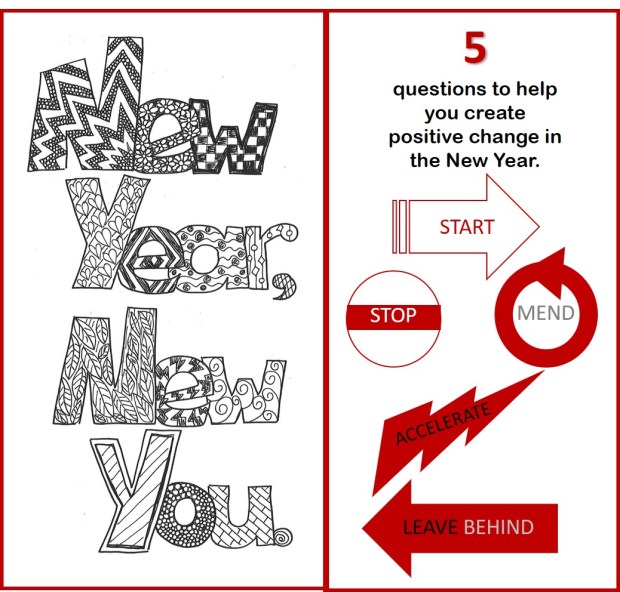
If you are receptive to the idea of setting New Year’s Resolutions but are undecided which resolutions will contribute real positive change to your life we have outlined 5 questions that we believe frame change that will introduce the most meaningful adaptions into your life in the New Year – creating a New You in the New Year.
 START. What one behaviour or habit could you start today that you will be thankful for in two to three years time? Perhaps you might considering undertaking a new area of study. Perhaps start a savings plan for that special vacation that you have been dreaming about. How about trying to eat properly, or commit to an exercise plan. Write down your options and consider which you would be most happy about in a few years time.
 STOP. I’m sure there is a at least one behaviour that you would benefit from LESS of in the New Year. Think about it, write about it. Consider something that you might consider to eliminate this year. Some ideas you might consider are to quit drinking, smoking, explore your propensity to explode in anger, feelings of jealousy, comparing yourself to others, procrastinations, over-eating, your addiction to technology, controlling others, or overworking.
Do you believe you CAN stop? If you believe, then what is holding you back? Have you tried to measure the impact your ‘STOP’ behaviour on your life, both in terms of financial implications, but also the repercussion on your personal life, your reputation, or your long-term health.
If you doubt if you can stop, then perhaps it might help to consider help. Sometimes a doctor, a counsellor, or even a good friend can help you brainstorm a way out. Try to visualise what your life might be like, if you can just STOP.
 MEND. Are you holding onto old hurts or disappointments from the past that disrupt your ability to move forward? Is there a rift in an important relationship in your life that you are grieving? Ask yourself could you mend some of these rifts or mend some of those hurts? One technique to think your way through these situation is to journal. (https://reddoorhongkong.wordpress.com/2017/03/22/six-fantastic-benefits-of-writing-a-journal/). Specific journal prompts might help you.
- Who or what event do you find it hard to mend in your mind? What wrong was done to you? Can you see this situation differently from a distance?
- Would there be a benefit to recover old friendships or relationships? Do you feel safe with that person? Can you better protect yourself in that relationship in the future?
- Are you still angry about events that have happened in the past. Write about that anger and other feelings. Why do those events continue to hurt you after all the time that has elapsed.
Some perspective and review may help you feel better. Always be kind to yourself in these evaluations. Also acknowledge some hurts are harder to heal. If you have experienced abuse, the mending to be done may not be of that abusive relationship but rather your relationship to yourself. If you need help, consider a counsellor.
 ACCELERATE. What positive practices do you engage in that you could accelerate, to your benefit, this year. If you want to be an artist, what commitment could you make this year that could make your dream become closer to reality. Perhaps you could commit to completing one piece of work a week. If you recently started your own business what key resources will you need to commit to getting this business off the ground. Are you working on this as many hours as it needs? Contemplate what activities bring you new clients – either directly or indirectly – and how can you pump up the volume on those tasks? Ideally, you are probably doing so many positive undertakings on a weekly basis, what could you DO MORE with real benefit to your goals?
 LEAVE BEHIND. In the tradition of closing one door, so that another can open, consider leaving something, even someone, behind as the old year ends and a new one begins. Are you involved in relationships that are toxic to you or sabotage your achievement of your goals? Review the people and practices in which you engage, do they hinder or help you? What person or practice could you let go of, in order to let yourself really grow?
If you have detailed a behaviour in response to each of these 5 provocative questions, then you have the beginning of a game plan for a New You in the New Year. Well done for spending this time reflecting about what will be of benefit to you. All the best for working on these behaviours in the next year. You should be proud of you.
#reddoor #newyear #Newyearresolutions #behaviorchange
 Disagreements are to be expected in any relationship. No two people see situations the same, or have completely the same goals. Resolving conflicts in a positive manner will make your relationship stronger, whilst unresolved battled and long-term contempt can erode your relationships’ chance of survival.
 Start your Red Door Journey